

Recent Blogs
Stay updated with our latest blog posts.


Are you standing at the sink trying to clear a sink full of scraps, only to discover that your garbage disposal hums but wont spin? If you are right in the middle of your November holiday prep, that low, vibrating noise can instantly trigger a wave of panic. In our decades of serving Pittsburg CA, we have seen countless homeowners assume the appliance is completely fried, leaving them with a major replacement project right before guests arrive.
Here is the good news: that humming sound is actually a positive sign. It means electrical power is successfully traveling from your wall switch directly into the unit. The motor is not completely dead. Instead, the disposal is experiencing a mechanical jam. The internal components are physically blocked from turning, but the system is still trying to work. Your next steps are about recognizing this decision point and taking safe actions to clear the blockage before the motor permanently burns out.
If you need immediate help resolving a stubborn kitchen sink jam, our expert plumbing services are ready to restore your system. You can request plumbing service today to get your kitchen back on track.
To understand how to approach a jammed disposal safely, you first need to understand the basic mechanics of how the appliance operates under your sink. Most standard residential units do not actually have sharp, spinning blades like a blender. Instead, they use a flat, spinning plate called a flywheel, which is equipped with small metal lugs called impellers. When you flip the switch, the motor spins the flywheel rapidly, and centrifugal force pushes food waste against a stationary grind ring to pulverize it.
When everything is working normally in your Pittsburg CA home, you hear a loud, aggressive grinding noise. But when something goes wrong, the sound changes entirely. The difference between a dead unit and a jammed unit comes down to the electrical versus mechanical divide.
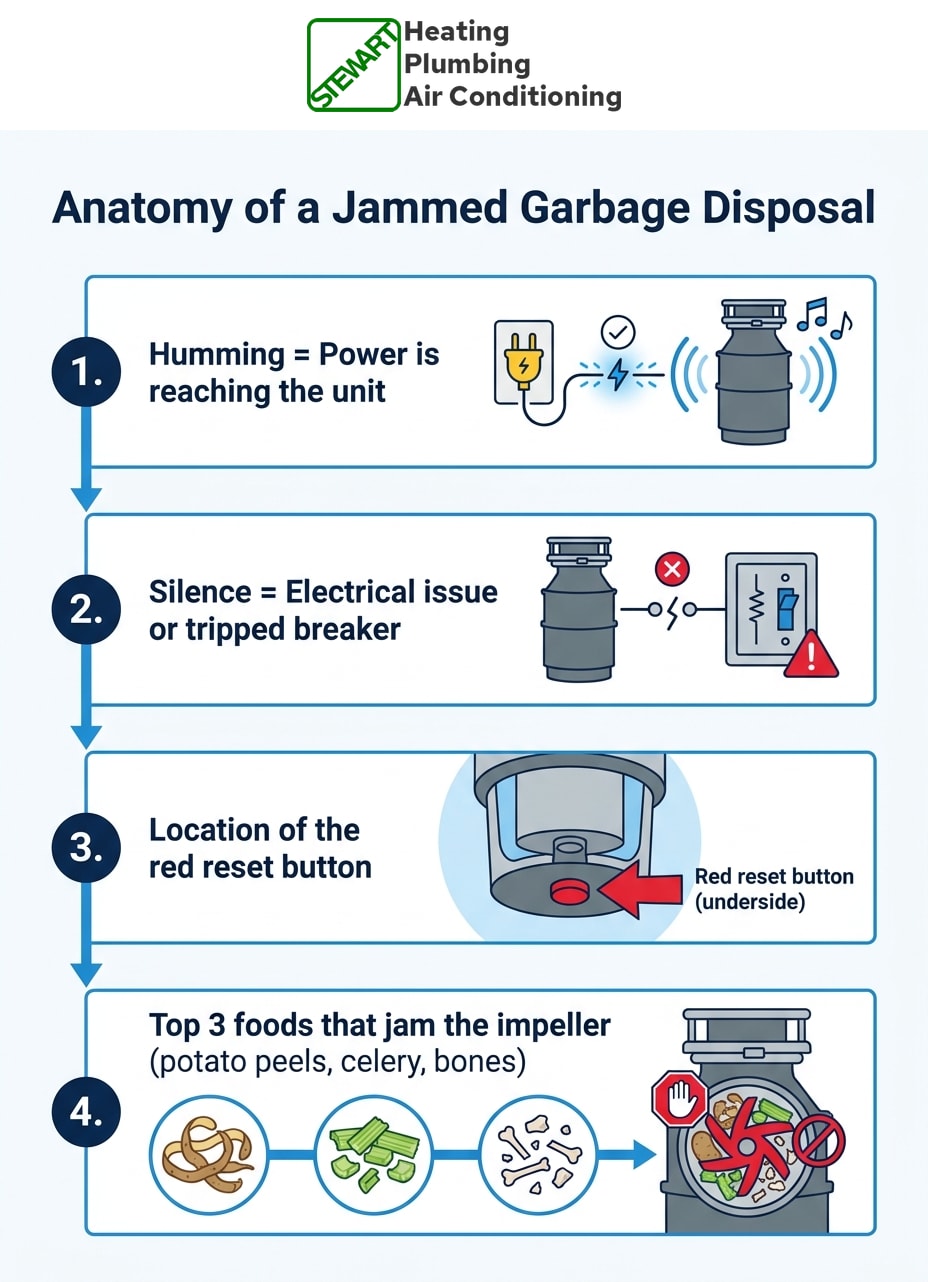
When you turn on the disposal switch, electricity flows through the wiring, into the unit, and energizes the induction motor. If the electrical path is broken—perhaps due to a tripped circuit breaker, a loose wire, or a completely fried motor—you will hear absolute silence. Silence indicates an electrical failure.
However, if the electrical path is perfectly intact but the flywheel is physically blocked by debris, the motor still receives full power. It attempts to spin the rotor, but the physical obstruction holds it firmly in place. This creates a state called a "locked rotor." The electrical current continues to surge into the motor windings, vibrating the metal components without actually turning them. That vibration is the distinct humming or buzzing sound you hear.
Hearing a hum is frustrating, but it is far better than hearing nothing at all. A silent disposal often requires extensive electrical diagnostics or a complete unit replacement. A humming disposal simply means something is wedged where it does not belong. In the vast majority of cases, once the physical obstruction is removed, the motor will resume normal operation.
• Absolute Silence — What It Means: Electrical failure or tripped safety breaker. Power is not reaching the motor. — Likely Resolution Path: Resetting breakers or performing electrical diagnostics.
• Loud Grinding/Rattling — What It Means: A hard object (like a spoon or glass) is bouncing loosely inside the chamber. — Likely Resolution Path: Immediate extraction of the loose foreign object.
• Low Humming or Buzzing — What It Means: Power is present, but the flywheel is physically jammed and cannot spin. — Likely Resolution Path: Clearing the mechanical blockage to free the impellers.
Understanding this distinction saves you from prematurely throwing away an appliance that still has plenty of life left in it.
While a humming motor means the appliance is still alive, it is also a warning siren. You must turn the wall switch off immediately. Never leave a jammed, humming garbage disposal turned on for more than three to five seconds. Allowing a stalled motor to continuously draw power is one of the fastest ways to destroy the unit entirely, turning a simple mechanical jam into a permanent failure.
If you are rushing through your November holiday prep and leave the humming unit running while you search for a tool or inspect the drain, you risk causing irreversible damage to the internal components.
When an electric motor stalls, it experiences a massive spike in electrical draw as it struggles to overcome the physical resistance. Because the rotor cannot turn, the electrical energy cannot convert into kinetic motion. Instead, all of that energy instantly converts into intense heat.
This heat builds up rapidly inside the motor windings. If left running, the protective insulation around the copper wiring will begin to melt. Once the insulation melts, the wires short out against each other, leading to a condition known as motor burnout. A burned-out motor cannot be repaired; the entire appliance must be replaced.
Fortunately, modern disposal units are designed with a built-in safety mechanism called a thermal overload protector. This is essentially an internal circuit breaker designed to save the motor from itself.
How the protection system works:
• Heat Detection: The sensor monitors the temperature of the motor windings.
• Automatic Trip: If the temperature spikes dangerously high due to a locked rotor, the protector trips, instantly cutting power to the motor.
• The Reset Requirement: Once tripped, the unit will go completely silent and will not turn back on until the motor cools down and the system is manually reset.
While the thermal overload protector is an excellent fail-safe, you should never rely on it as your primary defense. Repeatedly tripping the overload protector weakens the mechanism over time, eventually causing it to fail completely. The safest approach is always to flip the wall switch off the moment you hear the hum.
A mechanical jam rarely happens without a specific cause. The grinding chamber is designed to handle light, everyday food scraps, but it has strict limits. As Pittsburg CA and East Bay homes shift to heavy indoor entertaining during the cooler November weather, the volume and type of food entering the kitchen sink changes dramatically. Our plumbing team typically sees a massive spike in service calls this time of year because this sudden increase in heavy, complex food waste puts extraordinary strain on kitchen drainage systems.
The flywheel and impellers rely on a steady flow of cold water to flush pulverized particles down the drain line. When the chamber is overloaded faster than the water can clear it, or when the wrong types of materials are introduced, the impellers lock up.
The majority of disposal jams trace back to a few specific food categories that behave poorly inside a grinding chamber. Based on the hundreds of holiday plumbing emergencies we resolve every year, avoiding these items entirely will drastically reduce your risk of a sudden breakdown.
• Starchy Pastes: Potato peels, pasta, and rice are notorious offenders. We routinely pull thick, cement-like pastes out of locked-up units, created when these starches expand with water and coat the flywheel, eventually hardening enough to lock the motor in place.
• Fibrous Strings: Celery stalks, corn husks, asparagus, and onion skins contain tough, stringy fibers. Instead of breaking down, these fibers wrap tightly around the moving impellers, acting like a rope that binds the mechanism.
• Hard Organic Matter: Large poultry bones, fruit pits, and thick nutshells can wedge themselves firmly between the edge of the spinning flywheel and the stationary outer grind ring, stopping the rotation instantly.
• Accidental Drops: In a busy kitchen, it is common for small metal spoons, bottle caps, glass shards, or even jewelry to slip down the drain unnoticed until the unit is turned on.
If you are anticipating a busy cooking season, managing what goes down the drain is only half the battle. Ensuring your main lines are clear is equally important. Scheduling a pre-Thanksgiving drain inspection can help you identify slow drains and potential clogs before they cause a backup during a large family gathering.
When you are dealing with a stalled disposal during your November holiday prep, there are a few basic, external checks you can perform to assess the situation. However, safety is the absolute priority. A garbage disposal is a powerful electrical appliance connected to plumbing and standing water.
The Golden Rule: As licensed professionals, we cannot stress this enough: NEVER put your hands, fingers, or any part of your body down into the drain, even if you are absolutely certain the power is turned off. The impellers are sharp, and if a bound motor suddenly releases tension, the flywheel can spin unexpectedly, causing severe injury.
If your disposal was humming and then suddenly went completely silent, the internal thermal overload protector has likely tripped. Before any further troubleshooting can occur, you will need to check this switch.
1. Verify the wall switch is OFF: Double-check that the main power switch above the sink is in the off position.
2. Clear out the cabinet: Remove cleaning supplies and items from under the sink so you have clear access to the bottom of the disposal canister.
3. Locate the button: Look at the very bottom, outward-facing side of the unit. You will see a small, square red button.
4. Check its position: If the button is popped outward (protruding slightly), the safety breaker has tripped.
5. Press to reset: Wait about ten minutes for the motor to cool down, then firmly press the red button back in until it clicks and stays flush with the casing.
Once you have checked the reset button, you can attempt to identify the blockage visually. Do not dismantle any plumbing to do this.
Take a strong, bright flashlight and shine it directly down through the sink baffle (the black rubber flaps). Look closely at the outer edges of the grinding chamber, where the spinning plate meets the stationary wall. You are looking for obvious foreign objects—a wedged piece of bone, a trapped utensil, or a thick mass of fibrous material.
If you can clearly see the obstruction but cannot easily retrieve it with a pair of long-handled pliers or tongs, stop immediately. Forcefully prying at a wedged object can bend the impellers, damage the motor shaft, or break the sink flange seal, leading to persistent leaks. If these basic external checks do not resolve the issue, it is time to look into our plumbing repair specials to help offset the cost of professional intervention.
There is a strict boundary between safe, external troubleshooting and risky amateur plumbing repairs. Crossing that line often results in voided manufacturer warranties, hidden water damage, and a much higher final repair bill.
You should immediately stop troubleshooting and call a licensed professional if you experience any of the following signs:
• Persistent Humming After Resets: If you have pressed the reset button, but the unit immediately returns to humming and stalling when turned on, the jam is too severe for basic extraction.
• Tripping Main Breakers: If turning on the disposal trips the main electrical breaker in your home's electrical panel (not just the red button on the unit), you have a serious electrical short that requires professional diagnostics.
• Water Leaking Under the Sink: If you notice water pooling under the canister or dripping from the reset button housing, the internal seals are compromised.
• The Blockage is Invisible: If the flywheel is locked tight but a flashlight inspection reveals an empty chamber, the jam is located deep within the mechanism or the motor bearings have seized.
Attempting to disassemble the disposal unit yourself, or using improvised tools to force the flywheel to turn, is highly discouraged. A licensed plumber has the specialized wrenches required to manually unbind the motor shaft from below the sink without damaging the internal components. Furthermore, a professional will safely test the electrical draw of the motor to ensure the windings were not damaged during the stall.
At Stewart Heating, Plumbing and Air Conditioning, we have proudly built a legacy of serving Contra Costa County since 1974. We believe in providing honest, accurate assessments for our Pittsburg CA neighbors. If another contractor has told you that your humming disposal requires an expensive full replacement without attempting to clear the mechanical jam first, we encourage you to schedule a second opinion with our trusted team.
When you are dealing with a sudden kitchen plumbing issue right in the middle of November holiday prep, you need fast, accurate answers. Here are the most common questions homeowners ask when their disposal stops grinding.
The hum indicates electricity is flowing to the motor, but the grinding impellers are mechanically jammed by food or debris. Because the motor cannot turn, the electrical energy converts into a vibrating hum. It is a clear signal that the appliance has power but is physically stuck.
Turn off the power immediately to prevent the motor from burning out. Check the external red reset button on the bottom of the unit and perform a visual inspection with a flashlight to look for wedged objects. If the jam cannot be easily cleared with long tongs, a professional plumber should be called to manually unbind the motor shaft safely.
Yes, most units feature a small red reset button on the bottom exterior of the canister. This button is part of the thermal overload protector. It pops out automatically to cut power when the motor overheats from a jam, protecting the appliance from permanent electrical damage.
While a full-blown fire is rare due to the internal thermal overload protectors, leaving a stalled motor running is highly dangerous. It can cause severe overheating, melt internal wiring insulation, and create serious electrical hazards under your sink.
The motor will rapidly overheat as it struggles against the physical blockage. Within seconds, it will likely trip the internal overload protector, shutting the unit down. If the protector fails or is repeatedly bypassed, the motor windings will permanently burn out, requiring a total replacement.
With proper use and professional maintenance, most standard units last between 8 to 15 years before the motor naturally degrades. Avoiding starchy pastes, fibrous vegetables, and hard bones will significantly extend the lifespan of the impellers and the motor.
A humming garbage disposal is certainly stressful, but it does not automatically mean your appliance is ruined. In most cases, it simply means the unit needs to be safely unjammed. Having a fully functional kitchen sink is essential for peace of mind, especially when preparing large meals for family and friends in Pittsburg CA.
If your disposal is locked up, do not risk motor burnout or plumbing damage with heavy-handed DIY tactics. Reach out to our local experts to clear the jam safely, reliably, and quickly, so you can get back to enjoying your home.

Very professional and complete. I would recommend Stewart to anyone. Highest quality of workmanship and clean installation.
Stewart Heating Plumbing Air Conditioning just did some work for us for the first time. They did an installation at my home and it turned out well. I thought the price was fair and I definitely would use them again. The technicians were very friendly and knowledgeable about their work. I highly recommend Stewart Heating Plumbing Air Conditioning and already told friends to use them.
We have been using Stewart Heating Plumbing Air Conditioning since 1995. They put the original heating and air unit in the house, and we have just stayed with them. They are dependable and honest people, and they have done a good job for us every time that we have used them!
They came and did an inspection and are coming tomorrow to do the repair.
They replaced a regulator the first time, and then the water heater vent had to be replaced. They did great work.
The gentleman that serviced us was helpful, insightful, and knew what he was talking about. Overall, it was a great experience.