

Recent Blogs
Stay updated with our latest blog posts.

As November approaches and the crisp autumn air settles in, the risk of sudden overnight freezes becomes a real threat to your home's exterior plumbing. Upgrading to frost free hose bibs is one of the most effective ways to protect your property from unexpected winter pipe disasters. Many homeowners wait until the first local freeze warning is broadcasted to think about their outdoor faucets, but by then, the damage may already be underway. Standard exterior plumbing is highly vulnerable to temperature drops, and the consequences of ignoring this seasonal shift can be devastating to your home's foundation and interior walls.
When the weather begins to turn, you are faced with a critical decision regarding your property's winter readiness. You can either rely on temporary foam covers and the old method of dripping your faucets, or you can make a permanent, mechanical upgrade to your exterior plumbing. Making the right choice before the cold weather permanently settles in is the key to avoiding catastrophic water damage. If you are unsure about the current state of your exterior faucets, consulting with experts for professional plumbing services can provide the clarity you need. Proactive winterization is not just about convenience; it is about preserving the structural integrity of your home against the harsh realities of winter weather.
The danger lies in the unpredictability of late-fall weather patterns. A day that starts out sunny and mild can easily plummet into freezing temperatures overnight. When standard hose bibs are left exposed to these sudden drops, the water trapped inside them has nowhere to go. Taking action now, during the November pre-winter window, ensures that your home is fortified long before the first hard freeze threatens your plumbing system.
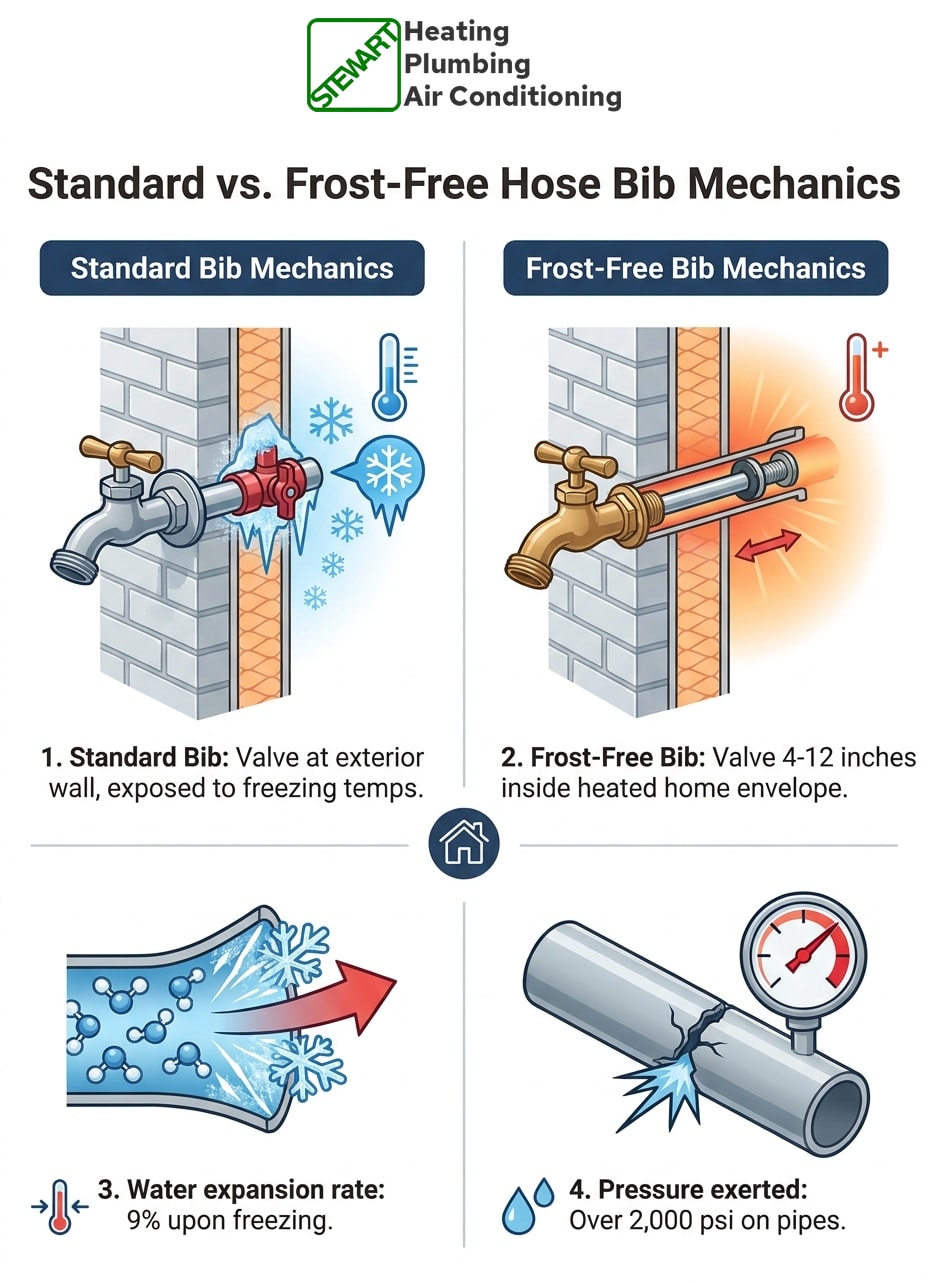
To understand why exterior pipes burst, you have to look at the basic physics of freezing water. The expansion factor: When water turns to ice, it expands its volume by approximately 9%. While that might not sound like a massive increase, the resulting force is staggering. This expansion exerts over 2,000 psi of pressure on standard exterior plumbing pipes. To put that into perspective, most residential plumbing systems are designed to handle only a fraction of that pressure. When the water inside a standard faucet freezes and expands, the copper or galvanized steel pipes simply cannot contain the force, leading to a catastrophic rupture.
In our decades of serving the East Bay and Pittsburgh CA area, our team at Stewart Heating, Plumbing and Air Conditioning has seen how our generally mild fall and winter temperatures often lull homeowners into a false sense of security. Because deep freezes are not a daily occurrence, outdoor plumbing is frequently left completely unprotected. When a sudden overnight freeze does hit, standard hose bibs are highly susceptible. These traditional faucets trap water right at the exterior wall, directly exposing the liquid to the freezing outside air. The cold transfers quickly through the metal fixture, freezing the water just inside the boundary of your home.
The hidden consequence: The most dangerous aspect of a freezing standard faucet is where the burst actually occurs. The ice block forms at the exterior, but the pressure builds up behind the ice, deeper inside the pipe. When the pipe finally gives way under the 2,000 psi of pressure, the rupture often happens inside your wall cavity or crawlspace. You might not even realize a pipe has burst until the weather warms up, the ice thaws, and water begins flooding your interior spaces. If you suspect your pipes have been compromised after a cold snap, it is critical to request plumbing service immediately to mitigate the damage. Hidden leaks can quickly lead to severe structural rot and widespread mold growth if left unaddressed.
A frost-free hose bib, also known as a frost-proof sillcock, is engineered specifically to combat the physics of freezing water. Its design fundamentally differs from a standard exterior faucet in one crucial way: the location of the shut-off valve. While a standard faucet stops the water right at the exterior handle, a frost-free model utilizes a specialized mechanical design to keep the water far away from the freezing outdoor air.
Here is a breakdown of the mechanics that make these fixtures so effective:
1. The elongated stem: A frost-free hose bib features a long metal tube that extends through your exterior wall and into your home. This stem is typically 4 to 12 inches long, depending on the thickness of your walls.
2. Internal valve placement: Because of this long stem, the actual mechanical shut-off valve is located 4 to 12 inches inside the home's heated envelope. When you turn the handle on the outside of your house, you are actually operating a valve that is safely tucked away in your warm basement, crawlspace, or interior wall cavity.
3. Gravity drainage: When you turn the faucet off, the water supply stops inside the warm house. The remaining water in the 4 to 12-inch exterior stem simply drains out onto the ground. Because the exterior portion of the pipe is left completely empty, there is absolutely nothing left to freeze.
This simple but brilliant mechanical shift changes everything about winter plumbing preparation. It is also worth noting that when standard exterior pipes freeze and block water flow, it can cause broader pressure imbalances throughout your entire plumbing system. These imbalances can sometimes manifest as unusual signs indoors, such as gurgling sounds in your plumbing vents. By upgrading to a frost-free system, you maintain the proper pressure and flow dynamics of your home's water supply, no matter how cold it gets outside.
Every autumn, hardware stores fill their endcaps with insulated foam faucet covers. While these temporary fixes are a common sight, they are far from a foolproof solution. When a winter freeze warning is issued, homeowners often scramble to install these covers or resort to leaving their faucets dripping overnight. It is time to look closely at how these temporary measures stack up against a permanent mechanical upgrade.
• Freeze Protection Level — Temporary Foam Covers: Moderate; traps residual heat but fails in deep or prolonged freezes. — Frost-Free Hose Bibs: Maximum; physically removes water from the freezing zone entirely.
• Maintenance Required — Temporary Foam Covers: High; must be manually installed and removed every season. — Frost-Free Hose Bibs: Zero; fully automatic protection once installed.
• Reliability — Temporary Foam Covers: Low; prone to falling off, blowing away, or degrading in sunlight. — Frost-Free Hose Bibs: High; permanent fixture integrated directly into your plumbing.
• Aesthetics — Temporary Foam Covers: Bulky and visually unappealing on the home's exterior. — Frost-Free Hose Bibs: Clean, modern, and flush with the exterior wall.
• Long-Term Value — Temporary Foam Covers: Requires frequent replacement year after year. — Frost-Free Hose Bibs: A one-time investment that protects the home indefinitely.
The flaws of temporary covers: Foam covers rely entirely on trapping the ambient heat escaping from your home's exterior wall. If the temperature drops low enough, or stays below freezing for an extended period, that minimal ambient heat is quickly overcome, and the pipe will freeze anyway. Furthermore, foam covers are notoriously fragile. They degrade from UV exposure, the securing straps dry rot and snap, and they are frequently knocked off by strong winter winds or curious pets. Relying on a flimsy foam cover to protect your home from extensive structural water damage is a risky gamble.
By contrast, upgrading to frost-free hose bibs requires zero annual setup. You do not have to watch the weather forecast with anxiety, and you do not have to run outside in the dark with a flashlight to tie on a foam cover. It frames the upgrade not as an ongoing seasonal chore, but as a one-time investment in permanent peace of mind.
While replacing a standard faucet might seem like a straightforward task, installing a frost-free hose bib is a complex procedure that requires licensed expertise. This is not a simple matter of unscrewing the old fixture and threading on a new one. Because the stem extends 4 to 12 inches into the home, the installation requires precise measurement and cutting directly into your home's existing indoor water supply lines.
Professional plumbers possess the specialized tools and training to ensure that the new fixture integrates perfectly with your existing plumbing. They must navigate tight spaces inside walls or floor joists, properly solder or secure the connections, and ensure a watertight seal that will hold up under municipal water pressure. Our plumbers frequently see the aftermath of botched DIY installations, which can easily result in a slow, hidden leak inside your walls that causes extensive rot and mold long before you notice a problem. Protecting your home requires a comprehensive approach, which is why having an expert handle the installation is often best bundled with a thorough preventative maintenance plan.
One of the most critical reasons to rely on a professional is the necessity of a downward pitch. For a frost-free hose bib to function correctly, the stem must be installed at a very specific, slight downward angle toward the exterior.
• Gravity is the mechanism: This angle ensures that when the valve is shut off inside the house, gravity pulls all the residual water out of the exterior stem.
• The DIY trap: If a homeowner or amateur handyman installs the bib perfectly level—or worse, with a slight upward tilt—water will remain trapped inside the stem.
• Neutralized benefits: Trapped water completely neutralizes the frost-free design. When the temperature drops, that trapped water will freeze, expand, and burst the expensive new fixture just as easily as a standard faucet.
Professionals use specialized levels and bracing techniques to guarantee the exact angle required for proper gravity drainage, ensuring your investment actually protects your home.
Older residential properties carry a unique set of vulnerabilities when it comes to winter weather. Many historic and mid-century homes were built with standard exterior plumbing that simply did not account for modern weather extremes. The building codes and plumbing practices of the past often routed pipes through uninsulated crawlspaces or shallow exterior walls, leaving them highly exposed to the elements.
The compounding risk: The danger is magnified by the age of the materials. Aging galvanized steel or older copper pipes may already be weakened by decades of hard water scaling, internal corrosion, or micro-pitting. When you introduce the sudden 2,000 psi pressure of expanding ice into a pipe that is already structurally compromised, a catastrophic burst is almost guaranteed. Older homes in the East Bay area are particularly at risk because their initial construction rarely prioritized deep-freeze protection.
Serving the community since 1974, our team at Stewart Heating, Plumbing and Air Conditioning has seen firsthand the specific patterns of costly water damage that unexpected freezes cause to older homes in the area. We highly recommend having an expert evaluate your aging exterior plumbing to determine if a replacement is necessary before the winter season begins. Taking the time to upgrade these vulnerable points is a critical step in preserving the integrity of a historic or aging property. Homeowners should also look for seasonal opportunities to bundle this upgrade with other necessary fixes by taking advantage of plumbing repair specials, ensuring the entire system is robust and winter-ready.
The easiest way to identify a frost-free hose bib is by looking at the faucet handle and the pipe connection. A standard faucet usually has the handle positioned parallel to the wall, with the water pipe going straight down or directly into the brick. A frost-free bib typically has a handle that sits perpendicular to the wall, attached to a metal stem that disappears straight back into the siding. If the fixture sits completely flush against the wall with a long stem behind it, it is likely frost-free.
No, frost-free hose bibs do not require external foam covers during the winter. Because the mechanical shut-off valve is located 4 to 12 inches inside the heated envelope of your home, the exterior portion of the pipe drains completely empty when turned off. With no water left in the exterior stem, there is nothing left to freeze, rendering foam covers unnecessary.
Yes, upgrading to a frost-free system is widely considered one of the best preventative investments a homeowner can make. The one-time cost of professional installation is significantly lower than the expense of repairing a burst pipe, remediating indoor flooding, and replacing damaged drywall or flooring. It provides permanent peace of mind and eliminates the annual chore of winterizing your exterior faucets.
Yes, a frost-free hose bib can still freeze if a garden hose is left attached to it during cold weather. The system relies on gravity to drain the residual water out of the stem. If a hose is connected, it traps the water inside the mechanism, preventing it from draining. When temperatures drop, that trapped water will freeze, expand, and rupture the internal stem of the frost-free bib.
The ideal time to replace an outdoor faucet is in the late fall, specifically during the November pre-winter window, before the first overnight freezes occur. Upgrading during the mild autumn months ensures your home is fully protected before the unpredictable winter weather arrives. Waiting until winter has already set in increases the risk of a burst pipe occurring before the upgrade can be completed.
Disconnecting garden hoses is the single most important maintenance step for any outdoor plumbing. Leaving a hose attached prevents water from draining out of the faucet, effectively holding water right at the freeze point. Even the most advanced frost-free hose bib will fail and burst if a connected hose traps water inside the stem during a sudden drop in temperature.
As the late-fall weather continues to cool, the window for proactive home protection is closing. Upgrading to frost free hose bibs is the definitive way to secure your exterior plumbing against the unpredictable temperature drops that characterize our winter season. By moving the water shut-off valve safely inside the heated envelope of your home, you eliminate the root cause of burst exterior pipes.
This permanent solution frees you from the annual scramble for inadequate foam covers and the anxiety of dripping faucets. Do not wait for a sudden overnight freeze to test the limits of your aging plumbing. Now is the time to schedule a professional inspection and secure your home's defenses. Reach out today to request plumbing service and ensure your property is completely winter-ready before the cold truly sets in. The satisfaction of knowing your home is permanently protected is an investment that pays off season after season.

Very professional and complete. I would recommend Stewart to anyone. Highest quality of workmanship and clean installation.
Stewart Heating Plumbing Air Conditioning just did some work for us for the first time. They did an installation at my home and it turned out well. I thought the price was fair and I definitely would use them again. The technicians were very friendly and knowledgeable about their work. I highly recommend Stewart Heating Plumbing Air Conditioning and already told friends to use them.
We have been using Stewart Heating Plumbing Air Conditioning since 1995. They put the original heating and air unit in the house, and we have just stayed with them. They are dependable and honest people, and they have done a good job for us every time that we have used them!
They came and did an inspection and are coming tomorrow to do the repair.
They replaced a regulator the first time, and then the water heater vent had to be replaced. They did great work.
The gentleman that serviced us was helpful, insightful, and knew what he was talking about. Overall, it was a great experience.