

Recent Blogs
Stay updated with our latest blog posts.

Knowing what to expect during an emergency service call can make all the difference between panic and confidence when your AC dies in the middle of a Contra Costa County heatwave or a pipe bursts at midnight. Here is a quick overview of how the process typically unfolds:
Most emergency repairs are completed within one to three hours once the technician is on-site, though more complex issues can take longer.
When your heating, cooling, or plumbing suddenly fails, the uncertainty of not knowing what happens next can feel just as overwhelming as the problem itself. About 70% of homeowners experience an HVAC breakdown during peak seasons, and over 60% of those emergencies happen during the worst possible windows — holiday weekends, the first major heatwave of summer, or the coldest night of the year. Roughly 40% of those calls, however, turn out to stem from something simple like a tripped breaker or a dead thermostat battery. Understanding the process before a crisis hits puts you in control, helps you act quickly, and can genuinely reduce the damage and cost involved.
This guide walks you through every stage of an emergency service call — from the moment something goes wrong to the final sign-off — so you know exactly what to expect when it matters most.
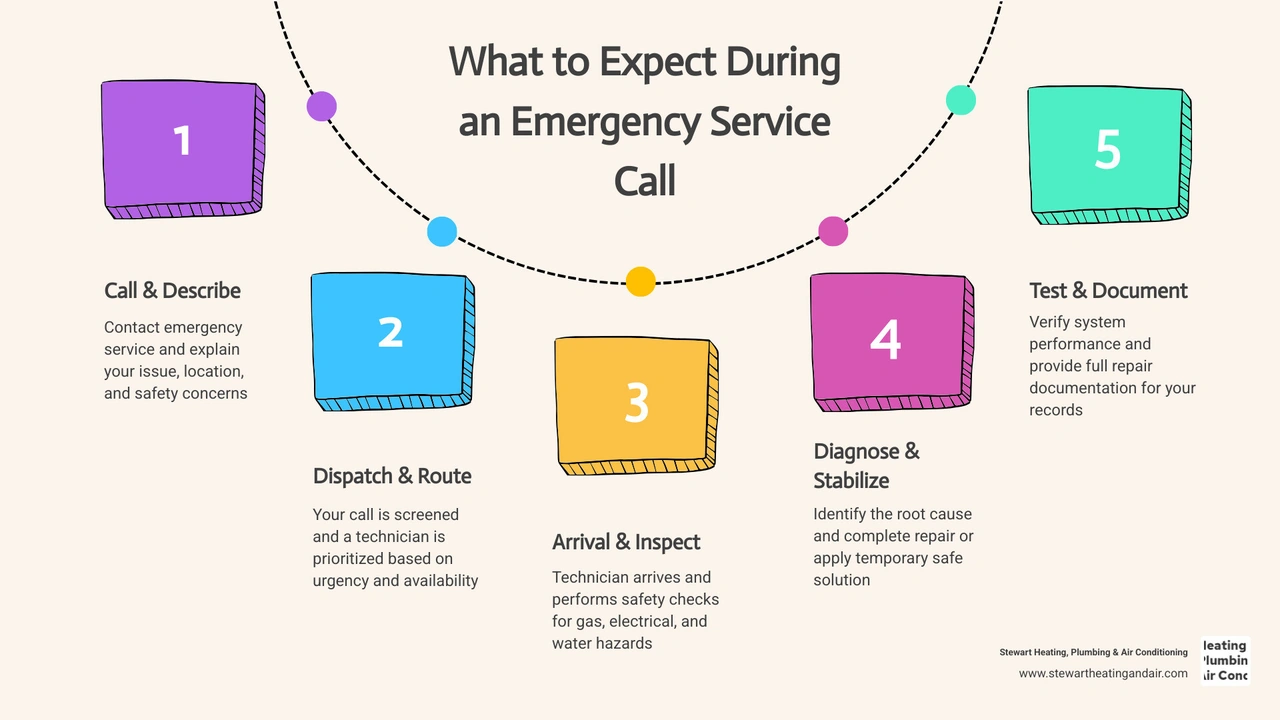
What to expect during an emergency service call vocab to learn:
Not every system glitch requires a technician to rush out to your home in the middle of the night. Distinguishing between a true emergency and a standard service request can save you unnecessary stress and help prioritize resources for those in critical need.
A true emergency is defined by three main factors: direct safety hazards, active property damage, or extreme indoor temperatures that pose a health risk to vulnerable family members (such as infants, the elderly, or those with chronic medical conditions). If your system fails but the outdoor temperature is a mild 68°F, your situation is inconvenient, but it is not a threat to your health or home. However, when outdoor conditions cross safety thresholds, or when your home's structural integrity is compromised, you are dealing with a situation where When an HVAC Failure is a True Emergency is an absolute reality.
When the weather in Contra Costa County turns extreme, a broken climate control system escalates from a minor annoyance to a major safety hazard. You should request immediate emergency HVAC repair if you experience any of the following:
Plumbing emergencies can be incredibly destructive because water damage spreads rapidly, warping floors, ruining drywall, and encouraging mold growth within 24 to 48 hours. Statistics show that about 1 in 60 insured homes files a water-damage claim each year, highlighting how common and costly these issues can be.
You are facing a plumbing emergency if you have:
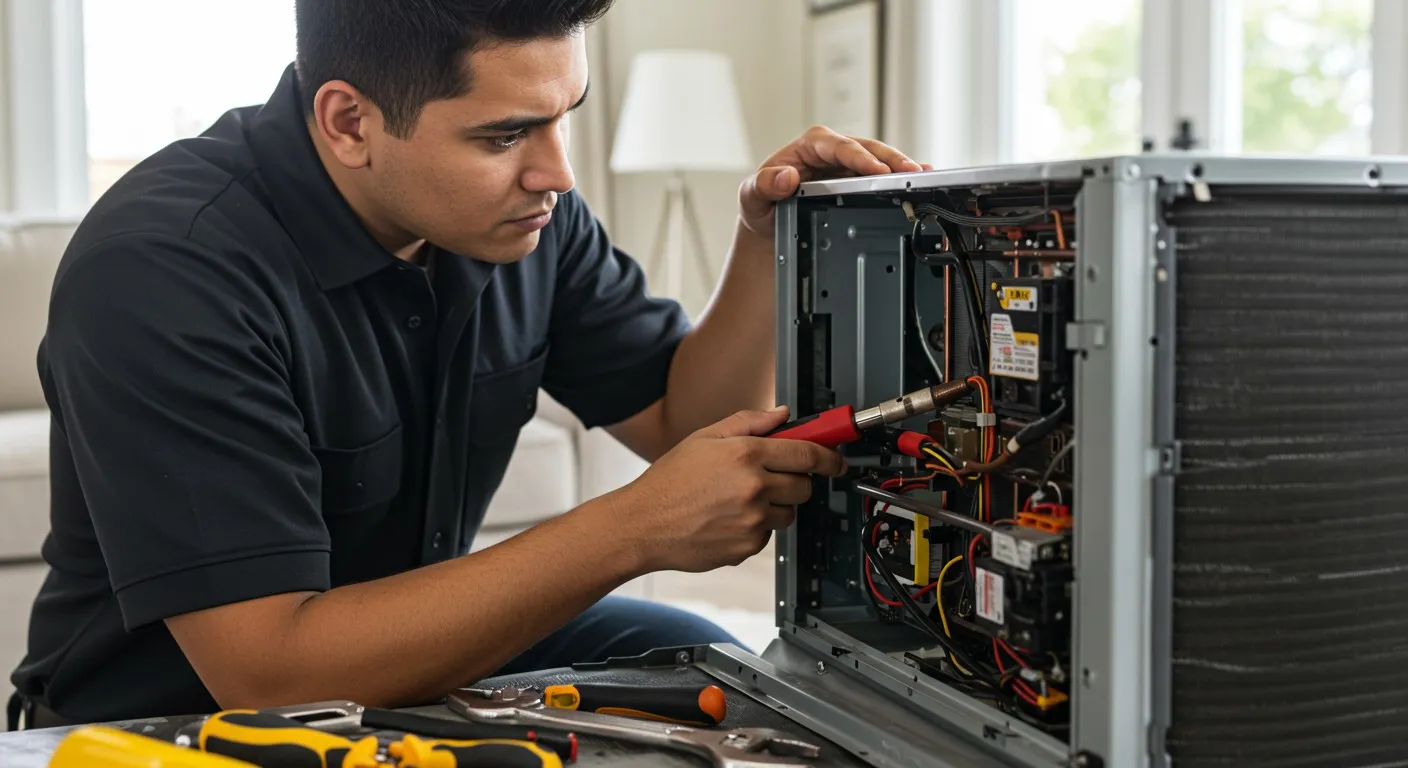
When a technician arrives at your home during a crisis, their visit follows a highly structured, professional protocol designed to resolve the issue safely and efficiently. They do not simply start swapping parts; instead, they approach your system systematically.
The emergency service process actually begins the moment you place your phone call. During this initial contact, our dispatch team performs a phone screening. We will ask you to describe the symptoms, confirm your exact address, check if you smell gas or see water, and ask if there are vulnerable individuals in the home.
This screening allows us to route our on-site teams based on the severity of the emergency. Once dispatched, the technician receives all the details you provided so they can mentally prepare and ensure their service vehicle is stocked with the necessary diagnostic tools and common replacement parts. If you are experiencing a cooling failure in Oakley, our team utilizing 24-Hour AC Repair Oakley CA protocols is coordinated to reach you as quickly as possible.
When the technician pulls up to your home, the physical process begins. Here is what to expect during this hands-on phase:
In an ideal scenario, the technician will have the exact replacement part on their truck and can complete a permanent repair on the spot. However, during late-night calls, holiday weekends, or peak seasonal rushes, specialized parts may not be immediately available. In these situations, the technician's primary goal shifts from a permanent fix to temporary stabilization.
| Aspect | Temporary Stabilization | Permanent Repair |
|---|---|---|
| Primary Goal | Stop active damage, ensure safety, and provide basic comfort. | Restore the system to its original, fully efficient operating condition. |
| Typical Actions | Shutting off a leaking zone, capping a pipe, or configuring auxiliary heat. | Installing factory-authorized replacement parts and calibrating system controls. |
| Safety Status | Completely safe to leave unattended, but the system may run with limited capacity. | Fully operational and optimized for long-term safety and energy efficiency. |
| Next Steps | Ordering parts and scheduling a follow-up visit during standard business hours. | No further action required; return to standard maintenance schedules. |
While you wait for our technician to arrive, there are several steps you can take to protect your property, ensure the safety of the service provider, and speed up the repair process. Taking a few proactive steps can make the visit smoother and help get your home back to normal faster. To understand the broader picture of managing sudden system failures, check out our guide on What to Do When Your HVAC Breaks Down Unexpectedly.
Your priority before help arrives should always be safety and damage mitigation. Depending on the type of emergency, perform these shutoff protocols:
To help our technician work as quickly and efficiently as possible, try to complete these preparation steps:
Experiencing an emergency is stressful enough, but worrying about response times and billing shouldn't add to your anxiety. Understanding how these factors are calculated can help you make informed decisions during a high-stress situation. A great way to minimize these worries in the long run is to learn How to Prevent HVAC Emergencies with Maintenance.
We always strive to reach your home as quickly as possible, but several external factors can influence dispatch and arrival times:
Emergency service calls operate differently than standard, pre-scheduled appointments because they require dispatching technicians outside of normal business hours, on weekends, or on holidays.
Typically, you can expect a diagnostic fee (sometimes called a dispatch or service call fee) that covers the cost of bringing the technician and their fully stocked mobile workshop to your door. Once the technician identifies the problem, they will present a clear, upfront explanation of the repair costs. We believe in complete financial transparency, meaning no work begins until you have reviewed and authorized the diagnostic findings and the proposed repair plan.
The absolute best way to handle an emergency service call is to prevent it from happening in the first place. Statistics show that homeowners who invest in regular maintenance are 50% less likely to face a sudden system breakdown. Furthermore, well-maintained systems operate 15% to 20% more efficiently, saving you money on monthly utility bills.
Consider this: a neglected HVAC system might only last 8 to 10 years, while a system that receives regular professional care can easily reach 15 to 20 years of reliable service. During a maintenance visit, our technicians clean vital components, tighten electrical connections, check refrigerant levels, and identify small issues (like a thinning wire or a worn capacitor) before they cascade into major system failures.
To keep your home protected year-round and enjoy priority scheduling, consider signing up for our comprehensive Maintenance Plan.
Once our technician is on-site, most emergency repairs are completed within one to three hours. Simple fixes, such as replacing a failed start capacitor, clearing a clogged condensate drain line, or replacing a thermostat, can often be resolved in under an hour. However, if the repair requires a complex component replacement (like an evaporator coil or compressor) or if we have to temporarily stabilize the system while waiting for a specialized part, the process will take longer. We will always keep you updated on our progress.
If you smell a strong odor of rotten eggs (which indicates a natural gas leak) near your furnace or boiler, you must prioritize your safety above all else:
Yes, absolutely. If your emergency service call involved active property damage — such as a burst pipe that flooded your living room or a ruptured water heater that damaged your garage — your homeowner's insurance company will require detailed documentation. Our technicians provide clear, itemized invoices that detail the diagnostics, the root cause of the failure, the exact repairs performed, and verification that the system is now safe and operational. This professional paperwork is vital for supporting your water damage or equipment claims.
When a home comfort or plumbing crisis strikes, you don't have to face it alone. Understanding what to expect during an emergency service call takes the mystery out of the process, helping you remain calm, protect your home, and make smart decisions for your family.
At Stewart Heating, Plumbing & Air Conditioning, we have built our reputation throughout Contra Costa County on a foundation of quality, customer satisfaction, and doing the job right the first time. Whether you need immediate help in Pittsburg, Concord, Walnut Creek, or any of our surrounding communities, our licensed, experienced team is ready to restore your peace of mind and comfort.
If you are experiencing a system failure or want to schedule a safety inspection, please Request Service today. For our neighbors in the Lafayette area looking to keep their systems in peak condition, explore our specialized HVAC Repair Lafayette CA services to ensure your home remains a safe, comfortable haven all year long.

Very professional and complete. I would recommend Stewart to anyone. Highest quality of workmanship and clean installation.
Stewart Heating Plumbing Air Conditioning just did some work for us for the first time. They did an installation at my home and it turned out well. I thought the price was fair and I definitely would use them again. The technicians were very friendly and knowledgeable about their work. I highly recommend Stewart Heating Plumbing Air Conditioning and already told friends to use them.
We have been using Stewart Heating Plumbing Air Conditioning since 1995. They put the original heating and air unit in the house, and we have just stayed with them. They are dependable and honest people, and they have done a good job for us every time that we have used them!
They came and did an inspection and are coming tomorrow to do the repair.
They replaced a regulator the first time, and then the water heater vent had to be replaced. They did great work.
The gentleman that serviced us was helpful, insightful, and knew what he was talking about. Overall, it was a great experience.