

Recent Blogs
Stay updated with our latest blog posts.

If you are asking yourself, "What Causes a Furnace Blower Motor to Whine During Startup?" when turning on your heat for the first time in early fall, you are certainly not alone. As the team at Stewart Heating, Plumbing and Air Conditioning, we hear this concern frequently from Pittsburg, CA homeowners during the September pre-heating season. Because your furnace is technically still producing warm air, it is incredibly tempting to ignore that strange, high-pitched squeal echoing through your vents and hope it goes away on its own as the weather gets colder. However, our technicians can tell you firsthand that this startup whine is not just a random nuisance. It acts as a mechanical "countdown timer," signaling early component wear inside your system.
When you hear this distinct sound, you are standing at a critical decision point: let it ride and risk a sudden mechanical failure, or address the internal friction before it permanently destroys the motor. The dilemma of early fall heating often tricks homeowners. The mornings are chilly enough to require heat, but the afternoons warm up, leading to short, stressful heating cycles. These short cycles put immense strain on a motor that has been sitting idle all summer. To protect your home's comfort and ensure your equipment operates efficiently, we highly recommend having your heating systems inspected by one of our professionals before the heavy winter usage begins.
In our decades of experience, we have seen many homeowners assume that if the air coming out of the registers is warm, the furnace is perfectly fine. This is a dangerous misconception. The heating element (the burners or heat exchanger) operates independently from the blower motor, which is simply the fan that pushes the heated air into your rooms. The whine indicates that the fan assembly is struggling. Ignoring this symptom during the September pre-heating season means allowing a minor friction issue to escalate into a major, costly repair.
One of the most confusing aspects we explain to customers about a whining residential forced-air furnace blower motor is that the noise often disappears after the system runs for a few minutes. Understanding the physical mechanics of a cold startup explains exactly why this happens and why the fading noise does not mean the problem is solved.
1. Cold-Metal Friction: When the system first powers on after sitting idle, the internal metal components are cold. The microscopic layer of lubrication that normally protects the moving parts may have settled or dried out over the summer. As the motor forces itself to spin at high speeds without adequate lubrication, the dry metal grinds against dry metal, producing a high-pitched squeal.
2. Thermal Expansion: As the motor runs, the electrical current and the physical friction generate significant heat. This heat causes the metal components, including the bearings and the motor shaft, to undergo thermal expansion. They swell by microscopic fractions of an inch. This slight expansion temporarily tightens the tolerances and alters the friction points, which often masks or entirely mutes the whining noise.
3. The Illusion of a Fix: The fading noise tricks many homeowners into believing the furnace has "warmed up" and resolved its own issue. Unfortunately, the mechanical wear is still occurring during every single cycle. The friction is simply happening at a different acoustic pitch or is being absorbed by the expanded metal, quietly grinding away at the motor's lifespan.
The underlying reality: Every time the furnace shuts off and cools down, the metal contracts again. The next time the thermostat calls for heat, the harsh cold-metal friction repeats. This daily cycle of grinding and expanding accelerates the degradation of the internal components.
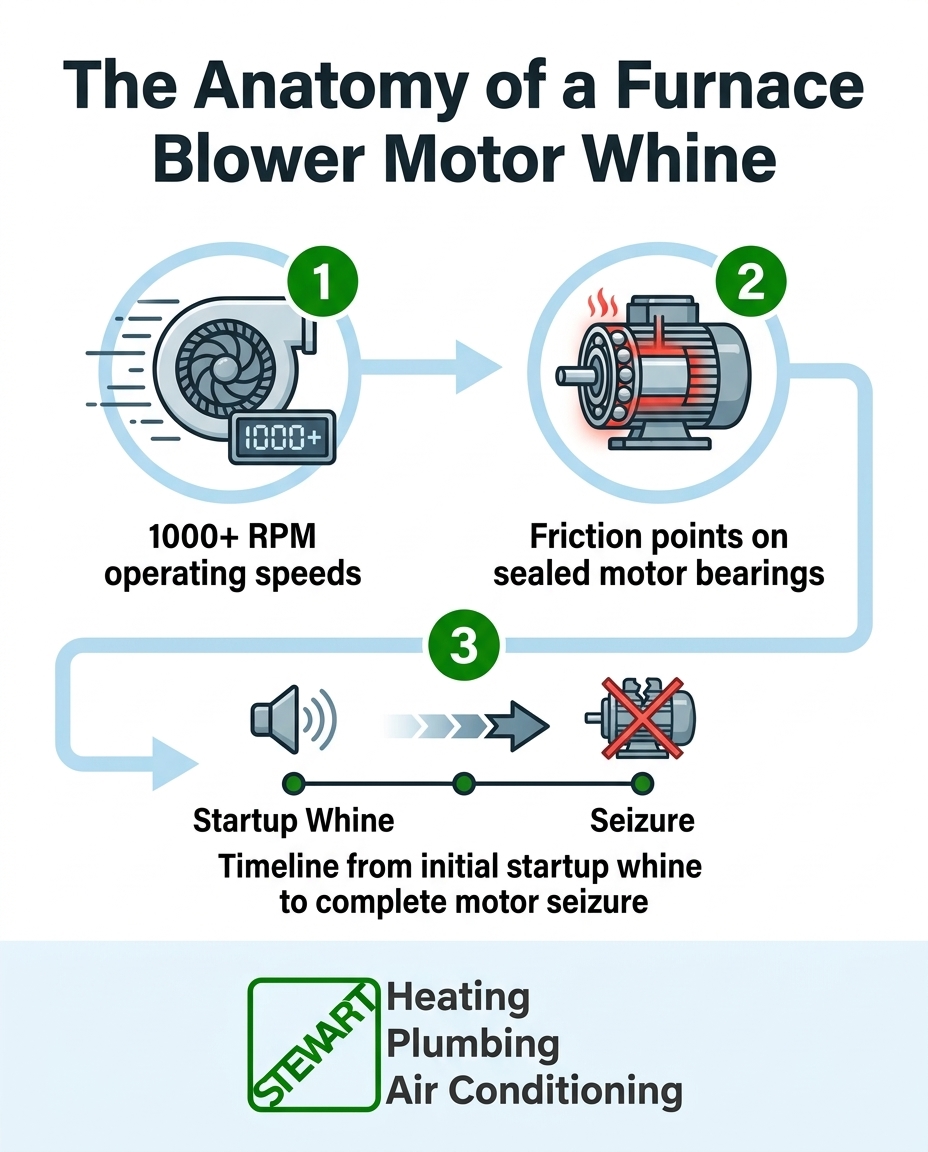
When our team tracks down the source of the noise, the leading culprit is almost always worn motor bearings. A standard residential forced-air furnace blower motor operates at extremely high speeds, often exceeding 1,000 to 1,200 revolutions per minute (RPM). At these velocities, perfectly smooth bearing operation is an absolute necessity.
Bearings are designed to reduce friction between the rapidly spinning motor shaft and the stationary motor housing. Over years of operation, the factory-applied lubrication inside these bearings begins to dry out, degrade, or leak. Once the lubrication is compromised, the metal ball bearings or sleeve bearings begin to scrape against their housing. This intense metal-on-metal friction is exactly what produces the high-pitched squeal or whine when the motor first engages.
Historically, older furnace motors featured small oil ports that allowed technicians (and sometimes savvy homeowners) to manually add a few drops of non-detergent motor oil to the bearings each fall. Today, the landscape is entirely different.
• Older Belt-Driven Motors — Lubrication Status: Unsealed (features oil ports) — Maintenance Action: Requires annual manual lubrication by a technician.
• Modern PSC Motors — Lubrication Status: Permanently Sealed — Maintenance Action: Cannot be oiled. Requires professional diagnostic and potential replacement.
• Modern ECM (Variable Speed) — Lubrication Status: Permanently Sealed — Maintenance Action: Cannot be oiled. Highly sensitive to friction; requires immediate professional care.
The vast majority of modern blower motors are permanently lubricated and sealed at the factory. This design prevents dust and debris from entering the motor housing, but it also means that the bearings cannot simply be "oiled" when they start to whine. If a sealed residential forced-air furnace blower motor begins to squeal, it indicates that the internal, inaccessible lubrication has failed. Attempting to drill into the housing or force WD-40 into the motor will instantly destroy the electrical components and create a severe safety hazard.
While worn bearings are the primary suspect in a residential forced-air furnace blower motor, our technicians know there are secondary mechanical and electrical issues that can mimic or contribute to startup noises. A thorough diagnostic must rule out these alternative causes.
• Slipped or frayed blower belts: If you live in an older home with a vintage, belt-driven furnace, the whine might not be the motor itself, but the rubber belt connecting the motor to the blower wheel. Over time, these belts dry rot, stretch, and slip along the pulleys during startup, creating a loud squeal similar to a slipping fan belt in a car.
• Severe airflow restrictions: Your blower motor is designed to push air against a specific amount of resistance, known as static pressure. If your air filter is heavily clogged, or if too many supply vents are closed off, the motor has to work twice as hard to pull and push the air. This severe overworking can cause the motor to strain, changing its acoustic pitch into a high-pitched whine as it fights against the restricted airflow.
• Electrical strain from a failing run capacitor: The run capacitor is a small electrical component that stores energy and provides a continuous boost of power to keep the motor spinning smoothly. If the capacitor is losing its charge, the motor struggles to maintain its RPMs. This electrical strain can sometimes cause a high-pitched electrical hum or whine as the motor fights to stay running.
• Connected electrical failures: Sometimes, erratic motor operation and strange noises trace back to the "brain" of the system. Electrical failures in connected components can cause the motor to receive improper voltage, leading to stuttering and whining. For example, a failing zone control board can send mixed signals to the blower, causing it to ramp up and down aggressively and produce unusual sounds.
Addressing the psychological decision point of ignoring the noise is critical. Because the furnace continues to push warm air into your home, the startup whine creates a false sense of security. It is easy to convince yourself that the system is "just getting old" and that the noise is a harmless quirk. In reality, that noise is the best early warning system you could ask for.
Ignoring the whine allows the internal friction to escalate rapidly. What starts as a brief squeal during the September pre-heating season will eventually transition into a low, rumbling grind. Finally, the friction will become so severe that the motor seizes completely and abruptly stops working. When the motor seizes, the furnace's safety limit switches will trip, shutting off the heat entirely.
With average winter low temperatures in the Pittsburg, CA area regularly dipping into the low 40s, a seized motor on a chilly winter night results in immediate, uncomfortable heat loss. Catching the problem early prevents this emergency scenario. Recently, our team helped a local homeowner who scheduled their first-ever fall tune-up after noticing a strange noise from their unit. Our technician performed a highly thorough inspection, explained exactly what was causing the friction, and advised on proper filter storage to keep the system running smoothly. Because they addressed the issue proactively rather than waiting for a failure, they felt completely confident in their heating system heading into winter.
When dealing with a whining residential forced-air furnace blower motor, it is strongly advised to avoid any do-it-yourself repair attempts. Modern HVAC equipment utilizes high-voltage electricity and precisely calibrated moving parts. Attempting to open, lubricate, or replace a sealed blower motor without proper training poses massive safety risks, including electrical shock and permanent equipment damage.
A professional diagnostic goes far beyond just listening to the noise. A trained technician will use a multimeter to test the electrical draw of the motor. If the motor is pulling more amps than it is rated for, it proves that internal friction is forcing the motor to overwork. They will also inspect the run capacitor, evaluate the static pressure of the ductwork, and assess the overall health of the entire heating system.
At Stewart Heating, Plumbing and Air Conditioning, we have been a family-owned business since 1974, bringing decades of hands-on experience identifying this exact mechanical wear. We believe in providing clear, technical explanations rather than pushy sales tactics. During a recent fall visit, one of our technicians thoroughly reviewed a customer's noisy system. By explaining the mechanical issues clearly and suggesting targeted efficiency measures, the homeowner was able to make an informed decision about their equipment. Proactive care is always the smartest financial move, which is why enrolling in a routine HVAC maintenance plan is the best way to catch these "countdown timer" noises before they turn into costly breakdowns.
A high-pitched noise at startup is usually caused by worn motor bearings or a slipping blower belt. The noise occurs prominently at startup due to cold-metal friction before the internal components heat up and undergo thermal expansion. Once the metal expands, the friction points shift, which is why the noise often fades after a few minutes of operation.
While your furnace may technically still run and produce heat, continuing to operate it will accelerate the mechanical damage. Every time the motor spins with worn bearings, the friction worsens. It is highly recommended to schedule a professional inspection before the motor seizes completely and leaves you without heat.
Early signs of a failing residential forced-air furnace blower motor include a high-pitched whine or squeal specifically at startup. As the internal mechanical failure progresses over time, that high-pitched whine may transition into a loud grinding, a deep humming, or a rattling noise, indicating that the motor is dangerously close to seizing.
No, the vast majority of modern furnace blower motors are permanently sealed and lubricated at the factory. They do not have oil ports. Attempting to drill into the housing or force oil into a sealed motor will destroy the electrical components, void your warranty, and pose a severe safety hazard.
While severe friction does generate excess heat, modern furnaces are equipped with safety limit switches that typically shut the system down if it begins to overheat. However, an overworked, whining motor can cause significant electrical strain and melt internal wiring, so it should be addressed promptly by a licensed professional to ensure your home remains safe.
Now that you know what causes a furnace blower motor to whine during startup, you understand that this noise is the best early warning system a homeowner can get. Hearing that squeal during the September pre-heating season gives you a valuable window of time to act before the heavy winter weather arrives. You do not have to wait for your system to fail completely in the middle of a freezing night.
By securing a clear, technical explanation and professional intervention now, you can solve the friction problem safely and efficiently. If your system is making unusual sounds, take control of your home's comfort and request furnace service today to ensure reliable, uninterrupted heat all winter long.

Very professional and complete. I would recommend Stewart to anyone. Highest quality of workmanship and clean installation.
Stewart Heating Plumbing Air Conditioning just did some work for us for the first time. They did an installation at my home and it turned out well. I thought the price was fair and I definitely would use them again. The technicians were very friendly and knowledgeable about their work. I highly recommend Stewart Heating Plumbing Air Conditioning and already told friends to use them.
We have been using Stewart Heating Plumbing Air Conditioning since 1995. They put the original heating and air unit in the house, and we have just stayed with them. They are dependable and honest people, and they have done a good job for us every time that we have used them!
They came and did an inspection and are coming tomorrow to do the repair.
They replaced a regulator the first time, and then the water heater vent had to be replaced. They did great work.
The gentleman that serviced us was helpful, insightful, and knew what he was talking about. Overall, it was a great experience.