

Recent Blogs
Stay updated with our latest blog posts.

Your furnace clicks on, the burners ignite, and just as you expect warm air to fill the room, the system abruptly shuts down—a frustrating cycle that perfectly illustrates the role of a flame sensor in preventing furnace gas leaks. For many homeowners in our Pittsburgh, CA service area, our team sees this exact scenario play out during the early fall transition. As September brings chilly nights, you walk over to the thermostat to call for heat, and the system seems to tease you. You hear the familiar hum of the draft inducer motor, the click of the gas valve, and the soft whoosh of the burners lighting. But three seconds later, everything goes completely silent.
It is incredibly tempting to walk back over to the thermostat and hit the reset button, hoping the system just needs a second chance to get going. You might even try it three or four times, only to find the house is still cold and the furnace refuses to respond at all. This is what our HVAC technicians call a "nuisance shutoff" or a short-cycle. To the person standing in a cold hallway, it feels like a mechanical failure. In reality, this abrupt shutdown is a deliberate, highly engineered response.
Modern heating systems are packed with advanced safety mechanisms designed to protect your home from unseen dangers. When the furnace shuts down after a few seconds of burning, it is not broken—it is actively locking you out to prevent a catastrophic hazard. The system has detected an anomaly in the ignition process. Rather than risking your family's safety by forcing the equipment to run blindly, the control board takes the safest route possible: it cuts the fuel supply. Understanding why this happens requires looking closely at a small, unassuming metal rod sitting right in the path of your furnace burners.
To understand the frustration, you have to understand what the furnace is trying to do. Every time your thermostat calls for heat, the system runs through a strict checklist:
• Airflow verification: The draft inducer motor pulls air through the heat exchanger to ensure the exhaust flue is clear.
• Ignition prep: The surface igniter glows red-hot, or the spark igniter begins to click.
• Fuel delivery: The gas valve opens, releasing fuel into the burner assembly.
• Flame verification: The system must prove the gas actually caught fire.
When that final step fails, the system aborts the cycle. This is the exact moment the frustration sets in, but it is also the exact moment your home is saved from a dangerous gas buildup.
To keep your home safe, the furnace control board needs definitive proof that the gas pouring out of the valve is burning. It cannot rely on a timer, and it cannot assume the igniter did its job. It needs physical confirmation. This is where the flame sensor comes in. The sensor is a surprisingly simple component: a small, metallic rod, usually bent at an angle, mounted directly in the path of the burner assembly.
Despite its simple appearance, the way it detects a flame relies on a fascinating scientific principle called flame rectification. Here is how the process works step-by-step:
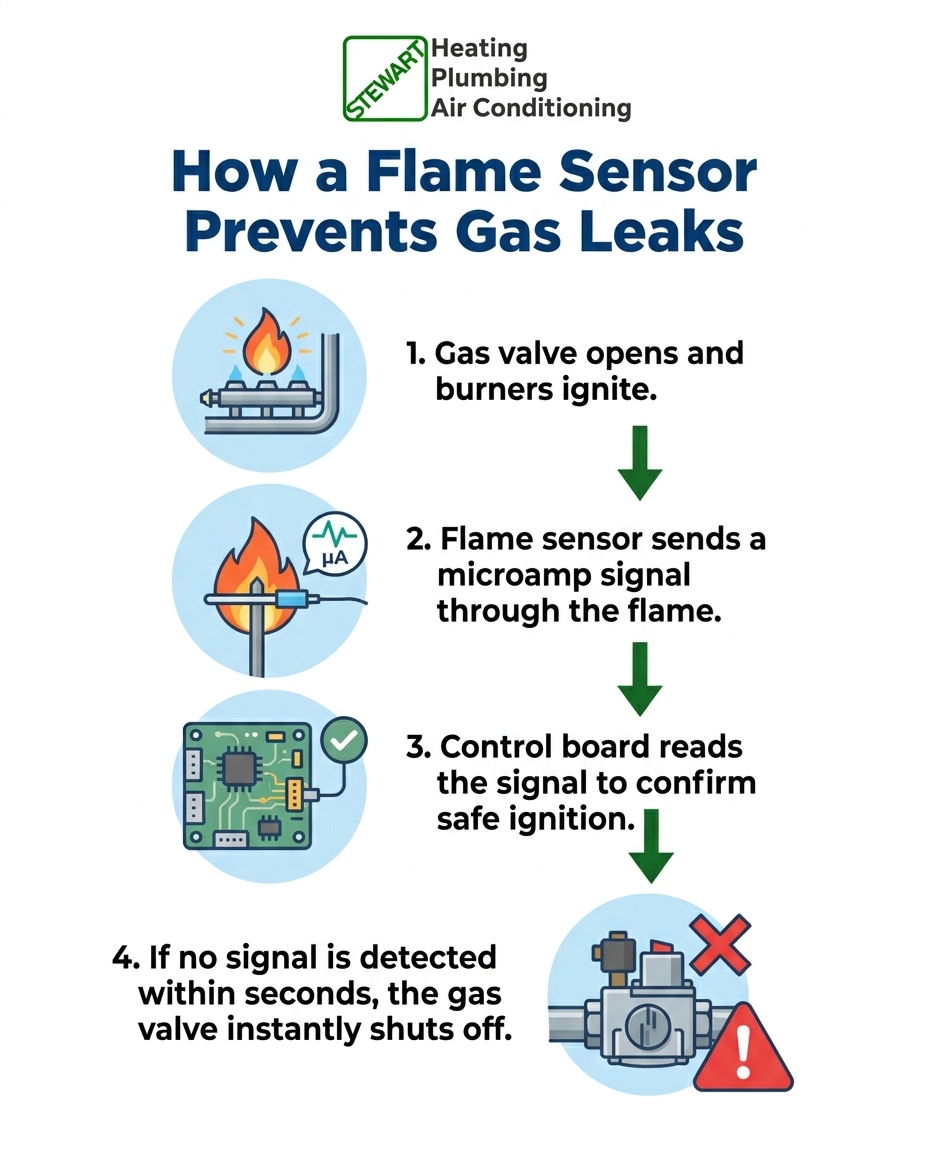
1. The electrical charge: The furnace control board constantly sends a very small electrical current to the metal rod.
2. The flame bridge: Fire is actually conductive because it contains ionized particles. When the gas ignites, the flames engulf the metal rod.
3. The microamp signal: The electrical current travels from the rod, through the actual fire, and grounds out on the metal chassis of the furnace.
4. The confirmation: The control board measures this returning current. Because the current is incredibly small, it is measured in microamps (one-millionth of an ampere).
If the control board receives a steady microamp signal, it knows with absolute certainty that a fire is burning. It will keep the gas valve open and turn on the main blower fan to distribute warm air through your home. If the board does not receive that specific electrical reading within about three to four seconds of opening the gas valve, it assumes the burners failed to light. The sequence of operation in a modern gas furnace dictates that the gas valve must be slammed shut immediately to prevent unburned fuel from escaping.
• Gas Valve Opens — Normal Operation: Fuel flows into the burner assembly. — Flame Sensor Failure: Fuel flows into the burner assembly.
• Burners Ignite — Normal Operation: Flames engulf the sensor rod. — Flame Sensor Failure: Flames engulf the sensor rod.
• Signal Detection — Normal Operation: Board reads a strong microamp signal. — Flame Sensor Failure: Board reads zero or weak current.
• System Action — Normal Operation: Gas stays on; blower fan activates. — Flame Sensor Failure: Gas valve shuts off instantly.
It is easy to view a furnace that won't stay on as an inconvenience. However, shifting your perspective reveals that this mechanical "failure" is actually a vital safety success. To understand why, you have to consider what would happen if the flame sensor did not exist.
If the gas valve opened, but the burners failed to ignite—or if a gust of wind down the flue pipe blew the flames out—raw natural gas or propane would continue pouring into the combustion chamber. Within minutes, that gas would spill out of the furnace cabinet. It would get pulled into your return ducts and distributed throughout every room in your house. The entire property would fill with highly combustible fuel, creating an extreme fire and explosion hazard. All it would take is a single spark from a refrigerator compressor kicking on or a light switch being flipped to cause a disaster.
By shutting the system down the moment the microamp signal drops, the flame sensor acts as the ultimate fail-safe. It prioritizes the safety of your property over your temporary comfort. During a recent pre-season service call right here in Pittsburgh, CA, one of our technicians responded to a homeowner concerned about their system abruptly locking out. After evaluating the unit, our technician didn't just reset the board; they made comprehensive recommendations for a new filter system, fire alarms, and carbon monoxide detectors, ensuring the home's entire defense against gas hazards was functioning perfectly. A furnace lockout means those safety mechanisms are doing exactly what they were engineered to do.
The Danger of Delayed Ignition: Even if the gas doesn't fill the house, a small pool of raw gas inside the furnace can cause a "delayed ignition." This happens when the gas finally catches a spark after pooling up, resulting in a miniature explosion inside the metal cabinet. This can crack the heat exchanger, blow the doors off the furnace, and send dangerous carbon monoxide leaking into your living space. The instant shutoff prevents this entirely.
If the flame sensor is so important, why does it seem to fail right when you need the heater the most? The answer lies in the seasonal changes and the long months your furnace sits idle over the summer. In the Bay Area and Delta region, chilly September evenings prompt the first furnace test-runs of the year, and our team consistently finds that this is exactly when the majority of sensor issues reveal themselves.
The Problem: Throughout the spring and summer, your air conditioning system is constantly pulling air through the ductwork. Even with a good air filter, microscopic particles of dust, pet dander, laundry lint, and airborne cooking oils manage to circulate. Because the furnace burners and the sensor rod sit right in the path of this airflow, they slowly collect a fine layer of debris.
The Cause: When early fall arrives and you turn on the heat for the first time, the burners ignite and engulf that dusty metal rod in fire. The intense heat instantly bakes the summer dust onto the metal, creating a hard, glass-like layer of carbon and silica. This baked-on soot acts as an electrical insulator. The next time the furnace fires up, the flames are present, but the carbon buildup blocks the tiny microamp signal from traveling through the fire. The control board gets a false negative reading.
The Solution: This is why proactive professional tune-ups are necessary. Our technicians make this common discovery frequently during early fall tune-ups. For example, when performing a first-time furnace service for a local homeowner recently, our technician thoroughly explained the sequence of events and actually showed the customer the damaged and dirty items—including the soot-covered sensor—before helping them optimize their detector placement and filter storage. Catching the buildup before the first cold snap saves you from waking up in a freezing house.
When a homeowner searches online for reasons their furnace is short-cycling, they are almost guaranteed to find DIY tutorials suggesting they pull the flame sensor out and scrub it clean. These videos often make the process look as simple as changing a lightbulb, recommending the use of sandpaper, steel wool, or wire brushes. However, handling gas system components without professional training is highly risky and strongly discouraged.
Since our team at Stewart Heating, Plumbing and Air Conditioning first opened our doors in 1974, we have spent decades serving the local community. In that time, we have seen firsthand how these safety mechanisms prevent disasters—and how quickly things go wrong when they are tampered with. Here is why we strongly warn against DIY cleaning:
• Micro-Scratches: Sandpaper is made of abrasive materials like aluminum oxide. When you scrub the sensor rod, you create microscopic grooves in the metal. These scratches dramatically increase the surface area of the rod, giving future carbon and dust a perfect place to cling. A sensor cleaned with sandpaper will foul up twice as fast the next time.
• Component Damage: The sensor is located right next to the hot surface igniter, which is made of silicon carbide and is as fragile as a potato chip. One accidental bump with a wrench while trying to remove the sensor will shatter the igniter, turning a simple cleaning into a costly repair.
• Gas Valve Tampering: Removing panels and working near the burner assembly puts you in direct proximity to the gas manifold and delivery valves. Tampering with any component near the gas delivery system without a license can compromise the integrity of the fittings, leading to the exact slow gas leaks the system was designed to prevent.
Professional handling is the only way to guarantee the safety mechanisms remain intact. Our technicians in Pittsburgh, CA use specialized, non-abrasive materials to clean the rod without damaging the protective coating, and we always test the electrical draw with a multimeter to ensure the microamp signal is strong and steady.
Addressing a dirty flame sensor is just one small part of preparing your heating system for the colder months. A furnace is a complex appliance that mixes combustible fuel, high-voltage electricity, and open flames inside a metal box inside your house. Ensuring it operates safely requires a holistic approach.
During a routine pre-season checkup this September, a homeowner asked one of our technicians to assess their aging unit. Our team member performed an extremely thorough and professional job checking the unit, leaving the customer confident in the system's safety for the winter. This level of thoroughness is exactly what you should expect from a comprehensive maintenance visit. A professional technician does not just wipe down a sensor; they evaluate the entire combustion process.
When you schedule heating service with our team, an expert will perform a deep dive into the system's vital functions:
• Burner Alignment: Ensuring the gas flows straight into the heat exchanger and does not roll out into the cabinet.
• Heat Exchanger Inspection: Checking for hairline cracks that could allow carbon monoxide to mix with the breathing air in your home.
• Flue Draft Testing: Verifying that exhaust gases are venting safely up the chimney or out the PVC exhaust pipe, rather than spilling backward.
• Electrical Verification: Testing the microamp signal of the flame sensor, checking capacitor health, and tightening loose wire connections.
Routine maintenance prevents nuisance lockouts from happening in the first place. By clearing away the summer dust, calibrating the burners, and verifying the safety controls, you ensure the system operates efficiently and safely all winter long. It provides the long-term reassurance that your equipment has been verified by an expert.
No, a bad flame sensor actually prevents a gas leak. Its entire purpose is to shut the gas valve immediately if a flame is not detected. If the sensor fails, it will fail in the "safe" position, meaning it will refuse to let the furnace run at all, completely eliminating the risk of unburned gas flooding your home.
This is typically a safety lockout. The furnace ignites, but the flame sensor fails to detect the flame (often due to carbon buildup blocking the microamp signal). Because the control board cannot confirm the fire is burning, it shuts off the gas to protect your home from a potential explosion or fuel buildup.
The furnace will short-cycle. It will attempt to start, ignite briefly, and shut down. After a few failed attempts (usually three to five, depending on the manufacturer), the system will enter a hard lockout mode. At this point, the furnace will not respond to the thermostat at all until the system is reset and the underlying issue is fixed.
If your furnace stays on and successfully heats your home to the temperature set on the thermostat, the sensor is working perfectly. A technician from our team can also verify its operation during a routine tune-up by hooking up a multimeter in series with the sensor wire to measure its exact electrical output.
Absolutely not. Bypassing this component removes the primary safeguard against raw gas flooding your home and creates an extreme fire and health hazard. Doing so is incredibly dangerous, violates all building and safety codes, and puts everyone inside the house at immediate risk.
A furnace that repeatedly shuts down after a few seconds can be incredibly annoying, especially when the temperatures drop in Pittsburgh, CA. However, recognizing that this shutoff is a vital safety feature actively protecting your home from raw gas buildup can turn that frustration into relief. The flame sensor is doing its job, and the lockout is proof that your system's safety controls are functioning properly.
Fortunately, these issues are easily resolved with expert care. Rather than fighting with the thermostat or attempting risky DIY repairs on gas components, the smartest move is to have the system professionally evaluated. By enrolling in an HVAC maintenance plan, you can ensure your system is cleaned, calibrated, and thoroughly inspected before the cold weather sets in. Schedule your professional tune-up with our team today, and enjoy the winter with absolute confidence in your home's safety and comfort.

Very professional and complete. I would recommend Stewart to anyone. Highest quality of workmanship and clean installation.
Stewart Heating Plumbing Air Conditioning just did some work for us for the first time. They did an installation at my home and it turned out well. I thought the price was fair and I definitely would use them again. The technicians were very friendly and knowledgeable about their work. I highly recommend Stewart Heating Plumbing Air Conditioning and already told friends to use them.
We have been using Stewart Heating Plumbing Air Conditioning since 1995. They put the original heating and air unit in the house, and we have just stayed with them. They are dependable and honest people, and they have done a good job for us every time that we have used them!
They came and did an inspection and are coming tomorrow to do the repair.
They replaced a regulator the first time, and then the water heater vent had to be replaced. They did great work.
The gentleman that serviced us was helpful, insightful, and knew what he was talking about. Overall, it was a great experience.