

Recent Blogs
Stay updated with our latest blog posts.

Are you dealing with a water heater or furnace that fires up, runs for a few seconds, and then abruptly shuts down? Since we opened our doors in 1974, our team at Stewart Heating, Plumbing and Air Conditioning has seen firsthand how finding the right local service expertise and area tips is crucial when you face unexpected equipment failures during your mid-fall heating startup. After sitting dormant for months, turning on your heating equipment for the first time in October often reveals hidden issues. You might notice a burning dust smell, experience short-cycling, or even feel concerned about your indoor air quality.
One of the most common culprits behind these sudden shutdowns that our technicians encounter is a pressure switch that has failed open. This small but critical component is designed to monitor your system's venting and airflow. When it detects a problem, it stops the ignition process in its tracks. The decision you face as a homeowner is determining whether this shutdown is just a normal quirk of a mid-fall heating startup or a serious safety hazard that requires immediate attention.
Ignoring a tripped safety switch can lead to dangerous situations, including the buildup of harmful exhaust gases inside your living space. Instead of repeatedly trying to reset the system, the safest path forward is securing professional plumbing services and expert water heater repair and replacement to ensure your home remains safe and comfortable.
The short answer is: A pressure switch that has "failed open" means its internal safety mechanism has deliberately broken the electrical circuit to shut down your equipment, preventing dangerous combustion gases from entering your home.
To understand why this happens, it helps to know how the switch operates. Modern power-vented water heaters and high-efficiency furnaces use a draft inducer motor to push toxic exhaust gases (like carbon monoxide) out of the house through a flue pipe. The pressure switch is connected to this draft inducer via a small rubber or vinyl tube. When the inducer motor turns on, it creates a negative pressure—or vacuum—inside the tube.
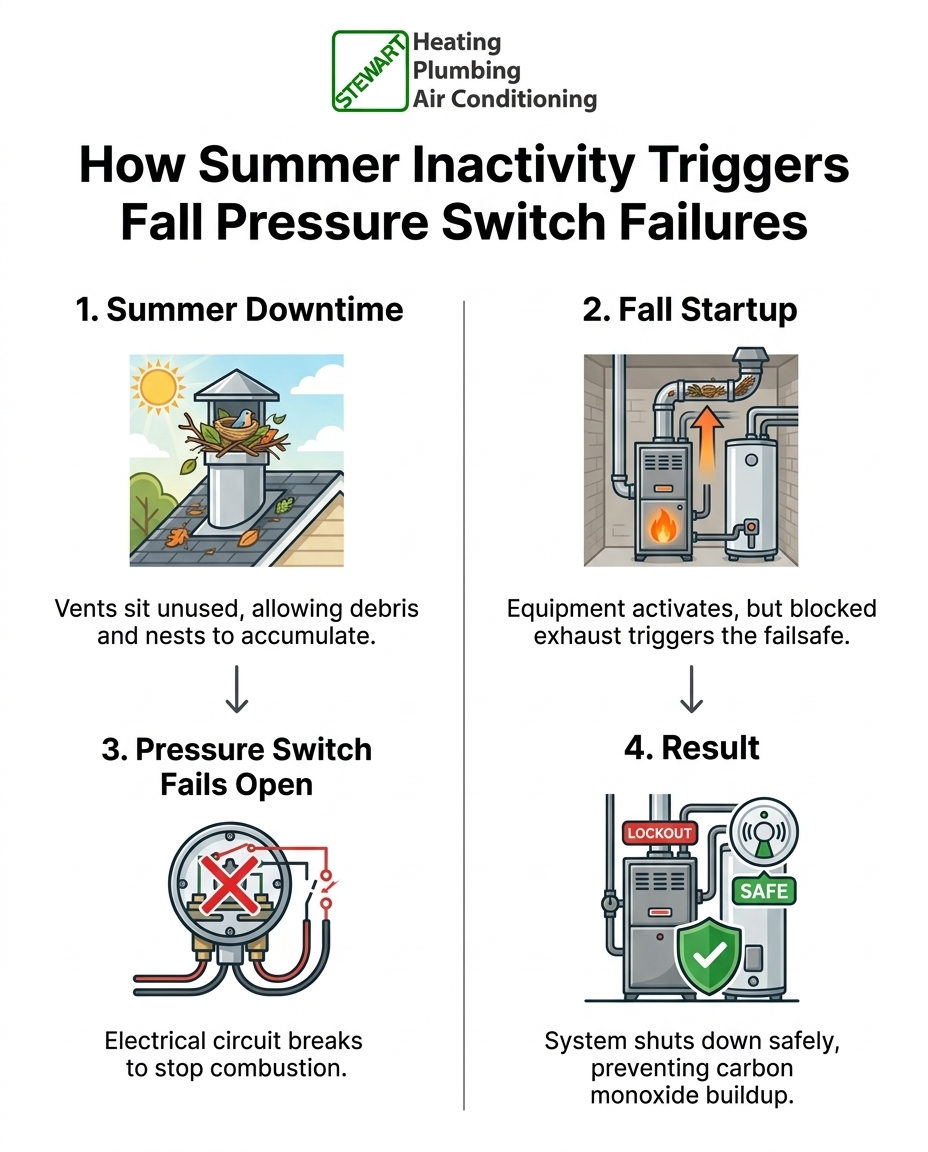
Inside the pressure switch is a sensitive diaphragm. When the vacuum is strong enough, it pulls the diaphragm inward, which closes an electrical microswitch. This "closed" state sends a signal to the control board that it is safe to open the gas valve and ignite the burners. If that vacuum drops because of a blockage, the diaphragm releases, the switch pops "open," and the electrical circuit is broken. The system instantly shuts down.
In our decades of serving Pittsburgh CA, we find that most homeowners don't realize that when one of our technicians says a switch has "failed open," the switch itself is usually doing exactly what it was designed to do. It hasn't necessarily broken; rather, it has successfully detected an underlying airflow problem and intervened to protect your family.
• Closed (Normal Operation) — What It Means for Airflow: Proper vacuum and draft are detected. Exhaust is venting safely outdoors. — System Action & Safety Level: Allows ignition and continuous heating. Home is safe.
• Failed Open (Tripped) — What It Means for Airflow: Inadequate draft detected. A blockage or moisture is restricting airflow. — System Action & Safety Level: Breaks the circuit. Shuts down the burner immediately to prevent CO buildup.
Your heating equipment works hard during the colder months, but it sits completely idle during the summer. This extended period of inactivity is exactly what sets the stage for a frustrating mid-fall heating startup. When exhaust vents go unused for months at a time, they become prime real estate for outdoor intruders and natural debris.
When our team gets called out to a system that suddenly fails to stay lit, we typically find the pressure switch is reacting to one of the following blockages that accumulated over the summer:
• Spider webs: Spiders love the dark, undisturbed environment of a dormant PVC exhaust pipe. Even a thick web can create enough drag to disrupt the delicate vacuum required by the pressure switch.
• Bird and wasp nests: Birds frequently build nests in chimney flues and vent terminations to stay warm. We often see wasps and mud daubers building dense nests that completely seal off the airflow.
• Natural debris: High winds during late summer storms can blow leaves, twigs, and dirt directly into the exhaust vents, creating a physical barrier.
• Corrosion and rust flakes: In older metal venting systems, summer humidity can cause internal rust. When the system is turned on, these flakes fall and block the draft inducer port.
Many homes feature shared venting systems, where both the furnace and the water heater exhaust through the same chimney or flue. If a blockage occurs high up in the shared stack, turning on your furnace for the first time in the fall can backdraft exhaust down into the water heater's draft hood, or vice versa. This shared restriction will immediately cause the pressure switch to fail open. If you are also dealing with a tankless system, the diagnostic process can be even more complex, which is why diagnosing a tripped pressure switch on a tankless water heater requires a thorough understanding of modern venting dynamics.
Environmental factors play a massive role in the performance of your heating equipment. Living in Pittsburgh CA, our proximity to the Delta means we experience unique climate shifts as the seasons change. The combination of dropping temperatures and higher fall humidity creates the perfect storm for pressure switch issues.
As the weather cools down, your water heater and furnace have to work harder and run in longer cycles to maintain your home's temperature. During cool fall nights, the temperature of the exhaust gases is significantly hotter than the cold outdoor air surrounding the vent pipes. This temperature differential causes the moisture inside the exhaust to condense into liquid water.
Because of the higher humidity levels coming off the Delta in Pittsburgh CA, our technicians frequently encounter systems drawing in excess moisture. If the venting is even slightly restricted, this condensation cannot properly drain away or evaporate. Instead, water droplets pool inside the draft inducer housing or get sucked directly into the small rubber tubing connected to the pressure switch.
The quick result: A single drop of water inside that tiny tube is enough to block the vacuum. The diaphragm loses its suction, the switch fails open, and your system shuts down. This is a highly predictable environmental stressor, which is why seasonal preparation is so vital.
When faced with a water heater or furnace that refuses to stay on, it can be tempting to look for a quick DIY workaround. We occasionally arrive at service calls where a homeowner has read an online forum suggesting that you temporarily bypass the pressure switch by jumping the wires together to force the system to run. This is incredibly dangerous and should never be attempted.
Bypassing a pressure switch removes the absolute only safety barrier protecting your home from toxic exhaust gases. If the switch failed open because a bird nest is blocking the flue, forcing the burner to ignite means all of that exhaust has nowhere to go but backward. It will spill directly out of the draft hood and into your basement, utility closet, or living space.
Carbon monoxide is an odorless, colorless gas that can be fatal. By overriding the switch, you are actively choosing to pump this gas into your home. This severely compromises your indoor air quality and puts your family's health at immediate risk.
Every major manufacturer strictly prohibits the bypassing of failsafe devices. Doing so not only voids your warranty but violates fundamental safety codes. A failed open switch is never just a nuisance to be overridden; it is a glaring symptom of a larger venting hazard. The switch is screaming that the system cannot breathe. Masking the symptom by jumping the wires does absolutely nothing to fix the actual blockage.
Because a tripped pressure switch is a symptom of a broader airflow or mechanical issue, accurately pinpointing the root cause requires specialized tools and licensed expertise. In our experience, this is never a scenario where guesswork or quick DIY fixes are appropriate.
When a Stewart Heating, Plumbing and Air Conditioning professional arrives at your home during a mid-fall heating startup failure, we don't just replace the switch and walk away. Testing the electrical components and verifying safe combustion venting requires a dual-port manometer to measure the exact water column inches of vacuum being produced by the draft inducer. A professional will:
• Inspect the entire flue: Checking the length of the exhaust pipe from the unit all the way to the roof termination to ensure there are no physical blockages.
• Clear the inducer ports: Using specialized tools to remove rust scale or debris that may be blocking the tiny port where the pressure switch hose connects.
• Check for condensation: Inspecting the vinyl tubing for water droplets and ensuring the system is pitched correctly for proper drainage.
• Test the electrical limits: Using a multimeter to verify that the microswitch itself hasn't mechanically degraded over time.
As a family-owned business serving the area since 1974, we believe in providing trustworthy, experienced diagnostics rather than pushing quick-fix sales pitches. We know how critical it is to get this right. To avoid these sudden breakdowns entirely, we highly recommend establishing a routine maintenance plan. Proactive maintenance allows our technicians to catch these vulnerabilities, clear out summer debris, and verify your safety switches before the colder months fully arrive.
A pressure switch failing open means the internal safety mechanism has deliberately broken the electrical circuit to shut down your equipment. This usually happens when the switch detects a lack of proper airflow or a venting blockage. By shutting the system down, it prevents dangerous exhaust gases from backing up into your home. It is a critical safety response, not necessarily a broken part.
Fixing a pressure switch stuck open requires identifying and resolving the underlying airflow restriction that caused it to trip. Our licensed professionals will inspect the exhaust flue for blockages, clear any condensation from the vacuum tubing, and test the draft inducer motor. Because this involves combustion safety, it is not a recommended DIY repair.
No, you should never bypass a water heater or furnace pressure switch. Bypassing this failsafe removes the only barrier preventing carbon monoxide and toxic exhaust gases from spilling into your living space. It is a severe safety hazard, violates manufacturer guidelines, and can lead to life-threatening indoor air quality issues.
If your pressure switch keeps tripping, your system is consistently failing to establish a safe draft for exhaust gases. Common causes we see include a partially blocked vent pipe, water pooling in the pressure switch tubing, a failing draft inducer motor, or severe rust buildup in the inducer port. Repeated tripping indicates a persistent safety hazard that requires professional diagnostics.
Pressure switches frequently fail during the fall because heating systems are turning on for the first time after months of summer inactivity. During the summer, exhaust vents often become blocked by spider webs, bird nests, or storm debris. Additionally, cooler fall temperatures combined with humidity can cause condensation to build up inside the switch tubing, blocking the required vacuum.
Absolutely not. Running a system with a bypassed pressure switch is incredibly dangerous. The switch tripped because the system cannot safely vent its exhaust. Forcing it to run guarantees that harmful combustion byproducts, including carbon monoxide, will enter your home rather than venting safely outdoors.
Your heating equipment's safety mechanisms are there to protect you and your family. If your system is struggling to stay running or repeatedly shutting down, don't ignore the warning signs. Let our experienced team provide the thorough diagnostics needed to restore your comfort and peace of mind safely. Reach out today to schedule a service call and ensure your home is fully prepared for the colder months ahead.

Very professional and complete. I would recommend Stewart to anyone. Highest quality of workmanship and clean installation.
Stewart Heating Plumbing Air Conditioning just did some work for us for the first time. They did an installation at my home and it turned out well. I thought the price was fair and I definitely would use them again. The technicians were very friendly and knowledgeable about their work. I highly recommend Stewart Heating Plumbing Air Conditioning and already told friends to use them.
We have been using Stewart Heating Plumbing Air Conditioning since 1995. They put the original heating and air unit in the house, and we have just stayed with them. They are dependable and honest people, and they have done a good job for us every time that we have used them!
They came and did an inspection and are coming tomorrow to do the repair.
They replaced a regulator the first time, and then the water heater vent had to be replaced. They did great work.
The gentleman that serviced us was helpful, insightful, and knew what he was talking about. Overall, it was a great experience.