

Recent Blogs
Stay updated with our latest blog posts.


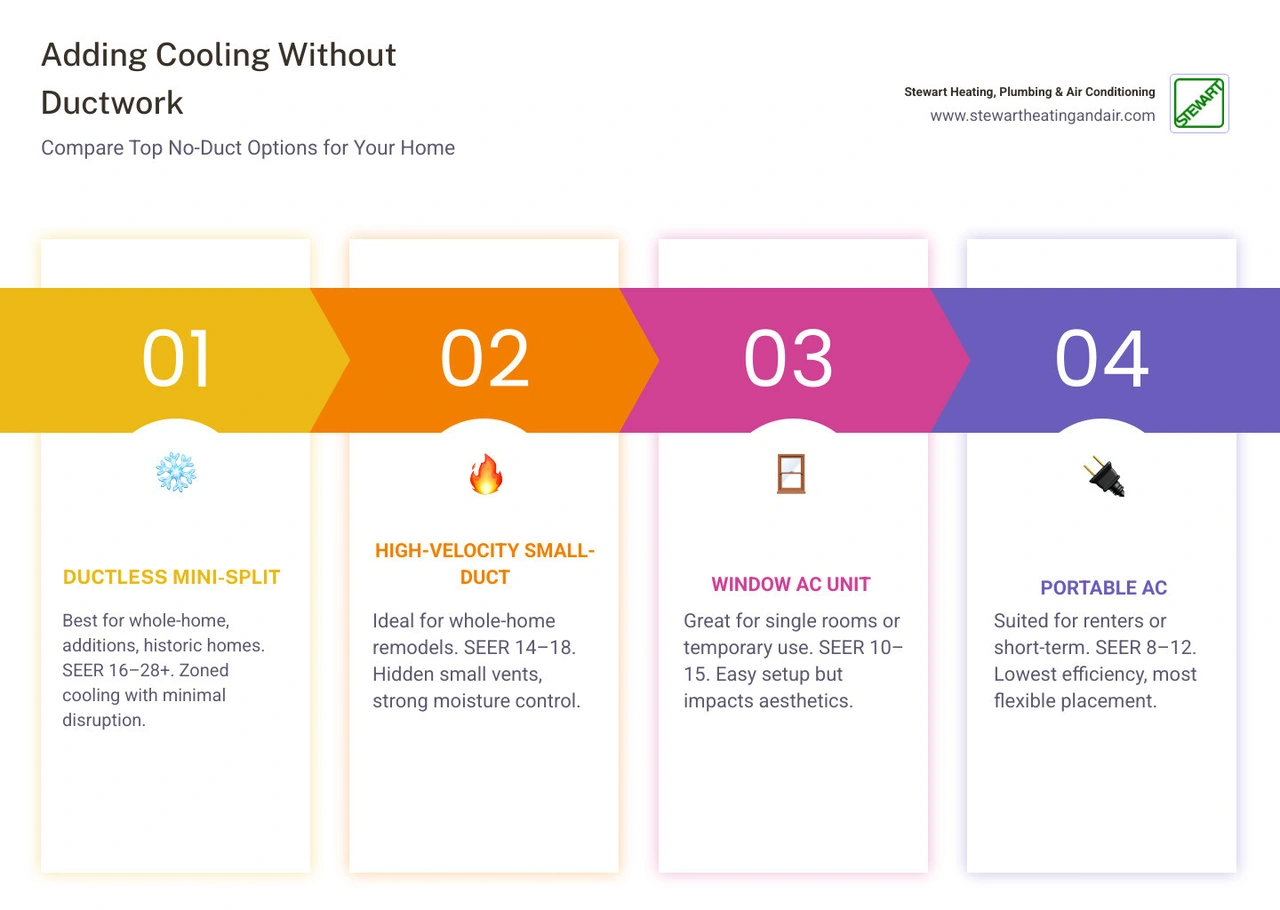
If your home has no ductwork, you have more good options than you might think. Here is a quick look at the main ways to add cooling without installing ducts:
| Cooling Option | Best For | SEER Rating | Key Tradeoff |
|---|---|---|---|
| Ductless mini-split | Whole-home, additions, historic homes | 16–28+ | Upfront complexity |
| High-velocity small-duct | Whole-home, remodels | 14–18 | Requires some duct work |
| Window AC unit | Single rooms, temporary use | 10–15 | Security, aesthetics |
| Portable AC | Renters, short-term | 8–12 | Least efficient option |
If your home was built without ductwork — or you are adding a room, converting a garage, or trying to cool one stubborn space — you are not stuck settling for a noisy window unit or an ugly portable cooler. Millions of older homes, including many of the historic bungalows and craftsman-style houses found throughout Contra Costa County, were built long before central air conditioning existed. Retrofitting traditional ductwork into these homes is often impractical, expensive, and damaging to original plaster walls and trim.
The good news is that modern ductless and low-disruption cooling systems have come a long way. Traditional ducted systems can lose up to 30% of their cooling power through leaks alone — meaning homeowners with aging ductwork are often paying to cool their attic, not their living room. The right no-duct solution, properly sized and installed, can actually outperform a conventional system while protecting the character of your home.
This guide breaks down every major option side by side, so you can make a confident, informed decision before you invest.
When homeowners start researching adding cooling without ductwork options compared, they usually want three things:
That is exactly where the differences between systems matter. Some options are built for whole-home comfort. Others are really just spot-cooling tools. Some run quietly and efficiently. Others get the job done, but with more noise, less humidity control, and higher energy use.
Here is the big-picture comparison:
| Option | Installation Impact | Efficiency | Noise | Humidity Control | Best Use |
|---|---|---|---|---|---|
| Ductless mini-split | Low to moderate | Excellent | Very low | Very good | Single rooms to whole homes |
| High-velocity small-duct | Moderate | Good | Low to moderate | Excellent | Whole-home retrofits |
| Window AC | Low | Fair | Moderate to high | Basic | One room, temporary |
| Portable AC | Very low | Poor to fair | High | Weak to fair | Short-term emergency use |
| Traditional central AC with new ducts | High | Good if well designed | Low | Good | Major remodels only |
A ductless mini-split has two main parts:
These are connected by refrigerant lines, power wiring, and a condensate drain through a small wall opening, often about 3 inches wide. The indoor unit pulls warm air from the room, cools and dehumidifies it, and sends it back into the space. The outdoor unit moves the heat outside.
Most modern mini-splits use inverter-driven compressors. Instead of turning fully on and fully off like an old-school system, they ramp up and down as needed. Think of it like a dimmer switch instead of a basic light switch. That helps with:
Many models are also heat pumps, which means they can cool in summer and provide heat in cooler weather. That makes them especially useful in Contra Costa County homes with radiators, boilers, or older heating setups that do not include air conditioning.
Mini-splits also allow zoning. Each indoor unit can serve a room or area independently, so you do not have to cool the entire house just to make one bedroom comfortable.
The most common no-duct or low-duct cooling choices are:
The right choice depends on whether you need:
For homes that already have well-designed, sealed ducts, central AC can work fine. But homes without ducts are a different story.
Adding traditional central air to a no-duct home often means:
It also introduces duct losses. Research shows traditional ductwork can lose up to 30% of cooling power through leaks. In older homes, that is a major strike against forcing a ducted design where one never existed.
In many older homes and additions, mini-splits are often a better fit because they avoid major demolition and can be paired with existing heat. For example, some homeowners keep their radiators or boiler heat for winter and use mini-splits for cooling and shoulder-season heating. That hybrid approach can work very well.
Different homes need different solutions. A compact bungalow in Pleasant Hill is not the same as a garage conversion in Brentwood or an upstairs bonus room in Concord.
Here is a quick best-fit list:
Historic and pre-1940 homes often have fragile plaster walls, original woodwork, and layouts never intended for ducts. They also tend to use more energy per square foot than newer homes, so system selection really matters.
In these homes, mini-splits are often the least invasive option because they need only a small wall penetration and limited interior disruption. They can be installed with wall-mounted heads, recessed ceiling units, or floor-mounted units depending on the room and the look you want to preserve.
They are also ideal when you want to avoid carving up original finishes just to squeeze in bulky ductwork.
Before installing any new cooling system in an older home, we also recommend evaluating insulation and air leakage. Improving air sealing and insulation can reduce heating and cooling costs by roughly 15% to 30%, which can change the load and improve comfort.
For more on older-home ductless planning, see this Pleasant Hill ductless guide.
This is where ductless mini-splits really shine.
They are especially useful for:
These spaces often stay uncomfortable because the existing system was never designed to serve them. Extending old ductwork can overload the main HVAC system or create airflow imbalances. A dedicated mini-split solves that by creating an independent zone with its own thermostat control.
Installation is usually faster and less disruptive than adding ductwork, which is why this is such a popular upgrade path in Contra Costa County.
For local examples, visit Mini Split AC Brentwood CA.
High-velocity small-duct systems are the middle ground between full central AC and fully ductless cooling. They still use ducts, but the ducts are much smaller and more flexible, and the supply outlets are small enough to fit discreetly into ceilings, walls, or floors.
These systems can make sense when:
One of their biggest strengths is dehumidification. Research shows high-velocity systems can remove about 30% more moisture than conventional systems because of colder coil operation. That can be a real advantage in homes that feel cool but still muggy.
The tradeoff is that they still require some duct routing, so they are generally more invasive than mini-splits.
Ductless cooling has earned a strong reputation for a reason, but it is not magic. Every option comes with strengths and compromises.
Mini-splits are often the efficiency leader for no-duct homes because they combine:
Research indicates ductless mini-splits can reduce energy consumption by up to 40% compared with conventional ducted systems in the right applications. ENERGY STAR certified mini-splits can also use dramatically less energy than standard heating and cooling equipment.
Another major benefit is zoning. If nobody is using the guest room, you do not have to cool it. That room-by-room control can make a real difference in operating efficiency and comfort.
They are also very quiet. Indoor units often operate in the 19 to 32 decibel range, which is quieter than a whisper. In other words, they are a nice change if your current cooling strategy sounds like an airport runway.
No system is perfect. Here are the main tradeoffs to understand.
Portable units have their place, but for most homeowners they are more of a stopgap than a real comfort strategy.
Many homeowners are surprised to learn that a ductless mini-split can also heat. Modern heat pump mini-splits are designed to provide both cooling and heating, and many perform very well in cold weather. Some systems can maintain full heating output even when outdoor temperatures drop to around 5 degrees Fahrenheit.
That makes them useful for:
Humidity is another big topic. In hot weather, comfort is not just about temperature. It is also about moisture removal. A properly sized mini-split can dehumidify very effectively because variable-speed operation lets it run longer at lower output instead of blasting on and off.
If a system is oversized, though, it may cool the room too quickly and shut off before removing enough moisture. That is when homeowners say, "The air feels cold, but the room still feels muggy."
This is the part homeowners often underestimate. The best equipment in the world will not perform properly if it is oversized, poorly placed, or installed without attention to the home itself.
A proper Manual J load calculation is the right way to size a system. We should not size equipment by eyeballing the house or using simple square-foot rules.
A Manual J considers things like:
This is especially important in older homes and additions. Pre-1940 homes may have less insulation, more air leakage, and different room loads than newer construction.
Oversizing is one of the biggest mistakes in HVAC. Bigger is not better. An oversized system may short cycle, waste energy, and leave humidity behind. A right-sized system runs longer, steadier, and more comfortably.
In many cases, mini-split installation is surprisingly low disruption. A typical multi-zone system may be installed in 1 to 2 days, depending on the layout and number of zones.
The process usually includes:
For many homes, the visible impact is limited to the indoor unit, an outdoor unit, and neatly routed line-set covers. Good planning matters here. The goal is to hide tubing as cleanly as possible without hurting service access.
A panel upgrade or dedicated circuit may also be needed in some homes, especially older ones.
For more on the local process, read this Contra Costa County ductless installation guide.
Mini-splits are fairly low maintenance, but they are not no-maintenance.
Typical upkeep includes:
Window and portable units also need cleaning, but they are often neglected, which hurts performance and air quality.
High-velocity systems need regular HVAC maintenance too, including filter changes, blower checks, and coil inspection.
If indoor air quality is a concern, cleaner equipment and regular maintenance matter just as much as the cooling technology itself.
Efficiency ratings help compare systems, but real-world performance also depends on design, installation, and how you use the equipment.
Here is the practical efficiency range homeowners usually see by category:
For heat pump models, heating efficiency is often measured with HSPF or HSPF2. The exact rating varies by system, but the pattern is similar: high-efficiency mini-splits tend to perform very well, especially at part load.
That part-load performance is important because HVAC systems rarely run at full blast all day. Inverter mini-splits are strong precisely because they can modulate output rather than constantly cycling.
In 2026, qualifying heat pump installations may be eligible for the federal Section 25C tax credit. That credit covers 30% of eligible equipment and installation costs, up to a yearly cap of $2,000 for qualifying heat pumps.
Homeowners should also check for:
Because program details can change, it is smart to verify current requirements before installation. Efficiency certifications and product eligibility matter.
Yes, and in many older homes this is one of the smartest setups.
A hybrid approach may look like this:
This works especially well in homes where the existing heat is reliable, but there is no practical path for adding central air. It also lets you cool only the rooms you actually use.
For more on year-round ductless comfort, visit Ductless Heating Martinez CA.
Here are a few 2026 homeowner checkpoints before moving forward:
Yes, if it is properly sized and installed. Mini-splits can do an excellent job with both temperature control and dehumidification because variable-speed operation allows longer, steadier run times. That helps remove moisture instead of just dropping the temperature fast and shutting off.
The key is proper sizing, good drain management, and correct installation. If a room still feels muggy, the problem is often oversizing, air leakage, or another humidity source in the home.
In many cases, yes. Older homes in Concord, Antioch, Pleasant Hill, Walnut Creek, Martinez, and nearby communities are often strong candidates because ductless systems avoid major demolition and allow zoning.
They are especially useful where homeowners want to preserve original finishes or cool a home addition without rebuilding the entire HVAC system.
If you want to learn more about local ductless applications, see Ductless AC Concord CA.
Sometimes, yes. A window or portable unit can make sense when:
That said, they are usually not the best long-term answer for comfort, efficiency, noise, or appearance. Window units are often best viewed as a short-term patch, while portable ACs are usually the fallback option when almost nothing else will work.
If your house has no ductwork, you are not out of options. In fact, the best solution may be more efficient, quieter, and less disruptive than trying to force central air into a home that was never designed for it.
For many homeowners in Pittsburg, Antioch, Concord, Brentwood, Pleasant Hill, Walnut Creek, Martinez, and across Contra Costa County, ductless mini-splits offer the best mix of efficiency, zoning, comfort, and low-disruption installation. In other homes, a high-velocity small-duct system may be the better whole-home fit. And for short-term needs, window or portable units can still serve a purpose.
What matters most is proper design, correct sizing, and a clean installation done right the first time.
If you are weighing your options, explore our Mini Split page for next steps and local guidance. You can also learn more through our area-specific resources on Ductless AC Antioch CA, Ductless AC Concord CA Ultimate Guide, and Ductless Replacement Brentwood CA Guide.
At Stewart Heating, Plumbing & Air Conditioning, we focus on quality, comfort, and customer satisfaction so homeowners can enjoy cooling solutions that fit their homes without unnecessary disruption.

Very professional and complete. I would recommend Stewart to anyone. Highest quality of workmanship and clean installation.
Stewart Heating Plumbing Air Conditioning just did some work for us for the first time. They did an installation at my home and it turned out well. I thought the price was fair and I definitely would use them again. The technicians were very friendly and knowledgeable about their work. I highly recommend Stewart Heating Plumbing Air Conditioning and already told friends to use them.
We have been using Stewart Heating Plumbing Air Conditioning since 1995. They put the original heating and air unit in the house, and we have just stayed with them. They are dependable and honest people, and they have done a good job for us every time that we have used them!
They came and did an inspection and are coming tomorrow to do the repair.
They replaced a regulator the first time, and then the water heater vent had to be replaced. They did great work.
The gentleman that serviced us was helpful, insightful, and knew what he was talking about. Overall, it was a great experience.