

Recent Blogs
Stay updated with our latest blog posts.


Knowing when to repair vs replace your hvac system can save you thousands of dollars and years of frustration. Here's a quick-reference guide to help you decide:
Repair your HVAC system if:
Replace your HVAC system if:
Most homeowners face this decision at the worst possible time — right in the middle of a summer heat wave or a cold winter night. The system goes down, a technician gives you a repair quote, and suddenly you're wondering whether you're about to throw good money at a system that's already on its last legs.
It's a stressful spot to be in, and the answer isn't always obvious. The right call depends on a mix of factors: how old your system is, how often it's been breaking down, how efficient it actually is, and what it would cost to replace it versus keep patching it. According to Energy.gov, you should consider replacing your heat pump or air conditioner when it's over 10 years old, and your furnace when it's over 15 — but age is just one piece of the puzzle.
This guide walks you through the full picture so you can make a confident, informed decision for your home in Contra Costa County.
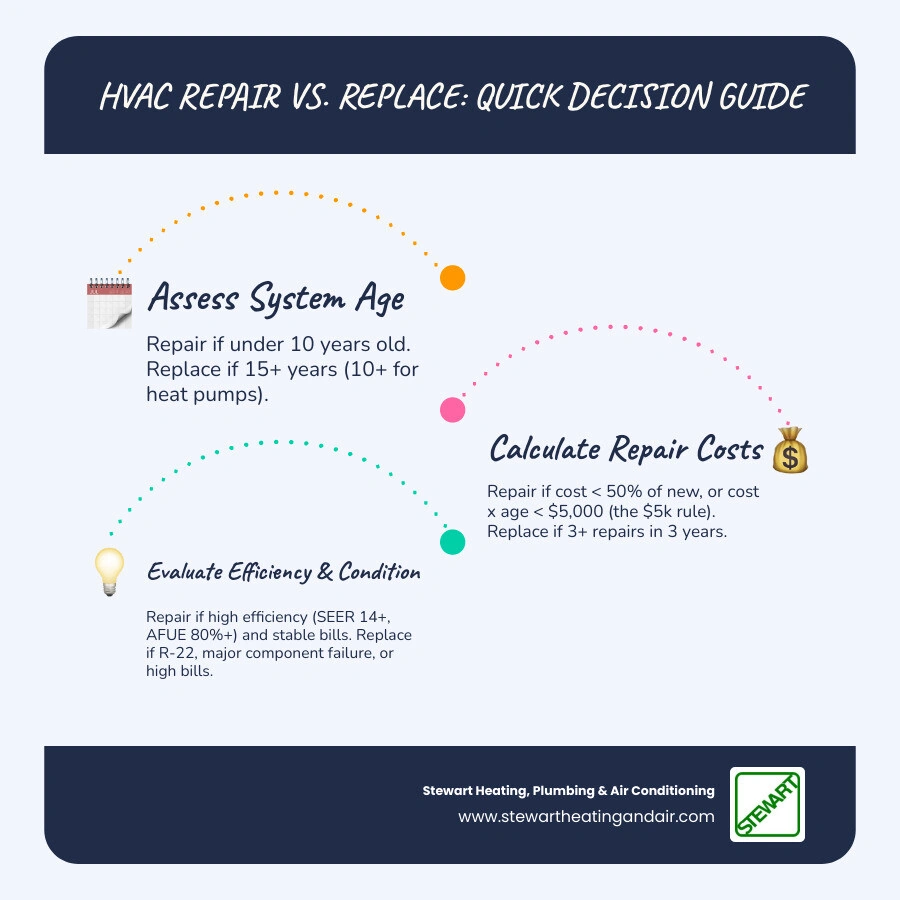
Every mechanical system has a finite lifespan, and your HVAC is no different. Think of it like a car; after a certain number of miles, the parts simply wear out. In the HVAC world, those "miles" are measured in years of service. Generally, a well-maintained central air conditioner or furnace can last between 15 and 20 years. However, heat pumps tend to have a slightly shorter lifespan, often hovering around the 15-year mark because they work year-round to provide both heating and cooling.
Energy.gov suggests that once an air conditioner or heat pump hits 10 years, it’s time to start keeping an eye on it. For furnaces, that window opens at 15 years. If your system was installed back in 2006 or 2011, you are likely entering the "danger zone" where components begin to degrade significantly. We often see units in cities like Concord or Pittsburg struggle because they’ve been pushed to their limits during our hot California summers.
Understanding these benchmarks helps you avoid being blindsided. If you know your system is 18 years old, you can plan for a transition rather than panic-buying a new unit when yours dies during a heatwave. For more specific details on heating units, check out these Signs That Indicate Furnace Replacement.
Age isn't just a number; it's a predictor of reliability. When we look at when to repair vs replace your hvac system, we categorize systems into three life stages:
If you’re a fan of hard data, there are two "golden rules" in the HVAC industry that can help remove the emotion from the decision-making process.
Beyond these rules, look at your repair frequency. One or two repairs over three years is normal maintenance. However, three or more repairs in that same timeframe suggests a "repair spiral" where one failing part puts stress on others, leading to a never-ending cycle of service calls. For a deeper dive into budgeting, see our Hvac Replacement Estimate Complete Guide.
| Indicator | Lean Toward Repair | Lean Toward Replacement |
|---|---|---|
| System Age | Under 10 years | Over 15 years |
| Repair Cost | Less than 30% of new unit | More than 50% of new unit |
| Repair Frequency | Once every few years | 3+ times in 3 years |
| Energy Bills | Stable | Rising significantly |
| Comfort | Consistent | Uneven / Humidity issues |
Efficiency is the "hidden" cost of an old system. You might think you're saving money by avoiding a replacement, but your monthly utility bills might tell a different story.
Since 2023, the industry has shifted to SEER2 ratings for cooling and updated AFUE (Annual Fuel Utilization Efficiency) standards for heating. If your current AC has a SEER rating under 10, it is incredibly inefficient compared to modern units that often reach SEER2 ratings of 16 to 25. Switching from a SEER 9 unit to a SEER 14 unit can reduce your energy consumption by more than 35%. In some cases, upgrading to a high-efficiency system can cut your cooling costs by as much as 50%. If you notice your bills spiking every summer despite your habits staying the same, your aging system is likely working twice as hard to produce half the comfort.
Sometimes, the decision is made for you by the type of failure your system experiences. There are "red flag" repairs that almost always signal the end of the road.
The R-22 Refrigerant Problem: If your air conditioner was built before 2010, it likely uses R-22 (Freon). Production of R-22 ceased in 2020 because it is harmful to the ozone layer. Today, R-22 is extremely scarce and expensive. If your old system has a refrigerant leak, the cost to recharge it can be astronomical. Investing that money into a new system that uses modern, environmentally friendly refrigerants is almost always the better choice.
Major Component Failures:
If you are currently facing a breakdown in Contra Costa County, our team can provide a professional diagnosis through our Hvac Repair Concord Ca service to see if your unit is a candidate for a fix or a "farewell."
Your HVAC system is responsible for more than just temperature; it manages the "health" of your indoor air. If you notice any of the following, your system is likely struggling:
When you decide to replace, there is a massive strategic advantage to doing a "full system upgrade"—meaning you replace both the furnace and the air conditioner at the same time.
Modern HVAC components are designed to work as "matched systems." When you pair a new, high-efficiency outdoor condenser with an old, inefficient indoor furnace blower, you won't actually achieve the SEER2 ratings promised on the box. It’s like putting a Ferrari engine into a 1990s sedan; the performance will be limited by the weakest link. By replacing both, you ensure maximum efficiency, a unified warranty, and reduced labor costs since the technicians are already on-site.
Furthermore, the financial landscape for replacement has never been better thanks to the Inflation Reduction Act of 2022. Many homeowners are now eligible for a tax credit of 30% (up to $2,000) for high-efficiency heat pump installations. There are also various rebates available for Energy Star-certified equipment that can knock thousands off the total investment. To see how these factors play out locally, read our Hvac Replacement Concord Complete Guide.
If you plan on staying in your home for 7 years or more, a new HVAC system is a no-brainer. You will recoup the investment through lower energy bills and avoided repair costs. However, even if you plan to sell soon, a new HVAC system can be a major selling point. Prospective buyers in Walnut Creek or Danville often ask for the age of the HVAC system during the inspection. A brand-new, high-efficiency unit with a transferable warranty provides immense "peace of mind" and can actually increase your property value.
Newer systems also offer smart home integration. Imagine controlling your home’s climate from your phone or having a system that automatically adjusts to save energy when you aren't home. This "future-proofing" makes your home more comfortable today and more attractive to buyers tomorrow.
Yes, in most cases, we highly recommend it. Replacing them together ensures that the indoor and outdoor units are perfectly matched for efficiency. It also saves you money on labor costs in the long run, as you won't have to pay for a second installation a few years down the line. Plus, you’ll have the peace of mind that your entire home comfort system is under a new manufacturer's warranty.
The phase-out makes repairing old AC units significantly more expensive. Since R-22 is no longer produced, any repairs requiring a recharge must use "reclaimed" gas, which is very costly. If your system has a leak and uses R-22, you are essentially pouring expensive chemicals into a "sinking ship." Replacing the system moves you to R-410A or newer refrigerants that are more affordable and better for the environment.
The primary benefit is lower monthly utility bills, often saving homeowners 20% to 50% on cooling costs. Beyond the money, high-efficiency systems typically feature variable-speed blowers, which provide much more consistent temperatures and better humidity control. They also tend to be much quieter than older models, improving the overall ambiance of your home.
Deciding when to repair vs replace your hvac system is about balancing the "now" with the "next." While a repair might be cheaper today, a replacement is often the better investment for your long-term comfort and bank account. At Stewart Heating, Plumbing & Air Conditioning, we are committed to helping our neighbors in Pittsburg, CA, and throughout Contra Costa County make the right choice the first time.
Whether you need a quick fix to get through the week or a complete system redesign, our focus on quality and customer satisfaction ensures you won't be left in the heat. We serve the following communities with pride:
Don't let an aging system compromise your family's comfort. Schedule your professional evaluation today and let us help you find the most cost-effective path forward.

Very professional and complete. I would recommend Stewart to anyone. Highest quality of workmanship and clean installation.
Stewart Heating Plumbing Air Conditioning just did some work for us for the first time. They did an installation at my home and it turned out well. I thought the price was fair and I definitely would use them again. The technicians were very friendly and knowledgeable about their work. I highly recommend Stewart Heating Plumbing Air Conditioning and already told friends to use them.
We have been using Stewart Heating Plumbing Air Conditioning since 1995. They put the original heating and air unit in the house, and we have just stayed with them. They are dependable and honest people, and they have done a good job for us every time that we have used them!
They came and did an inspection and are coming tomorrow to do the repair.
They replaced a regulator the first time, and then the water heater vent had to be replaced. They did great work.
The gentleman that serviced us was helpful, insightful, and knew what he was talking about. Overall, it was a great experience.