

Recent Blogs
Stay updated with our latest blog posts.


If you're wondering should i repair or replace my hvac system, here's the short answer:
| Situation | Best Choice |
|---|---|
| System under 10 years old, minor repair | Repair |
| System 10-15 years old, first major repair | Evaluate with $5,000 rule |
| System 15+ years old, recurring repairs | Replace |
| Repair cost exceeds 50% of new system cost | Replace |
| Safety issue (cracked heat exchanger, gas leak) | Replace immediately |
| System uses R-22 refrigerant, needs recharge | Replace |
Every year, millions of homeowners face the same stressful moment: the HVAC system stops working, a technician gives them a repair quote, and suddenly they're trying to make a major financial decision on the spot. It usually happens in the middle of a summer heat wave or the coldest week of winter — the worst possible time to think clearly.
The truth is, this decision doesn't have to be a guessing game. There are proven rules, clear warning signs, and practical frameworks that make the repair vs. replace question much easier to answer — and getting it right can save you thousands of dollars over the long run.
This guide walks you through everything you need to know to make a confident, informed decision for your home.
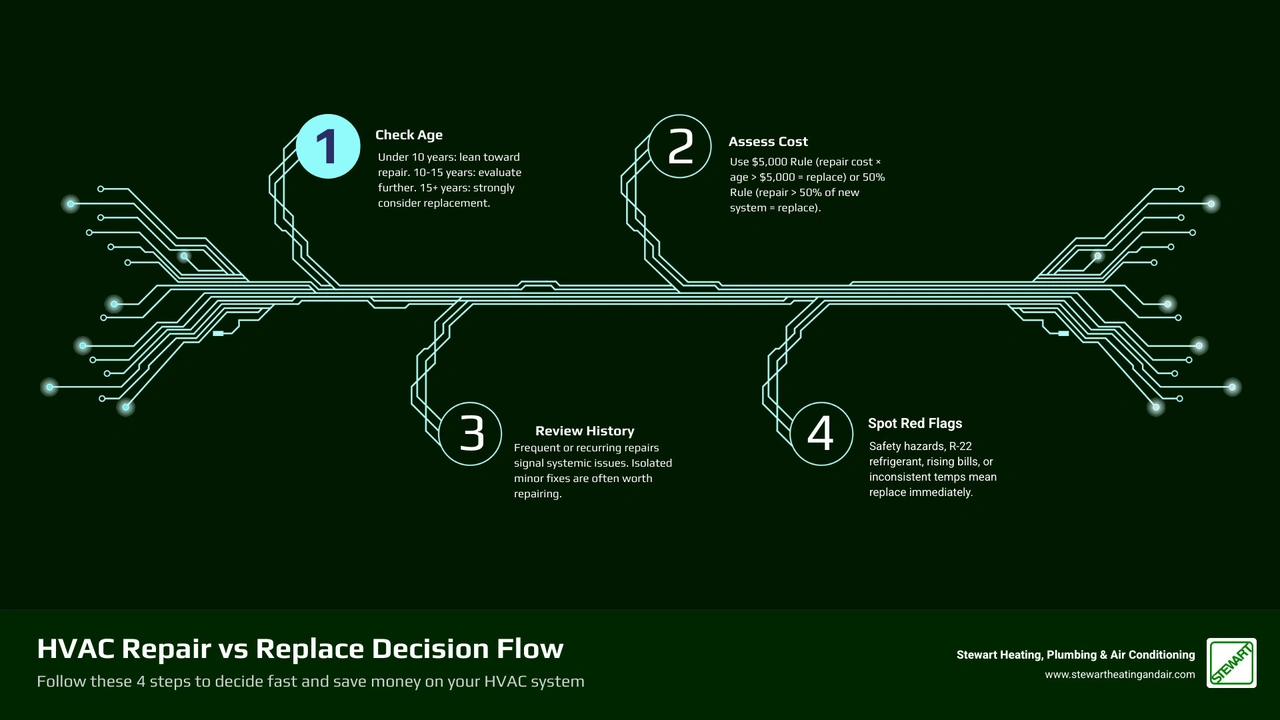
To repair, or to replace my HVAC system, that is the question. While it might feel like a major breakdown is the end of the world, many HVAC issues are actually simple, isolated problems that can be fixed without breaking the bank. As we move through April 2026, we’ve seen plenty of systems in Contra Costa County that just need a little TLC to get back to peak performance.
Generally, if your system is relatively young—specifically under 10 years old—repairing is almost always the smarter financial move. At this age, most major components are still in good condition, and the unit likely has plenty of life left. Furthermore, if your system is still under a manufacturer’s warranty, the cost of parts might even be covered, leaving you only with the labor costs.
We always recommend checking your warranty status first. If you aren't sure where to start, our HVAC Repair Concord Complete Guide offers deep insights into common fixes. Often, what seems like a catastrophic failure is just a thermostat calibration issue or a minor electrical glitch that can be resolved quickly.
Regular maintenance is the best way to keep your system in the "repairable" category for as long as possible. For our neighbors in Pittsburg, following an HVAC Maintenance Pittsburg CA Guide can help prevent the small issues from snowballing into system-wide failures. We also offer an HVAC Maintenance Agreement to ensure your system gets the professional eyes it needs twice a year, which is the best insurance policy against an early replacement.
Not all repairs are created equal. Some parts are considered "wear items," meaning they are expected to fail and be replaced at some point, much like the tires on your car. Replacing these doesn't mean your whole system is dying; it just means it needs a routine tune-up.
Common minor fixes include:
If you’re hearing a strange noise or noticing a slight drop in performance, don't wait for a total breakdown. You can Request Service from our team to get a clear diagnosis before a small part causes a "domino effect" of damage to more expensive components like the compressor.
According to Energy.gov, if your air conditioner or heat pump is less than 10 years old, you should lean heavily toward repair. Most modern systems are designed to last 15 to 20 years (though heat pumps usually lean closer to the 15-year mark).
When a system is under a decade old, parts are usually readily available, and the technology is still efficient enough that you won't see massive energy savings by upgrading just yet. However, we do look at the maintenance history. If a 7-year-old system has been neglected and has already had three major repairs, it might be the exception to the rule. But for a well-maintained system, a repair is usually the way to go.
Sometimes, the writing is on the wall. While we love fixing systems, there comes a point where pouring money into an old unit is like trying to fix a 20-year-old car with 300,000 miles on it—you’re just waiting for the next thing to break.
One of the biggest red flags is a sudden, unexplained spike in your energy bills. As systems age, they lose efficiency. A unit that used to keep your home cool on a 90-degree day in Walnut Creek might now struggle to keep up, running constantly and draining your bank account. If you’re noticing inconsistent temperatures or if some rooms feel like a sauna while others are freezing, your system may be reaching the end of its functional life.
You can learn more about these telltale signs in our guide on Signs That Indicate Furnace Replacement. Beyond just the bills, keep an ear out for excessive noise. Grinding, squealing, or banging sounds often indicate that internal components are failing. Additionally, if your home feels muggy or you notice excessive dust accumulation, your system is likely failing to manage humidity and filtration properly.
For those in the Concord area, our AC Replacement Concord CA Complete Guide provides a localized look at when it’s time to move on. Similarly, residents in Walnut Creek can refer to our Furnace Replacement Guide Walnut Creek CA for specific heating advice.
If your air conditioner was manufactured before 2010, there is a high chance it uses R-22 refrigerant (often called Freon). This is a major factor in the should i repair or replace my hvac system debate. R-22 has been phased out by the EPA because it is harmful to the ozone layer.
Because it is no longer being produced, the supply of R-22 is extremely limited and incredibly expensive. If an old R-22 system has a refrigerant leak, the cost of the repair—including finding and fixing the leak and then recharging the system—can be astronomical. In almost every case, we recommend replacing an R-22 system rather than repairing a leak. Moving to a modern system using R-410A (or the even newer refrigerants coming to market) is better for the environment and much more cost-effective for your wallet in the long run.
Safety is the one area where there is no room for compromise. If our technicians find a cracked heat exchanger in your furnace, we will recommend immediate replacement. A cracked heat exchanger can allow carbon monoxide—a colorless, odorless, and potentially lethal gas—to leak into your home’s air supply.
Other critical failures that often signal it's time to replace include:
When safety is at stake, refer to our HVAC Replacement Concord Complete Guide to understand the process of getting a safe, reliable system installed quickly.
When you're staring at a repair quote, it helps to have a mathematical way to strip the emotion out of the decision. Two of the most popular methods are the "$5,000 Rule" and the "50% Rule."
| Decision Rule | How it Works | When to Replace |
|---|---|---|
| The $5,000 Rule | Multiply the age of the system by the repair cost. | If the total is over $5,000. |
| The 50% Rule | Compare the repair cost to the cost of a new system. | If repair is > 50% of the replacement value. |
| The 3-in-3 Rule | Track how many repairs you've had recently. | If you've had 3+ major repairs in 3 years. |
Let’s look at the $5,000 Rule in action. If you have a 12-year-old AC unit and the repair costs $500, you multiply 12 by 500. The result is 6,000. Since 6,000 is greater than 5,000, the rule suggests replacement. However, if that same 12-year-old unit only needed a $300 fix, the total would be 3,600, suggesting the repair is still a reasonable gamble.
The 50% Rule is even simpler: if the repair costs more than half of what a brand-new system would cost, don't throw good money after bad. You’re better off putting that money toward a new unit with a 10-year warranty.
Finally, consider the "3-in-3" Rule. If you have had to call a technician for three or more significant repairs within a three-year span, your system is likely in a state of "systemic decline." Each repair is just a "band-aid" on a larger problem. At this point, the lack of reliability becomes a quality-of-life issue. You can get a better idea of what a full upgrade looks like in our HVAC Replacement Estimate Complete Guide.
When evaluating the cost of a new system, you have to look at the "effective cost." A new system isn't just an expense; it’s an investment that pays you back every month in lower utility bills.
Modern systems are rated using several benchmarks:
Over the 15-to-20-year lifespan of a new system, these monthly savings can add up to thousands of dollars, often covering a significant portion of the initial investment. If you're ready to see what the numbers look like for your specific home, you can Schedule HVAC Installation Estimate with us.
If you are leaning toward replacement, the timing in 2026 couldn't be better. Thanks to the Inflation Reduction Act, there are significant financial incentives available for homeowners who choose energy-efficient upgrades.
You may be eligible for a 30% federal tax credit (up to $2,000) for installing a high-efficiency heat pump. There are also various state and local rebates available that can further reduce the cost. These incentives are designed to help California homeowners transition to cleaner, more efficient technology.
Beyond the money, the technology available today is lightyears ahead of what was installed 15 years ago.
By replacing an aging unit now, you aren't just avoiding a breakdown; you're upgrading your home's entire environment and reducing your environmental footprint.
This is a common dilemma! If you plan to sell within the next year, a total replacement might not offer a full return on investment in terms of sale price. However, a non-working or aging HVAC system is a major red flag during a home inspection. Buyers may ask for a large credit or even back out of the deal if they see a 20-year-old unit.
If the system is working fine but is just old, a professional tune-up and a clean bill of health from a technician might be enough. But if it requires a major repair, replacing it can actually be a strong selling point, giving buyers "peace of mind" that they won't have a major expense immediately after moving in.
If your current AC unit has a SEER rating of 10 or lower, you are likely overpaying for your comfort by a significant margin. The federal minimum for new installations in our region is now SEER 14 or 15 (depending on the specific equipment type). Upgrading from SEER 9 to SEER 14 can save you more than 35% on energy consumption. Similarly, if your furnace is below 80% AFUE, it’s considered very inefficient by modern standards.
We call this the "repair spiral." If you’ve had two or more service calls in the last two years for the same system, it’s a sign of systemic decline. HVAC systems are complex; when one major part starts to fail due to age, it often puts extra strain on other aging parts. Repairing one thing often just moves the "weak link" to another component. If you find yourself on a first-name basis with your repair technician, it’s definitely time to consider a replacement.
Deciding should i repair or replace my hvac system is one of the most significant maintenance decisions you'll make as a homeowner. Whether you choose to extend the life of your current unit with a professional repair or invest in the future with a high-efficiency replacement, the goal is the same: a comfortable, safe, and efficient home.
At Stewart Heating, Plumbing & Air Conditioning, we’ve built our reputation in Pittsburg and throughout Contra Costa County on quality craftsmanship and honest advice. We are a referral-based business, which means we only succeed when our customers are truly satisfied with the work we do. We don't believe in high-pressure sales; we believe in doing the project right the first time.
Whether you're in Walnut Creek, Concord, Antioch, or anywhere in between, we're here to help you navigate this dilemma. If you're ready for a professional opinion you can trust, Schedule HVAC Installation Estimate today or visit our HVAC service page to learn more about how we can keep your home comfortable all year long.

Very professional and complete. I would recommend Stewart to anyone. Highest quality of workmanship and clean installation.
Stewart Heating Plumbing Air Conditioning just did some work for us for the first time. They did an installation at my home and it turned out well. I thought the price was fair and I definitely would use them again. The technicians were very friendly and knowledgeable about their work. I highly recommend Stewart Heating Plumbing Air Conditioning and already told friends to use them.
We have been using Stewart Heating Plumbing Air Conditioning since 1995. They put the original heating and air unit in the house, and we have just stayed with them. They are dependable and honest people, and they have done a good job for us every time that we have used them!
They came and did an inspection and are coming tomorrow to do the repair.
They replaced a regulator the first time, and then the water heater vent had to be replaced. They did great work.
The gentleman that serviced us was helpful, insightful, and knew what he was talking about. Overall, it was a great experience.