

Recent Blogs
Stay updated with our latest blog posts.


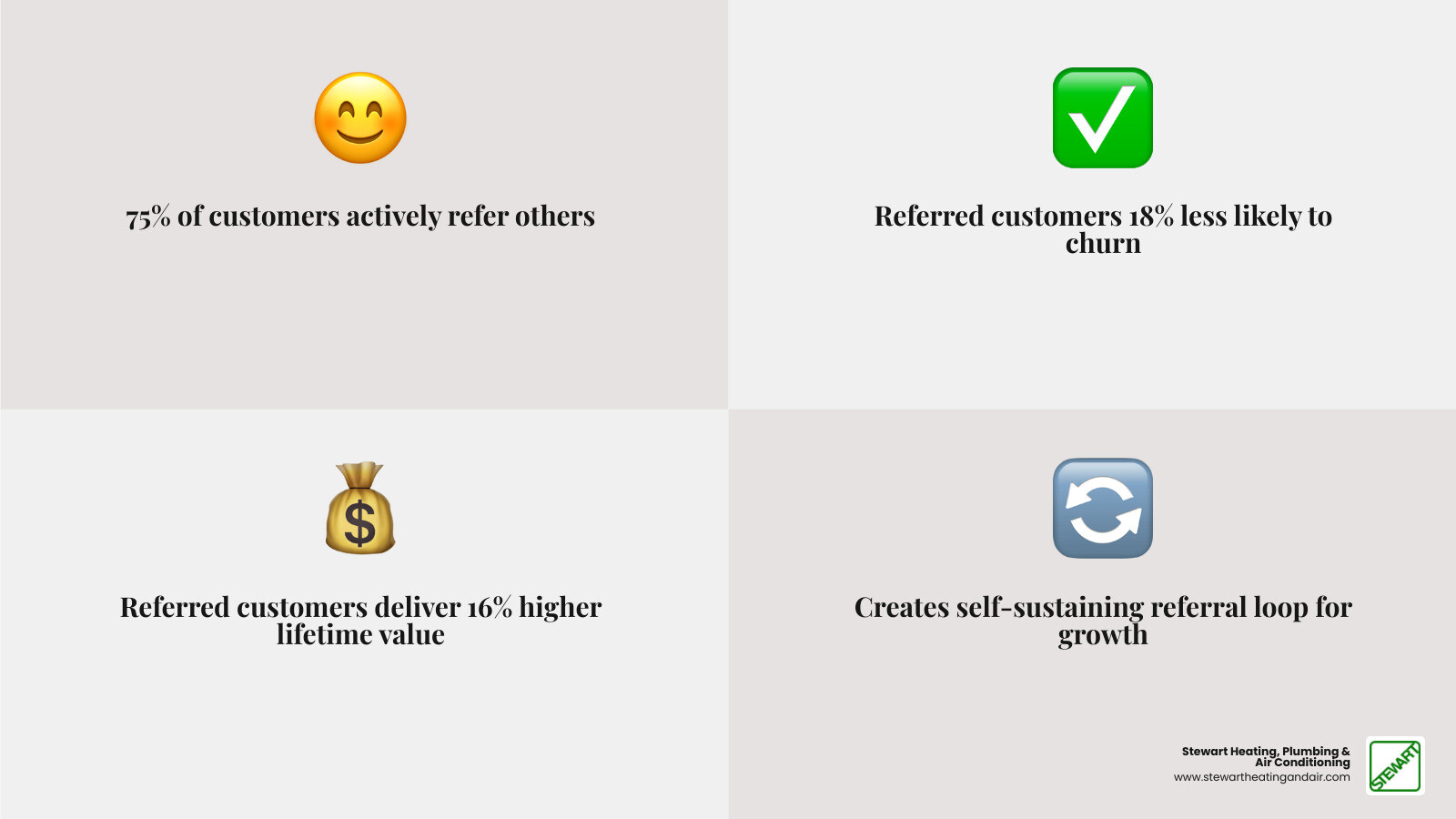
How a 75% referral rate reflects quality is straightforward: when 3 out of 4 customers actively share your name with friends and family, it means your service is consistently good enough that people stake their own reputation on recommending you.
Here is a quick breakdown of what that number signals:
For homeowners in Pittsburg, CA dealing with the stress of HVAC breakdowns or plumbing emergencies, choosing who to call is a big decision. Most people don't search review sites first - they call whoever their neighbor used last month. That is the power behind a 75% referral rate. It means a business has earned enough trust, repeatedly, that customers become unpaid advocates.
At Stewart Heating, Plumbing & Air Conditioning, that kind of trust is not accidental. It is built through consistent, reliable service that gives customers a reason to talk.
In marketing metrics, there is often confusion about what "referral rate" actually means. In the context of a structured program, a 75% share rate means that out of all the customers enrolled in the program, 75% of them have actively taken the step to share their unique referral link or contact information with someone else.
To put this in perspective, industry benchmarks for share rates often hover in the single digits—typically between 5% and 9%. When a business hits 75%, it is a statistical outlier that indicates a "perfect storm" of high engagement. It means the enrollment process is seamless, the incentive is motivating, and most importantly, the customer’s experience was so positive that they felt a natural urge to share it.
While many businesses look at Reviews to gauge success, the share rate is a more active form of participation. A review is a public statement, but a referral is a personal endorsement. Achieving this level of active participation requires:
Loyalty is not just about a customer coming back; it is about that customer becoming a brand advocate. When we see a 75% share rate, it acts as the ultimate social proof. It indicates an emotional connection that goes beyond a simple transaction. For a NATE Certified Contractor in Contra Costa County, this rate reflects the technical excellence required to pass rigorous industry testing, which in turn builds the peace of mind that drives recommendations.
High referral rates are also a leading indicator of retention. Statistics show that referred customers have an 18% lower churn rate. They stay with the business longer because the "social enrichment" of knowing someone else who uses the service creates a stronger bond with the brand.
The quality of a service can be measured by the "matching effect." This theory suggests that existing customers know their friends' needs better than any marketing algorithm ever could. Therefore, a 75% referral rate ensures that the leads coming in are already a "perfect fit" for the services offered.
| Metric | Referred Customers | Non-Referred Customers |
|---|---|---|
| Trust Level | High (pre-established) | Low (must be earned) |
| Conversion Rate | 10% - 30%+ | 1% - 3% |
| Churn Rate | 18% Lower | Standard |
| LTV | 16% Higher | Standard |
| Initial Margin | 25% Higher | Baseline |
This "homophily"—the tendency of individuals to associate with others who are similar—means that a high-quality customer base will naturally recruit more high-quality customers. When a Certified HVAC Technician arrives at a home in Walnut Creek or Danville, the fact that they were referred by a neighbor immediately lowers the "stranger danger" barrier. This trust allows the technician to focus on solving the problem rather than "selling" their credibility.
Reliability is the cornerstone of HVAC Industry Affiliations. Being part of professional organizations signals a commitment to standards that make a 75% referral rate possible. It tells the community that our work is backed by more than just words—it’s backed by industry-wide best practices.
Customer Lifetime Value (LTV) is the total revenue a business can expect from a single customer account. Research from academic journals and market reports consistently shows that referred customers are 16% more valuable than those acquired through other channels.
This value comes from several factors:
From a financial standpoint, how a 75 percent referral rate reflects quality is seen most clearly in the reduction of Customer Acquisition Cost (CAC). Traditional advertising in 2026—like paid search or social media ads—can be incredibly expensive. Referrals, however, leverage your existing customer base as a marketing team.
When your share rate hits 75%, your marketing efficiency skyrockets. Instead of spending thousands to find one new customer in Antioch or Pittsburg, you are investing in the quality of your service, which then generates new business organically. This allows for deeper Community Involvement, as funds typically reserved for aggressive advertising can be redirected into local sponsorships and events, further strengthening the brand's reputation.
The financial advantages include:
In growth marketing, the "K-factor" or viral coefficient measures how many new customers each existing customer brings in. A K-factor of 1.0 means that for every customer you have, they bring in exactly one more. This leads to exponential, self-sustaining growth.
A 75% share rate is a key component of reaching a high K-factor. If 75% of your participants are sharing, and they share with multiple people, the "referral-to-purchase" conversion rate (which is usually 3 to 5 times higher than standard web traffic) ensures that your business grows even when you aren't actively "selling." In 2026, this kind of sustainable acquisition is the only way to combat rising digital ad costs.
If your business is lucky enough to see high referral engagement, you can't just set it and forget it. You must optimize the experience to sustain that momentum. This involves constant About Us reflection—asking if our team is still living up to the values that earned those referrals in the first place.
While a 75% rate is fantastic, it does come with challenges. "Relationship fatigue" can set in if you ask the same customers to refer too often. It is important to segment your advocates and only prompt them when it feels natural.
Additionally, high-volume programs need robust fraud detection. You want to ensure that referrals are genuine and not just people trying to game the system for rewards. Finally, maintain long attribution windows (30-90 days) to ensure that if a neighbor in Brentwood hears about you in May but doesn't need service until July, the original referrer still gets the credit they deserve.
A 75% share rate indicates that your referral program is highly "contagious." It proves that your customers find the sharing process easy and the incentive valuable. More importantly, it signals that the user experience was so positive that 75% of your customers are willing to put their personal reputation on the line to recommend you. In an industry like HVAC and plumbing, where you are entering someone's private home, this is the ultimate indicator of trust and safety.
Referred customers come in with "pre-loaded" trust. Because they were referred by someone they know, they are 18% more likely to stay loyal over the long term. This leads to a 16% higher Lifetime Value (LTV). They are also 4x more likely to refer others, creating a viral loop that keeps the cost of acquisition low while the value of the customer base grows.
It is sustainable if the quality of the service remains the top priority. While a 75% rate is exceptionally high, it can be maintained through automation tools that remind customers to refer at the right time and by consistently delivering "right the first time" results. As long as the service in places like Concord and Pleasant Hill stays top-tier, the referrals will continue to flow.
At Stewart Heating, Plumbing & Air Conditioning, we know that how a 75 percent referral rate reflects quality isn't just a marketing theory—it is how we have built our business in Pittsburg and throughout Contra Costa County. Whether we are helping a family in Alamo with a new furnace or fixing a plumbing leak in Orinda, our goal is always the same: to do the job so well that you can't help but tell your neighbors about it.
Referrals are the lifeblood of our company because they prove we are meeting our commitment to excellence every single day. We don't just want to be the people you call when things go wrong; we want to be the team you trust enough to recommend to the people you care about most.
Learn more about our commitment to quality at Stewart Heating, Plumbing & Air Conditioning

Very professional and complete. I would recommend Stewart to anyone. Highest quality of workmanship and clean installation.
Stewart Heating Plumbing Air Conditioning just did some work for us for the first time. They did an installation at my home and it turned out well. I thought the price was fair and I definitely would use them again. The technicians were very friendly and knowledgeable about their work. I highly recommend Stewart Heating Plumbing Air Conditioning and already told friends to use them.
We have been using Stewart Heating Plumbing Air Conditioning since 1995. They put the original heating and air unit in the house, and we have just stayed with them. They are dependable and honest people, and they have done a good job for us every time that we have used them!
They came and did an inspection and are coming tomorrow to do the repair.
They replaced a regulator the first time, and then the water heater vent had to be replaced. They did great work.
The gentleman that serviced us was helpful, insightful, and knew what he was talking about. Overall, it was a great experience.