

Recent Blogs
Stay updated with our latest blog posts.

If you're looking for emergency HVAC repair tips for contra costa county homeowners, here's what to do right now:
Contra Costa County sees some punishing weather - winter lows dipping into the 30s and summer highs pushing into the high 90s. When your heating or cooling system fails during those extremes, it stops being an inconvenience and starts becoming a safety concern. Whether it's your furnace going out on a cold night in Pittsburg or your AC quitting during a Brentwood heatwave, knowing how to respond in the first few minutes can make a real difference - for your family's comfort, your home's safety, and the health of your HVAC system itself.
Stewart Heating, Plumbing & Air Conditioning has been serving Walnut Creek and Contra Costa County since 1974, and in that time we've seen what happens when homeowners know what to look for - and what happens when they don't. This guide walks you through the most important emergency HVAC repair steps, how to tell when a problem is truly urgent, and what to do before a technician arrives.
Similar topics to emergency hvac repair tips for contra costa county homeowners:
Our county is famous for its microclimates. Depending on whether you live in the breezy coastal-influenced areas of Orinda and Lafayette or further inland near Concord and Antioch, your heating and cooling systems experience very different levels of stress.
During the peak summer months, inland communities like Brentwood and Oakley regularly see temperatures soar into the high 90s—and occasionally the triple digits. These extreme heatwaves force air conditioning units to run continuously for hours on end. If there is a minor, undetected weakness in your system—such as a failing capacitor or a slow refrigerant leak—the relentless heat of July and August will expose it, often leading to a sudden, stressful breakdown.
Conversely, our winters bring a different kind of challenge. While we don't get heavy snow, winter nights in Alamo, Pleasant Hill, and Martinez can easily drop into the low 30s. When temperatures plunge, your furnace or heat pump has to work overtime to keep your home safe and warm. This seasonal transition from hot summers to cold winters places immense mechanical strain on your system. Understanding these local climate patterns is key to managing your home's comfort, which you can read more about in our guide on How Contra Costa County Climate Affects Your HVAC and Plumbing.
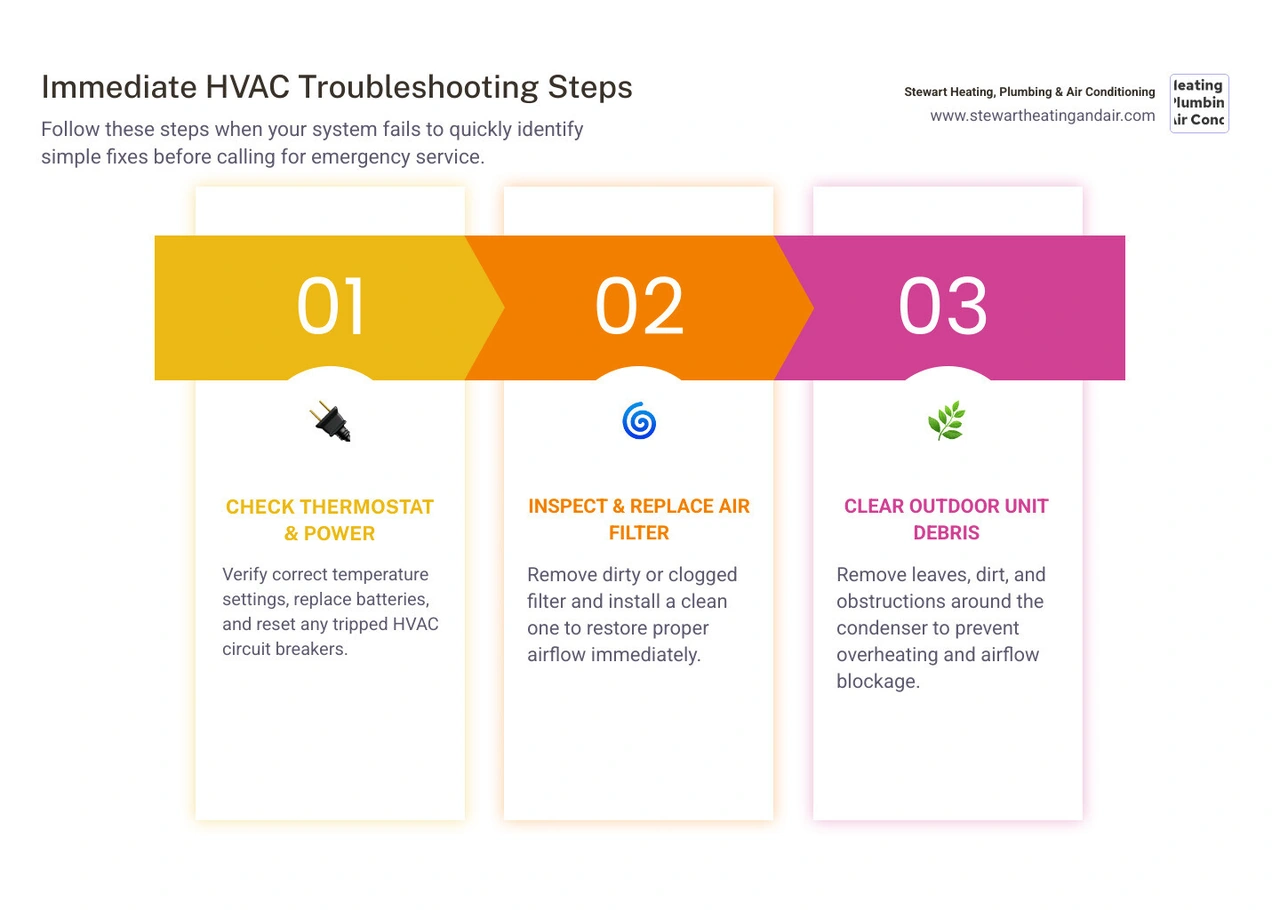
Before you pick up the phone to call for emergency service, it is highly beneficial to perform a few quick checks. Approximately 40% of the emergency service calls we receive actually stem from simple, easily resolvable issues that do not require a professional technician.

Here are the primary troubleshooting steps you should try first:
If you have completed these steps and your system still refuses to start, or if it is making alarming noises, it is time to call in the professionals.
Not every system malfunction requires a late-night or weekend emergency service call. However, there are several critical scenarios where waiting for normal business hours is simply not an option. A situation transitions from an inconvenience to a true emergency when it threatens your safety, your health, or the structural integrity of your property.
To help you decide whether to call immediately, read our detailed breakdown on When an HVAC Failure is a True Emergency. Generally, you are facing a true emergency if you experience any of the following:
When the summer sun beats down on Concord, Walnut Creek, or Brentwood, indoor temperatures in a home without air conditioning can quickly surpass 90°F. In these conditions, heat exhaustion and heat stroke are very real dangers.
If your cooling system fails during a major heatwave, turn off the system immediately to prevent further mechanical damage. While you wait for a technician to arrive, close all blinds and drapes to block out direct sunlight, stay well-hydrated, and gather your family in the coolest room of the house (usually on the ground floor).
For residents in Concord, you can find localized guidance in our Emergency AC Repair Concord CA Tips. If you reside in other central or eastern areas of the county, we provide dedicated, rapid-response services to restore your safety, which you can learn about through our service pages for Emergency AC Repair Walnut Creek CA and Emergency AC Repair Brentwood CA.
A winter heating failure in Pittsburg, Martinez, or Danville is more than just uncomfortable—it can be downright dangerous. When outdoor temperatures drop into the 30s, your home's indoor temperature will eventually follow, putting vulnerable residents at risk of hypothermia.
If your furnace or heat pump stops working during a cold snap, first check your thermostat and breakers as outlined above. If those are clear, shut the system down to prevent damage to the heat exchanger or fan motor. To stay warm while waiting for help, close off unused rooms to trap heat in a central living space, dress in layers, and avoid using outdoor gas camp stoves or ovens to heat your home, as these present extreme carbon monoxide hazards.
If you are in Pittsburg, consult our Emergency Furnace Repair Pittsburg CA guide. For families in nearby communities, we offer localized emergency heating support through our dedicated pages for Emergency Heating Repair Martinez CA and Emergency Heating Repair Danville CA.
When you call for emergency service, you shouldn't have to guess what happens next. A professional emergency response is structured to resolve your problem as quickly and safely as possible.
First, your call will be handled by a live dispatcher who will gather critical details about your system and the nature of the emergency. Once dispatched, a licensed, highly trained technician will arrive at your home in a fully equipped service vehicle. Because we understand how vital a fast resolution is, our trucks are stocked like mobile warehouses, carrying the most common replacement parts—such as capacitors, contactors, fan motors, and universal thermostats—allowing us to complete the vast majority of repairs on our very first visit.
Our deep familiarity with local neighborhoods, building designs, and regional climate patterns plays a massive role in how quickly we can diagnose and resolve your issues. You can read more about why this matters in our article on How Deep Local Knowledge Improves Service Quality.
To help you understand how emergency services differ from standard scheduled visits, we've broken down the key differences below:
| Feature | Standard Service Call | Emergency Service Call |
|---|---|---|
| Scheduling | Booked days or weeks in advance | Dispatched immediately, 24/7/365 |
| Response Time | Within a scheduled multi-hour window | Typically within 1 to 3 hours |
| Primary Goal | Routine maintenance, efficiency tuning, or non-urgent repairs | Rapid hazard mitigation and restoration of basic safety/comfort |
| Parts Availability | Standard truck stock or ordered from warehouse | Fully stocked mobile warehouse for immediate, single-visit repairs |
A true HVAC emergency is any situation that directly threatens the safety of your household or the structural integrity of your home. This includes gas leaks (indicated by a rotten-egg smell), carbon monoxide alerts, active and uncontainable water leaks from your HVAC equipment, a complete loss of heat when outdoor temperatures are freezing, or a complete loss of air conditioning during an extreme summer heatwave.
Response times can vary depending on weather conditions and current call volume, but a dedicated local emergency service typically arrives at your home within 1 to 3 hours of your call. Because we maintain local dispatch centers across the region, we are able to provide rapid, same-day emergency response to homes throughout our entire service area. You can view our full list of service areas on our Contra Costa County Locations page.
The absolute best way to prevent a middle-of-the-night HVAC emergency is to invest in regular preventative maintenance. Homeowners who have their heating and cooling systems professionally serviced every year are 50% less likely to experience a total system breakdown. Additionally, changing your air filters every 1 to 3 months and ensuring your system was properly sized for your home's square footage during installation are crucial steps. You can learn more about correct system sizing in our guide to Getting the Right Size HVAC for Contra Costa County Homes.
When your heating or cooling system fails unexpectedly, it can quickly turn your comfortable home into a stressful environment. By keeping this guide handy, trying basic troubleshooting steps first, and knowing how to identify a true safety hazard, you can protect your family and your property from the worst effects of a system breakdown.
At Stewart Heating, Plumbing & Air Conditioning, we have built our reputation on quality, integrity, and customer satisfaction since 1974. We are committed to doing every job right the first time, and our team is always ready to respond with fast, professional service when you need us most.
If you are experiencing a heating or cooling crisis, don't wait for a minor issue to become a major disaster. For reliable, expert assistance in Lafayette and the surrounding areas, visit our Lafayette HVAC Repair Services page or contact us directly to restore your home's comfort today.

Very professional and complete. I would recommend Stewart to anyone. Highest quality of workmanship and clean installation.
Stewart Heating Plumbing Air Conditioning just did some work for us for the first time. They did an installation at my home and it turned out well. I thought the price was fair and I definitely would use them again. The technicians were very friendly and knowledgeable about their work. I highly recommend Stewart Heating Plumbing Air Conditioning and already told friends to use them.
We have been using Stewart Heating Plumbing Air Conditioning since 1995. They put the original heating and air unit in the house, and we have just stayed with them. They are dependable and honest people, and they have done a good job for us every time that we have used them!
They came and did an inspection and are coming tomorrow to do the repair.
They replaced a regulator the first time, and then the water heater vent had to be replaced. They did great work.
The gentleman that serviced us was helpful, insightful, and knew what he was talking about. Overall, it was a great experience.