

Recent Blogs
Stay updated with our latest blog posts.

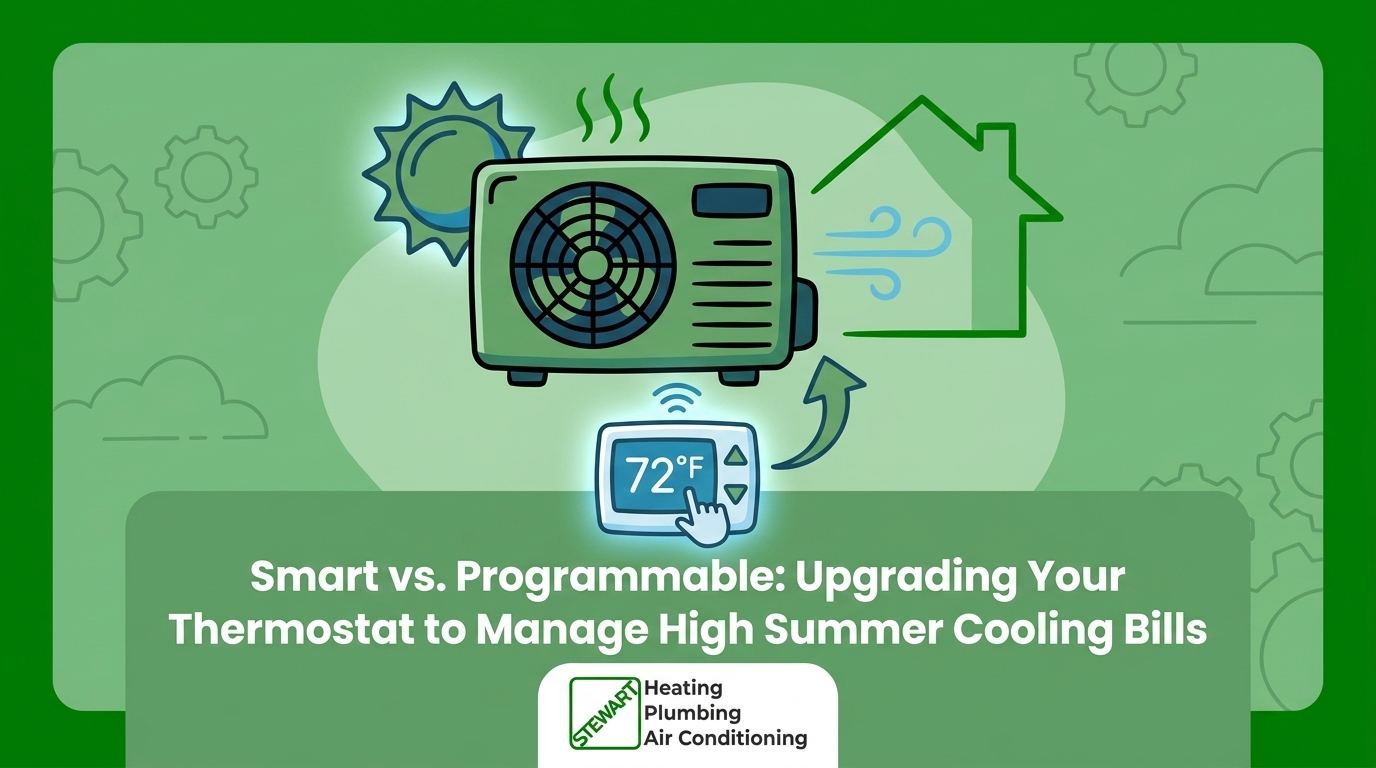
There is a persistent myth among homeowners that simply buying a basic programmable unit and setting a strict schedule is the ultimate fix for energy efficiency, but upgrading to a smart thermostat to manage high summer cooling bills is often the only way to truly optimize your system when daily routines become unpredictable. Many people believe that once they program their cooling schedule for the week, their energy consumption problems are solved. However, this "set and forget" mentality creates a hidden trap. The primary conflict arises because rigid schedules completely fail when your household routines shift unexpectedly.
If you are exploring home energy efficiency upgrades, understanding the difference between static programming and dynamic adaptation is the first crucial step. At Stewart Heating, Plumbing and Air Conditioning, our team finds that the core problem for many families is managing high cooling consumption during late-summer heatwaves, especially when schedules become chaotic.
A standard programmable thermostat operates on a very simple premise: it does exactly what you tell it to do, exactly when you tell it to do it. You might program it to raise the temperature to 78 degrees at 8:00 AM when everyone leaves the house, and drop it back to 72 degrees at 5:00 PM when everyone returns. On a perfectly predictable Tuesday, this works flawlessly.
But real life is rarely perfectly predictable. During the late-summer back-to-school transition, routines are completely upended. Kids might come home early due to half-days, sports practices get canceled due to extreme heat, or a parent might suddenly need to work from home. When these unexpected shifts happen, your rigid programmable thermostat has no idea that the house is suddenly occupied. It continues to follow its static time blocks, leaving your family sweltering in a hot house until someone manually overrides the system. This constant battle between rigid programming and real-world living leads to wasted cooling, higher utility consumption, and deep frustration. The modern alternative is smart technology that actually adapts to your living patterns as they happen.
To understand why a thermostat upgrade makes such a difference, we have to look at the specific failure points of traditional programmable models during erratic seasonal transitions. These older units rely entirely on strict, time-based rules. They cannot sense if the house is empty, they cannot detect if someone arrived home three hours early, and they certainly cannot anticipate a sudden spike in outdoor temperatures.
Because rigid schedules fail so frequently during chaotic weeks, our technicians see homeowners almost always resort to overriding their programmed settings. You walk into a hot house, feel uncomfortable, and immediately press the "hold" button to force the air conditioner to run. By placing the unit in a permanent hold mode, you are effectively turning a programmable thermostat back into a manual dial. This completely negates any energy efficiency benefits the device was supposed to provide.
This problem is magnified in the Pittsburgh CA / East Bay area, where our microclimate frequently delivers intense 100-degree heat waves in August and September. When the outdoor temperature is soaring past triple digits, a rigid, unresponsive cooling schedule becomes unbearable if your family comes home unexpectedly early.
Manual adjustments simply cannot keep up with the rapid temperature fluctuations of intense late-summer heat. When you leave a programmable thermostat on "hold" at a low temperature all day just in case someone comes home early, your cooling equipment runs constantly, working overtime to cool an empty house. Conversely, if you let the house heat up to 85 degrees and then demand that it cool down to 70 degrees at 4:00 PM during the hottest part of the day, you place massive strain on your air conditioning systems. Neither scenario is efficient, and our repair teams frequently see how both lead to excessive wear and tear on your major HVAC components.
The solution to the rigid scheduling problem is found in dynamic adaptation. Unlike older models that only know what time it is, smart thermostats know what is actually happening inside your home. They use a combination of advanced sensors, algorithmic learning, and location data to take control of your comfort automatically.
When you first install a smart thermostat, it spends the first few weeks studying your home's heating and cooling patterns. It learns how long it takes your specific air conditioner to cool your specific house. More importantly, it utilizes built-in occupancy sensors to detect when the house is empty and when it is active. If your schedule says you should be at work, but the sensors detect movement in the hallway, the thermostat knows someone is home and will adjust the temperature automatically to keep them comfortable.
One typical pattern our Stewart Heating technicians see involves the limitations of manual controls on older equipment. For example, during a recent service call to repair a malfunctioning circuit board on a heating and cooling unit located in an unusual, hard-to-reach spot, our technician quickly fixed the board and explained the underlying issue. Because the unit was so difficult to access manually, our team recommended upgrading to a new smart thermostat to automate the climate control, completely removing the daily hassle for the homeowner.
Perhaps the most powerful feature of modern smart thermostats is geofencing technology. This feature uses the location data from your smartphone to create a virtual boundary around your neighborhood. When your phone crosses that boundary as you leave for the day, the thermostat automatically enters an energy-saving mode. When you cross the boundary heading back home, it begins cooling the house before you ever walk through the front door.
These features work together to provide dynamic temperature setbacks based on occupancy, completely eliminating the need for manual "hold" overrides. Your home is always comfortable when you are there, and it never wastes energy cooling empty rooms when you are gone.
When deciding whether an upgrade makes sense for your home, it helps to see the differences laid out clearly. The contrast between these two technologies becomes especially obvious during the chaotic late-summer back-to-school transition, when schedules are at their most unpredictable.
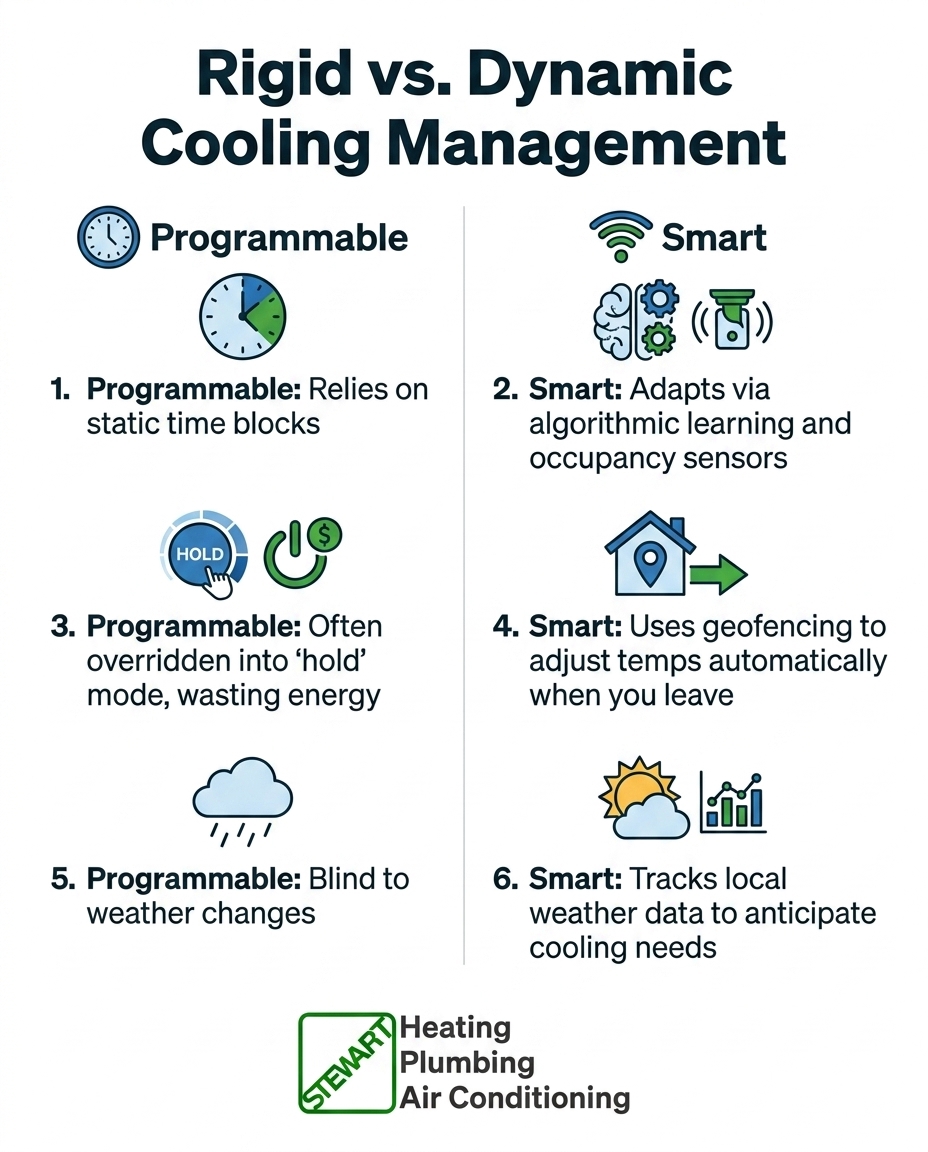
Below is a direct comparison of how rigid programmable models stack up against dynamic smart learning models across four key categories:
• Schedule Flexibility — Traditional Programmable Thermostat: Relies on static time blocks; fails when routines change unexpectedly. — Smart Learning Thermostat: Adapts to real-time lifestyle changes using algorithmic learning and occupancy sensors.
• Remote Accessibility — Traditional Programmable Thermostat: Limited to basic wall-panel controls; adjustments must be made in person. — Smart Learning Thermostat: Comprehensive smartphone app management allows control from anywhere in the world.
• Energy Tracking — Traditional Programmable Thermostat: Provides zero feedback; you only see the result when the utility bill arrives. — Smart Learning Thermostat: Delivers detailed energy usage reports that identify consumption trends and areas for improvement.
• Weather Responsiveness — Traditional Programmable Thermostat: Only senses indoor temperature; blind to incoming weather fronts. — Smart Learning Thermostat: Uses internet-connected weather tracking to anticipate heat waves and adjust cooling proactively.
Connecting the advanced features of smart thermostats directly to your home's energy efficiency is where the real value of an upgrade becomes clear. The goal isn't just to have a fancy gadget on your wall; the goal is the reduction of unnecessary energy use and improved home efficiency.
During a recent late-summer system review, a customer asked our technicians how to improve their overall system efficiency. Our team explained the underlying issues clearly and suggested several measures to improve system efficiency, including upgrading their outdated thermostat. The outcome was that the customer understood exactly what needed to be done to make the system more efficient moving forward.
Here is how smart technology directly impacts your cooling consumption:
1. Eliminating Empty-House Cooling: By utilizing dynamic temperature setbacks based on occupancy, a smart thermostat prevents the air conditioner from running at full blast while the house is completely empty. This single feature is a primary driver of reduced energy consumption.
2. Leveraging Detailed Energy Reports: Smart models send monthly reports directly to your phone, breaking down exactly how many hours your system ran. These detailed energy reports empower homeowners to make minor adjustments—like raising the baseline temperature by a single degree—that yield major efficiency improvements over a full season.
3. Optimizing Equipment Runtime: Smart thermostats learn the thermal profile of your house. They know exactly how long it takes to drop the temperature by three degrees, which allows them to optimize the runtime of your cooling equipment. This reduces short-cycling, prevents unnecessary wear and tear, and helps address concerns if you are wondering if it is normal for your air conditioner to run constantly on 100-degree days.
While exact savings will always vary based on the size of your home and the condition of your ductwork, stopping the cycle of cooling an empty house is the most effective way to manage consumption.
With smart thermostats readily available at local hardware stores, many homeowners are tempted to attempt a do-it-yourself installation. However, upgrading to a smart learning model is rarely as simple as swapping out a few batteries. Understanding the complexities of these devices reveals why professional assessment is critical for high-voltage and complex HVAC systems.
The most common hurdle in a thermostat upgrade is the requirement of a "C-wire" (common wire). Unlike basic programmable models that run for months on AA batteries, smart thermostats feature bright, full-color LED screens and maintain a constant Wi-Fi connection. This requires continuous 24-volt power from your HVAC system. Many older homes in the Pittsburgh CA / East Bay area simply do not have a C-wire run to the thermostat location. Trying to bypass this requirement or install aftermarket adapters without professional electrical knowledge is highly risky.
Modern HVAC equipment relies on sensitive electronic control boards. We strongly warn against the risks of DIY electrical work and improper wiring, as our Stewart Heating repair teams frequently see how crossing the wrong wires during a DIY thermostat installation can instantly short out the main control board in a furnace or air handler. What started as a simple weekend project can quickly turn into a major repair bill.
As a trusted local partner serving the East Bay community since 1974, Stewart Heating brings deep local knowledge to every installation. A professional assessment ensures complete compatibility between the new smart thermostat and your existing cooling equipment. Having your system properly wired, calibrated, and tested by an expert provides peace of mind that your new investment will operate safely and efficiently from day one.
A smart thermostat is an incredible tool for managing your comfort, but it is important to remember that it operates best when the underlying HVAC equipment is well-maintained. The smartest computer in the world cannot force cold air through a clogged filter or a failing compressor.
First and foremost, a smart thermostat cannot fix a failing or heavily restricted air conditioning unit. If your system is low on refrigerant or suffering from a dying blower motor, the thermostat will continue to call for cooling, but the house will never reach the target temperature. This will cause your energy consumption to skyrocket regardless of how advanced the wall control is.
Regular filter changes are absolutely essential. Clean filters allow the thermostat to accurately measure and manage airflow throughout the house. When filters are clogged, the system suffocates, and the temperature readings become inaccurate. Furthermore, routine tune-ups ensure the mechanical system responds efficiently to the smart thermostat's digital commands. Combining advanced smart technology with consistent, professional upkeep through an HVAC maintenance plan is the ultimate strategy for managing cooling consumption in the Pittsburgh CA / East Bay area.
Adapting to erratic schedules requires smarter technology, not just stricter programming. When your daily routine shifts unexpectedly, a traditional programmable unit will leave you either cooling an empty house or returning to a sweltering living room. By utilizing dynamic temperature setbacks based on occupancy, a smart thermostat takes the guesswork out of your daily comfort, learning your habits and adjusting automatically.
If you are tired of battling rigid schedules and high utility bills, professional guidance is the best way to ensure you select and install the right model for your specific HVAC system. We encourage you to schedule an assessment with our team to explore your efficiency options. A clear, practical upgrade to a smart learning thermostat will adapt to your erratic late-summer schedules far better than your old programmable model, validating your decision to take control of your home's comfort.
The main difference is how they handle scheduling. Programmable thermostats rely on rigid, static time blocks that you input manually, and they execute those commands regardless of whether anyone is home. Smart thermostats use algorithmic learning, sensors, and location data to understand your actual habits and adjust the temperature dynamically based on real-time occupancy.
Yes, they are specifically designed to handle unpredictable routines. Because they feature occupancy sensors and geofencing capabilities, they can detect when you leave early or arrive home unexpectedly. This allows them to adjust the climate control automatically without requiring you to constantly punch in manual overrides or hit the "hold" button.
Geofencing ties your home's climate control to the location tracking on your smartphone. When you travel a certain distance away from your house, the system automatically enters an energy-saving setback mode so you aren't cooling an empty space. As soon as you cross back over that virtual boundary on your way home, it begins cooling the house so it is perfectly comfortable when you arrive.
They are highly effective at reducing unnecessary energy waste. By preventing your air conditioner from running constantly when the house is empty, and by providing detailed energy reports that help you track your usage trends, they optimize your system's runtime. The elimination of empty-house cooling is one of the most reliable ways to manage your overall consumption.
While a smart thermostat can optimize runtime and prevent unnecessary cooling when you aren't home, it cannot fix underlying mechanical issues. If your AC is running constantly because it is undersized, low on refrigerant, or struggling with extreme 100-degree heat, the thermostat will help manage the schedule, but you will still need a professional assessment to ensure the equipment itself is functioning properly.

Very professional and complete. I would recommend Stewart to anyone. Highest quality of workmanship and clean installation.
Stewart Heating Plumbing Air Conditioning just did some work for us for the first time. They did an installation at my home and it turned out well. I thought the price was fair and I definitely would use them again. The technicians were very friendly and knowledgeable about their work. I highly recommend Stewart Heating Plumbing Air Conditioning and already told friends to use them.
We have been using Stewart Heating Plumbing Air Conditioning since 1995. They put the original heating and air unit in the house, and we have just stayed with them. They are dependable and honest people, and they have done a good job for us every time that we have used them!
They came and did an inspection and are coming tomorrow to do the repair.
They replaced a regulator the first time, and then the water heater vent had to be replaced. They did great work.
The gentleman that serviced us was helpful, insightful, and knew what he was talking about. Overall, it was a great experience.