

Recent Blogs
Stay updated with our latest blog posts.

You step into the shower expecting endless hot water, but instead, you get a sudden blast of cold. Figuring out exactly how to tell if your tankless water heater just needs a descaling flush or if you are facing a major mechanical failure is a stressful position for any homeowner. The frustration of dealing with fluctuating water temperature and reduced flow rate usually leads to one immediate fear: the entire heating system is broken and will cost a fortune to replace.
If you are dealing with sudden hot water drop-offs, our team at Stewart Heating, Plumbing and Air Conditioning provides comprehensive water heater services to accurately diagnose the problem.
Fortunately, in our experience, many symptoms that mimic a catastrophic breakdown are actually just signs of mineral scale buildup restricting the system. Tankless units operate by passing water through very narrow, highly efficient heat exchangers. When those narrow pathways become coated in hard water minerals, the unit struggles to transfer heat, triggering safety sensors and causing erratic performance. Knowing the difference between a simple maintenance need and a broken component saves you from unnecessary stress and expensive, unneeded repairs.
To understand why tankless water heaters require regular flushing, you have to look at the chemistry of your local water supply. Hard water contains high levels of dissolved minerals, primarily calcium and magnesium. When hard water is rapidly heated inside a tankless unit, the solubility of these minerals changes. The heat causes the calcium carbonate to crystallize and precipitate out of the water, clinging tightly to the metal walls of the heat exchanger.
In our decades of servicing the Pittsburgh CA area, we've seen firsthand how our local water supply—often classified as moderately hard to hard—directly impacts how your plumbing appliances operate. Because the water in Contra Costa County and the East Bay area carries this heavy mineral load, our team typically sees mineral scale accumulate on heat exchangers much faster than standard manufacturer baseline estimates.
This chalky white buildup acts as a layer of insulation between the heating element and your water. The thicker the scale gets, the harder the unit has to work to push heat through that barrier. Because of this accelerated local buildup, scheduling an annual or bi-annual descaling flush is a regional necessity, not an optional luxury. Ignoring this maintenance allows the scale to harden, eventually restricting water flow so severely that the unit cannot function.
When our technicians are called out to local homes, we always advise that recognizing the early warning signs of mineral accumulation can help you schedule maintenance before the system shuts down completely. Because scale affects both the temperature and the physical flow of water, it produces a very specific set of symptoms.
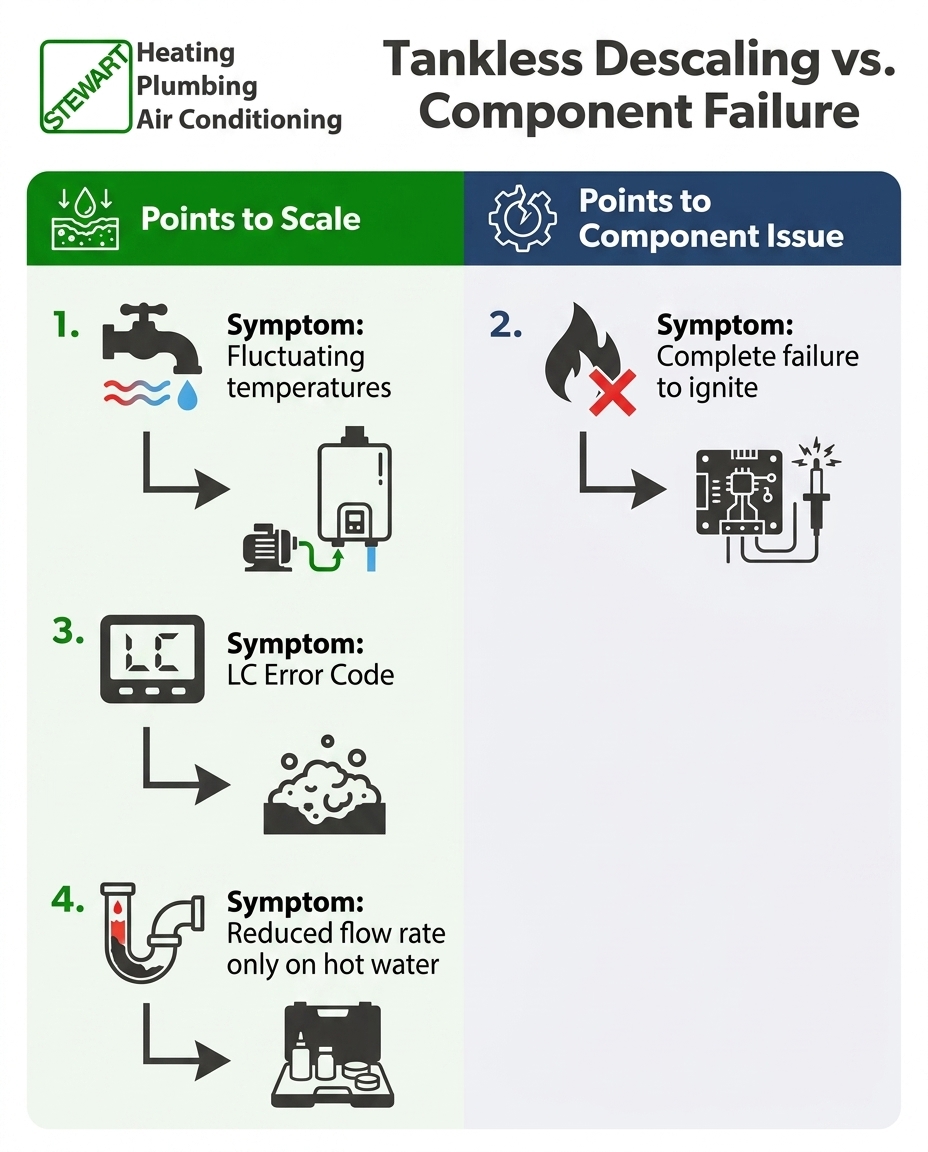
• Reduced flow rate: As scale narrows the internal water pathways, the unit physically restricts the amount of water that can pass through. You will notice a significant drop in water pressure when running hot water, while your cold water pressure remains completely normal.
• The "cold water sandwich": This happens when you experience a blast of hot water, followed by a sudden drop to cold, and then a return to hot. If you are wondering why your tankless water heater randomly runs cold, it is a pattern we see often: scale buildup is forcing the burner to shut off temporarily to prevent overheating.
• Strange rumbling or popping noises: A healthy tankless unit operates with a smooth humming sound. If you hear loud popping, knocking, or rumbling, it usually indicates that water is getting trapped behind layers of scale and boiling directly against the heat exchanger.
• Extended ignition times: If the unit takes noticeably longer to fire up when you turn on a faucet, scale may be insulating the flow sensor, making it harder for the system to detect that water is moving.
Most modern tankless water heaters are equipped with advanced onboard diagnostics. When scale reaches a critical level, the system's computer will trigger a specific error code on the digital display panel to protect the unit from overheating. Common scale-related codes include "LC" (Limescale Clearance) or "00" depending on the manufacturer. Always check your unit's digital display before assuming a part has broken; that blinking code is often just the system asking for a routine descaling flush.
Homeowners often panic when their hot water stops, assuming the worst. However, our team constantly reassures customers that there is a distinct difference between the gradual performance decline caused by scale buildup and the sudden, complete failure of a broken internal component.
When a heat exchanger cracks or a flow sensor shorts out completely, the unit will typically refuse to fire up at all. You will turn on the hot water tap, and the system will remain silent and cold. In contrast, mineral scale usually allows the unit to run, but it runs poorly—struggling to maintain temperature, dropping water pressure, or short-cycling the burner.
If you suspect your unit is struggling, we highly recommend scheduling professional plumbing solutions rather than attempting a fix yourself. We strongly warn against DIY chemical flushes. Opening the unit, isolating the correct valves, and circulating specialized descaling chemicals requires professional expertise. Using the wrong acid concentration or flushing the system incorrectly can permanently damage delicate internal flow sensors and seals, turning a simple maintenance task into a costly repair.
• Ignition Behavior — Mineral Scale Buildup (Needs Flush): Takes longer to fire, but eventually ignites. — Component Failure (Needs Repair): Fails to ignite completely; remains silent.
• Water Temperature — Mineral Scale Buildup (Needs Flush): Fluctuates constantly (cold water sandwich). — Component Failure (Needs Repair): Remains completely cold with no heat transfer.
• Error Codes Displayed — Mineral Scale Buildup (Needs Flush): LC, 00, or specific limescale warning codes. — Component Failure (Needs Repair): Ignition failure, exhaust blockage, or sensor fault codes.
• Flow Rate Changes — Mineral Scale Buildup (Needs Flush): Gradual decrease in hot water pressure over months. — Component Failure (Needs Repair): Sudden, immediate drop or complete stoppage of water.
A tankless unit with a moderate amount of scale might perform perfectly fine when only one bathroom faucet is running. Because the water demand is low, the restricted heat exchanger still has enough time and capacity to heat the water to your target temperature. However, household routines change, and those changes often expose underlying flow-rate issues.
During the late summer and back-to-school transition, morning routines become much more hectic. Multiple family members might be taking showers at the same time, while the dishwasher or washing machine is also running. This simultaneous hot water demand forces the restricted unit to work at maximum capacity. Because the internal pathways are narrowed by calcium buildup, the unit cannot push enough water through quickly enough to satisfy the demand, which triggers safety shut-offs and leaves someone taking a cold shower.
Proactive maintenance is the best way to prevent these high-demand interruptions. During a recent late-summer maintenance call right here in Pittsburgh, a homeowner asked our technician to look at a few items needing attention for system efficiency. After a thorough review, our technician provided excellent advice on necessary maintenance—specifically, scheduling a dedicated descaling flush—which resolved the flow restrictions and left the customer completely satisfied. Getting your system flushed before your household enters its busiest season ensures your hot water keeps up with your daily routine.
When your plumbing appliances act up, you need the peace of mind that comes from having a highly trained technician accurately explain the problem. Misdiagnosing a tankless water heater is surprisingly common; an inexperienced contractor might see an overheating error code and immediately recommend replacing the entire heat exchanger. An honest professional will properly test the system and recommend a simple descaling flush if that is truly all the unit needs.
One local homeowner, who has relied on our company for 33 years, recently reached out regarding system issues that needed to be addressed. The responding technician took the time to explain the exact problem and the required fix, and then helped the customer set up a regular maintenance contract. The customer felt entirely confident knowing exactly what was happening inside their unit and how to prevent it going forward.
As a family-owned business serving the community since 1974, our team at Stewart Heating, Plumbing and Air Conditioning maintains a 75% referral rate by prioritizing honest diagnostics. We've spent decades learning the specific quirks of local plumbing systems, and we believe in recommending a simple flush over an expensive repair whenever possible. Setting up a routine maintenance plan ensures your system gets the professional care it needs on a consistent schedule. Proper, regular descaling significantly extends the lifespan of your tankless unit, protecting your investment for years to come.
You will typically notice flow rate drops, fluctuating water temperatures, and specific error codes on the display panel. If your hot water pressure feels noticeably weaker than your cold water pressure, scale has likely narrowed the internal pipes. Additionally, if the unit takes longer than usual to ignite or makes rumbling noises, it is time to schedule a professional flush.
Scale buildup will force the unit to overwork, leading to severe overheating and frequent safety shut-offs. As the calcium layer thickens, the heat exchanger has to burn hotter to transfer heat through the scale and into the water. Over time, this excessive heat stress causes the metal heat exchanger to warp, crack, and fail prematurely, requiring a highly expensive replacement.
A scale buildup error code indicates that internal sensors have detected restricted water flow or abnormal temperatures caused by mineral deposits blocking the heat transfer. The system's computer monitors how fast water moves and how hot the exhaust gases get. When scale disrupts these metrics, the computer flashes the code (often LC or 00) and shuts down the burner to prevent the unit from melting its own internal components.
Yes, hard water minerals like calcium carbonate adhere directly to the internal heating elements, creating a physical blockage over time. Every time the unit heats hard water, a small amount of calcium crystallizes and sticks to the metal. Over months and years, these microscopic layers build up into a thick, chalky crust that can completely clog the narrow water pathways inside the heat exchanger.
Mineral buildup narrows the internal water pathways, physically restricting the amount of water that can pass through the unit. Because a tankless system requires a specific flow rate to safely activate the burners, the internal flow control valve will further restrict the water if it senses the unit cannot heat it fast enough. This combination results in a drastic drop in hot water pressure at your faucets.
It is highly recommended to hire a licensed professional to perform a descaling flush. The process involves isolating the unit from your main plumbing, connecting a submersible pump, and circulating specialized acidic solutions through the heat exchanger for nearly an hour. Handling delicate internal sensors and using the correct concentration of descaling fluid requires professional expertise to avoid permanently damaging the unit.
Fluctuating temperatures, unexpected pressure drops, and blinking error codes are incredibly frustrating, but they are often just your system's way of asking for routine maintenance. Before you assume your tankless unit needs a major repair or a complete replacement, get a professional diagnostic to confirm if a thorough descaling flush will solve the issue.
If your system is struggling to keep up with your household's demand, do not wait for it to shut down completely. Reach out to our experienced technicians to request plumbing service and let us provide an honest assessment to restore your hot water flow today.

Very professional and complete. I would recommend Stewart to anyone. Highest quality of workmanship and clean installation.
Stewart Heating Plumbing Air Conditioning just did some work for us for the first time. They did an installation at my home and it turned out well. I thought the price was fair and I definitely would use them again. The technicians were very friendly and knowledgeable about their work. I highly recommend Stewart Heating Plumbing Air Conditioning and already told friends to use them.
We have been using Stewart Heating Plumbing Air Conditioning since 1995. They put the original heating and air unit in the house, and we have just stayed with them. They are dependable and honest people, and they have done a good job for us every time that we have used them!
They came and did an inspection and are coming tomorrow to do the repair.
They replaced a regulator the first time, and then the water heater vent had to be replaced. They did great work.
The gentleman that serviced us was helpful, insightful, and knew what he was talking about. Overall, it was a great experience.