

Recent Blogs
Stay updated with our latest blog posts.

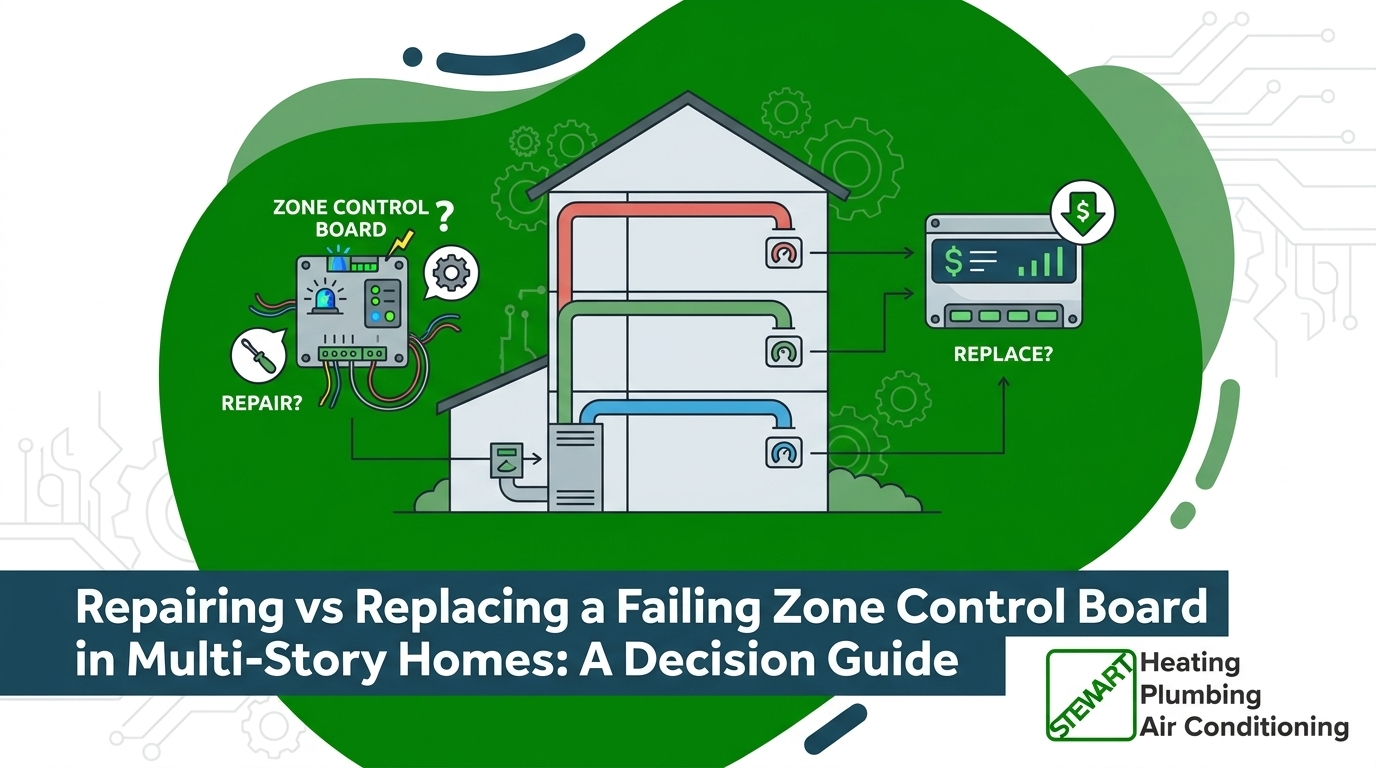
Are you currently dealing with a stifling hot second floor while the ground floor feels like an icebox? Navigating the decision of repairing vs replacing a failing zone control board in multi-story homes forces many homeowners to face a frustrating crossroad. At Stewart Heating, Plumbing and Air Conditioning, a pattern we see often during the peak-heat summer months is this exact dynamic: a sweltering upstairs and a freezing downstairs. It is the hallmark symptom of a zone control board failure. When the central "brain" of your zoning system stops communicating with the motorized dampers in your ductwork, your air conditioner loses the ability to direct cold air where it is needed most. Instead of balanced comfort, you are left with extreme temperature disparities that make the upper levels of your house uninhabitable.
Facing this breakdown during peak mid-summer temperatures is incredibly stressful. When the outdoor heat is relentless, a functional air conditioning system is not a luxury; it is a necessity for your family's comfort, indoor air quality, and safety. As you look at the malfunctioning system, you are immediately confronted with a major financial decision: do you pay for a proprietary replacement board, or is it time to invest those funds into a full system upgrade? To accurately diagnose the root cause and map out your next steps, securing professional HVAC services from our experienced team is the essential first step.
Many homeowners assume that a hot upstairs automatically means the entire air conditioning unit is broken. However, in a zoned setup, the main compressor and blower might be working perfectly fine. The issue lies entirely in the distribution. If the zone control board fails to open the upstairs dampers, all the cold air gets dumped into the downstairs living areas, dropping the temperature to uncomfortable lows while the bedrooms bake. Understanding exactly what is happening inside your ductwork is the key to making an informed, cost-effective decision about your home's cooling infrastructure.
To understand why zone control boards fail, you first have to understand the physics of cooling a multi-story house. The primary challenge is the stack effect. Heat naturally rises, which means the heaviest thermal loads are always trapped on the upper floors. Compounding this issue, the roof absorbs massive amounts of radiant solar heat, radiating it down into the second-story bedrooms. In areas experiencing intense mid-summer heat, like Pittsburgh CA and the surrounding East Bay, the stack effect is severely exacerbated. In our decades of keeping local homes comfortable, we consistently see that what might be a minor temperature difference in the spring turns into an urgent, sweltering comfort crisis by July.
Your zone control board is the critical component fighting against this natural physics. It acts as the command center, reading temperatures from multiple thermostats and directing motorized dampers inside the ductwork to open or close. By physically blocking off airflow to the naturally cooler downstairs, the board forces the system to push cold air up to the second floor, overcoming the rising heat.
This constant battle against the stack effect puts immense strain on the zoning equipment. During a severe heatwave, your air conditioner might run for hours at a time under heavy load. This prolonged operation directly impacts the aging components on the zone board.
• Electrical relay degradation: The tiny electrical relays on the board click open and closed thousands of times a season. Continuous operation during peak heat degrades these relays, eventually causing them to fuse or fail entirely.
• Static pressure imbalances: When dampers close to force air upstairs, the static pressure inside the ductwork spikes. This increased pressure can cause aging damper motors to stick, overworking the system and sending fault codes back to the control board.
• Thermal stress: Control boards located in hot attics or poorly ventilated garages are subjected to extreme ambient temperatures, which can accelerate the degradation of the printed circuit board components.
When the board finally succumbs to this stress, the entire cooling strategy is compromised. The system defaults to the path of least resistance—usually the downstairs—making upstairs comfort impossible until the board is addressed.
A hot upstairs certainly points to a zoning issue, but it does not automatically mean your proprietary zone control board is dead. Our expert technicians know that jumping straight to a board replacement without a thorough diagnostic is a mistake. Many times, the symptoms of a dead board are actually caused by much simpler faults.
For example, during a recent hot holiday weekend, our team responded to a local homeowner who experienced a system that was suddenly blowing warm air instead of cold. While it seemed like a catastrophic board or compressor failure, our thorough diagnostic revealed nothing more than a loose wire in the control circuitry. The technician secured the connection, and the system was fully restored without the need for proprietary parts.
Before condemning the zone board, a professional diagnostic process will systematically rule out other culprits. Technicians will test the communication lines to ensure the thermostats are actually sending the correct voltage signals to the board. They will also manually test the individual motorized damper actuators; if a damper motor has burnt out and is stuck closed, the board might be functioning perfectly, but the air still cannot reach the upstairs.
Additionally, verifying the transformer voltage is a critical step. If the transformer supplying power to the board has failed or tripped a low-voltage fuse, the board will appear dead even though it is perfectly fine. Keeping up with routine HVAC maintenance often catches these minor wiring faults, sticking dampers, or static pressure issues long before they mimic a catastrophic board failure, saving you from prematurely replacing parts.
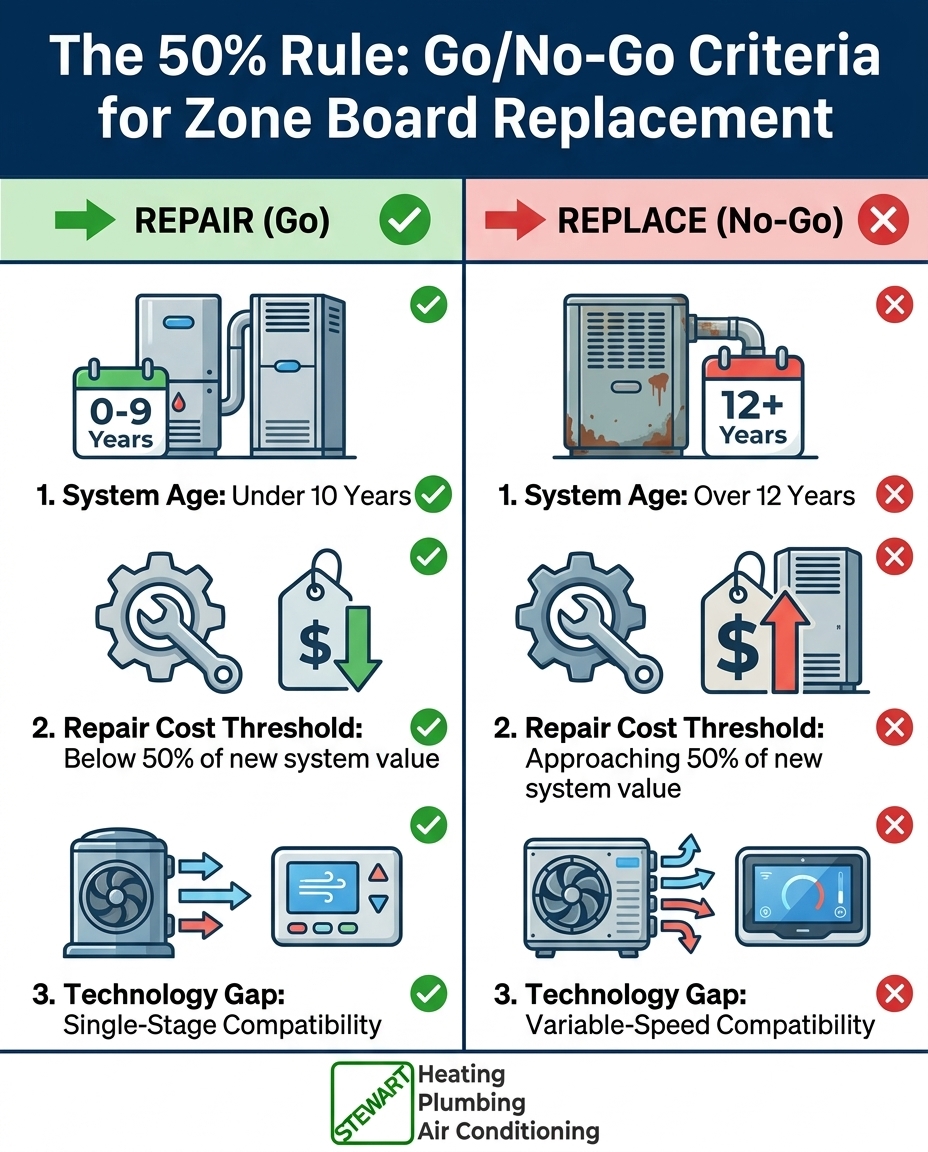
If the diagnostic confirms that the zone control board has indeed failed, you are faced with a significant financial decision. Proprietary zone boards are not standard, off-the-shelf components. They are highly specialized computers designed to communicate with specific equipment. To evaluate whether this repair makes financial sense, our professionals rely on a percentage-based framework known as the 50% Rule.
The 50% Rule states that if the total cost of the repair exceeds half the value of a comparable new system, replacement is the smarter financial move. When dealing with proprietary zone boards on older systems, the repair quote often pushes dangerously close to this threshold. According to Department of Energy guidelines, central HVAC systems typically last 10 to 15 years. If your system is already 12 years old, sinking a large amount of money into a new board yields severely diminishing returns.
Beyond the immediate price of the part, there are hidden costs and risks associated with repairing an aging zoned system.
1. Supply chain delays: Sourcing obsolete boards for older, discontinued systems can lead to extended shipping delays. In the middle of a mid-summer heatwave, waiting weeks for a part is often not a viable option for your family.
2. The sunk-cost fallacy: Throwing good money after bad is a common trap. Replacing the control board does not reset the clock on your aging compressor, evaporator coil, or blower motor. You could replace the board today, only to have the compressor fail next month.
3. Lack of warranty coverage: While the new board might carry a brief part warranty, the rest of the aging system remains unprotected, leaving you vulnerable to further out-of-pocket expenses.
One of the most critical factors in the repair versus replace debate is technological compatibility. The HVAC industry has evolved rapidly over the last decade, and the way modern systems handle zoning is fundamentally different from older setups. Older systems are typically single-stage, meaning the compressor and blower run at 100% capacity whenever they turn on. If a retrofitted zone board closes off half the house, that 100% volume of air is forced into a much smaller space, creating massive static pressure issues and loud, rushing airflow.
To combat this, older systems often use a bypass damper to dump excess cold air back into the return duct. This is highly inefficient and puts unnecessary wear on the equipment. Modern variable-speed systems, on the other hand, natively support zoning. They can ramp their compressor and blower speeds up or down in tiny increments to perfectly match the exact demand of whatever zones are open.
• Airflow Control — Older Retrofitted Zoned Systems (Single-Stage): Blasts air at 100% capacity, causing pressure spikes when dampers close. — Modern Upgrades (Variable-Speed): Automatically adjusts blower speed to match the exact number of open zones.
• Efficiency & Bypass — Older Retrofitted Zoned Systems (Single-Stage): Relies on wasteful bypass dampers that dump conditioned air back into the return. — Modern Upgrades (Variable-Speed): Eliminates the need for bypass dampers, drastically reducing energy waste.
• Multi-Story Comfort — Older Retrofitted Zoned Systems (Single-Stage): Often struggles to push adequate air upstairs without overcooling the downstairs. — Modern Upgrades (Variable-Speed): Provides continuous, gentle airflow that easily overcomes the stack effect.
• Future Compatibility — Older Retrofitted Zoned Systems (Single-Stage): Proprietary boards may not communicate with newer equipment if the AC fails later. — Modern Upgrades (Variable-Speed): Native communicating thermostats and boards are perfectly synced with the equipment.
The risk of repairing an old system is that you might spend a significant amount of money replacing a proprietary board now, only to find out it cannot integrate with a modern variable-speed AC unit when your main system inevitably fails a year or two down the road.
Making the right choice for your home requires stepping back from the immediate frustration of a hot upstairs and looking at the objective technical data. As a trusted, family-owned business serving the Pittsburgh CA community since 1974 with a 75% referral rate, our team believes in providing honest, objective advice rather than aggressive sales tactics. We recommend using a clear framework to determine your next steps.
Use this objective go/no-go criteria checklist to confidently decide whether to approve a repair quote or begin exploring air conditioning replacement and repair options tailored to your home's specific heat load.
• Proceed with the Repair if:
— Your central HVAC system is under 10 years old and has been well-maintained.
— The zone control board or the system is still covered under a manufacturer's warranty.
— The total cost of the diagnostic and board replacement is well below the 50% threshold of a new system.
— Your current system uses modern, environmentally compliant refrigerant (R-410A).
• Pivot to System Replacement if:
— The HVAC system is over 12 years old and nearing the end of its Department of Energy expected lifespan.
— The system still relies on obsolete, phased-out R-22 Freon, making any future refrigerant leaks incredibly expensive to fix.
— The cost of the proprietary board replacement approaches or exceeds the 50% mark.
— You have a history of frequent breakdowns, sticking dampers, or loud airflow issues indicating the old single-stage setup is poorly matched to your ductwork.
If your system meets the criteria for replacement, we advise shifting your perspective from dealing with an emergency repair to making a long-term investment in your home's infrastructure. A modern, correctly zoned variable-speed system permanently resolves the "hot upstairs" problem. By continuously adjusting its output, a new system provides a steady, gentle flow of conditioned air that effortlessly overcomes the stack effect, keeping your second-story bedrooms perfectly comfortable even on the hottest mid-summer afternoons.
Beyond immediate comfort, the energy efficiency gains are substantial. An aging single-stage unit struggling with a failing control board and wasteful bypass dampers consumes a massive amount of electricity. A new variable-speed system uses only the precise amount of energy required to cool the active zones, which can significantly lower your monthly utility bills. Furthermore, understanding how a new HVAC system increases home value makes the upfront investment highly beneficial in the long run. Prospective buyers place a high premium on homes with modern, reliable, and highly efficient climate control systems.
Most importantly, upgrading your system provides unparalleled peace of mind. You will no longer have to worry about an aging zone board failing right before a major heatwave, allowing you to enjoy your summer without the looming threat of a sudden breakdown.
A failing zone control board does not have to ruin your summer. By utilizing a clear, objective go/no-go criteria list, you are empowered to confidently decide between approving a repair quote or starting fresh with a full system replacement. Whether your system just needs a simple wire reconnected or it is time to upgrade to a high-efficiency variable-speed unit, taking action now is critical.
Do not wait for the next major heatwave to hit Pittsburgh CA before addressing your sweltering second floor. The longer your system struggles with a compromised zoning board, the more stress it places on the remaining components. Schedule an expert, no-pressure inspection with our team today to evaluate your zone control board and overall system health, and take the first step toward restoring reliable, balanced multi-story cooling for your home.
Is it worth replacing a zone board on an old HVAC system?
The short answer is that it depends heavily on the age of your equipment and the cost of the part. If your system is over 12 years old and the replacement board quote approaches 50% of the cost of a new unit, we generally do not recommend the investment. Sinking money into an aging system does not prevent the older compressor or blower motor from failing shortly after.
Why is my upstairs hot and downstairs cold with zoned HVAC?
This usually means your zone control board has failed, or a motorized damper inside the ductwork is stuck closed. Because heat naturally rises to the second floor, the system must actively force cold air upstairs to balance the temperature. When the zoning equipment malfunctions, the cold air defaults to the downstairs, leaving the upper levels sweltering.
How long do HVAC zone control boards last?
Most zone control boards are designed to last 10 to 15 years, which aligns with the expected lifespan of the central air conditioning equipment. However, boards located in extremely hot attics or subjected to frequent electrical surges may degrade faster. Routine maintenance can help ensure the electrical connections remain secure over the board's lifespan.
Can a bad zone board cause the AC to stop working entirely?
Yes, a completely failed zone board can prevent the air conditioner from turning on at all. If the board cannot process the voltage signals from your thermostats, it will not send the command to the outdoor compressor or the indoor blower motor to initiate a cooling cycle. In some cases, a blown low-voltage fuse on the board will shut down the entire system to protect it from electrical damage.
Are modern variable-speed systems better for multi-story homes than older zoned systems?
Modern variable-speed systems offer vastly superior multi-story temperature control compared to older single-stage units. Because they can adjust their airflow and cooling capacity in tiny increments, they perfectly match the demands of individual zones without causing massive pressure spikes in the ductwork. This eliminates the need for wasteful bypass dampers and ensures quiet, even cooling across all floors.

Very professional and complete. I would recommend Stewart to anyone. Highest quality of workmanship and clean installation.
Stewart Heating Plumbing Air Conditioning just did some work for us for the first time. They did an installation at my home and it turned out well. I thought the price was fair and I definitely would use them again. The technicians were very friendly and knowledgeable about their work. I highly recommend Stewart Heating Plumbing Air Conditioning and already told friends to use them.
We have been using Stewart Heating Plumbing Air Conditioning since 1995. They put the original heating and air unit in the house, and we have just stayed with them. They are dependable and honest people, and they have done a good job for us every time that we have used them!
They came and did an inspection and are coming tomorrow to do the repair.
They replaced a regulator the first time, and then the water heater vent had to be replaced. They did great work.
The gentleman that serviced us was helpful, insightful, and knew what he was talking about. Overall, it was a great experience.