

Recent Blogs
Stay updated with our latest blog posts.

Your thermostat is set to heat, but the vents are blowing cold air and the house still feels freezing. At Stewart Heating, Plumbing and Air Conditioning, our team frequently fields calls from Pittsburgh and East Bay homeowners wondering how to safely relight a Concord furnace pilot light that keeps going out. You are certainly not alone. The rapid shift from warm autumn days to sudden, chilly nights makes unexpected heating failures highly noticeable and deeply frustrating. When the sun goes down and the temperature drops, a furnace that refuses to ignite becomes an immediate comfort crisis.
For immediate assistance with restoring your home's warmth, explore our heating services to ensure your system operates safely and efficiently.
Often, this frustrating scenario happens during a September pre-heating season startup. You go to turn on the system for the first time in months, only to discover that the pilot flame simply will not hold. A pattern we see often in our daily service calls is homeowners struggling to distinguish between a simple draft or dust issue that can be easily resolved, and a genuine mechanical failure that requires expert intervention. Fortunately, most pilot light issues have clear, identifiable causes. By understanding how your system operates, you can make an informed, safe decision about whether to attempt a relight or call our professionals for support.
To understand why your flame keeps extinguishing, you first need to understand the mechanical relationship between the pilot light, the thermocouple, and the gas valve inside your Concord furnace. In our decades of servicing these units, we always emphasize that these components work together in a tightly coordinated system designed primarily to keep your home safe from uncombusted gas.
The thermocouple is a critical safety sensor positioned directly in the path of the pilot flame. When the pilot is lit, the heat from the flame warms the tip of the thermocouple. This heat generates a tiny, continuous electrical current—typically between 25 to 30 millivolts of electricity. While this sounds incredibly small, it is exactly enough power to send a signal to the main gas valve, telling it to stay open because a flame is present to safely burn the fuel.
If the pilot light goes out due to a strong draft, dirt buildup, or a failing sensor, the thermocouple rapidly cools down. The moment it cools, the millivolt electrical signal drops to zero. Without that signal, the gas valve automatically snaps shut, safely cutting off the gas supply to the furnace. This prevents raw, unburned gas from leaking into your home.
This ingenious piece of engineering acts as the first line of defense in combustion safety. In older standing-pilot models, this system operates entirely independently of the main electrical control board, meaning it will safely shut down the gas even during a power outage.
• Prevents gas accumulation: By shutting off the valve the moment the flame disappears, it stops hazardous gas from pooling in your basement or utility closet.
• Operates mechanically: Because it relies on heat-generated voltage, it doesn't require complex computer boards to trigger a safety shutdown.
• Fails safely: When a thermocouple degrades over time, it defaults to the "closed" position, meaning a broken sensor results in no gas flow, rather than uncontrolled gas flow.
Understanding these mechanics helps clarify why your system behaves the way it does. Just as knowing how a failing pressure switch mimics other heating issues can save you hours of troubleshooting, recognizing the signs of a thermocouple safety shutdown prevents you from endlessly trying to light a system that is intentionally locking you out for your own protection.
• Flame is strong and steady — Thermocouple Action: Generates 25-30 millivolts — Gas Valve Response: Remains open — Resulting Safety Condition: Normal, safe heating operation
• Flame blows out from draft — Thermocouple Action: Cools down, voltage drops to zero — Gas Valve Response: Snaps shut immediately — Resulting Safety Condition: Safe shutdown; requires manual relight
• Thermocouple probe is degraded — Thermocouple Action: Cannot generate sufficient voltage — Gas Valve Response: Refuses to stay open — Resulting Safety Condition: System lockout; requires professional repair
Before you even touch the gas valve on your furnace, it is vital to establish strict safety boundaries. Working with natural gas appliances carries inherent risks, and taking shortcuts is never worth the danger to your property and family. It is no surprise that this is a top local search query: How to Safely Relight a Concord Furnace Pilot Light That Keeps Going Out. Homeowners rightly prioritize safety over quick fixes, and as a family-owned business serving Pittsburgh and the surrounding areas since 1974, our team at Stewart Heating has built a legacy on prioritizing community gas safety above all else.
Strict Safety Prerequisites:
• Stop and smell for gas: This is the most critical step. Natural gas is infused with a chemical called mercaptan, which gives it a distinct "rotten egg" or sulfur smell. If you detect this odor near the furnace, do not attempt to light anything. Do not flip electrical switches, do not use your cell phone in the room, and do not try to find the leak yourself. Evacuate the home immediately and call emergency services or your utility provider from outside.
• Ensure proper ventilation: If there is no smell of gas and you are ready to proceed, make sure the utility room or basement is well-ventilated. Open a nearby door or window to ensure fresh air circulation while you work.
• Locate the furnace gas valve: Find the main control valve on the furnace. This usually has a knob with three settings: ON, OFF, and PILOT. Familiarize yourself with its location and how it turns.
• Identify the pilot assembly and reset button: Look near the bottom of the burner assembly for the pilot tube and the thermocouple probe. Locate the reset button, which is often integrated into the gas valve knob itself or situated immediately next to it.
• Gather the right tools: Use a long-reach BBQ lighter or a long fireplace match. Never use a standard cigarette lighter or a short match, as this puts your hand dangerously close to the ignition point.
If you have verified that there is no gas smell and you have located all the necessary components on your Concord furnace, you can proceed with the manufacturer-aligned instructions for safely relighting the pilot. Our technicians always recommend following these steps exactly as written, and to never rush the process.
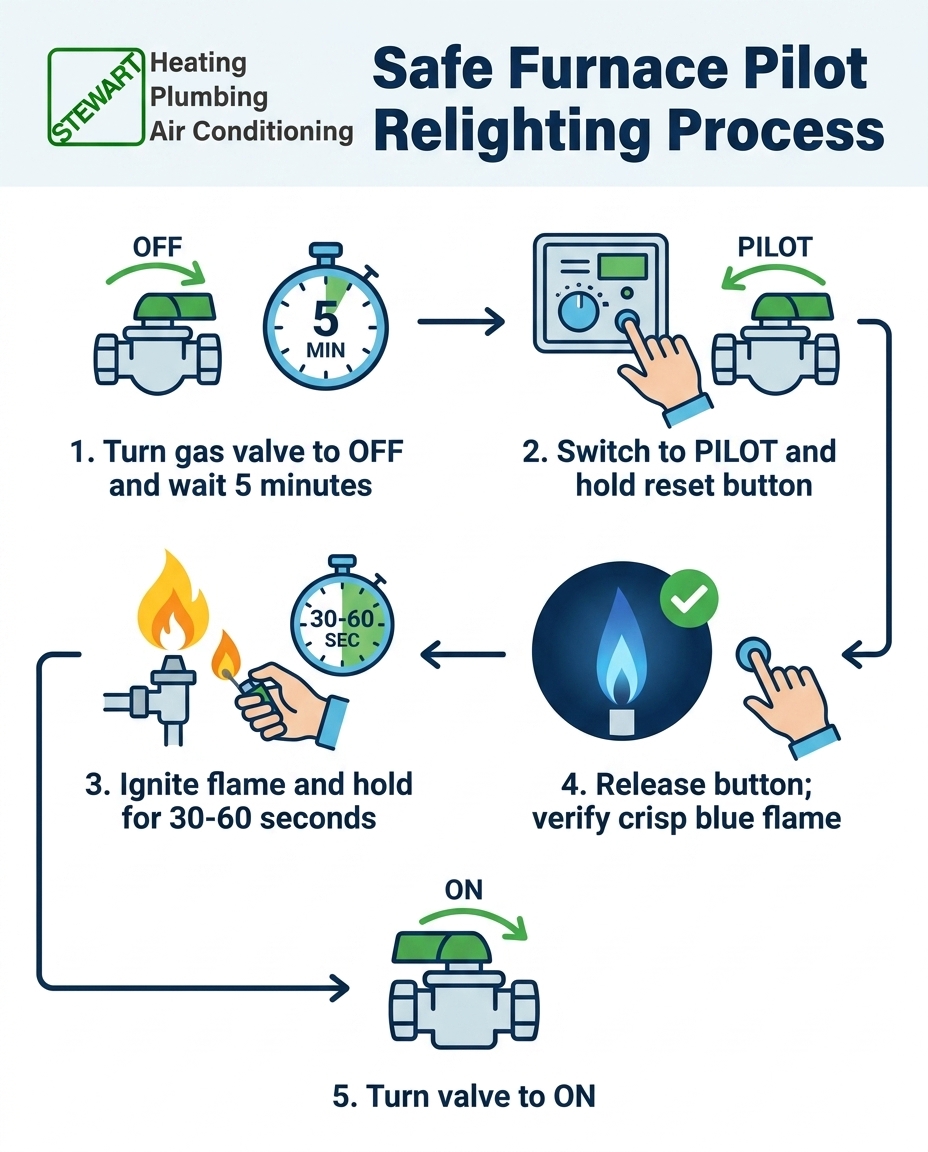
1. Turn the gas valve knob to the 'Off' position: Before doing anything else, turn the control knob to OFF. Wait a full five minutes. This waiting period is non-negotiable; it allows any residual gas that may have pooled in the combustion chamber to safely dissipate into the air. Skipping this step risks a dangerous flash ignition.
2. Turn the knob to the 'Pilot' position: After five minutes have passed, turn the knob from OFF to the PILOT setting. This aligns the internal valve to allow a tiny amount of gas to flow specifically to the pilot tube, but not to the main burners.
3. Press and hold the reset button while applying a flame: Press the reset button (or depress the control knob itself, depending on your model) and hold it down firmly. While holding it down, bring your long lighter or match to the pilot orifice to ignite the gas.
4. Continue holding the button for 30 to 60 seconds: Once the flame ignites, do not let go of the button. You must continue holding it down for a full 30 to 60 seconds. This duration is critical because it gives the thermocouple time to heat up and generate the required millivolts to signal the valve to stay open.
5. Release the button and observe the flame: Slowly release the reset button. The flame should remain lit. Take a moment to observe the flame quality—it should be a crisp, steady blue cone that fully engulfs the top half-inch of the thermocouple probe.
6. Turn the knob to 'On': If the crisp blue flame holds steady after you release the button, turn the gas valve knob to the ON position. Your furnace is now ready to respond to the thermostat's call for heat.
While relighting a pilot is a standard homeowner task, there is a strict boundary where DIY troubleshooting ends and professional repair must begin. If you follow the steps above, hold the button for a full 60 seconds, and the flame dies immediately upon releasing the button, your thermocouple is likely dead.
The quick fix is no longer an option: Repeatedly trying to force a failing sensor to work will not yield different results. Visual signs of poor combustion, such as a yellow, orange, or wavy flame instead of a crisp blue cone, also indicate that the system is either dirty or failing and cannot safely operate.
We explicitly warn against attempting a DIY thermocouple replacement. While the part itself may seem small, replacing it requires handling the gas line assembly, ensuring perfect alignment, and verifying that there are no micro-leaks after installation. Improper gas line handling carries severe, life-threatening risks.
When a sensor fails, it is also highly valuable to have a comprehensive system check performed, as other components may be compromised. During a recent early fall service call in Pittsburgh, our team helped a homeowner who reached out because their furnace unit required a thorough check and inspection after repeated pilot failures. One of our expert technicians performed an extremely thorough and professional job checking the furnace unit, identifying the faulty sensor, and ensuring the rest of the combustion chamber was safe. The customer felt confident in our technician's knowledge and was relieved to have the system safely restored without resorting to dangerous DIY guesswork.
If you find yourself stuck at this step, it is time to seek professional furnace repair in Concord to accurately diagnose and safely resolve the mechanical failure.
• Flame goes out immediately when button is released — Likely Cause: Dead or failing thermocouple — Required Action: Call for professional replacement
• Flame is yellow, orange, or highly wavy — Likely Cause: Dirty pilot orifice or poor draft — Required Action: Requires professional cleaning and inspection
• Flame holds, but main burners won't ignite — Likely Cause: Gas valve failure or thermostat issue — Required Action: Requires professional diagnostic
It is incredibly common for pilot light and thermocouple issues to manifest during the very first cold snap of the year. Contextualizing this mechanical failure within the seasonal reality of summer dormancy explains why your system might have worked perfectly last winter but refuses to start now.
Months of inactivity allow dust accumulation, pet dander, and even spider webs to clog the tiny opening of the pilot tube. In our experience working across Contra Costa County, the long summer dormancy is sharply contrasted by the sudden demand placed on the furnace during the first cold September evening. When you attempt a September pre-heating season startup, that accumulated debris disrupts the gas flow, creating a weak, wavy flame that fails to properly heat the thermocouple.
Routine pre-season maintenance prevents these sudden ignition failures. During a comprehensive tune-up, technicians clean the pilot assembly, test the millivolt output of the thermocouple, and verify that the gas valve is operating within safe parameters. The long-term benefits of regular system tune-ups for older standing-pilot furnaces cannot be overstated.
Just recently, during a September pre-heating season startup, a local customer contacted us for their first-time furnace tune-up after noticing the system was struggling to ignite. Our technician performed a thorough job, cleaning the pilot assembly, explaining everything clearly, and even advising on proper filter storage to prevent future airflow issues. The customer was highly satisfied with our service and felt secure knowing professional eyes had inspected the gas appliances before the heavy winter workload began.
By securing an HVAC maintenance agreement, you ensure that these hidden issues are caught and corrected during the mild fall weather, rather than waiting for a complete breakdown on a freezing January night.
This usually indicates a faulty thermocouple that isn't sensing the flame properly. When the thermocouple fails to generate the required electrical signal, the gas valve automatically shuts off as a safety precaution. It can also be caused by a dirty pilot orifice that prevents the flame from fully engulfing the sensor, meaning the thermocouple never gets hot enough to keep the valve open.
The standard manufacturer recommendation is to hold the button for 30 to 60 seconds after the flame ignites. This specific duration allows the thermocouple to heat up fully and generate the 25 to 30 millivolts of electricity required to signal the main gas valve. Releasing the button too early will cause the flame to die, even if the components are perfectly healthy.
The clearest sign is if the pilot light instantly dies the exact moment the reset button is released after a full 60-second hold. Additionally, a visual inspection may show heavy soot buildup, severe corrosion, or physical degradation of the copper probe. If you have followed the relighting steps perfectly multiple times and the flame refuses to hold, the sensor has likely failed.
The pilot light is typically located near the bottom of the burner assembly inside the main furnace cabinet. You can usually find it by following the small aluminum or copper tubing leading away from the main gas valve down toward the burners. It will be situated right next to the thermocouple probe.
A very light dusting with a soft, dry cloth is possible if the system is completely turned off and cool, but abrasive cleaning can easily damage the sensitive sensor. Homeowners should never use sandpaper or harsh chemicals on gas components. If a light dusting doesn't resolve the ignition issue, a professional diagnostic is required to ensure safe operation.
A healthy pilot flame should be a strong, crisp blue cone that steadily covers the top half-inch of the thermocouple probe. A yellow, orange, or wavy flame indicates poor combustion, a dirty pilot tube, or an improper draft. If your flame is not crisp and blue, the system requires professional cleaning to prevent carbon monoxide risks.
While relighting a pilot light is a standard homeowner task, repeated failures are a hard stop. If you have followed the safety steps, held the button for the required time, and the flame still extinguishes, your furnace is doing exactly what it was designed to do: protecting you from a potential gas hazard by shutting down.
Reassure yourself that a faulty thermocouple is a straightforward and routine fix for a licensed Stewart Heating HVAC technician. There is no need to risk your family's safety by attempting complex DIY repairs on gas lines. By scheduling an inspection with our team now, you can address the root cause of the ignition failure and ensure safe, reliable heat for the upcoming season. Take proactive steps and explore affordable furnace maintenance options to secure your home's comfort long before the harsh winter weather arrives.

Very professional and complete. I would recommend Stewart to anyone. Highest quality of workmanship and clean installation.
Stewart Heating Plumbing Air Conditioning just did some work for us for the first time. They did an installation at my home and it turned out well. I thought the price was fair and I definitely would use them again. The technicians were very friendly and knowledgeable about their work. I highly recommend Stewart Heating Plumbing Air Conditioning and already told friends to use them.
We have been using Stewart Heating Plumbing Air Conditioning since 1995. They put the original heating and air unit in the house, and we have just stayed with them. They are dependable and honest people, and they have done a good job for us every time that we have used them!
They came and did an inspection and are coming tomorrow to do the repair.
They replaced a regulator the first time, and then the water heater vent had to be replaced. They did great work.
The gentleman that serviced us was helpful, insightful, and knew what he was talking about. Overall, it was a great experience.