

Recent Blogs
Stay updated with our latest blog posts.

When the temperature drops, you adjust the thermostat, and you expect instant warmth—but our team at Stewart Heating, Plumbing and Air Conditioning knows there is a hidden risk in this exact moment, which is exactly why we always test carbon monoxide detectors during fall furnace checks. During the September pre-heating transition, most homeowners assume that because their heating equipment worked perfectly last winter, it is perfectly safe to fire up again. You might hear the burners ignite and smell that familiar faint odor of burning dust, assuming everything is operating exactly as it should. However, in our decades of experience, we consistently see that months of inactivity create an environment where mechanical vulnerabilities develop completely out of sight.
One of the most dangerous assumptions you can make is trusting that the small, silent monitor on your ceiling is still actively protecting your family just because it has not beeped. A carbon monoxide monitor that sits dormant or untested can give you a false sense of security. Verifying that this device is fully functional, properly placed, and within its active lifespan is a mandatory, non-negotiable step before any of our professional technicians sign off on your heating equipment for the season.
Common blind spots our team typically sees during the first startup include:
• Assuming a quiet alarm means a safe home: Silence does not mean the air is clean; it often just means the sensor has quietly expired.
• Relying on the "test" button alone: Pressing the button only confirms the battery can power the horn, not that the chemical sensor can actually detect gas.
• Ignoring the summer downtime: Furnaces undergo physical changes while sitting unused for months, increasing the likelihood of a startup failure.
Catching these exact vulnerabilities before they become late-night emergencies is the primary reason why a routine HVAC maintenance plan is so important. By addressing both the mechanical health of the furnace and the operational status of your safety monitors, we help ensure a truly safe transition into the colder months.
Over our years of servicing East Bay homes, we have seen firsthand how our region's weather patterns create a unique challenge for residential heating equipment. For homeowners in Pittsburgh CA and the surrounding areas, the distinct seasonal shift means your furnace sits entirely dormant during our mild summers, only to be thrust into heavy operation when sudden chilly autumn nights arrive. This abrupt transition from zero activity to high-demand heating forces mechanical components to work incredibly hard without any gradual warmup period.
While your furnace sits unused from May to September, several physical and environmental changes occur inside the cabinet. These changes directly impact how safely the unit will operate when it finally receives the signal to ignite.
The four main effects of summer dormancy we encounter most often:
1. Heavy dust accumulation: Dust, pet dander, and airborne particles settle on the burners, ignitors, and heat exchangers. When the unit fires up, this debris burns off, but severe buildup can interfere with clean combustion.
2. Lubricant degradation: The oils and greases that keep blower motors and inducer fans spinning freely can dry out or thicken over the summer. This forces the motors to draw more electrical current and run hotter than normal.
3. Ventilation blockages: Flue pipes and exhaust vents are common nesting spots for birds, rodents, and insects during the warmer months. A blocked exhaust pipe forces dangerous combustion gases back into your living space.
4. Accelerated metal fatigue: The internal metal components of your furnace are subjected to humidity and temperature swings even when the unit is off, which can worsen existing stress points from the previous winter.
Because of this sudden shift in demand, the highest risk for undiagnosed mechanical failures occurs right during this initial startup window. Before you rely on your heating systems to carry you through the winter, it is critical to have a professional address the toll that months of inactivity have taken on the internal components.
To understand why carbon monoxide testing is so critical during the September pre-heating transition, you have to understand the role of your furnace's heat exchanger. The heat exchanger is essentially the lungs of your heating system. It is a series of metal tubes or coils where the actual combustion of natural gas takes place. As the gas burns inside this sealed metal chamber, the metal gets incredibly hot. Your blower motor then pushes your home's indoor air over the outside of this hot metal, warming the air before it circulates through your vents.
The most important function of the heat exchanger is keeping the toxic combustion gases completely separate from the breathable air blowing through your house. However, this metal chamber undergoes intense thermal stress. Every time your furnace cycles on, the metal expands rapidly as it heats up. When the cycle ends, the metal cools and contracts. Over years of operation, this continuous expansion and contraction causes metal fatigue.
Eventually, that fatigue leads to microscopic cracks or stress fractures in the metal. When a heat exchanger cracks, it breaks the seal between the toxic exhaust and your home's breathable air. Carbon monoxide—a colorless, odorless, and tasteless gas—can then escape through these fissures and be pumped directly into your bedrooms and living areas.
Homeowners often ask us why our technicians cannot simply look at the metal and spot a crack. In our experience, the reality of metal physics makes this extremely difficult. Microscopic cracks often remain tightly closed when the metal is cold. If we inspect the furnace while it is turned off, the heat exchanger might look perfectly intact.
It is only when the burners ignite and the metal expands that these tiny fissures open up, allowing dangerous gases to escape. Because gas can slip through gaps completely invisible to the naked eye, relying on a visual check alone leaves a massive blind spot in your home's safety.
• Visual Inspection (Cold) — What It Detects: Rust, large visible fractures, soot buildup, and structural warping. — Limitations: Cannot reveal microscopic cracks that only open when the metal is hot.
• Combustion Analysis — What It Detects: Measures the exact levels of gases in the exhaust flue to ensure clean burning. — Limitations: Does not directly measure if gas is leaking into the home's supply air.
• Active CO Testing — What It Detects: Detects trace amounts of carbon monoxide actively escaping into the living space. — Limitations: Requires specialized meters and running the system through a full heating cycle.
This physical reality makes active monitoring via highly sensitive detectors absolutely critical. A visual check is a great starting point, but active testing is the only way we can prove the barrier is holding.
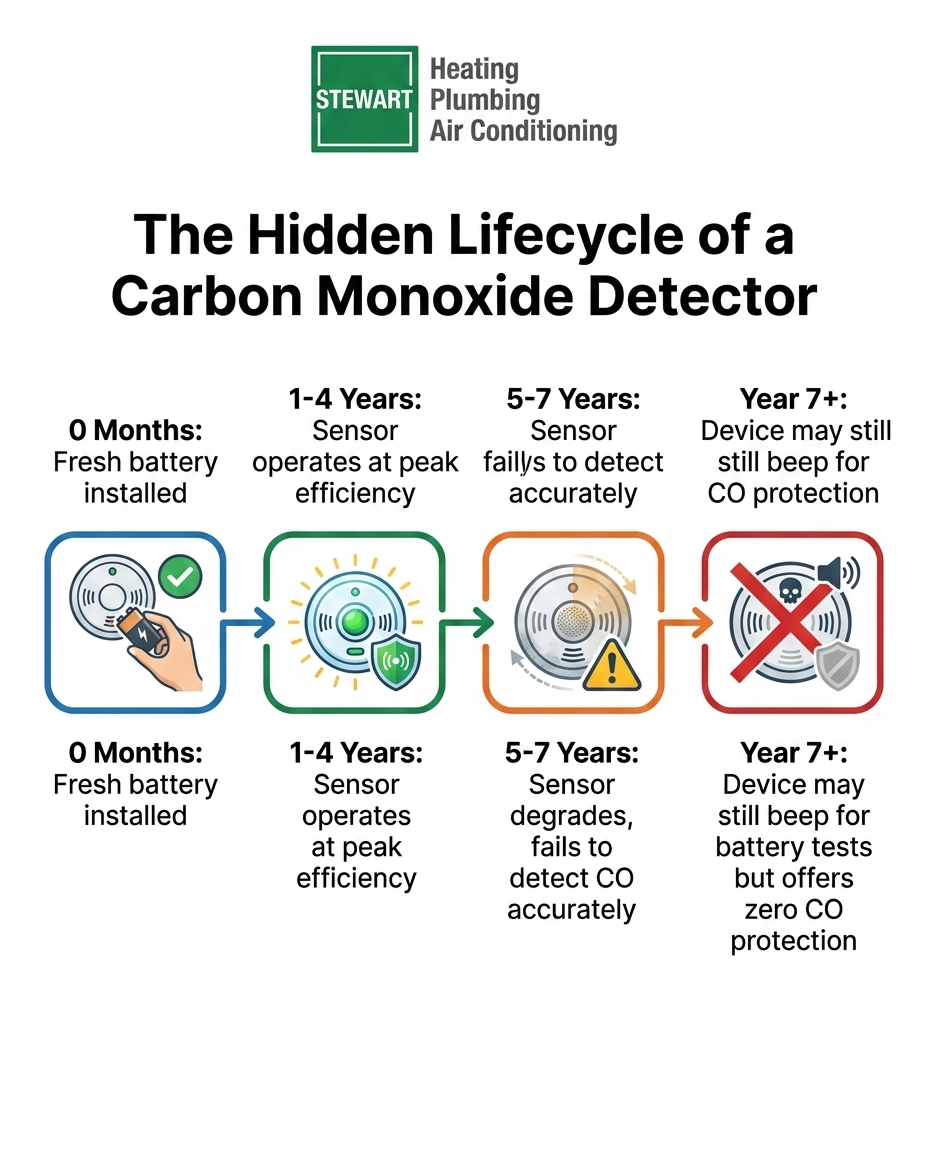
One of the most persistent myths our team encounters during fall tune-ups is that as long as you put fresh batteries in your carbon monoxide detector every autumn, you are fully protected. This misunderstanding leaves thousands of Pittsburgh CA and surrounding East Bay homes vulnerable every year. There is a fundamental difference between the life of the battery and the life of the sensor inside the device.
Carbon monoxide detectors use electrochemical sensors to monitor the air. Inside the plastic casing, a chemical solution reacts when exposed to carbon monoxide, generating a small electrical current that triggers the alarm. Over time, this chemical solution degrades, dries out, and loses its sensitivity. According to data from the Consumer Product Safety Commission (CPSC), these sensors have a strict expiration date, typically degrading entirely after 5 to 7 years.
The danger of the "Beep Test":
When you press the test button on an expired detector, it will likely still emit a loud, piercing beep. This leads homeowners to believe the unit is working perfectly. In reality, that button only tests the circuitry between the battery and the speaker. It does not test whether the chemical sensor is still capable of detecting toxic gas. You could have a device with a brand-new battery that will beep loudly when tested, yet remain completely silent while your home fills with carbon monoxide.
To ensure your family is actually protected, we always check the manufacturer date stamped on the back of the unit. If the device is older than seven years, it is nothing more than a plastic wall decoration. Exploring carbon monoxide detector upgrades is a necessary step to restore your home's safety net.
Since 1974, our legacy of serving the community has been built on a strict, safety-first approach. Decades of protecting local families have cemented our belief that a tune-up is never just a basic performance check. Treating the home's carbon monoxide detector as an integral part of the heating system is a core standard we refuse to compromise on during the September pre-heating transition.
We do not view these monitors as optional accessories; they are the final line of defense against mechanical failure. Our technicians follow a rigorous checklist to ensure every layer of your heating safety is intact.
Our comprehensive safety protocol includes:
• Verifying expiration dates: We physically remove the detectors from the wall or ceiling to check the manufacturer date stamped on the back, ensuring the chemical sensor is still within its active lifespan.
• Testing functionality: Beyond just pressing the battery test button, we verify that the units are receiving proper power and are free from heavy dust blockages that could impair airflow to the sensor.
• Ensuring optimal placement: We check that detectors are installed at least 15 to 20 feet away from the furnace to prevent false alarms, and confirm they are properly placed outside of all primary sleeping areas.
• Active system monitoring: We run the heating system through a full cycle while actively monitoring the ambient air for any trace levels of escaping gases.
This level of thoroughness makes a tangible difference. One homeowner reached out last November to schedule their furnace's very first tune-up, noting that a few minor items required repair. When our technician arrived, they didn't just fix the damaged components; they explained the entire scope of the work, showed the homeowner the worn items, and actively helped them properly place their new carbon monoxide detectors and store their backup filters. The homeowner was left feeling completely informed and confident in their system's safety.
Maintaining an active HVAC maintenance agreement ensures this critical, life-saving checklist is never skipped, year after year.
While carbon monoxide is undoubtedly the most dangerous and immediate threat that can circulate through your ductwork, it is not the only air quality concern you face as the seasons change. When our technicians assess Pittsburgh CA and surrounding East Bay homes, we consistently notice that the shift into autumn means windows are closed tightly, sealing off fresh air ventilation. This "tight home" syndrome traps everything inside.
When your house is sealed for the winter, the air inside simply recirculates through your HVAC system again and again. Without proper intervention, you are continuously breathing in the same dust, pet dander, volatile organic compounds (VOCs), and airborne allergens. A cracked heat exchanger introduces toxic gases into this loop, but a neglected system also introduces a steady stream of respiratory irritants.
Why a holistic approach matters to our team:
• Stagnant air concentration: Contaminants build up much faster in the fall and winter because natural drafts from open windows are eliminated.
• Filter bypass: If your furnace filter is clogged from summer dust, air will force its way around the edges, pulling unfiltered debris directly into your blower motor and pushing it into your living room.
• Humidity imbalances: Heating the air naturally dries it out, which can irritate nasal passages and make airborne dust feel much more severe.
Comprehensive indoor air quality assessments go hand-in-hand with our furnace safety checks. By verifying your ventilation, upgrading your filtration, and monitoring your home's total indoor air quality, we help protect your family from both acute dangers like gas leaks and chronic issues like allergen buildup.
Our technicians check carbon monoxide levels to ensure the absolute safety of your household before the heavy heating season begins. Because gas furnaces rely on combustion to create heat, they are a primary potential source of toxic gas if a mechanical failure occurs. Testing for CO guarantees that the exhaust system is safely venting all byproducts outside your home, rather than leaking them into your ductwork during the September pre-heating transition.
Yes, a gas furnace can leak carbon monoxide, primarily through a cracked heat exchanger or an improperly installed exhaust vent. Every gas furnace produces carbon monoxide during the normal combustion process, but a healthy system completely contains this gas and pushes it safely up the chimney or flue. It is only when the metal barrier fails or the exhaust pipe becomes blocked that this toxic gas spills backward into your living space.
Most carbon monoxide detectors expire after 5 to 7 years due to the natural degradation of their internal sensors. Even if you change the batteries religiously, the electrochemical sensor inside will eventually lose its ability to detect gas. The exact expiration date or manufacturing date is typically printed on a sticker on the back of the device, and the entire unit must be replaced once that date passes.
We recommend detectors be placed at least 15 to 20 feet away from the furnace to prevent false alarms caused by minor, harmless startup puffs of gas. While it is important to have a monitor near the mechanical room, primary placement should always prioritize the areas right outside of sleeping quarters so the alarm can easily wake your family in the middle of the night.
Early signs include excess soot buildup inside the cabinet, strange formaldehyde-like odors when the heat runs, or a burner flame that burns yellow and wavy instead of a crisp blue. However, as we often remind homeowners, there are frequently absolutely no visible signs or smells, which is why relying on professional diagnostic testing and active monitors is required to catch a failure before it becomes dangerous.
At Stewart Heating, Plumbing and Air Conditioning, we believe there is a profound sense of comfort that comes from knowing your home is not just warm, but truly safe. By treating your carbon monoxide detectors as vital components of your heating infrastructure, we eliminate the guesswork and false security that plague so many Pittsburgh CA and surrounding East Bay homes during the seasonal shift.
Do not wait for the first freezing night to find out if your safety monitors have expired or if your dormant furnace has developed hidden vulnerabilities. Taking proactive steps now ensures that when the deep winter cold finally arrives, your family is protected by a thoroughly evaluated, expertly verified heating system. Schedule a comprehensive evaluation with our team today to lock in your peace of mind for the entire season.

Very professional and complete. I would recommend Stewart to anyone. Highest quality of workmanship and clean installation.
Stewart Heating Plumbing Air Conditioning just did some work for us for the first time. They did an installation at my home and it turned out well. I thought the price was fair and I definitely would use them again. The technicians were very friendly and knowledgeable about their work. I highly recommend Stewart Heating Plumbing Air Conditioning and already told friends to use them.
We have been using Stewart Heating Plumbing Air Conditioning since 1995. They put the original heating and air unit in the house, and we have just stayed with them. They are dependable and honest people, and they have done a good job for us every time that we have used them!
They came and did an inspection and are coming tomorrow to do the repair.
They replaced a regulator the first time, and then the water heater vent had to be replaced. They did great work.
The gentleman that serviced us was helpful, insightful, and knew what he was talking about. Overall, it was a great experience.