

Recent Blogs
Stay updated with our latest blog posts.

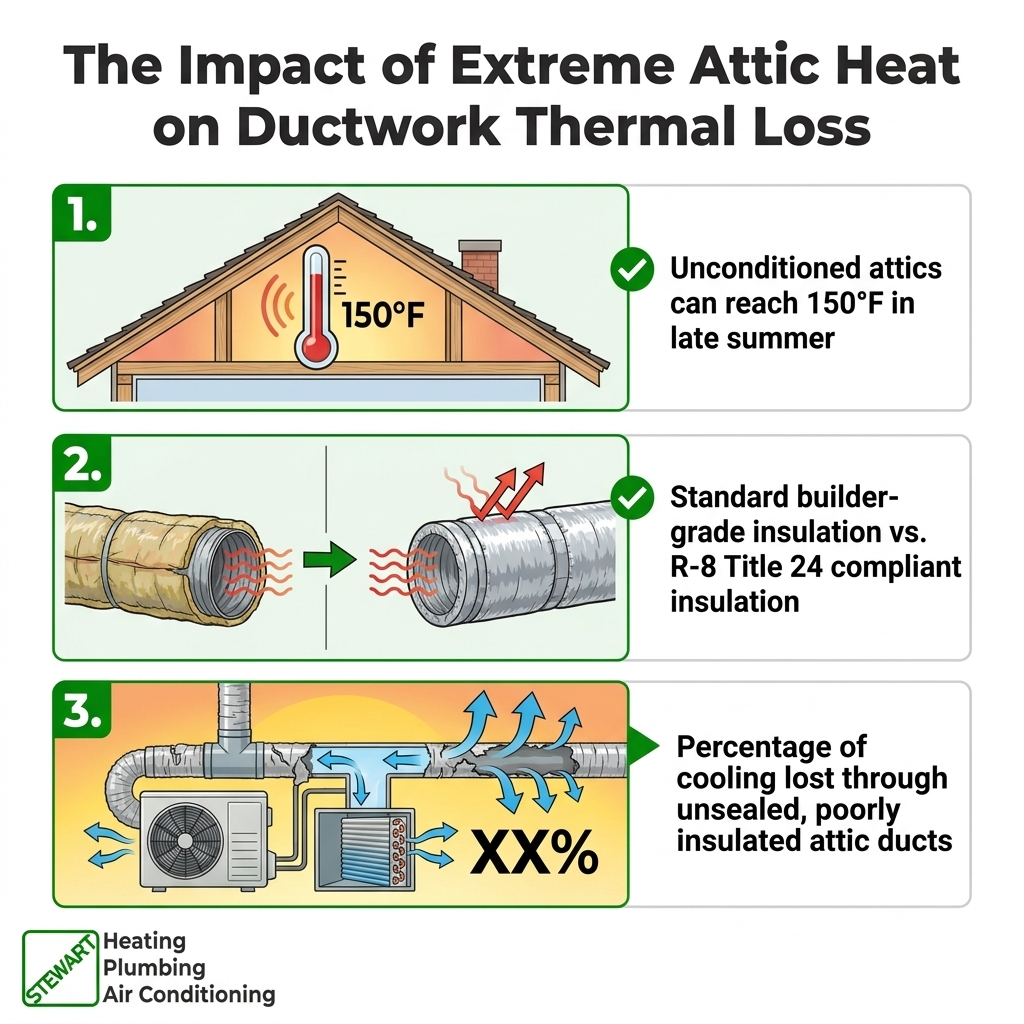
During peak summer weather, an unconditioned attic can easily reach a blistering 150 degrees Fahrenheit. If you want to understand why Concord homes need specific duct insulation strategies, that staggering temperature is the absolute main culprit. Your air conditioning system works tirelessly to chill the indoor air, only to push that freshly cooled air through a network of thin ducts suspended inside what is essentially a rooftop oven. In many local houses, the standard builder-grade duct insulation installed decades ago completely fails to protect your cooled air from this intense heat.
Addressing this massive thermal loss requires a professional approach, combining comprehensive HVAC services with targeted home energy efficiency upgrades.
As the late summer heat in Contra Costa County creates an intense thermal load that peaks right before the end of the season, the strain on your cooling system reaches its maximum point. Homeowners are frequently faced with a frustrating decision point: identifying whether their poor indoor cooling performance is due to a failing air conditioning unit, or if the system is perfectly fine but losing the battle against extreme unconditioned attic temperatures. When the attic environment overwhelms the thin thermal barrier surrounding your ductwork, the air that finally reaches your living room registers several degrees warmer than when it left the air handler.
Understanding this hidden toll is the first step toward restoring your home's comfort. The issue is rarely just a matter of the air conditioner lacking power. Instead, it is a structural and environmental challenge. When ductwork is exposed to triple-digit ambient heat day after day, the thin fiberglass wrapping degrades, compresses, and loses its ability to resist heat transfer. This forces your cooling equipment to run continuously, wasting energy and accelerating mechanical wear and tear long before the season ends.
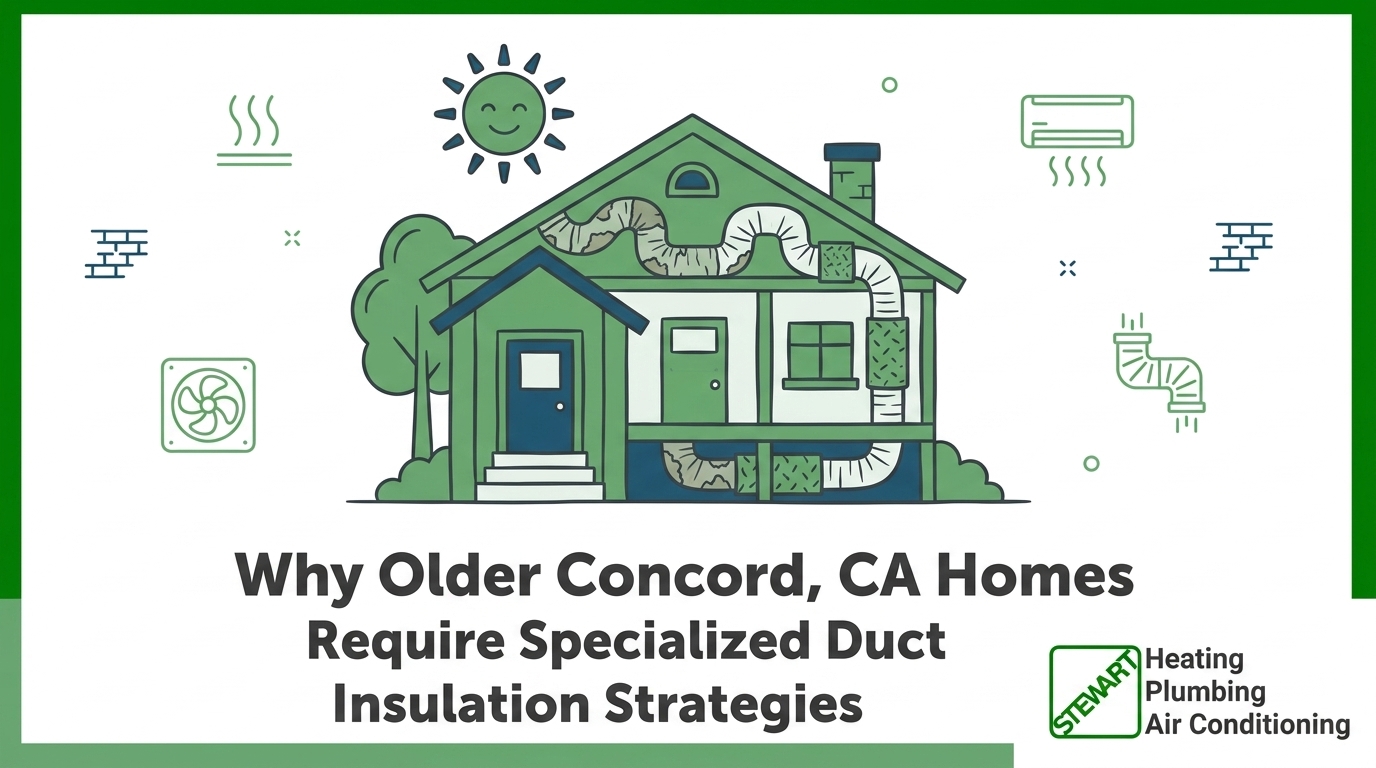
To fully grasp why standard insulation fails, you have to look at the specific structural realities of the local housing stock. Many older Concord residential neighborhoods were built long before modern energy codes dictated how attics should be ventilated and insulated. During the housing booms of the 1960s and 1970s, construction prioritized rapid development over long-term thermal efficiency. As a result, these legacy homes feature distinct architectural traits that inadvertently turn the attic space into a heat trap.
Since 1974, Stewart Heating and Air has worked inside these exact attics, giving us authoritative, firsthand insight into the historical building practices of Contra Costa County homes. We consistently see the same structural patterns that exacerbate ductwork vulnerabilities. Tight, unconditioned spaces lack the necessary airflow to dissipate trapped solar radiant heat. The sun beats down on the roof deck, and that heat radiates directly into the cramped attic space, essentially baking the ductwork suspended within it.
The rooflines of legacy homes often feature low pitches and minimal overhangs, which directly limits the amount of ventilation that can be installed. Passive venting in older homes is frequently insufficient for modern extreme heat.
• Undersized soffit vents: Older designs often feature small or blocked intake vents at the eaves, preventing cooler outside air from entering the attic space.
• Inadequate exhaust venting: Many legacy homes rely on a single gable vent or a few small roof louvers, rather than continuous ridge vents that allow hot air to escape efficiently.
• Proximity to the roof deck: In homes with shallow roof pitches, the ductwork is physically forced closer to the superheated underside of the roof, increasing its exposure to intense radiant heat.
• Lack of radiant barriers: Unlike modern construction, older homes rarely include foil radiant barriers stapled to the rafters, meaning 100% of the solar heat transfers into the attic air.
These architectural limitations stand in stark contrast to modern building practices, which prioritize highly ventilated attic spaces or fully conditioned attics where the thermal boundary is moved to the roofline itself. In an older home, the ductwork is left entirely exposed to the harshest environment in the house.
When you examine the mechanics of heat transfer, it becomes clear why standard materials completely fail when subjected to end-of-season extreme temperatures. Thermal loss occurs when heat moves from a warmer area to a cooler area. In the HVAC world, this movement is governed by the temperature difference, often called the Delta-T. If the air inside your ducts is 55 degrees, and the air outside the ducts is 150 degrees, the massive Delta-T creates an overwhelming pressure for the heat to force its way inside.
Standard builder-grade insulation, which is often rated at R-4 or even lower, simply lacks the thermal resistance to block this level of ambient heat. The physics of thermal loss dictate that the longer the cooled air travels through a superheated environment, the more heat it absorbs. This creates a compounding effect: the supply air temperature rises significantly before it ever reaches the registers in your living space.
The Problem: The attic acts as a massive thermal battery. During late August heatwaves, the ambient temperature remains high for consecutive days. The heavy wood framing and existing insulation absorb heat all afternoon and never fully cool down overnight.
The Cause: Because the attic starts the next morning already warm, the daytime thermal loss increases exponentially. The standard R-4 fiberglass wrapping around the ducts offers virtually no resistance to this relentless, compounding heat load.
The Solution: Upgrading the thermal barrier to a material with a high enough resistance (R-value) to break the cycle of heat transfer, ensuring the air remains cold from the equipment all the way to the room.
When a home refuses to cool down, the immediate assumption is usually that the air conditioner is broken. However, an AC unit might be functioning perfectly, generating cold air exactly as designed, while extreme unconditioned attic temperatures are entirely neutralizing its output. Distinguishing between a mechanical equipment failure and an insulation or ductwork failure is critical to solving the root problem.
If you suspect your system is struggling, there are specific symptoms of thermal loss in the ductwork to watch for. You might notice weak airflow coming from the registers, specific rooms that never seem to cool down regardless of the thermostat setting, or an air conditioning unit that runs constantly without ever satisfying the target temperature. In many cases, compromised insulation also masks underlying duct leaks, where your expensive cooled air escapes directly into the attic space before it even has a chance to reach your living areas.
To accurately pinpoint the source of the cooling loss without relying on guesswork, we highly recommend professional duct leakage testing. This diagnostic process measures the exact amount of air escaping the system and identifies where the thermal envelope has failed.
Even without specialized equipment, homeowners can sometimes spot the physical signs that their duct insulation is no longer doing its job. If you safely inspect the visible portions of your attic ductwork, look for these indicators:
• Condensation or sweating: Moisture forming on the exterior of the ductwork means the cold metal is interacting with the hot, humid attic air, proving the insulation barrier has failed.
• Visible deterioration: Insulation that looks flattened, compressed, or heavily degraded has lost the tiny air pockets it needs to resist heat transfer.
• Peeling vapor barrier: The outer foil or plastic jacket acts as a vapor barrier; if it is peeling, cracked, or falling away, the inner fiberglass is completely exposed to the elements.
• Discoloration around seams: Dark streaks near duct joints often indicate that dirty attic air is being pulled into the system, or cold air is blowing out through a breach in the insulation.
Recognizing the massive energy waste caused by poorly insulated ductwork, regulatory bodies have established strict benchmarks for home performance. The California Energy Commission Title 24 Building Energy Efficiency Standards provide a clear baseline for what older Concord residential neighborhoods actually need to perform efficiently in the modern climate. These regulations are not just arbitrary rules; they are rooted in the physics of thermal dynamics and designed to reduce the heavy burden on the local power grid during peak summer months.
Under Title 24 standards, ductwork running through unconditioned spaces is generally required to meet specific R-values, typically R-8. The "R" stands for resistance, meaning an R-8 rating offers significantly more resistance to heat flow than the legacy R-4 materials found in most older homes. Upgrading to R-8 insulation dramatically slows the rate of heat transfer, keeping the intense attic heat out and the expensive cooled air inside.
• Legacy Builder-Grade — Typical R-Value: R-4 or lower — Thermal Resistance Level: Minimal — Performance in 150°F Attic: Fails rapidly; high thermal loss
• Modern Standard — Typical R-Value: R-6 — Thermal Resistance Level: Moderate — Performance in 150°F Attic: Acceptable for mild climates
• Title 24 Compliant — Typical R-Value: R-8 — Thermal Resistance Level: High — Performance in 150°F Attic: Highly effective at blocking extreme heat
Adhering to these modern standards does more than just keep you comfortable. It actively protects your cooling efficiency, lowers your monthly utility burdens, and extends the lifespan of your mechanical equipment. When the ductwork is properly insulated to an R-8 standard, the air conditioner does not have to run as long or work as hard to cool the house, significantly reducing mechanical fatigue.
Stopping end-of-season cooling loss requires a holistic approach to your home's thermal envelope. Slapping new insulation over old, leaking ducts will not solve the problem. The most effective strategy begins with a thorough diagnostic assessment. We recommend starting with professional home energy audits to evaluate the entire thermal envelope of the house, identifying exactly where heat is entering and where cooled air is escaping.
Once the vulnerabilities are mapped out, the physical upgrade process can begin. This typically involves safely removing the degraded, old insulation, which is often contaminated with decades of dust and debris. Next, the bare ductwork is inspected for structural integrity. In some extreme cases, homes with severely compromised layouts might benefit from rerouting the ductwork entirely, or even exploring cooling options for homes without ductwork, such as ductless mini-split systems, which bypass the hot attic altogether.
By executing these comprehensive upgrades, you alleviate the immense strain on the HVAC system. This proactive approach is the best way to prevent premature mechanical breakdowns, especially during late August heatwaves when equipment is pushed to its absolute limit.
One of the most critical steps in this strategy is properly sealing the system. Insulation alone cannot stop air leaks; it only stops heat transfer. The physical seams of the ductwork must be mechanically sealed first.
• Mastic sealant is mandatory: Professionals use a specialized, paint-on mastic sealant or UL-listed foil tape to permanently seal joints. Standard cloth "duct tape" dries out and fails rapidly in a hot attic.
• Securing the vapor barrier: Once the R-8 insulation is applied, the outer vapor barrier must be meticulously taped and secured to prevent condensation and moisture intrusion.
• Avoiding DIY disasters: Attempting this work without professional training often leads to failed inspections, code violations, and improperly secured barriers that trap moisture and encourage mold growth.
Why is my AC struggling to cool the house in late summer?
Late summer heat creates a compounding thermal load that overwhelms your home's defenses. As the attic absorbs intense heat day after day without cooling down at night, standard duct insulation fails, causing the cooled air inside the ducts to heat up before it reaches your rooms.
What happens to ductwork in an unconditioned attic?
Ductwork in an unconditioned attic is exposed to extreme temperature fluctuations, often reaching up to 150 degrees. Over time, this intense radiant heat bakes the thin fiberglass insulation, causing it to compress, degrade, and lose its ability to resist heat transfer.
Is my AC failing or do I need better duct insulation?
If your AC unit is blowing cold air at the indoor unit but warm air is coming out of your ceiling registers, insulation failure is highly likely. Professional diagnostic testing can measure the temperature drop and airflow to determine if the equipment is failing or if the ductwork is leaking and losing thermal resistance.
What is the best insulation for ductwork in an unconditioned attic?
The best insulation for extreme attic environments is a high-density fiberglass wrap with a durable, reinforced foil vapor barrier, rated at R-8. This specification meets rigorous energy codes and provides the necessary thickness to block severe radiant heat.
How much does duct insulation improve AC performance?
Upgrading to high R-value insulation significantly improves performance by ensuring the air temperature remains consistent from the equipment to the vent. This reduces the amount of time the AC has to run to satisfy the thermostat, easing the mechanical strain on the system and improving indoor comfort.
Does California Title 24 require R-8 duct insulation for older homes?
When older homes undergo significant HVAC alterations or ductwork replacements, Title 24 standards generally require the new ductwork in unconditioned spaces to meet the R-8 insulation requirement. This ensures the home is brought up to modern energy efficiency and performance standards.
When you rely on aging, builder-grade materials in a hot climate, you are fighting a losing battle against the sun. Upgrading your home's thermal defenses provides a clear, expert solution that stops cooling loss at the source. Schedule an evaluation today to ensure your specific attic architecture gets the specialized duct insulation strategy it demands.

Very professional and complete. I would recommend Stewart to anyone. Highest quality of workmanship and clean installation.
Stewart Heating Plumbing Air Conditioning just did some work for us for the first time. They did an installation at my home and it turned out well. I thought the price was fair and I definitely would use them again. The technicians were very friendly and knowledgeable about their work. I highly recommend Stewart Heating Plumbing Air Conditioning and already told friends to use them.
We have been using Stewart Heating Plumbing Air Conditioning since 1995. They put the original heating and air unit in the house, and we have just stayed with them. They are dependable and honest people, and they have done a good job for us every time that we have used them!
They came and did an inspection and are coming tomorrow to do the repair.
They replaced a regulator the first time, and then the water heater vent had to be replaced. They did great work.
The gentleman that serviced us was helpful, insightful, and knew what he was talking about. Overall, it was a great experience.