

Recent Blogs
Stay updated with our latest blog posts.

In our decades of serving Pittsburg CA, our team frequently encounters a frustrating scenario during November pre-winter preparation: your furnace is running constantly, but the living room still feels chilly while the upstairs bedrooms are sweltering. Learning how to balance HVAC airflow is critical to solving these cold spots, but many homeowners resort to a quick fix we strongly advise against: closing the supply vents in the warmer rooms.
If you are struggling with uneven temperatures, it is time to have a professional evaluate your heating systems rather than risking damage to your equipment.
Homeowners frequently experience cold spots and uneven heating as the seasons change. In Pittsburg, sudden winter temperature drops and coastal breezes make cold spots in perimeter rooms much more noticeable. The immediate, instinctual reaction we see from many customers is to walk into the warmest room in the house and shut the floor or ceiling register. The logic seems sound on the surface: if you block the air from entering one room, it will naturally be forced into the colder rooms that need it more.
This misconception stems from older heating methods. With traditional plumbing or old-school steam radiators, closing a valve simply redirects the fluid or steam to another open pathway. Forced-air HVAC systems do not operate under these same principles. Your modern heating system requires a highly specific, balanced volume of airflow to function safely and efficiently.
Closing a vent does not tell the furnace to produce less air, nor does it magically teleport that air to the opposite side of the house. Instead, it creates a physical roadblock in a closed-loop system. The air still travels down that duct, hits the closed register, and backs up. This backup fundamentally alters the mechanical operating conditions of your entire heating system, transforming a minor comfort issue into a major mechanical hazard. Understanding the reality of system pressure is the first step toward achieving true, safe indoor comfort.
To understand why closing vents is harmful, you have to look at how a forced-air system breathes. Residential HVAC systems are designed around a concept called static pressure. Static pressure is the resistance to airflow within your ductwork. Every component in your system—from the air filter and the cooling coil to the physical turns in the sheet metal ducts—creates a certain amount of resistance.
Heating systems are meticulously designed and calibrated using ACCA Manual D standards. These engineering standards dictate exactly how much air a specific furnace blower must move, and exactly how much ductwork is required to carry that air without exceeding the system's static pressure limits. The blower motor is sized to overcome a very specific amount of resistance.
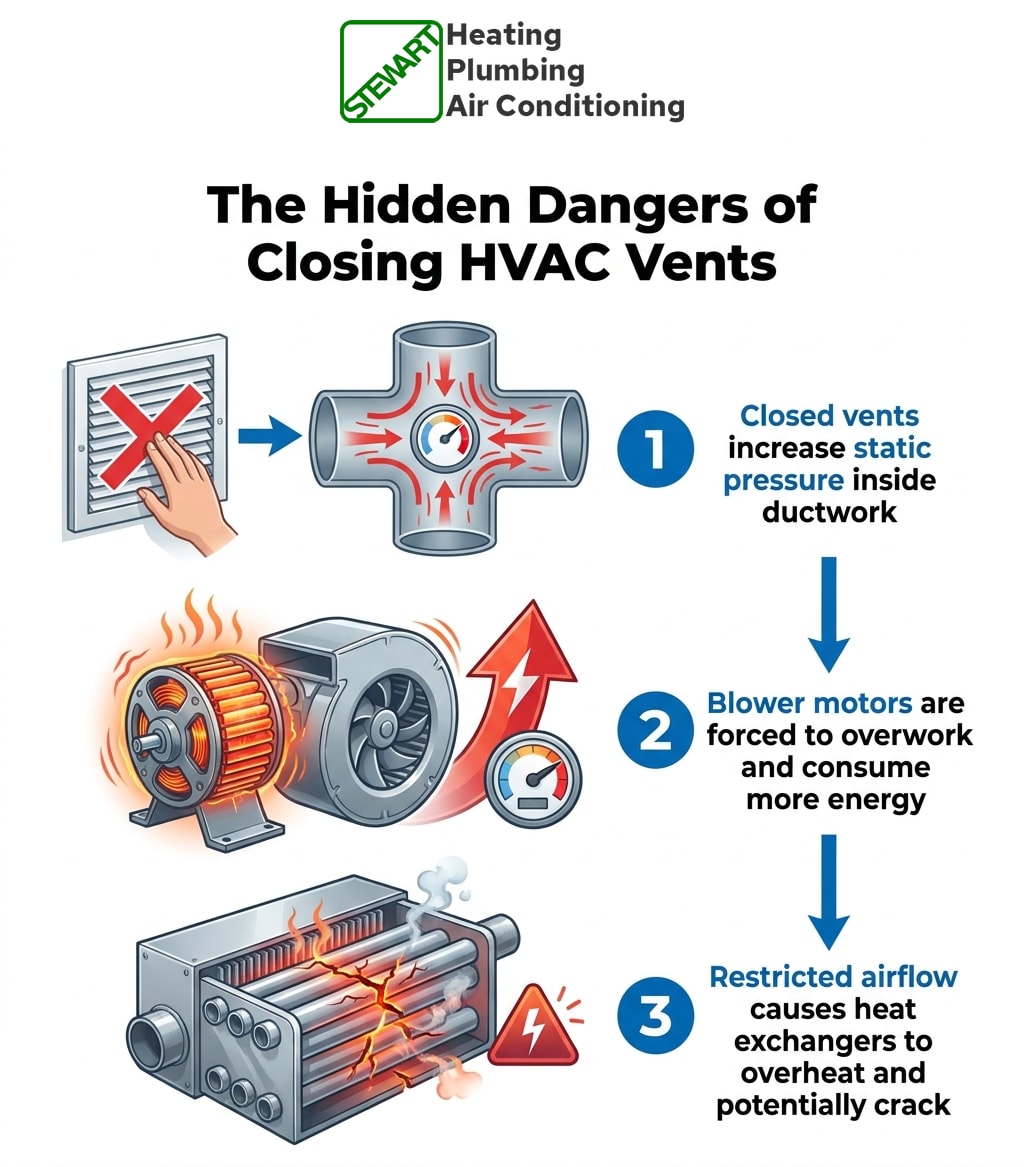
When you close a supply register, you artificially increase the resistance in the ductwork. You are essentially shrinking the total size of the pathways the air has to escape through, which immediately disrupts the delicate balance of the system. Forcing the same volume of air through fewer openings does not equate to better heating in cold rooms; it simply pressurizes the ductwork beyond its intended design parameters.
Think of your ductwork's resistance like breathing through a straw. If you breathe normally through a wide milkshake straw, your lungs do not have to work very hard. If you pinch that straw halfway closed, you suddenly have to exert significantly more effort to push the same amount of air out.
• The blower motor's burden: Your furnace's blower motor acts as the lungs of the system. It has to work against the resistance you create when you close vents.
• Immediate efficiency drops: Exceeding design limits causes the motor to consume more electricity while actually moving less total air through the house.
• Ductwork leakage: High static pressure forces air to find the path of least resistance, which often means blowing out through tiny unsealed seams in your ductwork, wasting heated air in your attic or crawlspace.
The physics are undeniable: restricted pathways increase pressure, decrease total airflow volume, and force mechanical components to work far outside their safe operational limits.
The consequences of exceeding static pressure limits go far beyond a slight increase in your monthly utility bill. Restricted airflow physically damages the core components of your furnace, often leading to catastrophic failures that require premature system replacement.
The most critical component at risk is the heat exchanger. The heat exchanger is a series of metal tubes or coils that get incredibly hot when the furnace burners ignite. The blower motor pushes cold indoor air over this hot metal, warming the air before it travels into your rooms. The system relies on a constant, predictable volume of air passing over the heat exchanger to keep the metal from overheating.
When you close vents and restrict airflow, not enough air passes over the heat exchanger to cool it down. The metal overheats, expanding and contracting violently. Over time, this thermal stress causes the metal to crack. A cracked heat exchanger is a severe safety hazard, as it can allow dangerous combustion gases, including carbon monoxide, to leak directly into your home's breathing air. Because of this risk, a cracked heat exchanger almost always necessitates an immediate, costly replacement of the entire furnace.
Furthermore, the blower motor itself bears the brunt of the restriction. Modern furnaces are often equipped with variable-speed ECM (Electronically Commutated Motor) blowers. These intelligent motors are programmed to maintain a specific airflow volume. If they sense high static pressure from closed vents, they will automatically ramp up their RPMs to try and overcome the resistance.
This creates a dangerous cycle. To learn more about how these components interact during a heating cycle, understanding the sequence of operation in a modern gas furnace provides valuable context. The motor spins faster and faster, consuming massive amounts of energy. The continuous strain leads to rapid overheating of the motor's internal electronics, resulting in early motor failure. By trying to save a little heat in one room, you risk destroying the two most expensive components inside your furnace.
Cold spots are the most obvious indicator that your home's airflow is not balanced, but they are rarely the only symptom. Because coastal breezes in Pittsburg can exacerbate perimeter heat loss, our technicians know it is crucial to identify airflow imbalances early in the season before the furnace is forced into continuous, heavy cycling.
We advise homeowners to look for the mechanical symptoms of high static pressure and poor distribution. Recognizing these signs early can save your system from long-term damage.
• Whistling noises at return or supply vents — Underlying Mechanical Cause: High air velocity forcing air through restricted grilles due to excessive static pressure.
• Interior doors closing on their own — Underlying Mechanical Cause: Severe pressure imbalances between rooms (one room is heavily pressurized, the hallway is depressurized).
• Sudden spikes in winter energy bills — Underlying Mechanical Cause: The blower motor ramping up to overcome resistance, or heated air leaking into the attic from over-pressurized ducts.
• Reliance on plug-in space heaters — Underlying Mechanical Cause: The central HVAC system is failing to deliver adequate BTUs to specific zones due to ductwork or balancing issues.
The quick fix is never the right fix: If you notice a whistling sound coming from your return grille, it means the system is starving for air. If supply vents are whistling, the air is being forced out at too high a velocity. We always warn our customers that relying on space heaters in certain rooms is a major red flag that the central system is not balanced properly. These are clear indicators that the system requires professional diagnostics, not just another closed vent.
Correcting airflow issues requires scientific measurement and a holistic understanding of fluid dynamics. It is not a matter of guessing which vents to tweak. At Stewart Heating, Plumbing and Air Conditioning, our professionals use specialized tools and proven methodologies to measure actual airflow and pressure at various points throughout the home, ensuring the system operates within its safe static pressure limits while delivering even comfort.
Here is how our licensed experts approach the balancing process safely:
1. Static Pressure Testing: Technicians use a tool called a manometer to measure the exact pressure on both the supply and return sides of the furnace. This provides a baseline health metric for the entire duct system.
2. Airflow Measurement: Using an anemometer or a specialized flow hood, the technician measures the cubic feet per minute (CFM) of air coming out of individual registers to compare actual delivery against the room's requirements.
3. System and Filter Evaluation: The process involves evaluating the entire ductwork system, checking for collapsed flex ducts, disconnected joints, or major air leaks. Technicians also assess the air filter condition, as overly restrictive or dirty filters can mimic the symptoms of closed vents and starve the system of return air. This step is closely tied to your home's indoor air quality, as poor airflow often leads to poor filtration.
4. Internal Damper Adjustment: Instead of closing the grilles in the floor or ceiling, professionals adjust internal duct dampers. These are metal valves located deep inside the ductwork near the main trunk line. Adjusting these dampers evenly distributes air without creating the localized pressure spikes that damage equipment. This work must be performed by licensed experts to ensure safety thresholds are never exceeded.
By adjusting the airflow at the source rather than at the termination point in the room, technicians can gently guide the air where it needs to go without suffocating the blower motor.
Our technicians always emphasize that true comfort comes from a system working in harmony, not from fighting its design. When you close vents, you are fighting the engineering of the home. A balanced system operates quietly, maintains consistent temperatures across all rooms, and cycles on and off predictably.
Since we opened our doors in 1974, our team at Stewart Heating, Plumbing and Air Conditioning has learned that taking a comprehensive "whole-home" approach to comfort is always more effective than quick fixes. When we perform holistic evaluations, we often identify the true root cause of cold spots. In many cases, the issue isn't just the HVAC equipment itself. Poor attic insulation, drafty windows, or undersized ductwork runs to the perimeter of the house can cause a room to lose heat faster than the furnace can supply it.
We view professional balancing as an investment in your system's lifespan and your home's overall efficiency. Sometimes, resolving uneven temperatures requires looking beyond the ductwork entirely. Exploring options like home energy audits can reveal where the building envelope is failing, allowing you to seal leaks and upgrade insulation so the HVAC system doesn't have to work as hard. Federal tax credits or utility incentive programs may even apply to qualifying energy-efficiency upgrades, though you should verify current programs with your utility or a tax professional. True whole-home comfort is achieved when the equipment, the ductwork, and the building structure all work together efficiently.
Closing vents in unused rooms forces your HVAC system to work against increased static pressure. Modern forced-air systems are designed to distribute a specific volume of air throughout the entire house. When you block that airflow at the register, the air backs up into the ductwork, causing the blower motor to strain and the heat exchanger to potentially overheat. It is always safer to leave all vents fully open.
If you close too many HVAC vents, the immediate result is a severe drop in system efficiency and a high risk of mechanical failure. The restricted airflow prevents the furnace's heat exchanger from cooling down properly during a heating cycle, which can lead to metal fatigue and cracking. Additionally, the blower motor will consume significantly more electricity as it struggles against the high pressure, often leading to premature motor burnout.
Proper HVAC airflow balancing is achieved by adjusting internal duct dampers located near the main supply plenum, rather than closing the room registers. Professionals use manometers to measure static pressure and flow hoods to measure the exact cubic feet per minute (CFM) of air entering each room. They then make calculated adjustments to the internal dampers to direct air evenly without exceeding the system's safe operating limits.
Balancing an HVAC system requires specialized diagnostic tools and a deep understanding of fluid dynamics and static pressure limits. While homeowners can ensure their air filters are clean and all room registers are fully open, our team strongly advises that adjusting internal duct dampers or modifying blower speeds should never be attempted as a DIY project. Incorrect adjustments can quickly cause severe damage to the furnace and create safety hazards.
No, closing HVAC vents does not save money on heating bills; it typically increases them. When vents are closed, variable-speed blower motors will automatically consume more electricity to try and force air past the restriction. Furthermore, the increased pressure often forces heated air out of tiny leaks in the ductwork, wasting energy by heating your attic or crawlspace instead of your living areas.
As you tackle your November pre-winter preparation, remember that leaving your vents open is one of the easiest ways to protect your furnace. Opting for professional airflow balancing from our experienced team ensures that your system operates safely, efficiently, and effectively, resolving cold spots without risking a catastrophic breakdown.
Do not wait until the coldest weather sets in to address uneven heating in your home. Proactive care extends the life of your equipment and keeps your indoor environment consistently comfortable. Protect your investment and ensure your system is ready for the season by scheduling a comprehensive HVAC maintenance plan visit with us today.

Very professional and complete. I would recommend Stewart to anyone. Highest quality of workmanship and clean installation.
Stewart Heating Plumbing Air Conditioning just did some work for us for the first time. They did an installation at my home and it turned out well. I thought the price was fair and I definitely would use them again. The technicians were very friendly and knowledgeable about their work. I highly recommend Stewart Heating Plumbing Air Conditioning and already told friends to use them.
We have been using Stewart Heating Plumbing Air Conditioning since 1995. They put the original heating and air unit in the house, and we have just stayed with them. They are dependable and honest people, and they have done a good job for us every time that we have used them!
They came and did an inspection and are coming tomorrow to do the repair.
They replaced a regulator the first time, and then the water heater vent had to be replaced. They did great work.
The gentleman that serviced us was helpful, insightful, and knew what he was talking about. Overall, it was a great experience.