

Recent Blogs
Stay updated with our latest blog posts.

When you step into the shower on a damp November night and are hit with a freezing stream of water instead of a relaxing blast of steam, having access to reliable local service expertise and area tips can save your evening. Your tankless water heater is running cold, and the sudden chill is more than just a minor inconvenience—it is a massive disruption to your routine as you prepare your home for the winter holidays. When November cold snaps hit, they have a frustrating way of exposing the neglected summer wear-and-tear on your home's vital plumbing systems. The decision you face right now is whether this is a simple flow issue you can quickly reset yourself, or a complete system failure that requires professional diagnosis before the freezing weather truly sets in.
This walkthrough is designed to help you perform safe, basic diagnostic checks before you assume the worst about your system. For immediate assistance, learn more about our tankless water heater services or request water heater repair today.
Most homeowners do not realize that the temperature of the water entering their home changes drastically with the seasons. In Pittsburgh, CA and the East Bay, we experience notable drops in groundwater temperatures during late fall. When the water sitting in the underground municipal pipes gets significantly colder, your tankless water heater has to work much harder to heat it up to your preferred shower temperature.
In the plumbing world, we call this the "temperature rise," or Delta-T. It is the exact number of degrees the heater must raise the incoming cold water to reach the output temperature set on your digital thermostat. During the heat of the summer, the incoming water might be relatively warm, so the system only needs to raise the temperature by 30 or 40 degrees. But when November cold snaps drive groundwater temperatures down, that required temperature rise spikes dramatically.
When an idle system is suddenly forced to operate at maximum capacity, it relies on built-in safety mechanisms to maintain your comfort. If the tankless unit realizes it cannot physically heat the water fast enough to meet the demand, it will intentionally reduce the flow of water passing through the heat exchanger. This ensures the water that does make it to your faucet is actually hot.
Many homeowners mistake this intentional flow reduction for a complete system breakdown. You might turn on the faucet and notice the water pressure is suddenly much lower than it was in August. This is actually your system protecting itself.
Here is a quick look at how seasonal shifts change the demand on your system:
• Summer — Incoming Water Temp: Warmer (Less Delta-T required) — System Workload: Low to Moderate — Expected Flow Rate: Maximum gallons per minute
• Late Fall / Winter — Incoming Water Temp: Colder (High Delta-T required) — System Workload: Maximum Capacity — Expected Flow Rate: Reduced gallons per minute
Understanding this regional seasonal shift helps you differentiate between a unit that is simply overwhelmed by the cold and one that is actually broken and in need of repair.
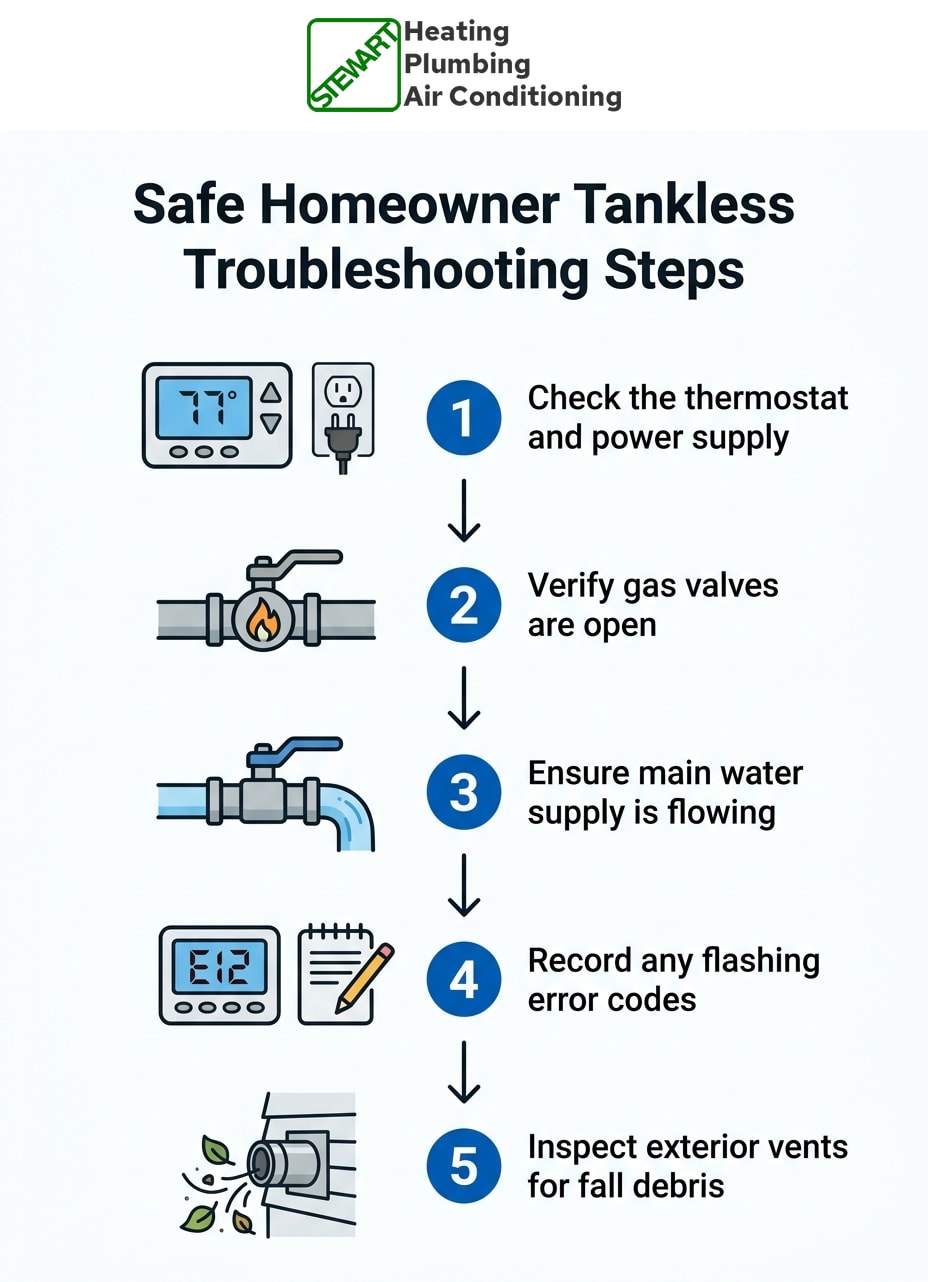
Before you panic about a broken unit, there are several basic, completely safe checks you can perform on your own. Tankless water heaters are complex machines that rely on three separate utilities to function: electricity, natural gas, and water. If any one of these is interrupted, the system will shut down to protect your home. Here is how to safely verify your supply lines without opening the unit's cabinet or touching any dangerous components.
1. Verify the electrical connection: Even though a gas tankless heater uses natural gas to heat the water, it absolutely requires electricity to power the computer board, sensors, and electronic ignition. Check your home's main electrical panel for a tripped circuit breaker. Look for a breaker switch that has flipped to the middle position, and firmly push it to "off" before clicking it back to "on." Next, look at the outlet where the heater is plugged in to ensure the cord has not vibrated loose. If you are troubleshooting a tankless water heater that won't ignite, a simple lack of power is often the first culprit.
2. Confirm the gas supply: The system cannot create a flame without fuel. Check the gas valve located on the pipe leading into the bottom of the heater; the handle should be parallel to the pipe, meaning it is fully open. To confirm your home actually has gas flowing from the utility company, try turning on your gas stove or checking another gas appliance to see if it operates normally.
3. Check the water flow: Tankless units use an internal flow sensor to detect when you open a tap. If water is not flowing fast enough, the burner will not ignite. Ensure the main water shutoff valve to the house is completely open and not partially closed.
Sometimes the problem is not the water heater at all. Test multiple fixtures in your home to narrow down the issue. Turn on the kitchen sink, then a bathroom faucet, and finally the shower. If you have hot water in the kitchen but the shower is freezing, the issue is isolated to that specific showerhead. Often, a clogged aerator or a failing anti-scald valve in the shower handle restricts flow just enough that the tankless unit does not register the demand to turn on.
Modern tankless water heaters are essentially smart appliances. When something goes wrong, they do not just stop working quietly; they actively try to tell you exactly what the problem is. This communication happens through the digital display panel, which is usually located right on the front cover of the unit or on a wired remote controller inside your home.
When the system detects a fault, it will lock out the burner for safety and display a flashing diagnostic code. These flashing numbers or letters are not random. They are specific error codes designed by the manufacturer to pinpoint the exact point of failure, whether that is an ignition failure, a blocked exhaust vent, or a malfunctioning flow sensor.
The most important step you can take is to write down the exact code before you try to reset the system. Resist the urge to simply unplug the unit to clear the screen. While a hard reset might temporarily remove the code, it erases the diagnostic history that a technician needs to fix the underlying issue permanently.
Once you have the code written down, consult your owner's manual. The troubleshooting section will contain a chart explaining what the specific letters and numbers mean.
• Ignition codes: Usually indicate a problem with the gas supply, a dirty flame sensor, or the igniter failing to spark.
• Airflow codes: Point to a blockage in the intake or exhaust pipes, preventing safe combustion.
• Maintenance codes: Warn that the system has reached a certain number of operational hours and requires immediate flushing due to scale buildup.
Providing this exact error code to a dispatcher when you call for help drastically speeds up professional repair times. The technician can arrive at your home with the correct replacement parts already loaded on the truck, getting your hot water restored much faster during those freezing November cold snaps.
In our decades of experience serving East Bay homeowners since 1974, our team at Stewart Heating, Plumbing and Air Conditioning has found that one of the most common reasons a tankless system suddenly fails during a cold snap has nothing to do with broken mechanical parts, but rather what is flowing through the pipes themselves. Contra Costa County's varying hard water levels rapidly accelerate scale buildup inside tankless heat exchangers. If you have noticed white, chalky residue around your showerheads or kitchen faucets, that exact same mineral buildup is happening inside your water heater.
Hard water contains high levels of dissolved minerals, primarily calcium and magnesium. When this water is rapidly heated inside the narrow copper coils of a tankless heat exchanger, a chemical reaction occurs. The intense heat causes the minerals to separate from the water and bake onto the inside walls of the pipes.
Over time, this creates a thick, rock-like layer of scale. The major problem is that scale acts as a powerful insulator. It creates a physical barrier between the hot gas burner on the outside of the pipe and the cold water flowing on the inside.
During the summer, the incoming water is warm enough that the heater can still push enough thermal energy through the scale layer to get the job done. But neglected summer scale buildup becomes a critical point of failure when winter groundwater temperatures demand maximum heat transfer. The burner fires at maximum capacity, but the heat simply cannot penetrate the thick scale. The internal temperature of the unit overheats, triggers a safety sensor, and shuts the system down completely.
To prevent permanent heat exchanger damage—which is often explicitly not covered by manufacturer warranties if caused by scale—annual flushing and descaling is an absolute necessity. Scheduling routine plumbing maintenance ensures a technician pumps a specialized descaling solution through the unit for nearly an hour, dissolving the hardened minerals and restoring the heat exchanger to peak efficiency before the severe cold weather sets in.
Tankless water heaters do not just require water and gas; they need a massive amount of fresh air to function safely. These high-efficiency systems rely on precise airflow for clean combustion. If they cannot "breathe" properly, built-in safety switches will immediately lock the system out to prevent dangerous gas buildup or carbon monoxide production.
If your system is displaying an airflow error code, the safest step you can take as a homeowner is to visually inspect the exterior exhaust and intake pipes. Depending on your home's layout, these PVC or metal pipes will exit through the side wall of your house or vertically up through the roof.
Late fall is the prime time for venting obstructions. As the weather changes in Pittsburgh, CA and the East Bay, environmental factors can easily choke off your system's air supply.
Common venting obstructions include:
• Accumulated leaves: Fall foliage blowing across the yard can easily get sucked against a low-lying intake screen, completely blocking fresh air.
• Small animal nests: Birds, mice, and insects often seek the warmth of an exhaust pipe to build nests as the outdoor temperatures drop.
• Heavy debris: Strong wind storms can blow plastic bags, twigs, or dirt directly into the venting hoods.
While clearing a dry leaf off the exterior screen is perfectly safe, you must draw a strict line when it comes to the pipes inside your home. Never attempt to dismantle, loosen, or clean any interior venting pipes connected to the top of the water heater.
Improper reassembly of these exhaust pipes can lead to dangerous carbon monoxide leaks inside your living space. Carbon monoxide is an odorless, colorless gas that is a natural byproduct of burning natural gas. The venting system is carefully sealed with specialized gaskets to push this gas safely outside. If you suspect an obstruction deep inside the pipe, leave the unit turned off and wait for a professional to inspect the flue safely.
There is a significant difference between checking a tripped breaker and attempting a mechanical repair. Establishing firm boundaries for homeowner troubleshooting is critical for the safety of your family and the longevity of your expensive equipment. Basic visual checks, verifying the gas valve position, and resetting a breaker are the absolute limits of safe DIY troubleshooting.
The moment a repair requires removing the front cover of the tankless unit, a licensed professional is legally and practically required. Inside that cabinet is a complex, tightly packed integration of high-voltage electrical components, highly pressurized water lines, and combustible natural gas.
Testing internal electrical sensors, adjusting gas manifold pressure, or attempting to clean the burner assembly requires specialized diagnostic tools and years of training. Attempting these repairs on your own carries severe risks:
• Hazardous gas leaks: Stripping a gas fitting or improperly seating a valve can result in a catastrophic natural gas leak in your garage or utility closet.
• Voided warranties: Every major tankless manufacturer explicitly states that any internal repairs performed by an unlicensed individual will instantly void the warranty, leaving you responsible for the entire cost of a replacement.
• Electrical shorts: Accidentally crossing wires on the computer board can permanently destroy the system's "brain," turning a minor sensor issue into a total system replacement.
As a family-owned business serving the East Bay since 1974, our technicians at Stewart Heating bring decades of trusted expertise to safely diagnose complex gas and plumbing issues. A pattern we see often is homeowners accidentally causing more damage by attempting internal fixes. Local expertise ensures that every repair meets strict municipal safety codes and manufacturer specifications. When you reach the limit of visual checks, relying on professional plumbing services is the only way to guarantee your home remains safe.
While minor flow issues or a tripped breaker can sometimes be resolved quickly at home, persistent cold water during a November cold snap requires expert attention. Do not let a struggling tankless water heater ruin your family's comfort as winter approaches. Prioritize safety over guesswork, and never take risks with natural gas or electrical components.
If your system is locked out, displaying error codes, or simply failing to provide the heat you need, the best next step is to consult with a local expert for a thorough diagnosis. You deserve clear, expert guidelines on what is normal upon first startup versus what requires professional intervention to ensure your hot water reliability through the winter.
Why is my tankless water heater suddenly running cold in the winter?
Your tankless water heater runs cold in the winter because dropping groundwater temperatures force the system to work much harder. As the incoming water gets colder, the unit requires a higher temperature rise to reach your set thermostat level. If the system is overwhelmed or heavily scaled with minerals, it cannot transfer enough heat, causing it to either reduce water flow intentionally or shut down entirely for safety.
How do I check the error code on my tankless water heater?
You can check the error code by looking at the digital display panel on the front of the unit or on your wired indoor remote controller. When a fault occurs, the screen will flash a specific sequence of numbers or letters. Write this code down exactly as it appears and consult your owner's manual to identify the specific issue before calling for a professional repair.
Is there a reset button on a tankless water heater?
Most tankless water heaters do not have a traditional "reset button" on the outside of the unit. You can often reset the computer board by turning the power off at the digital controller or temporarily flipping the circuit breaker. However, repeatedly resetting the system without addressing the underlying flashing error code can cause permanent damage to the internal components.
Why does my tankless water heater go cold after a few minutes?
A tankless water heater going cold after a few minutes is commonly referred to as a "cold water sandwich," usually caused by a drop in water flow or a blocked exhaust vent. If the flow sensor detects that water is not moving fast enough—often due to a clogged showerhead or severe scale buildup—it will shut off the burner to prevent the water from boiling. Once the burner shuts off, a pocket of cold water travels through the pipes to your faucet.
How often should a tankless water heater be descaled in Contra Costa County?
In Contra Costa County, a tankless water heater should be descaled at least once a year due to the region's varying hard water levels. Hard water causes calcium and magnesium to rapidly bake onto the heat exchanger, acting as an insulator that blocks heat transfer. Annual flushing with a specialized descaling solution prevents permanent damage and keeps the system running efficiently through the winter.

Very professional and complete. I would recommend Stewart to anyone. Highest quality of workmanship and clean installation.
Stewart Heating Plumbing Air Conditioning just did some work for us for the first time. They did an installation at my home and it turned out well. I thought the price was fair and I definitely would use them again. The technicians were very friendly and knowledgeable about their work. I highly recommend Stewart Heating Plumbing Air Conditioning and already told friends to use them.
We have been using Stewart Heating Plumbing Air Conditioning since 1995. They put the original heating and air unit in the house, and we have just stayed with them. They are dependable and honest people, and they have done a good job for us every time that we have used them!
They came and did an inspection and are coming tomorrow to do the repair.
They replaced a regulator the first time, and then the water heater vent had to be replaced. They did great work.
The gentleman that serviced us was helpful, insightful, and knew what he was talking about. Overall, it was a great experience.