

Recent Blogs
Stay updated with our latest blog posts.

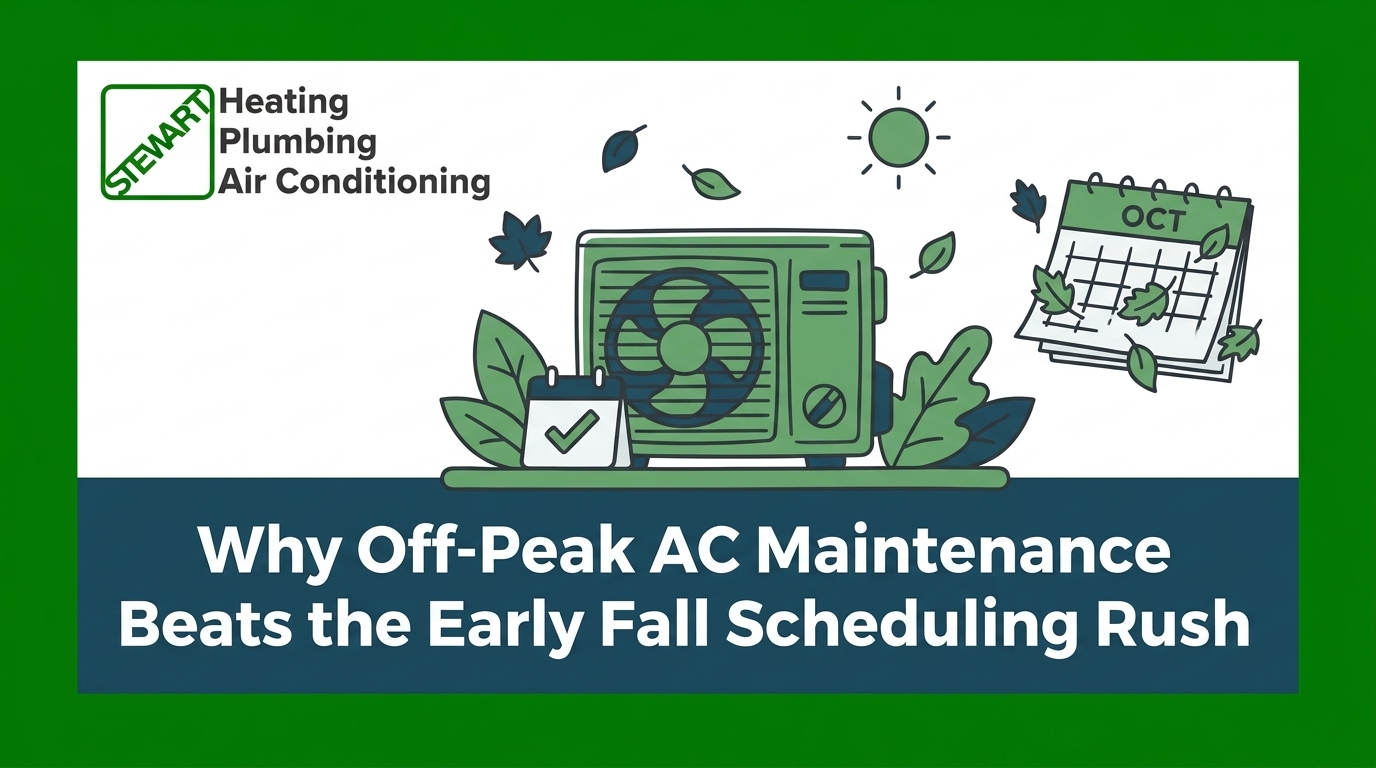
The end of summer is quickly approaching in the East Bay, and while the calendar is about to turn, your cooling system is still working overtime. Here at Stewart Heating, Plumbing and Air Conditioning, we always advise our customers that Scheduling Off-Peak AC Maintenance to Avoid the Holiday Rush is the absolute best way to protect your equipment after months of heavy use. If you are noticing longer cooling cycles or slightly warmer air coming from your vents, your system is already showing the cumulative wear and tear of a long, hot season in Pittsburgh, CA. Catching these minor issues now prevents them from turning into major failures when the local temperature spikes.
For comprehensive air conditioning services, securing your HVAC maintenance plan before the seasonal transition is the smartest move you can make.
Air conditioning systems do not simply break down out of nowhere. Every hour your unit runs during the peak summer months, it accumulates microscopic wear. Belts stretch, lubrication dries up, and electrical connections vibrate loose. By the time late August arrives, your system has endured hundreds of hours of intense, continuous operation. Acknowledging this heavy workload is the first step in protecting your investment.
Waiting until the official start of fall to address this wear is a common mistake that leads to unexpected breakdowns. Homeowners who delay their tune-ups often find themselves stuck in a massive scheduling bottleneck, competing with hundreds of other residents for the exact same appointment slots. Proactively booking your service right now ensures uninterrupted comfort for your family and gives your system the exact care it needs to cross the finish line of the hot season smoothly.
In our decades of serving Pittsburgh, CA, our technicians have seen firsthand how the intense, dry heat of the East Bay summer does more than just make you uncomfortable—it actively accelerates dust accumulation and system strain on your outdoor unit. Over the past few months, airborne debris, pollen, and dry soil have been pulled directly into your system's delicate fins. This restricts critical airflow, forcing the compressor to work twice as hard just to achieve the same indoor temperature.
Continuous cycling stresses internal components in ways you cannot see from the outside. When a system struggles to breathe through dirty filters or clogged coils, the internal operating temperature rises. This excess heat degrades the performance of critical parts like motors, capacitors, and contactors. Addressing this wear immediately through professional AC coil cleaning and a thorough inspection prevents minor friction from compounding into a total mechanical failure.
The physics of continuous cooling takes a heavy toll on your system's moving parts. When our team opens up an AC unit after a long summer in Pittsburgh, CA, here is exactly what we typically find inside:
• Lubrication breakdown: Blower motors and condenser fans running non-stop generate immense friction. Over time, the factory lubrication degrades, leading to metal-on-metal grinding that can destroy the motor bearings entirely.
• Electrical fatigue: The constant vibration of the outdoor unit, combined with the thermal expansion and contraction from daily temperature swings, causes electrical connections to loosen. Loose wires create resistance, which generates heat and can eventually melt critical components.
• Refrigerant fluctuations: Even a microscopic pinhole leak can cause refrigerant levels to drop over months of heavy use. Running a system with low refrigerant forces the compressor to overwork, risking a catastrophic failure that requires a complete system replacement.
When you ignore these hidden tolls, you are essentially gambling with your equipment's lifespan. A proactive inspection catches the dry bearings, tightens the loose wires, and verifies the exact refrigerant charge, restoring your system to factory specifications before the damage becomes permanent.
The late August back-to-school transition is not just a shift in your family's daily routine; it is the exact moment the local home service industry experiences a massive spike in demand. Understanding how this bottleneck forms is the key to avoiding it.
Step 1: The Routine Shift
As summer vacations end and families return to strict school and work schedules, homeowners suddenly start paying closer attention to their indoor environment. The house is occupied differently, thermostats are reprogrammed, and lingering comfort issues that were ignored during summer trips suddenly become daily annoyances.
Step 2: The Sudden Realization
Right as the season turns, thousands of residents simultaneously realize they need maintenance. Some want to fix a rattling noise they have heard since July, while others are trying to prep their furnaces for the upcoming winter. This dual demand floods local dispatchers with calls, instantly booking up the calendar for weeks in advance.
Step 3: The Holiday Emergency
Our dispatchers at Stewart Heating, Plumbing and Air Conditioning often see the consequences of this bottleneck firsthand. For instance, one local homeowner found themselves without cooling when their system suddenly started blowing warm air at 7 p.m. on the Friday of Labor Day weekend during a major heat wave. Our technician had to troubleshoot the system for two hours before discovering a loose wire that had finally failed after months of vibration. While cooling was restored for the hot holiday weekend, the stress, discomfort, and emergency dispatch could have been avoided entirely with an earlier inspection.
Operating in the area since 1974, our team brings over 50 years of local experience to the table, and we have watched this exact scheduling pattern unfold year after year. Positioning yourself ahead of this predictable calendar bottleneck guarantees you get the service you need on your own terms, rather than waiting days for an available technician during a heatwave.
Putting off your late-summer tune-up does not just risk a breakdown; it actively drains money from your wallet every time the thermostat clicks on. The U.S. Department of Energy reports that air conditioners can lose up to 5% of their original efficiency for every single year of missed maintenance. When you multiply that across a system's lifespan, the financial impact of neglect becomes staggering.
When our technicians get called out to homes with skyrocketing late-summer utility bills, the biggest culprit we find is restricted airflow. Airborne dirt and debris coat the outdoor condenser coils, acting like a thick insulating blanket. This prevents the system from releasing the heat it absorbed from inside your house. In fact, running an air conditioner with dirty condenser coils can increase the system's energy consumption by up to 30%. Your unit is forced to run longer, harder cycles just to achieve the same cooling output.
This reduced efficiency also directly diminishes your indoor air quality and creates uneven cooling throughout the home. When the blower motor struggles to push air through a clogged filter or dirty evaporator coil, the rooms furthest from the system simply will not receive enough conditioned air. Late-summer maintenance restores this lost efficiency just when it is needed most, ensuring your home in Pittsburgh, CA remains perfectly balanced.
• Proactively Maintained — Energy Consumption: Operates at peak factory efficiency — Cooling Cycle Length: Short, effective cycles — Indoor Air Quality: Clean, properly filtered air
• Delayed Maintenance — Energy Consumption: Up to 30% increase in energy draw — Cooling Cycle Length: Extended runtime to reach set temp — Indoor Air Quality: Increased dust and allergen circulation
• Severely Neglected — Energy Consumption: Maximum energy draw, high utility bills — Cooling Cycle Length: Continuous running, never satisfies thermostat — Indoor Air Quality: Poor airflow, stale and humid air
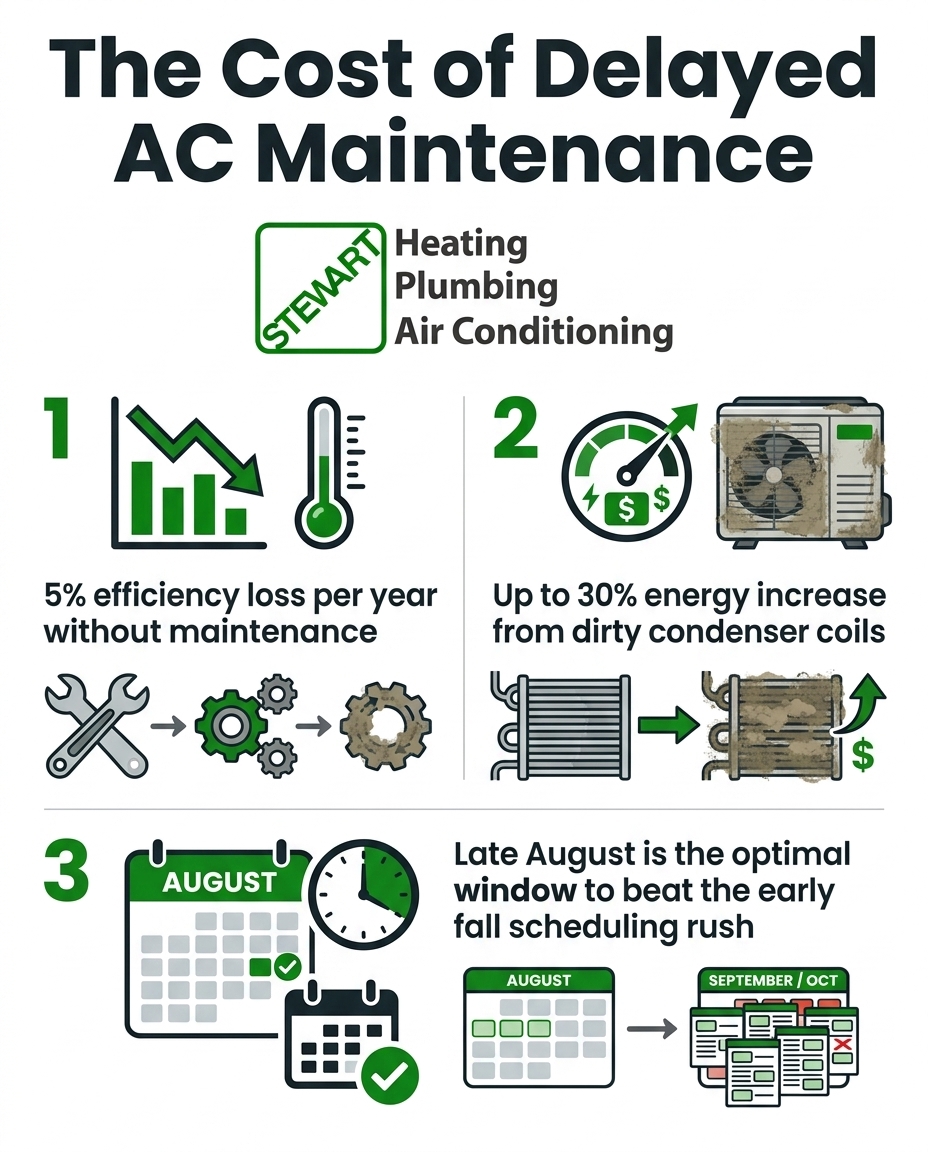
Traditional home improvement advice often suggests that you should start preparing your home for fall the moment September arrives. However, as a team that has kept East Bay homes cool since 1974, we know that generic advice completely ignores the specific reality of our climate. In our region, late summer heat frequently extends well into September, demanding sustained and reliable AC usage past the typical summer window.
Your air conditioner must remain fully optimized even as the calendar officially shifts to autumn. The late August back-to-school transition might signal the end of summer vacations, but it certainly does not signal the end of cooling season. A system that has been compromised by heavy July and August usage is incredibly vulnerable to failure during these unexpected late-season temperature spikes.
When an unmaintained system is suddenly hit with a 95-degree day in mid-September, the accumulated stress often proves to be too much. Capacitors blow, fan motors seize, and compressor relays fail. By securing an off-peak tune-up now, you gain the ultimate peace of mind. You will know with absolute certainty that your freshly tuned system is fully capable of handling whatever unpredictable weather September decides to throw your way.
Beyond the mechanical benefits to your equipment, choosing to book your service during the brief late-summer window offers massive logistical advantages for you as a homeowner. When you schedule a tune-up before the seasonal rush begins, you take total control of the process.
Here is what you gain by acting during the late August back-to-school transition:
• Shorter wait times for preferred slots: Instead of taking whatever emergency appointment is left, you get first pick of the dates and times that actually fit your family's routine.
• Greater flexibility around your schedule: Off-peak booking means you do not have to burn vacation time or scramble to find someone to wait at the house for a technician.
• Thorough, unhurried inspections: When technicians are not buried under a massive backlog of emergency breakdown calls, they have the time to perform deeply comprehensive diagnostics on your entire system.
• Immediate parts availability: If your system does need a minor repair, securing the necessary replacement parts is fast and easy before the seasonal rush depletes the inventory at local supply houses.
Taking advantage of this quiet period in the HVAC calendar is the easiest way to guarantee a stress-free service experience.
Off-peak scheduling is the perfect solution for preventing immediate emergencies, but true home comfort requires a long-term strategy. Transitioning from reactive repairs to proactive care is the single best way to protect your home in Pittsburgh, CA year after year. This is where the value of an ongoing HVAC maintenance agreement truly shines.
Formalizing your maintenance takes all the guesswork out of the seasonal transition. You no longer have to remember to call and book an appointment; the process is automated for you. Recently, a local customer who has relied on our team at Stewart Heating, Plumbing and Air Conditioning for 33 years called us about an unexpected AC performance issue. After our technician thoroughly inspected the unit, explained the underlying problem, and demonstrated how a simple fix would resolve it, the homeowner saw the immediate value in preventing future surprises. They signed up for an ongoing maintenance contract on the spot, knowing it would keep their system running efficiently for years to come.
By locking in an agreement, you guarantee that your system receives professional attention before every major weather shift. You bypass the scheduling lines, maximize your energy efficiency, and dramatically extend the functional lifespan of your heating and cooling equipment.
The brief window for off-peak scheduling is closing quickly. As the late August back-to-school transition finishes and we move deeper into the early fall months, appointment availability will drop drastically. Do not wait for a lingering September heatwave to test the limits of your tired air conditioner.
Proactive booking ensures your home remains a comfortable sanctuary through the rest of the warm season. By taking action now, you can lock in your preferred time slot and explore the benefits of a comprehensive HVAC maintenance plan. Scheduling Off-Peak AC Maintenance to Avoid the Holiday Rush is the smartest decision you can make for your equipment, your comfort, and your peace of mind.
What is the best month for AC maintenance?
Our team recommends scheduling AC maintenance during the off-peak transitional months, specifically late spring (May) and late summer (August). Booking during these windows ensures you avoid the massive scheduling bottlenecks that occur during the first major heatwave or the early fall rush. Technicians have more availability, allowing you to choose an appointment time that fits your schedule perfectly.
Is August too late for an AC tune-up?
Our technicians find that August is actually an ideal time for an AC tune-up, especially in regions like ours that experience lingering heat into the fall. Your system has just endured months of heavy summer usage, causing cumulative wear and tear on moving parts. A late-summer inspection addresses this wear immediately, restoring lost efficiency and protecting the unit against unexpected breakdowns during September heatwaves.
How often should an air conditioner be serviced?
Your air conditioning system requires professional servicing at least once a year to maintain optimal performance and efficiency. If your home utilizes a heat pump system that provides both cooling and heating, it should be inspected twice a year—once before summer and once before winter. Consistent annual service is the only way to catch minor friction before it causes major mechanical failure.
Why are HVAC companies so busy in the fall?
HVAC companies experience a massive surge in demand during the fall because homeowners are simultaneously dealing with late-season AC breakdowns and early-season furnace preparations. As the weather fluctuates, systems are tested in new ways, revealing underlying issues that were ignored during the summer. This dual demand floods dispatch centers and creates significant wait times for appointments.
How does late-summer heat affect my AC's lifespan?
Late-summer heat forces an already fatigued air conditioner to continue running at maximum capacity when its internal components are at their most vulnerable. Parts that have lost lubrication or filters that are clogged with summer dust cause the system to overheat and overwork. If this stress is not relieved through proper maintenance, it can permanently damage the compressor and shorten the equipment's overall lifespan.
What is the difference between off-peak and peak-season HVAC scheduling?
Peak-season scheduling occurs during extreme weather events when dispatchers are overwhelmed with emergency breakdown calls, leading to long wait times and limited appointment flexibility. Off-peak scheduling takes place during mild transitional periods when demand is lower. Booking off-peak guarantees you faster service, your choice of convenient appointment times, and a thorough, unhurried inspection from your technician.

Very professional and complete. I would recommend Stewart to anyone. Highest quality of workmanship and clean installation.
Stewart Heating Plumbing Air Conditioning just did some work for us for the first time. They did an installation at my home and it turned out well. I thought the price was fair and I definitely would use them again. The technicians were very friendly and knowledgeable about their work. I highly recommend Stewart Heating Plumbing Air Conditioning and already told friends to use them.
We have been using Stewart Heating Plumbing Air Conditioning since 1995. They put the original heating and air unit in the house, and we have just stayed with them. They are dependable and honest people, and they have done a good job for us every time that we have used them!
They came and did an inspection and are coming tomorrow to do the repair.
They replaced a regulator the first time, and then the water heater vent had to be replaced. They did great work.
The gentleman that serviced us was helpful, insightful, and knew what he was talking about. Overall, it was a great experience.