

Recent Blogs
Stay updated with our latest blog posts.

In our experience at Stewart Heating, Plumbing and Air Conditioning, searching for reliable home maintenance tips and troubleshooting usually happens after something goes wrong in the house. You turn on your heating system for the mid-fall October heating startup, and within minutes, a distinct burning odor fills your hallways. The immediate reaction is almost always panic. Smelling smoke or burning material coming from your air vents is alarming, and your first instinct is likely to wonder if your house is in danger.
Here is the reality of the situation: that initial burning smell is incredibly common. However, you face an immediate decision point. You need to know whether it is safe to let the system run its course, or if you need to immediately power it down at the thermostat to prevent a larger hazard. Making the wrong choice can either lead to an unnecessary emergency service call or, conversely, ignore a genuine electrical hazard.
As a full-service home contractor offering professional plumbing services and comprehensive HVAC care since 1974, our dispatchers receive numerous calls about this exact issue every autumn. Homeowners are right to be cautious. Your heating system involves combustible gas, high-voltage electricity, and intense heat. But not every strange odor means your equipment is failing. By understanding exactly what is happening inside your ductwork and equipment cabinet, you can confidently diagnose the situation without putting your home at risk.
What you need to evaluate immediately:
• The type of odor: Does it smell like dusty lint, or does it smell like melting plastic?
• The presence of smoke: Is there actual visible smoke in the room, or just an invisible smell?
• The duration: Has the smell been present for five minutes, or has it lingered for an hour?
By paying attention to these sensory details, you can make an informed decision about your next steps.
To understand why your heater smells like it is burning, you have to look at what happens during the off-season. For several months out of the year, your heating equipment sits completely idle. While your air conditioner might be running, the specific heating components inside your furnace remain cold and unused.
During this extended dormant period, airborne particles circulate through your home. Pet dander, skin cells, textile fibers, and everyday household dust bypass the filter and settle directly onto the internal components of your heating system. The most critical component here is the heat exchanger—a large, clam-shaped metal shield that separates the combustion flames from the breathable air blowing into your rooms.
Our technicians consistently see how long, dry East Bay summers allow significant dust accumulation, making the first chilly October night startup in Pittsburgh CA particularly prone to this burning smell. The dust settles in a thick, uniform layer over the cold metal of the heat exchanger.
The Ignition Sequence and Burn-Off
When you finally switch your thermostat to "Heat," the system goes through its ignition sequence. The burners light, and the heat exchanger rapidly heats up to hundreds of degrees. As that metal shield gets hot, it instantly incinerates the layer of settled dust and debris. Because your blower motor is actively pushing air over that hot metal and into your ductwork, the smell of that incinerated dust is carried directly into your living spaces.
This is a completely normal mechanical process. However, safety must always remain your top priority. As HVAC professionals, we must stress that homeowners should never attempt to open the furnace cabinet to check for dust themselves. The interior of the cabinet houses raw gas lines, high-voltage capacitors, and delicate sensors. Removing the access panels exposes you to significant danger and can accidentally damage the equipment. The diagnosis must be made safely from the outside, relying on your senses rather than physical inspection.
If you suspect the odor is simply harmless dust burning off the heat exchanger, you need a reliable way to verify it. When our team guides Pittsburgh CA residents through over-the-phone diagnostics, the most accurate diagnostic tool we recommend is a strict timeline. A normal dust burn-off event follows a very predictable pattern of intensity and duration.
Follow these steps to safely monitor the situation:
1. Note the start time: The moment you notice the smell, look at the clock. Do not rely on guessing how much time has passed.
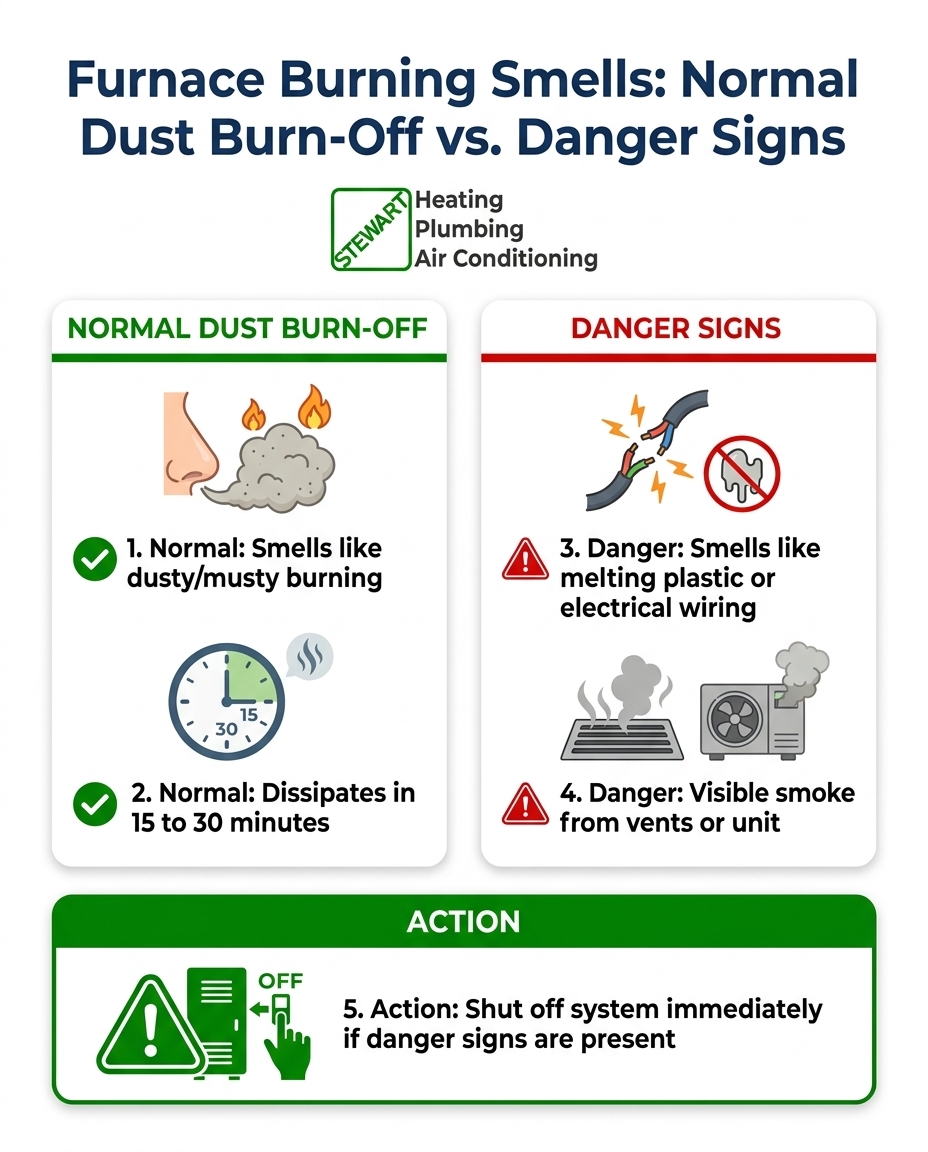
2. Monitor the intensity: The smell should peak within the first five to ten minutes of the blower turning on. After this initial peak, the odor should steadily decrease in strength. It should never get stronger or more acrid as the cycle continues.
3. Apply the time limit: The golden rule for this scenario is a 15 to 30 minutes maximum dissipation time. By the time half an hour has passed, the smell should be completely gone, or so faint that you barely notice it.
4. Ventilate the space: Because the smell of burning dust is a nuisance, you can open a few windows or doors to help clear the air. This also helps you determine if the smell is actually fading from the vents or just lingering in the room.
If the smell persists beyond that 30-minute window, the situation changes. A persistent odor means the system is no longer just burning off a thin layer of summer dust. It indicates that something is actively overheating, melting, or burning continuously. If you hit the 30-minute mark and the smell is still strong, you must shut the system off at the thermostat immediately. Continuing to run the equipment at this point risks severe mechanical damage or a fire hazard.
While a musty, dusty smell during a mid-fall October heating startup is normal, certain odors are immediate red flags. Over our decades of field experience, we have learned that when complex electrical wiring, heavy-duty motors, and synthetic components fail, they produce distinct smells that are very different from incinerated household dust.
Knowing how to identify these dangerous odors can save your equipment from a catastrophic breakdown and keep your home safe.
• Musty, dusty, or like singed hair — Likely Cause: Normal summer dust burning off the heat exchanger. — Required Action: Monitor for 15 to 30 minutes. If it fades, no action is needed.
• Burning plastic or melting rubber — Likely Cause: Electrical short, melting wire insulation, or a failing capacitor. — Required Action: Shut off immediately. Call for professional electrical diagnostics.
• Sharp metallic or ozone scent — Likely Cause: Overheating blower motor or worn-out mechanical bearings. — Required Action: Shut off immediately. The motor requires professional replacement.
• Rotten eggs or sulfur — Likely Cause: Natural gas leak near the combustion chamber or gas valve. — Required Action: Evacuate the home, call the gas company, and request emergency service.
The Smoke Rule: Regardless of the smell, if you ever see visible smoke coming from your air vents, rising from the equipment cabinet, or filling the utility room, treat it as an active emergency. Dust burn-off creates an odor, but it does not generate visible plumes of smoke. Shut the system down instantly at the thermostat, turn off the breaker if it is safe to do so, and contact a professional.
That first mid-fall October heating startup serves as a loud, sometimes smelly reminder that the seasons are changing. While diagnosing a furnace odor is a high priority, our team always advises using this time for a broader evaluation of your home's comfort systems. Winter places a heavy burden on multiple utilities in your house, not just your heating equipment.
Taking a proactive approach prevents emergency breakdowns across all your essential systems. When temperatures drop, equipment works harder, runs longer, and experiences more mechanical stress. Waiting for a system to fail in the middle of a cold snap leaves you vulnerable to uncomfortable nights and urgent repair needs.
This is the ideal time of year to evaluate your hot water supply. Our plumbers frequently notice that cold winter groundwater requires your water heater to expend significantly more energy to reach comfortable temperatures. If your hot water supply has been inconsistent, or if you want to ensure peak efficiency before the deep cold sets in, fall is the perfect season to schedule tankless water heater repair and installation. Ensuring your hot water is reliable is just as important as ensuring your furnace operates safely.
To keep everything running smoothly, we strongly recommend enrolling in a routine maintenance plan. These plans ensure that all major systems are cleaned, inspected, and validated annually by professionals, taking the guesswork out of seasonal preparation.
In our daily service routes, we find that handling your heating and plumbing needs simultaneously offers significant convenience and peace of mind. Both systems are heavily impacted by dropping temperatures.
• Shared mechanical stress: Just as your furnace blower works overtime to push warm air, your plumbing system faces the strain of colder intake water and increased indoor usage.
• Professional validation: Systems that work harder in colder months need professional validation to ensure safety switches, pressure valves, and electrical connections are secure.
• Efficiency gains: A well-maintained water heater and a clean furnace both operate more efficiently, reducing the overall energy load on your home.
The most effective way to handle a burning smell on startup is to prevent it from happening in the first place. Professional maintenance eliminates the anxiety of that first chilly night. When you schedule a professional fall tune-up with our team, a technician performs a comprehensive cleaning of the internal components before you ever turn the thermostat to "Heat."
During a tune-up, our technicians safely access the cabinet and clean the heat exchanger, removing the accumulated summer dust, pet dander, and debris. Because the fuel source for the odor is removed, the initial startup is clean and odor-free.
More importantly, we check for hidden issues that a homeowner cannot see. We test the electrical draw on the blower motor, inspect the wire insulation for signs of melting, verify the integrity of the gas valve, and check the heat exchanger for microscopic cracks that could leak carbon monoxide.
As a family-owned business serving the East Bay since 1974, we understand both local HVAC safety requirements and regional plumbing challenges. We know exactly how the local climate impacts your home's infrastructure. When you book your fall HVAC tune-up, it is also a great time to look for our seasonal plumbing repair specials to ensure your entire home is ready for winter.
If you are experiencing other seasonal utility issues alongside your heating concerns, educating yourself on system behaviors is always beneficial. For instance, understanding why your tankless water heater randomly runs cold can help you identify whether you are dealing with a minor flow issue or a sensor failure that requires our technicians' expertise.
How long should a furnace smell like burning?
A normal dust burn-off smell should completely dissipate within 15 to 30 minutes of the heating cycle. The odor will peak in the first few minutes and then steadily fade. If the smell lasts longer than half an hour, you should shut the system down.
Is it normal for a heater to smell like burning dust?
Yes, it is entirely normal during the first use of the season. Over the summer, dust and airborne particles settle on the cold heat exchanger. When the system ignites for the first time, it safely incinerates this thin layer of dust.
When should I be worried about my furnace smelling?
You should be concerned if the smell resembles melting plastic, burning rubber, or sharp electrical ozone. Additionally, if you see visible smoke or if a dusty smell persists beyond 30 minutes, shut the system off and call a professional.
What does it mean if my furnace smells like burning plastic?
A burning plastic odor usually indicates an electrical failure inside the cabinet. This could be melting wire insulation, a failing capacitor, or a seized motor overheating its housing. This is a severe safety hazard that requires immediate professional attention.
Can a dirty air filter cause a burning smell?
Yes, a severely clogged air filter restricts airflow, causing the blower motor to work much harder than intended. This excessive strain can cause the motor to overheat, producing a hot, metallic, or electrical burning smell.
Should I open the furnace cabinet to clean the dust myself?
No, you should never open the equipment cabinet to clean internal components. The cabinet contains high-voltage electrical connections, sensitive sensors, and raw gas lines. Professional technicians have the training to clean these parts safely without causing damage or risking injury.
Understanding the strict time limit for harmless dust burn-off gives you the confidence to operate your heating system safely. If you are ever in doubt about an odor, or if you want to prevent these smells entirely with a professional cleaning, prompt action is the best policy. Reach out to the Stewart Heating, Plumbing and Air Conditioning team to schedule your seasonal inspection and ensure your home remains comfortable all winter long.

Very professional and complete. I would recommend Stewart to anyone. Highest quality of workmanship and clean installation.
Stewart Heating Plumbing Air Conditioning just did some work for us for the first time. They did an installation at my home and it turned out well. I thought the price was fair and I definitely would use them again. The technicians were very friendly and knowledgeable about their work. I highly recommend Stewart Heating Plumbing Air Conditioning and already told friends to use them.
We have been using Stewart Heating Plumbing Air Conditioning since 1995. They put the original heating and air unit in the house, and we have just stayed with them. They are dependable and honest people, and they have done a good job for us every time that we have used them!
They came and did an inspection and are coming tomorrow to do the repair.
They replaced a regulator the first time, and then the water heater vent had to be replaced. They did great work.
The gentleman that serviced us was helpful, insightful, and knew what he was talking about. Overall, it was a great experience.