

Recent Blogs
Stay updated with our latest blog posts.

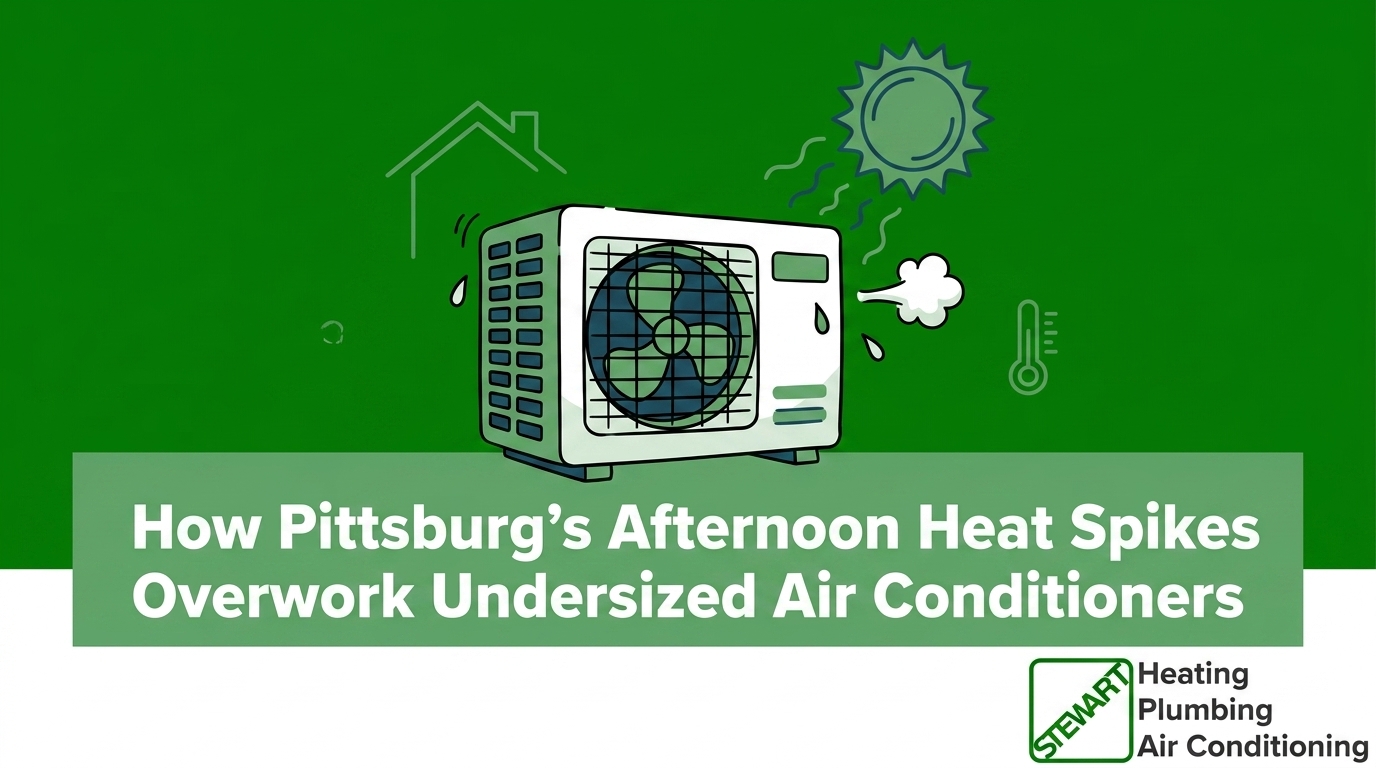
Your living room feels like an oven, and you are left wondering exactly how Pittsburg's afternoon heat spikes overwork undersized air conditioners year after year. It is 5 p.m., the thermostat reads 82 degrees, and your vents are blowing air, but the house simply will not cool down. You hear the condenser humming outside without a break, desperately trying to keep up with the rising temperature indoors. At Stewart Heating, Plumbing and Air Conditioning, our team sees this exact scenario play out daily across the unique Pittsburg CA microclimate. During the early parts of the day, your home might feel perfectly comfortable, lulling you into a false sense of security about your cooling system's capabilities.
As the sun dips lower in the western sky, intense late-afternoon heat surges flood the East Bay before the evening coastal breezes finally arrive to offer relief. These sudden, rapid temperature jumps can completely overwhelm standard cooling equipment. The thermal mass of your home—your roof, your walls, and your attic—absorbs this intense solar radiation and begins radiating it down into your living spaces right as you are getting home from work or preparing dinner.
The core decision you face in this moment is determining whether your system needs a basic repair or if the unit simply lacks the capacity to handle your home's peak thermal load. A system that runs continuously without lowering the indoor temperature is a system in distress. If you are constantly battling this evening heat and losing, reaching out for professional air conditioning services is the first step toward getting your home comfortable again. Understanding the mechanics behind this daily struggle will help you make an informed decision about your home's cooling infrastructure.
In our years of optimizing cooling systems throughout the East Bay, we've seen firsthand how the local geography creates a very specific, challenging weather pattern for residential air conditioning systems. The surrounding hills and geographical features often block the early marine layers that cool down coastal cities, leaving our area exposed to intense, concentrated solar heat gain. During the peak of summer, particularly during those brutal July afternoon heat spikes, outdoor temperatures can climb rapidly between the hours of 4 p.m. and 7 p.m. This creates what our HVAC professionals refer to as an "extreme cooling load."
To truly understand why your system struggles, you have to look at how heat enters your home. Heat transfer occurs through conduction (heat moving through your walls and roof), convection (hot air infiltrating through gaps), and radiation (the sun beating directly on your windows). Between 4 p.m. and 7 p.m., the angle of the sun is lower, meaning it strikes west-facing windows and walls almost directly. This sudden influx of radiant heat causes the indoor temperature to spike drastically.
Flat Heat vs. Surging Thermal Load
There is a massive difference between a steady, flat heat and a sudden thermal surge. When an air conditioner is properly sized for a home, it is designed to remove a specific amount of heat per hour. Here is how different weather patterns impact your equipment:
• Flat, Consistent Heat — Characteristic: Gradual temperature rise throughout the morning and early afternoon. — Impact on Cooling Equipment: System cycles on and off normally, easily maintaining the thermostat setpoint.
• Surging Thermal Load (4 PM - 7 PM) — Characteristic: Rapid, intense temperature jump combined with direct solar radiation. — Impact on Cooling Equipment: System runs continuously, struggling or failing to catch up as heat enters faster than it can be removed.
When the July afternoon heat spikes hit, the cooling load on your house essentially doubles in a matter of hours. If your equipment was installed based on average daily temperatures rather than these extreme local peaks, it will inevitably fall behind, leaving you sweating in your own living room until the sun finally goes down.
When our technicians inspect struggling systems in local residential developments, we routinely find homes originally constructed with standard builder-grade AC units. In the construction industry, "builder-grade" simply refers to minimum-standard installations. These units meet the baseline SEER (Seasonal Energy Efficiency Ratio) and tonnage requirements mandated by building codes at the time of construction, but they rarely exceed them. Builders install these systems to keep construction costs manageable, relying on basic square-footage rules of thumb rather than detailed scientific calculations.
The Limitations of Minimum-Standard Installations:
• Sized for the Average, Not the Extreme: Builder-grade units are typically sized for "average" regional temperatures. They are not engineered to handle the extreme peak surges we experience locally in the late afternoon.
• Basic Single-Stage Compressors: These units usually feature single-stage compressors, meaning they only have one speed: 100% ON or 100% OFF. They cannot ramp up their capacity to handle a sudden influx of heat.
• Lower Quality Components: Minimum-efficiency systems often feature thinner coils and less robust fan motors, making them less capable of rapid heat transfer when the outdoor temperature skyrockets.
The mechanical failure point for these systems is a matter of basic physics. An air conditioner does not actually "create" cold air; it absorbs heat from inside your house and pumps it outside. If your builder-grade unit is capable of removing 36,000 BTUs of heat per hour (a standard 3-ton unit), but the late afternoon sun is pushing 45,000 BTUs of heat into your home per hour, the system will run continuously but the indoor temperature will still rise. The equipment simply cannot transfer heat fast enough to overcome the massive solar gain pouring through your windows and roof.
This continuous operation puts immense strain on the compressor, the condenser fan motor, and the electrical components. Over time, pushing a minimum-standard unit to its absolute limit day after day leads to premature wear and tear, meaning these systems often require replacement long before their expected lifespan is up.
When your house is 85 degrees inside at dinner time, the immediate assumption is that the air conditioner is broken. However, our team frequently discovers that the system is functioning exactly as it was manufactured to function—it is just fundamentally too small for the job. Differentiating between a mechanical failure (which can be repaired) and a capacity issue (which requires replacement) is vital for long-term comfort.
Sometimes, a system that appears to be undersized is actually suffering from a hidden mechanical fault that is severely limiting its cooling output. For example, our dispatch team took a frantic call from a local homeowner on a sweltering Friday evening over a summer holiday weekend because their air conditioning was suddenly blowing warm air instead of cold. One of our technicians arrived quickly, spent time thoroughly troubleshooting the unit, and discovered a loose wire that was interrupting the cooling cycle. Once the wire was secured, the cooling was fully restored despite the hot weekend weather. Regular check-ups through a routine AC maintenance plan can catch these loose wires, failing capacitors, and dirty coils before they cause a total shutdown during a heat wave.
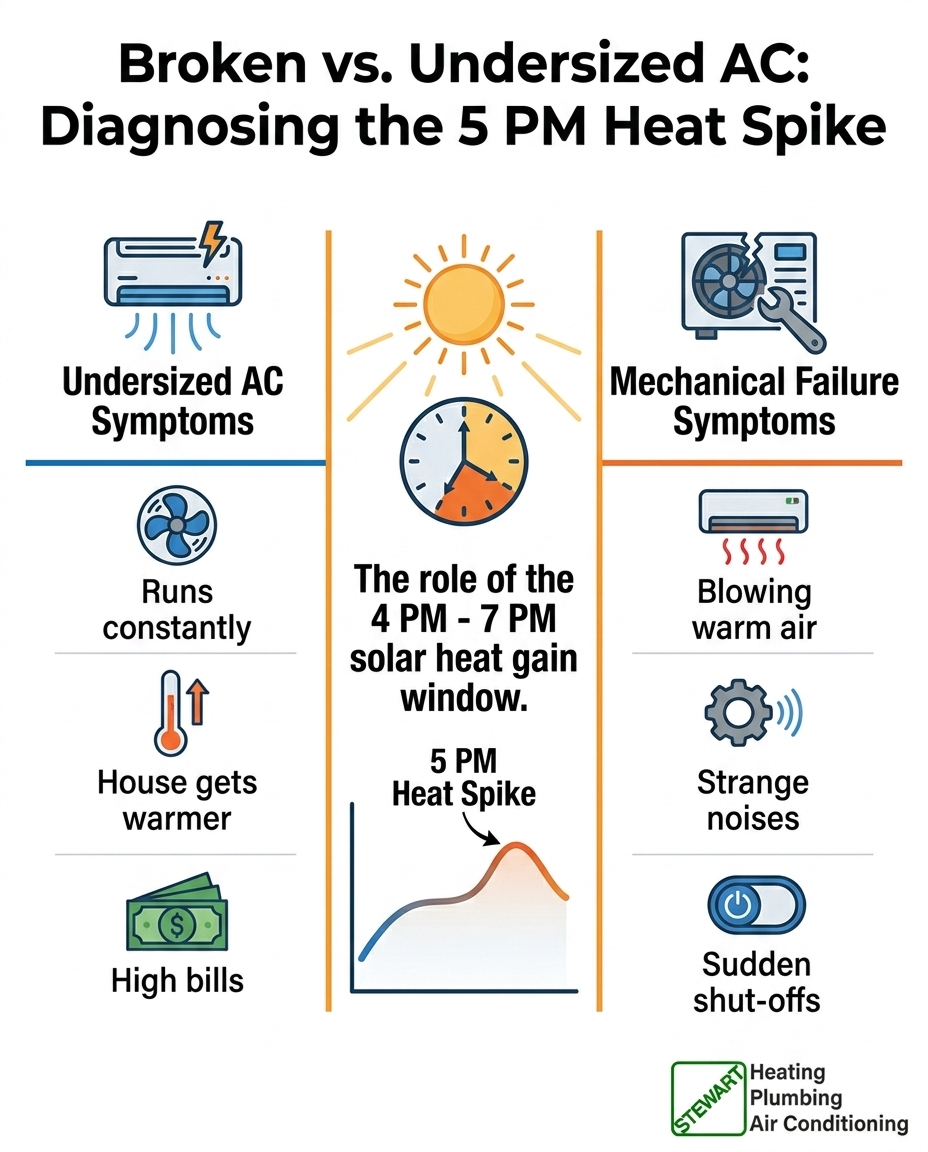
If your system is well-maintained but still failing to keep you cool, you are likely dealing with a capacity shortfall. Here are the key indicators we look for to determine if your system is undersized rather than broken:
• Continuous operation with rising temperatures: The unit turns on at 3 p.m. and does not shut off until 9 p.m., yet the indoor temperature continues to climb above your setpoint.
• High energy bills despite poor comfort: You are paying for the system to run non-stop, but you are not getting the cooling relief you are paying for.
• Takes hours to cool down after sunset: An undersized unit will eventually cool the house down, but it might take until midnight to finally reach 72 degrees.
The Danger of Secondary Failures
Pushing an undersized unit to run continuously can actually lead to severe secondary mechanical failures. When a system runs without cycling off for six or seven hours, the evaporator coil inside your home can drop below freezing. If the airflow isn't absolutely perfect, condensation on the coil will turn to ice. Once the coil freezes over, it acts as an insulator, completely blocking heat transfer. At this point, the system will blow warm air, and the compressor outside can overheat and fail entirely. Because of these overlapping symptoms, a professional evaluation from our team is always recommended to determine the true root cause of your 5 p.m. struggle.
You cannot guess the right size for an air conditioner, and you certainly cannot rely solely on the square footage of your home. The industry standard for determining exact cooling requirements is the ACCA Manual J Load Calculation. This is a highly detailed, scientific approach to HVAC sizing that takes the guesswork out of indoor comfort.
A proper Manual J calculation accounts for a wide variety of factors that dictate how much heat enters your home. Our technicians measure the exact square footage, but they also evaluate the orientation of your home—specifically, how many windows face west and take the brunt of the late-afternoon sun. They factor in the R-value of your attic insulation, the height of your ceilings, the type of roofing material you have, and the condition of your ductwork. Crucially, a proper calculation also accounts for the specific Pittsburg CA microclimate, ensuring the system can handle the unique local temperature surges.
Why Skipping the Calculation is a Costly Mistake
Many contractors skip this step, simply offering to replace your existing 3-ton unit with a new 3-ton unit. But if the original unit was undersized when the house was built, you are simply paying to install a brand new problem. Skipping the load calculation leads directly to the installation of inadequate equipment that will continue to fail during late-afternoon surges.
At Stewart Heating, Plumbing and Air Conditioning, our strict adherence to accurate Manual J load calculations and deep local knowledge of Contra Costa County means we never guess on your comfort. We take the time to measure and calculate exactly what your specific home needs to combat the local heat. Understanding the importance of this meticulous process helps explain how upgrading to a properly sized HVAC system increases home value, as buyers are increasingly looking for homes with reliable, correctly engineered climate control systems.
If your builder-grade AC units are fundamentally undersized and failing to keep your family comfortable, our team consistently finds that the most cost-effective long-term solution is a full system replacement. Continuing to pour money into repairing an undersized system that runs continuously will only lead to higher utility bills and ongoing frustration.
Modern, correctly sized systems handle sudden thermal loads beautifully. Many new high-efficiency units feature variable-speed or two-stage compressors. Unlike a standard single-stage unit that blasts at 100% capacity all the time, a variable-speed unit can run at a lower, energy-saving capacity during the mild morning hours, and then ramp up to maximum capacity precisely when the 5 p.m. heat surge hits. This provides a much more even, consistent temperature throughout the entire day, eliminating the late-afternoon hot flashes.
Upgrading or repairing complex issues often requires a professional who understands the whole picture and can adapt to the unique layout of your property. For instance, our crew recently helped a local customer dealing with a malfunctioning circuit board in their air conditioning unit, which was installed in a very unusual and hard-to-reach location. Our technician was able to quickly access and fix the problem, clearly explain the underlying issue to the homeowner, and arrange for a new modern thermostat installation to improve overall system control. This kind of comprehensive, thoughtful approach ensures your new system will be installed correctly, regardless of your home's unique quirks.
While upgrading your entire cooling infrastructure is a significant investment, it completely resolves the ongoing discomfort, the anxiety of potential breakdowns, and the high utility costs associated with struggling units. To help make this essential upgrade accessible, we offer flexible HVAC financing options that allow you to invest in a properly sized system without breaking your monthly budget.
Your house gets hotter because the amount of heat entering your home exceeds your air conditioner's capacity to remove it. During the late afternoon, intense solar heat gain hits your west-facing walls and windows, drastically increasing the thermal load. If your AC is undersized, it will run continuously but still fall behind the rapidly rising temperatures. Upgrading to a properly sized unit based on a Manual J calculation will solve this issue.
The most obvious sign of an undersized AC is continuous operation without reaching the temperature set on your thermostat. If your system runs for five or six hours straight during the July afternoon heat spikes but the house remains uncomfortably warm, it likely lacks the necessary tonnage. High energy bills paired with poor indoor comfort are also strong indicators of a capacity shortfall. A licensed HVAC professional from our team can perform a load calculation to confirm if the unit is too small.
At 5 p.m., the outdoor temperature and solar radiation are often at their absolute peak, putting maximum strain on your cooling equipment. If your AC runs constantly but fails to cool, it is either suffering from a mechanical issue (like low refrigerant or a dirty coil) or it is fundamentally undersized for the space. Continuous running is the system's desperate attempt to catch up with the heat transfer. You should have a technician inspect the unit to rule out mechanical failures before assuming it needs to be replaced.
Air conditioners in the East Bay typically struggle the most between 4 p.m. and 7 p.m. During this window, the sun is lower in the sky, casting direct radiant heat into homes, and the local geography often blocks early coastal breezes. This creates a sudden, intense spike in the cooling load that forces HVAC systems to work exponentially harder. Systems that are perfectly adequate at noon will often reveal their weaknesses during this specific late-afternoon window.
Yes, an undersized AC can absolutely cause the indoor evaporator coils to freeze over. Because an undersized unit has to run continuously for hours on end to try and cool the house, the evaporator coil gets excessively cold. If the system never cycles off to allow the coil to warm up slightly, or if the airflow is even slightly restricted, the condensation on the coil will turn to solid ice. This ice block prevents further heat transfer, causing the system to blow warm air and potentially damaging the outdoor compressor.
A Manual J load calculation is the industry-standard scientific method for determining exactly how much heating and cooling capacity a specific home requires. It factors in your home's square footage, window layout, insulation quality, ceiling height, and local climate data. You need one before installing a new AC to ensure you do not buy a unit that is too small (which will run constantly and fail to cool) or too large (which will short-cycle and fail to remove humidity).
Sweating through the late afternoon in your own living room is not a mandatory requirement of local summers. Understanding the crucial difference between a broken mechanical part and an undersized builder-grade unit is the first step to securing lasting comfort in the Pittsburg CA microclimate. When you know exactly what you are up against, you can stop wasting money on temporary band-aid repairs for a system that was never big enough to handle the job in the first place.
You deserve a home that provides a cool, relaxing sanctuary after a long day, no matter how hot it gets outside. Stop letting the 5 p.m. heat surges dictate your comfort and your utility bills. Take control of your indoor environment and schedule an HVAC installation estimate today to get a professional load calculation and system evaluation from a team that truly understands the local climate.

Very professional and complete. I would recommend Stewart to anyone. Highest quality of workmanship and clean installation.
Stewart Heating Plumbing Air Conditioning just did some work for us for the first time. They did an installation at my home and it turned out well. I thought the price was fair and I definitely would use them again. The technicians were very friendly and knowledgeable about their work. I highly recommend Stewart Heating Plumbing Air Conditioning and already told friends to use them.
We have been using Stewart Heating Plumbing Air Conditioning since 1995. They put the original heating and air unit in the house, and we have just stayed with them. They are dependable and honest people, and they have done a good job for us every time that we have used them!
They came and did an inspection and are coming tomorrow to do the repair.
They replaced a regulator the first time, and then the water heater vent had to be replaced. They did great work.
The gentleman that serviced us was helpful, insightful, and knew what he was talking about. Overall, it was a great experience.