

Recent Blogs
Stay updated with our latest blog posts.

How old is too old for an HVAC system is one of the most common questions homeowners in Pittsburg, Antioch, Concord, and across Contra Costa County face — especially when the energy bills start creeping up or the system makes a noise it never made before. The short answer depends on the type of equipment you have, but most systems hit a critical turning point well before they stop working completely.
Here is a quick reference for the typical lifespan of common residential HVAC equipment:
| Equipment Type | Average Lifespan | Consider Replacement |
|---|---|---|
| Central Air Conditioner | 15-20 years | At 12-15 years |
| Gas Furnace | 15-20 years | At 15+ years |
| Heat Pump | 10-15 years | At 10-12 years |
| Boiler | 20-35 years | At 20+ years |
| Ductless Mini-Split | 15-20 years | At 15 years |
If your system is pushing past these ranges, you are likely spending more on energy and repairs than you need to. Nearly one in three homeowners experiences a major HVAC breakdown before their system even reaches the end of its expected lifespan — often at the worst possible time, like the hottest week of summer or during a cold snap in January.
The good news is that age alone does not tell the whole story. Maintenance history, local climate conditions, and the type of repairs your system needs all factor into whether it makes sense to keep going or make the switch to something more efficient and reliable.
When we talk about whether a system is "too old," we have to look at the specific biology of your home’s heating and cooling setup. In Contra Costa County, our systems work hard. From the 100-degree afternoons in Brentwood to the damp, chilly mornings in Walnut Creek, your HVAC unit is under constant thermal stress.
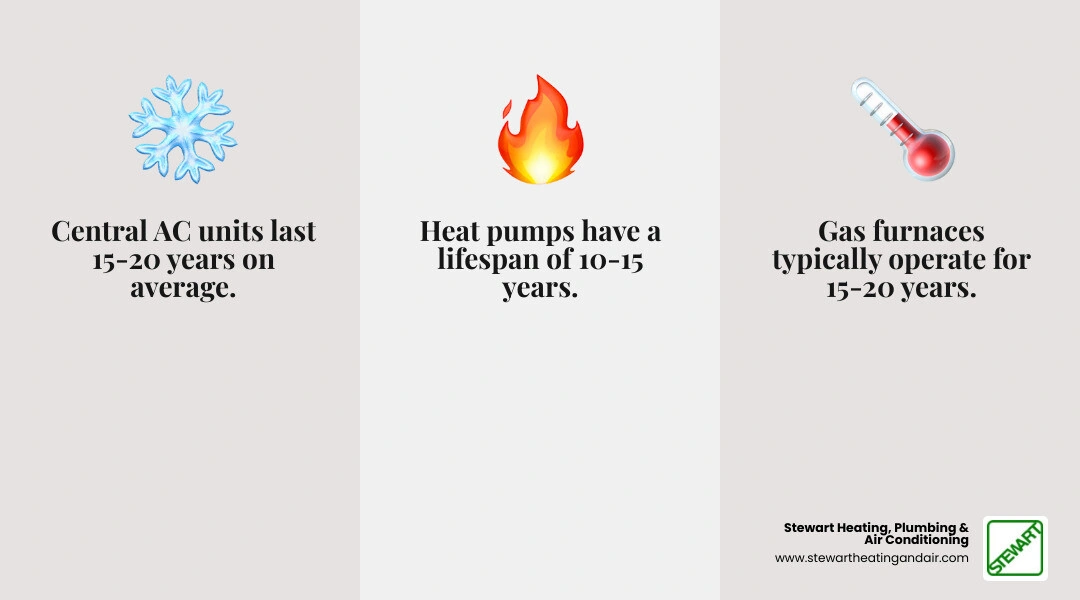
Most modern central air conditioners are designed to last between 15 and 20 years. However, the "effective" life—the period where it actually runs efficiently—often ends around the 15-year mark. By this point, the mechanical wear on the compressor and the accumulation of dirt on the coils usually mean the unit is working twice as hard to provide half the cooling.
Gas furnaces are the marathon runners of the HVAC world. Because they only run during the cooler months in Northern California, they often last a solid 20 years. However, once a furnace crosses the 15-year threshold, the risk of a cracked heat exchanger increases. This isn't just a repair issue; it’s a major safety concern. We often see Signs That Indicate Furnace Replacement such as soot around the registers or a yellow burner flame, which signal that the system is reaching its limit.
Heat pumps have a shorter lifespan than dedicated furnaces or AC units for one simple reason: they work double-time. A heat pump provides both heating and cooling, meaning it operates year-round without a seasonal break. In areas like Pittsburg or Antioch, a heat pump might run for 4,000 to 5,000 hours a year. This constant operation usually brings its retirement age down to the 10-to-15-year range.
If you live in an older home in Lafayette or Alamo with a boiler system, you might be surprised to find your unit is 30 years old and still kicking. Cast-iron boilers are incredibly durable, but they are also incredibly inefficient compared to May 2026 standards. While they can last 35 years, the energy waste usually makes them "too old" long before they actually stop heating.
It is important to distinguish between "design life" and "expected lifespan." Design life is what the manufacturer says the unit can do in a laboratory. Expected lifespan is what happens in the real world. In coastal-influenced areas of Contra Costa, salt air and humidity can cause base pan corrosion, shortening a 20-year design life to a 12-year reality.
Before you can decide if your system is too old, you need to know exactly how old it is. Most homeowners don't keep the original receipts from an installation that happened over a decade ago, but your unit carries its "birth certificate" on its sleeve.
To find the age, look for the metal manufacturer’s nameplate on the side of your outdoor condenser or the indoor furnace cabinet. You’ll see a model number and a serial number. While some brands print the manufacture date clearly, others hide it in the serial number. Usually, the first four digits represent the week and year. For example, a serial number starting with "1426" often means the unit was built in the 14th week of 2026.
If the nameplate is faded from the California sun, check for a service sticker left by a previous technician. Regular maintenance is the best way to track a system’s health over time. Our HVAC Service Frequency Complete Guide explains how these records help us predict when a component is likely to fail before it actually leaves you in the heat.
At 12 years old, an HVAC system is entering its "midlife crisis." This is the inflection point where efficiency slippage becomes noticeable. Research shows that by year 12, most central air systems operate at only 80% to 85% of their original efficiency.
If your 12-year-old unit was installed back when SEER ratings were lower, you are likely paying 20-30% more on your PG&E bills than necessary. Mechanical fatigue starts to set in around this age—bearings wear down, capacitors fail more frequently, and the fan motor might start sounding like a 90s dial-up modem. If you are in Pittsburg, checking our HVAC Maintenance Pittsburg CA Guide can help you determine if a 12-year-old unit just needs a tune-up or if it’s time to start shopping.
Once a system hits 15 years, it has hit "The Wall." At this stage, technological obsolescence is a bigger factor than mechanical failure. Even if the unit is still running, it is likely using outdated refrigerant (like R-22 or early R-410A) and lacks the variable-speed technology that makes modern homes so comfortable.
Frequent breakdowns become the norm at 15 years. If you find yourself calling for a repair every summer, the system is telling you it's tired. For those with older heating systems in Concord, our Furnace Maintenance Concord CA Guide highlights why the 15-year mark is often the most cost-effective time to upgrade.
Deciding to replace an HVAC system is a major financial move. To take the emotion out of the decision, we use two industry-standard "rules of thumb" to help our customers in Contra Costa County.
This one is simple: If the cost of a single repair is 50% or more of the cost of a brand-new system, you should replace it. Spending thousands of dollars to fix a 15-year-old compressor is like putting a brand-new engine into a car with 300,000 miles and a rusted frame. You might fix the engine, but the transmission is likely next.
This is a favorite among technicians for its mathematical clarity. Multiply the age of your system by the cost of the repair. If the result is more than $5,000, it is time to replace the unit.
One of the biggest factors in repair costs today is refrigerant. R-22 (Freon) was phased out in 2020. If your old system has a leak and uses R-22, the cost of the "liquid gold" refrigerant alone can make the repair unjustifiable.
Furthermore, as of May 2026, we are well into the R-410A phasedown. This means even systems from ten years ago are becoming more expensive to service as the industry moves toward lower-GWP (Global Warming Potential) refrigerants. Investing in a modern system now ensures you aren't stuck with an obsolete refrigerant in a few years.
Understanding the long-term value is key. We often discuss with homeowners Is an HVAC Maintenance Plan Worth It because proactive care can delay these expensive decisions by several years, giving you more time to plan for an upgrade.
Keeping an "ancient" HVAC system isn't just a matter of high bills; it can actually be a hazard to your home and health.
The biggest risk of an old furnace is a cracked heat exchanger. This component is the only thing standing between the combustion gases (including carbon monoxide) and the air you breathe. Over 15-20 years, the metal expands and contracts thousands of times, eventually leading to stress cracks. Because carbon monoxide is odorless and colorless, an old furnace is a silent threat that requires annual safety inspections.
Older AC units often struggle with moisture management. If the condensate drain is old or the coils are permanently caked with dust, they can become a breeding ground for bacteria and mold. This air is then circulated throughout your home in Brentwood or Martinez. Upgrading to a new system often includes advanced filtration and UV light options that dramatically improve indoor air quality.
In 2023, the industry moved to SEER2 standards, which are much more stringent. A new system today is 20-40% more efficient than a unit from 2010. Modern variable-speed compressors don't just turn "on" or "off"—they ramp up and down to maintain a perfect temperature. This results in better humidity control and fewer "hot spots" in your home.
Don't forget the basics during this transition, though. Even a brand-new system will fail prematurely if you don't know How Often Should You Change Your HVAC Air Filter.
Why does your neighbor’s AC last 22 years while yours is struggling at 12? Several local factors influence how fast a system ages in Contra Costa County.
The most important day in the life of an HVAC system is the day it is installed. If a system is oversized, it will "short cycle," turning on and off constantly, which wears out the compressor. If the ductwork is leaky, the system has to run longer to reach the thermostat setting. We focus on doing projects right the first time because proper sizing and sealing can add five years to a system's life.
In Pittsburg and Antioch, we deal with extreme temperature swings. A system might deal with a 40-degree morning and a 95-degree afternoon. this causes "thermal stress" as components rapidly expand and contract. This is why regular maintenance—cleaning the coils and checking refrigerant levels—is so critical in our region.
While we aren't directly on the ocean, the "Delta Breeze" brings in moisture and salt air that can accelerate corrosion on outdoor units in Brentwood and Oakley. Additionally, leaky ductwork can waste up to 30% of your conditioned air. If your system is old, your ducts might be too, leading to a "slow bleed" of energy and money.
It is possible, but very rare. We typically only see this with high-quality gas furnaces or cast-iron boilers that have been meticulously maintained every single year. However, even if a system lasts 30 years, it is usually a financial mistake to keep it. The efficiency of a 30-year-old unit is often less than half of a modern unit, meaning you are effectively paying for a new system every few years through inflated energy bills.
The primary risk is a cracked heat exchanger leading to carbon monoxide poisoning. Secondary risks include electrical fires from brittle wiring and property damage from leaking condensate lines. If a technician finds a cracked heat exchanger, safety codes (like NFPA 54) often require the system to be shut down immediately until it is replaced.
In a competitive real estate market like Walnut Creek or Danville, an old HVAC system is a "red flag" for buyers. A new, Energy Star-rated system with a transferable warranty provides buyer confidence. It signals that the home has been well-maintained and that the new owner won't face a massive expense immediately after moving in. Plus, integration with smart thermostats allows for the modern, tech-forward home experience buyers expect in 2026.
At Stewart Heating, Plumbing & Air Conditioning, we have spent years helping our neighbors in Pittsburg, Concord, and throughout Contra Costa County navigate the "repair vs. replace" dilemma. We know that how old is too old for an hvac system isn't just a technical question—it's a question of safety, comfort, and financial peace of mind.
Whether your system is 12 years old and needs a professional assessment or 20 years old and ready for a graceful retirement, our team is committed to quality craftsmanship and customer satisfaction. We don't just install equipment; we design comfort solutions that are built to last.
If you are concerned about the age or performance of your heating and cooling system, don't wait for a breakdown during a heatwave. Contact us today to schedule a comprehensive system evaluation.
Schedule Your HVAC Assessment with Stewart Heating, Plumbing & Air Conditioning

Very professional and complete. I would recommend Stewart to anyone. Highest quality of workmanship and clean installation.
Stewart Heating Plumbing Air Conditioning just did some work for us for the first time. They did an installation at my home and it turned out well. I thought the price was fair and I definitely would use them again. The technicians were very friendly and knowledgeable about their work. I highly recommend Stewart Heating Plumbing Air Conditioning and already told friends to use them.
We have been using Stewart Heating Plumbing Air Conditioning since 1995. They put the original heating and air unit in the house, and we have just stayed with them. They are dependable and honest people, and they have done a good job for us every time that we have used them!
They came and did an inspection and are coming tomorrow to do the repair.
They replaced a regulator the first time, and then the water heater vent had to be replaced. They did great work.
The gentleman that serviced us was helpful, insightful, and knew what he was talking about. Overall, it was a great experience.