

Recent Blogs
Stay updated with our latest blog posts.

Your morning routine is running like clockwork until you step into the shower and are met with an icy shock. The water heater has stopped working again, leaving you frustrated and behind schedule. Our team at Stewart Heating, Plumbing and Air Conditioning fields countless calls from homeowners facing this exact scenario. If you are trying to understand how a failing hot water tank pressure switch mimics other heating issues, you are facing a common but confusing diagnostic puzzle. Intermittent hot water failures during high-demand mornings are incredibly disruptive, and power vent water heaters are particularly vulnerable to this specific type of diagnostic confusion.
When a no-hot-water lockout occurs, you face a critical decision point: do you approve an expensive electronic component replacement right away, or do you request further isolation of the venting system? Because modern water heaters rely on a strict sequence of safety checks, a failure early in the process often looks exactly like a major component failure later in the cycle. Symptom mimicry is incredibly common in these units, and methodical troubleshooting is the only way to avoid wasted money. For comprehensive support with your home's comfort systems, explore our Heating Services.
To understand why symptom mimicry happens, you first need to understand how power vent water heaters actually operate. Unlike traditional atmospheric water heaters that rely on natural draft to carry exhaust gases up a chimney, power vent models use a motorized fan to push exhaust gases outside. Because this mechanical venting is critical for safety, the water heater's computer board demands proof that the fan is working before it allows any gas to flow.
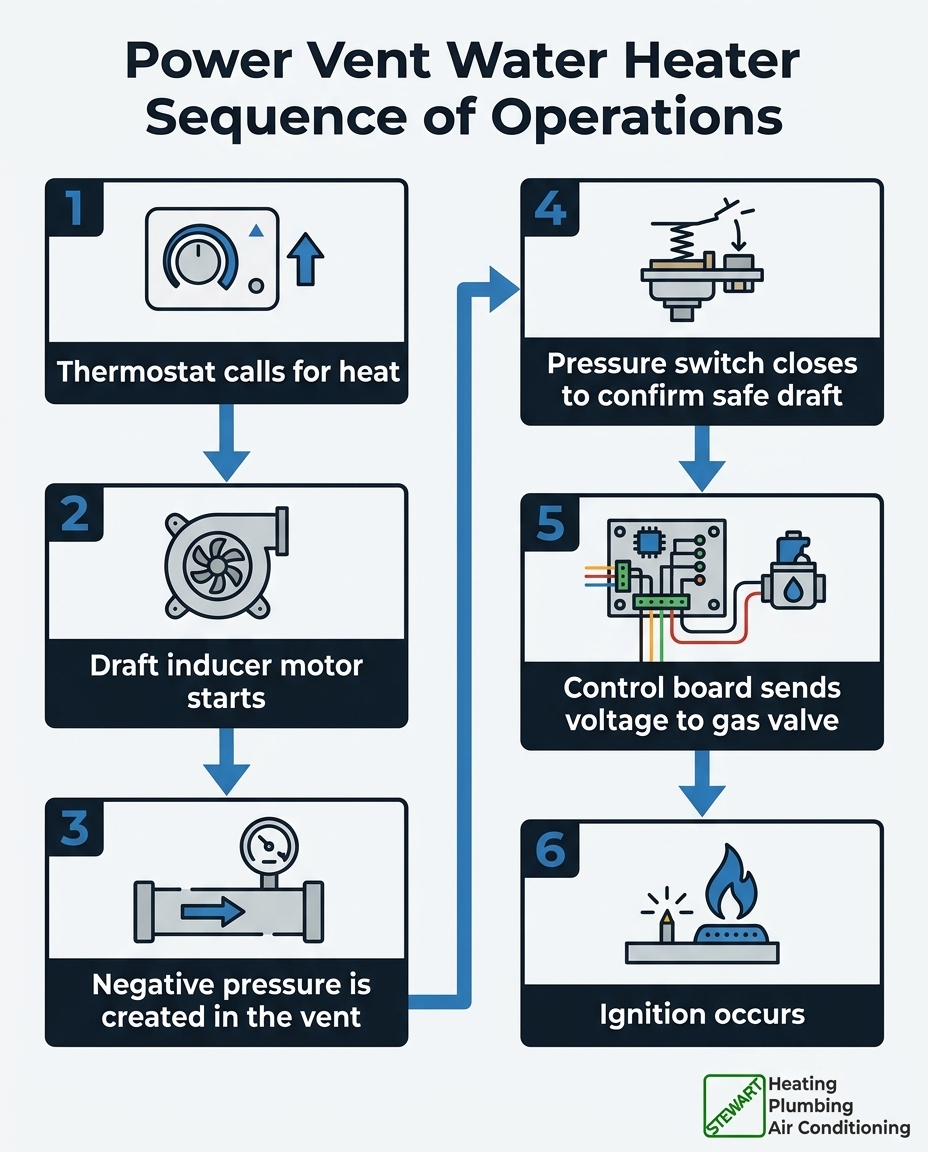
This verification process is called the sequence of operations. It happens every single time your water heater tries to turn on. If any step fails, the sequence halts immediately, locking out the system to protect your home from dangerous exhaust fumes.
1. The thermostat calls for heat: The temperature sensor inside the tank detects that the water has cooled down and signals the main control board to begin a heating cycle.
2. The draft inducer motor starts: Before any gas is released, the control board turns on the draft inducer fan located on top of the water heater.
3. Negative pressure is created: As the fan spins, it creates a vacuum (negative pressure) inside the venting pipe, proving that air is successfully moving outward.
4. The pressure switch closes: A small rubber tube connects the vent to the pressure switch. When the switch senses the correct amount of negative pressure, its internal electrical contacts close, sending a "safe to proceed" signal back to the control board.
5. Voltage is sent to the gas valve: Only after receiving the signal from the pressure switch will the control board send electricity to the gas valve, instructing it to open.
6. Ignition occurs: The igniter lights the gas, and the water begins to heat.
When a halt in this sequence occurs, it absolutely protects your home, but it also masks the root cause of the failure. In our experience servicing these units, if a technician skips steps in verifying this sequence, it almost always leads to a misdiagnosis. For a deeper dive into how these safety mechanisms behave across different equipment, reading about Diagnosing a Tripped Pressure Switch can provide additional helpful context.
When researching your system's symptoms, you might come across the phrase "pressure switch failed open water heater." In electrical terms, a switch that is "open" is like a light switch turned off—the circuit is broken, and electricity cannot flow through it. When the pressure switch fails to close (or fails "open"), the ignition sequence halts right before the gas valve is supposed to engage.
This is precisely where the symptom mimicry occurs. A technician or homeowner might observe the system trying to start, hear the fan running, but notice a complete lack of gas flow. Because the gas valve never clicks open and the burner never lights, it is incredibly easy to incorrectly assume the gas valve itself is dead. However, the gas valve is simply doing its job by remaining closed when it doesn't receive the required safety signal from the pressure switch. If you suspect your system is failing, professional Water Heater Repair and Replacement ensures the right components are tested before anything is condemned.
The confusion extends beyond the gas valve. Often, a failed pressure switch creates the illusion of a completely dead main control board. Modern water heaters use blinking LED lights or digital screens to display error codes when a lockout occurs. Unfortunately, these error codes can sometimes be vague, pointing to a general "ignition failure" rather than specifically identifying a draft issue.
When a system is unresponsive and throwing generic codes, it often leads to a rushed conclusion that the main control board has shorted out or failed internally. Testing the control board without simultaneously testing the pressure switch circuit leads to false positives. The board might appear to be withholding voltage from the gas valve, but it is doing so intentionally because the pressure switch is telling it that venting is unsafe.
• No gas flowing to the burner — Common Misdiagnosis: Failed gas valve — Actual Root Cause (Mimicry): Pressure switch failed open, preventing the gas valve from receiving power.
• System locks out after fan starts — Common Misdiagnosis: Bad control board — Actual Root Cause (Mimicry): Control board is functioning perfectly but reacting to a lack of draft confirmation.
• Generic "Ignition Failure" code — Common Misdiagnosis: Faulty igniter or gas supply — Actual Root Cause (Mimicry): Sequence halted before ignition was even attempted due to an open pressure switch.
Water heater issues rarely announce themselves at convenient times. In fact, environmental factors and household habits play a massive role in when these symptoms finally surface. During the middle of the summer, a staggered household shower schedule might easily mask a slow recovery time or an intermittent draft issue. If the water heater is only running occasionally, a slightly sticky pressure switch might manage to close just enough to keep the system operational.
However, as the season shifts, chilly late-summer/early-fall mornings in Pittsburgh CA's Mediterranean climate make reliable hot water critical during early household routines. The sudden shift to late-summer back-to-school morning routines exposing hot water recovery issues is a pattern our technicians at Stewart Heating, Plumbing and Air Conditioning see frequently. Concentrated morning demand stresses the venting and ignition sequence repeatedly in a very short time frame.
When the water heater is forced to cycle on and off multiple times in a single hour to keep up with back-to-back showers, a failing pressure switch is pushed to its limit. The internal diaphragm of the switch can become stiff, or condensation inside the venting tube can cause it to stick open only after multiple rapid cycles. This explains why your water heater might work perfectly fine on a quiet Sunday afternoon, but consistently locks out during the chaotic Monday morning rush. The mechanical stress of sudden, high-demand usage exposes the underlying sensor failure.
Because symptom mimicry is so prevalent in power vent systems, a proper diagnostic process requires patience, specialized tools, and a strict adherence to safety protocols. Guesswork has no place in diagnosing gas appliances. Here is how our experts methodically isolate the true cause of a lockout.
The Problem: The water heater fan turns on, but the system locks out before the burner ignites, leaving you with no hot water.
The Potential Causes: The issue could be a blocked vent pipe, a failing pressure switch, a damaged control board, or a faulty gas valve. Without testing, they all look identical.
The Professional Solution:
• Measuring actual draft pressure: Before condemning any electronic parts, professionals use a highly sensitive tool called a manometer. This device measures the exact amount of negative pressure (vacuum) the draft inducer fan is creating. If the manometer shows strong, adequate pressure, the technician knows the venting is clear and the fan is working.
• Visual and physical inspection: If the manometer shows weak pressure, the technician will inspect the vent pipe for minor obstructions. Things like fallen leaves, bird nests, or insect nests can cause slight pressure drops that are invisible to the naked eye but significant enough to keep the pressure switch open.
• Verifying electrical continuity: Only after confirming that proper draft pressure exists will the technician test the switch's electrical continuity. If the manometer proves the vacuum is strong, but the switch's electrical contacts still refuse to close, the switch is definitively proven to be the culprit.
Our commitment to expert, precise diagnostics at Stewart Heating, Plumbing and Air Conditioning means we pinpoint the exact issue rather than guessing, saving you from unnecessary stress and expense. Because testing involves interacting with live voltage and combustible gas, this process must always be handled by a licensed expert. Do not attempt DIY multimeter testing on live water heater components. When you need accurate answers, you can Request Diagnostic Service from a qualified professional.
There is a massive difference between methodical troubleshooting and the expensive habit of "parts-swapping." Parts-swapping occurs when a technician looks at a symptom, makes a guess based on the most obvious component, and replaces it without verifying the root cause. If the new part doesn't fix the issue, they simply move on to replacing the next most expensive component.
Replacing a gas valve or a main control board will not fix your water heater if the root cause is actually a blocked exhaust vent or an inexpensive pressure switch that has lost its calibration. Accurate diagnostics prevent extended periods without hot water while you wait days for incorrect, expensive parts to arrive from a supply house. As a homeowner, you have the right to ask neutral, expert questions to ensure your system is being evaluated comprehensively.
Questions to ask during a diagnostic visit:
• "Did we verify the actual draft pressure with a manometer before condemning the control board?"
• "Is the pressure switch successfully closing during the ignition cycle?"
• "Have we checked the exterior vent termination for any hidden obstructions?"
• "Are there any specific error codes pointing to the gas valve, or is it a generic ignition failure?"
Empowering yourself with these questions ensures that the technician takes the time to isolate the pressure switch and venting system before recommending a major overhaul.
When a water heater pressure switch fails, it typically fails in the "open" position, meaning its electrical contacts refuse to close. This halts the ignition sequence immediately, preventing the system from heating water. The main control board senses this failure and locks out the system to prevent unsafe gas buildup or carbon monoxide risks inside the home.
Yes, a failed pressure switch can absolutely cause a gas valve code or a generic ignition failure code. Because the control board expects the gas valve to open during the sequence, an open pressure switch prevents that authorization signal from ever being sent. The board registers that ignition did not occur and may throw a code that mimics a bad gas valve, even though the valve is perfectly fine.
A technician diagnoses this issue by using a dual-port manometer to test the actual draft pressure being created by the exhaust fan. If the draft pressure meets the manufacturer's requirements, they will then test the electrical continuity of the switch while the inducer is running. If the pressure is good but the switch remains electrically open, the switch is condemned and replaced.
Yes, a bad pressure switch will stop the heater from working entirely because it is a critical, non-negotiable safety device. If it fails open, the water heater will not ignite under any circumstances, as the system assumes toxic exhaust gases cannot safely exit the home. Bypassing this switch is incredibly dangerous and should never be attempted.
Lockouts occur whenever the strict sequence of operations is interrupted by a safety sensor. Common causes include blocked vent pipes, failed pressure switches, weak draft inducer motors, or ignition failures. A lockout is the system's way of prioritizing your family's safety over hot water production until a professional can resolve the underlying issue.
Understanding how a failing hot water tank pressure switch mimics other heating issues is the best way to protect yourself from unnecessary and expensive repairs. When a power vent water heater locks out, it is easy to assume the worst. However, knowing that a simple safety sensor can halt the entire sequence of operations—making a healthy gas valve or control board look completely dead—changes how you approach the problem.
A clear understanding of the diagnostic process ensures that you know the right questions to ask when a professional arrives at your home. You now know that verifying draft pressure and isolating the pressure switch are mandatory steps before any major components are replaced. When you are facing frustrating morning lockouts, always reach out to a local expert like our team at Stewart Heating, Plumbing and Air Conditioning who relies on methodical testing rather than guesswork, ensuring your hot water is restored safely, accurately, and efficiently.

Very professional and complete. I would recommend Stewart to anyone. Highest quality of workmanship and clean installation.
Stewart Heating Plumbing Air Conditioning just did some work for us for the first time. They did an installation at my home and it turned out well. I thought the price was fair and I definitely would use them again. The technicians were very friendly and knowledgeable about their work. I highly recommend Stewart Heating Plumbing Air Conditioning and already told friends to use them.
We have been using Stewart Heating Plumbing Air Conditioning since 1995. They put the original heating and air unit in the house, and we have just stayed with them. They are dependable and honest people, and they have done a good job for us every time that we have used them!
They came and did an inspection and are coming tomorrow to do the repair.
They replaced a regulator the first time, and then the water heater vent had to be replaced. They did great work.
The gentleman that serviced us was helpful, insightful, and knew what he was talking about. Overall, it was a great experience.