

Recent Blogs
Stay updated with our latest blog posts.

You switch your thermostat to "heat" for the first time since April, but instead of a quiet rush of immediate warmth, your system greets you with a strange whirring, a series of distinct clicks, and a sudden odor of burning dust. If you are working through your seasonal home maintenance checklist, you might wonder if these sensory experiences are normal or a sign of impending failure. When those late fall and November overnight temperature drops hit the East Bay, turning on the furnace for the first time can be an anxiety-inducing experience if you do not know what to expect.
For expert help navigating your system's startup, explore our heating services or request furnace service today.
Every modern gas heating system runs through a built-in safety protocol known as the sequence of operation. This sequence is a strict mechanical checklist the system must complete before it ever delivers warm air to your living room. The furnace verifies that exhaust gases can vent safely, that the ignition source is hot enough, and that a steady flame is present. If any single step fails, the entire sequence halts immediately.
Understanding this step-by-step sequence helps you distinguish between the normal, harmless behaviors of a system waking up from a long summer nap and mechanical red flags that require professional attention. Knowing exactly what happens inside that metal cabinet sets the stage for a safe, comfortable winter and helps you recognize exactly when it is time to call for backup.
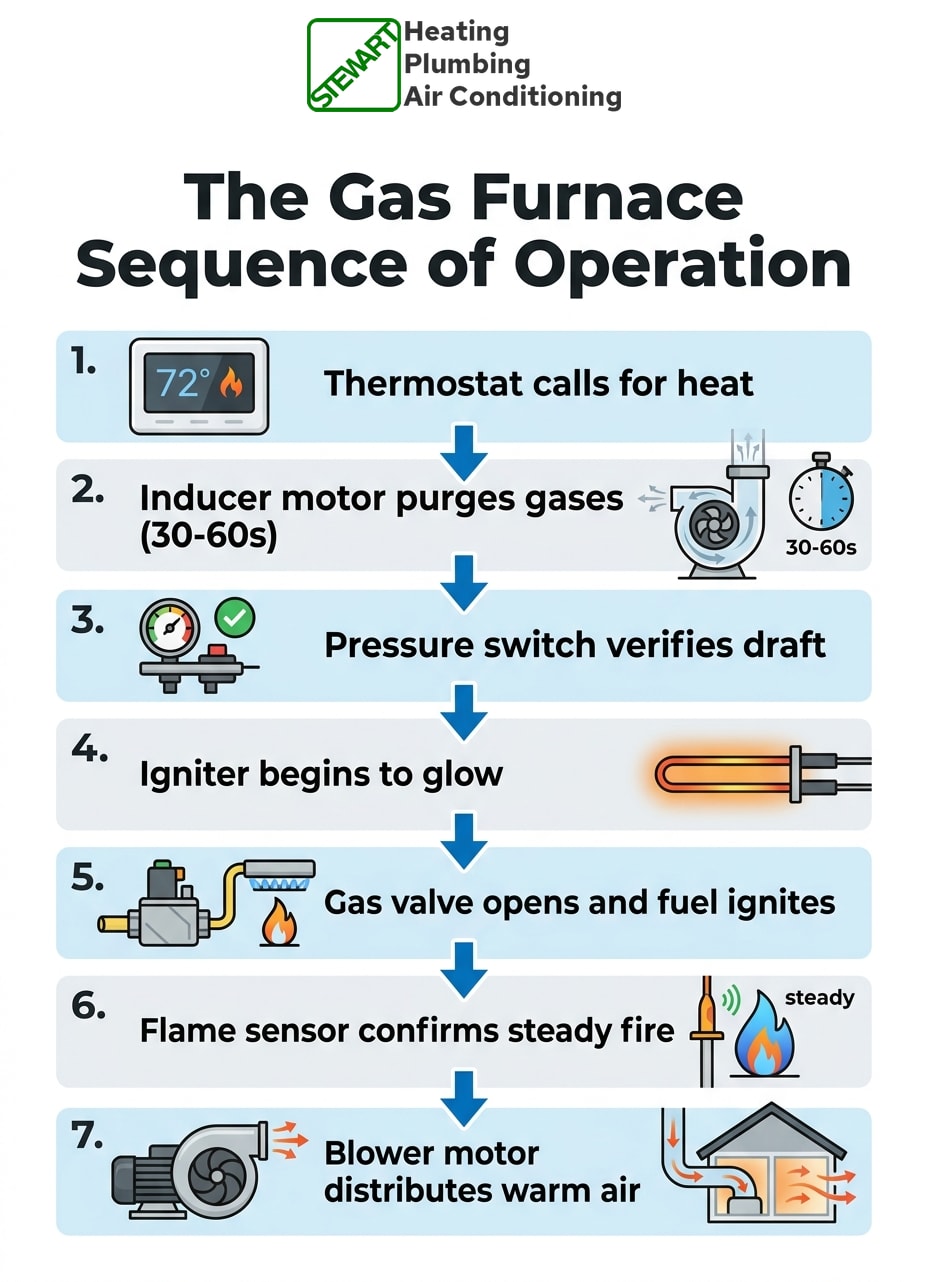
The sequence of operation officially begins the moment your indoor temperature drops below the thermostat's setpoint. The thermostat acts as the brain of the operation, sending a low-voltage electrical signal to the furnace control board requesting heat. However, the first component to physically activate is not the gas valve or the main blower fan—it is a smaller component called the inducer draft motor.
When the inducer motor kicks on, you will hear a noticeable humming or whirring sound coming from the unit. This small fan has a massive responsibility: it pulls air through the heat exchanger and pushes it out through the flue pipe. The inducer motor typically runs for 30 to 60 seconds before any gas is introduced. This pre-purge cycle is designed to clear the heat exchanger of any residual combustible gases that may have lingered from a previous cycle.
In the Pittsburgh CA and greater East Bay area, our long, dry summers mean your heating system sits completely dormant for over six months. During this extended idle period, significant dust and even pest debris—like spider webs or small insect nests—can accumulate inside the flue pipe. The inducer motor's pre-purge cycle physically blows this debris out, ensuring a clear path for dangerous exhaust gases (like carbon monoxide) to exit your home safely.
If the inducer motor fails to start, or if it cannot spin fast enough to create the necessary draft, the furnace's control board will register a fault. As a strict safety precaution, the entire sequence halts immediately. You will hear the initial click from the thermostat, but the system will refuse to proceed any further.
While the inducer draft motor is spinning, the furnace must verify that the motor is actually doing its job. This is where the pressure switch comes into play. The pressure switch is a dedicated safety monitor connected to the inducer motor via a small rubber tube. It measures the negative pressure (or draft) created by the spinning inducer fan.
The pressure switch acts as a physical gatekeeper during the initial 30-minute startup cycle after 6+ months idle. It verifies that the inducer motor is successfully venting air outward and that there are no blockages in the exhaust flue. If a bird's nest or heavy debris is blocking the vent pipe, the inducer motor will run, but the pressure switch will not detect the correct draft pressure. Consequently, the switch will remain open, and the control board will deny ignition to prevent exhaust gases from backing up into your home.
Once proper draft pressure is confirmed, the pressure switch closes, signaling the control board to proceed. The board then sends voltage to the ignition source. In most modern furnaces, this is a hot surface igniter. You might hear a faint click from the control board, followed by the igniter glowing a bright, intense orange as it rapidly heats up to hundreds of degrees.
• Hot Surface Igniter — What You See: A bright orange or yellow glow inside the burner compartment. — What You Hear: A single, faint click from the control board relay.
• Direct Spark Igniter — What You See: A small, rapid blue spark near the burner assembly. — What You Hear: A rapid, repetitive clicking or ticking sound.
• Standing Pilot (Older Models) — What You See: A small, continuous blue flame that is always lit. — What You Hear: No distinct sound prior to the main gas valve opening.
After the hot surface igniter has glowed for a few seconds and reached the correct temperature to ignite fuel, the control board moves to the next critical phase. It sends a signal to open the main gas valve, releasing natural gas into the burner assembly. As the gas hits the glowing igniter, it combusts. This ignition creates a distinct, low "whoosh" sound that is entirely normal—especially noticeable during those late fall and November overnight temperature drops when the house is quiet.
The moment the gas ignites, a new safety component immediately takes over: the flame sensor. The flame sensor is a thin metal rod positioned directly in the path of the newly lit flames. Its sole purpose is to confirm that a steady, continuous fire is actually burning. It does this by passing a tiny electrical current (measured in microamps) through the flame itself.
The flame sensor has a very tight window to do its job. Within just three to seven seconds of the gas valve opening, the sensor must detect a strong, steady flame. If the sensor fails to register the flame—whether because the burners failed to light, the gas pressure is too low, or the sensor itself is coated in carbon buildup—the control board triggers an immediate safety lockout.
This lockout forcefully shuts the gas valve. By instantly cutting the fuel supply, the system prevents unburned natural gas from flowing freely into the combustion chamber and accumulating inside your home. This fail-safe is one of the most critical protections built into your heating equipment.
At this point in the sequence, the burners are successfully lit and the flame sensor has confirmed a steady fire. However, you still will not feel warm air coming from your vents right away. The burners need time to sufficiently warm up the heat exchanger—the large metal shield that separates the toxic combustion gases from the breathable air in your home.
Once the heat exchanger reaches the appropriate temperature (usually after 30 to 60 seconds of burner operation), the control board sends power to the main blower motor. This large fan engages, pulling cold air from your return vents, passing it over the hot exterior of the heat exchanger, and pushing the newly warmed air through your supply ducts.
This specific stage is where homeowners in the Pittsburgh CA and East Bay area commonly experience a distinct "burning dust" smell. Because our region experiences an extended dry season from spring through early fall, a significant layer of dust inevitably settles on the exterior of the dormant heat exchanger. When the burners heat that metal for the first time in months, the settled dust physically burns off. The blower motor then pushes that slightly smoky scent directly into your living spaces. This odor is typically harmless and should dissipate entirely within the first few heating cycles.
While a temporary burning smell is expected, unusual noises at this stage are not. If you hear a loud squealing or notice your furnace blower motor whining on startup, it generally indicates a mechanical issue with the blower assembly itself, such as a failing motor bearing or a slipping belt, which requires professional diagnosis.
Because the sequence of operation relies on a chain of safety checks, a failure at any single point will stop the furnace from heating your home. Understanding what these disruptions look and sound like helps you troubleshoot effectively during that initial 30-minute startup cycle after 6+ months idle.
Modern furnaces are deliberately designed to shut down entirely rather than operate in an unsafe condition. While a sudden lack of heat is frustrating, a system lockout means your safety controls are functioning exactly as intended. If you notice persistent disruptions, it is a clear sign that a specific component within your HVAC system requires attention.
One local homeowner reached out to us this fall to schedule their first-ever professional furnace tune-up. During the inspection, we walked them through these exact sequence steps. By taking the time to explain how the system works, we were able to advise them on proper air filter storage and the critical importance of carbon monoxide detectors, ensuring they felt completely confident operating their equipment.
• The Problem: The furnace turns on, the inducer motor runs, the burners ignite with a "whoosh," but then the entire system shuts down completely after just 30 seconds to a minute.
• The Cause: This classic short-cycling behavior is usually caused by a flame sensor failing to read the flame. Over time, the sensor rod becomes coated in invisible carbon deposits, insulating it and preventing the microamp current from passing through.
• The Solution: The system shuts the gas valve to protect the home. A licensed professional must carefully remove and clean the flame sensor rod using specialized materials to restore proper function.
• The Problem: You hear the inducer motor running, followed by a series of repeating clicks from the furnace cabinet, but the burners never ignite and the blower never kicks on.
• The Cause: This is often a sign that the hot surface igniter is failing to reach the necessary temperature, the spark igniter is misaligned, or the gas valve is failing to open and release fuel.
• The Solution: Because this involves direct fuel delivery and high-voltage ignition components, it requires professional diagnostic tools to test the electrical draw and resolve the issue safely without risking a gas leak.
While understanding your furnace's sequence of operation is empowering, it is vital to recognize the line between homeowner troubleshooting and professional intervention. Basic homeowner tasks—like verifying your thermostat is set to "heat," checking that the furnace power switch is turned on, and replacing a heavily soiled air filter—are excellent first steps. A severely clogged air filter can restrict airflow so badly that the furnace overheats and triggers a high-limit switch lockout.
However, bypassing safety switches, attempting to clean internal sensors, or tampering with the gas valve requires a licensed professional. The safety mechanisms in your furnace exist to prevent catastrophic events like carbon monoxide exposure or fire. If your system repeatedly locks out or fails to complete its sequence, it is actively trying to tell you that something is mechanically wrong.
Another homeowner contacted us in the spring about an unspecified, recurring problem with their heating system failing to start reliably. By dispatching a technician to clearly explain the specific sequence failure and the necessary repair steps, we resolved the immediate issue and prevented future occurrences. The customer gained so much confidence in their system's reliability that they signed up for an ongoing maintenance contract.
Since 1974, our team has built a foundation of trust by accurately diagnosing complex sequence failures and safety lockouts in the local community. We know exactly how the Pittsburgh CA and East Bay area climate impacts heating equipment. A thorough seasonal inspection on a preventative maintenance plan allows a technician to clean the flame sensor, test the igniter's electrical draw, and clear the inducer flue before these components cause a mid-winter breakdown. Routine professional care ensures the entire sequence operates smoothly, cycle after cycle.
Decoding the gas furnace sequence of operation brings a profound sense of peace of mind. When you understand that every click, whir, and brief odor of burning dust is part of a carefully orchestrated process, those late fall and November overnight temperature drops become much less intimidating. You can confidently listen to your system start up, knowing that robust safety mechanisms are constantly monitoring the process to protect your home and your family.
If you notice that your system is short-cycling, clicking without igniting, or struggling to distribute warm air, do not ignore the warning signs. Proactive service is the best way to prevent a minor sensor issue from turning into a freezing night without heat. Trust the built-in safety controls, and let a professional handle the rest.
What is the correct sequence of operation for a gas furnace?
The correct sequence of operation follows a strict, step-by-step safety protocol. It begins with a thermostat call for heat, followed by the inducer motor purging gases, the pressure switch verifying draft, the igniter heating up, the gas valve opening, the flame sensor confirming ignition, and finally, the blower motor distributing warm air. If any step fails, the sequence stops immediately.
Why is my furnace clicking but not turning on?
A furnace that clicks repeatedly without producing heat usually indicates an issue with the ignition phase. The clicking sound is often the control board attempting to send voltage to a failing igniter, or a spark igniter attempting to light gas that isn't flowing. This requires a professional to test the igniter and the gas valve for proper function.
What happens first when a gas furnace turns on?
The very first mechanical action is the activation of the inducer draft motor. Before any gas is released or any heat is generated, this small fan turns on to pull residual gases and debris out of the heat exchanger and vent them safely outdoors. You will hear this as a distinct humming or whirring sound.
Why does my furnace shut off after 30 seconds?
If your furnace shuts down completely after about 30 seconds of burner operation, it is typically due to a dirty or failing flame sensor. The sensor must detect a steady flame within seconds of ignition; if carbon buildup prevents it from reading the flame, the system shuts the gas valve as a safety precaution to prevent unburned gas accumulation.
Is it normal for my furnace to smell like burning dust on the first use?
Yes, a temporary burning dust smell is entirely normal during the first few heating cycles of the season. Over the long summer months, dust settles on the exterior of the dormant heat exchanger. When the burners heat up for the first time, this dust burns off, and the blower motor pushes the scent into your home.
How long does the inducer motor run before ignition?
The inducer draft motor typically runs for 30 to 60 seconds before the ignition sequence begins. This pre-purge cycle is critical for clearing out any leftover combustible gases or physical debris from the flue pipe, ensuring a safe, clear path for exhaust once the burners ignite.

Very professional and complete. I would recommend Stewart to anyone. Highest quality of workmanship and clean installation.
Stewart Heating Plumbing Air Conditioning just did some work for us for the first time. They did an installation at my home and it turned out well. I thought the price was fair and I definitely would use them again. The technicians were very friendly and knowledgeable about their work. I highly recommend Stewart Heating Plumbing Air Conditioning and already told friends to use them.
We have been using Stewart Heating Plumbing Air Conditioning since 1995. They put the original heating and air unit in the house, and we have just stayed with them. They are dependable and honest people, and they have done a good job for us every time that we have used them!
They came and did an inspection and are coming tomorrow to do the repair.
They replaced a regulator the first time, and then the water heater vent had to be replaced. They did great work.
The gentleman that serviced us was helpful, insightful, and knew what he was talking about. Overall, it was a great experience.