

Recent Blogs
Stay updated with our latest blog posts.

Here in Pittsburgh, CA, our team at Stewart Heating, Plumbing and Air Conditioning knows that the late August back-to-school transition is right around the corner. We constantly remind our customers that preparing your home's air filtration for back-to-school illness season is one of the smartest steps you can take for your family's health. As children return to crowded classrooms, they inevitably bring home new airborne pathogens. At the exact same time, late-summer heat waves force your HVAC system to run continuously. This creates a perfect storm inside your house. While the air conditioner keeps you cool, it also rapidly circulates these microscopic germs throughout every room in your living space.
Most standard 1-inch filters are completely unequipped to capture biological contaminants, leaving families vulnerable to pediatric respiratory illnesses just as the school year begins. The decision point for homeowners is whether to continue relying on basic throwaway filters or to upgrade to a comprehensive system that actively neutralizes these threats before the fall illness season peaks.
Looking for indoor air quality solutions? Explore our HVAC maintenance plan to keep your system running safely and efficiently all year long.
When the cooling system runs heavily, a basic filter provides a false sense of security. Instead of trapping germs, the constant airflow pushes microscopic droplets right through the thin mesh. Upgrading your filtration strategy in late summer transforms your HVAC system from a transit network for germs into an active defense mechanism.
Basic throwaway filters were designed with a single purpose: keeping large dust, hair, and debris out of the HVAC equipment. They were never engineered to protect human lungs. Airborne viruses and bacteria are microscopic—often smaller than 0.3 microns—allowing them to pass right through the loose fiberglass mesh of a standard filter without any resistance.
During our late-summer maintenance visits across Pittsburgh, CA and the East Bay area, we frequently see how these basic filters act as a fast-pass transit system for germs when air conditioners run continuously. The blower motor pulls contaminated air from the living room, pushes it past the ineffective filter, and distributes it directly into bedrooms and hallways. Relying on standard filters while heavily using your cooling system provides a false sense of security regarding your indoor air quality. If you want to stop microscopic threats, you need professional air conditioning services to evaluate and upgrade your filtration capabilities.
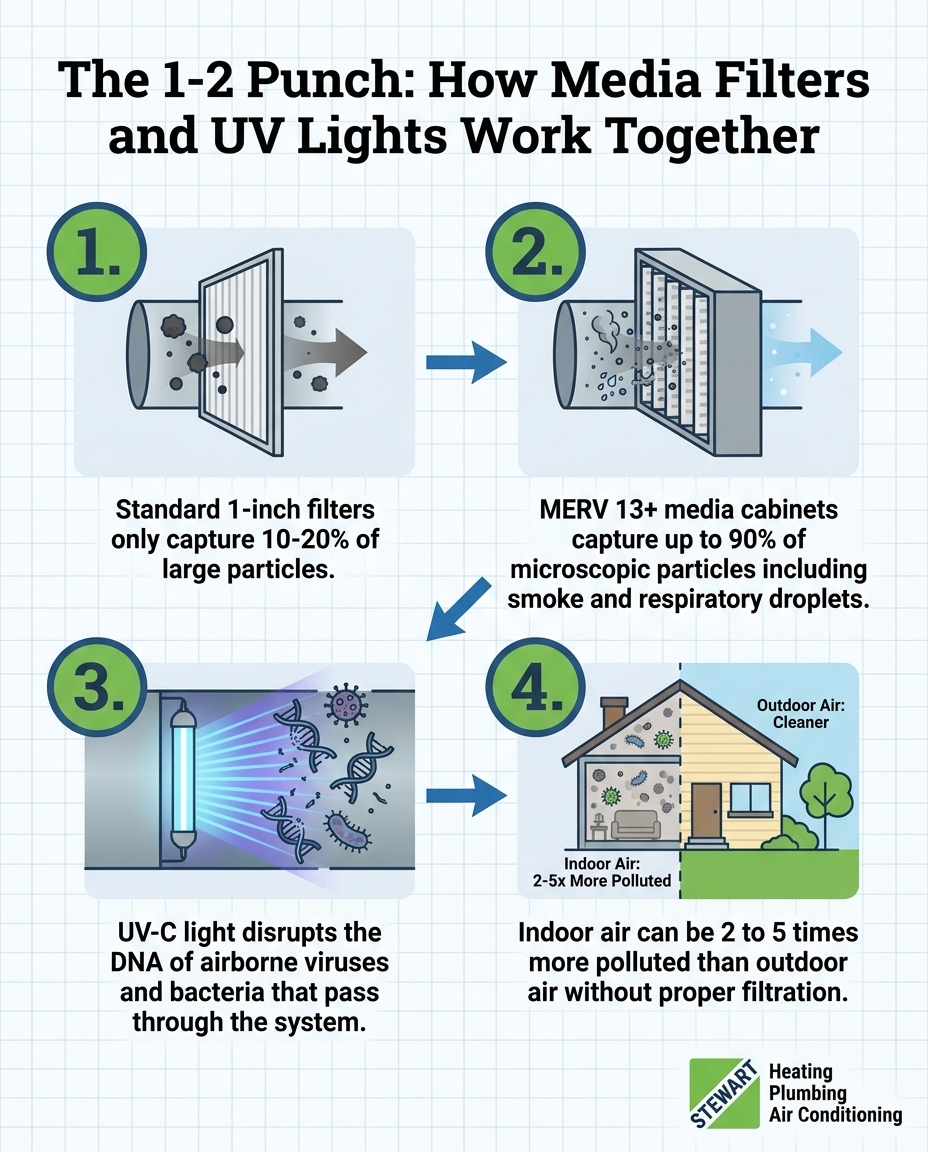
To understand why basic filters fail, you have to look at MERV ratings. MERV stands for Minimum Efficiency Reporting Value, and it measures how effectively a filter traps specific particle sizes. Most standard 1-inch filters sit around MERV 4 to MERV 8. These are great for catching pet hair and heavy dust mites, but they do almost nothing to stop viral particles.
The quick fix: Upgrading your filtration rating. ASHRAE (the American Society of Heating, Refrigerating and Air-Conditioning Engineers) recommends MERV 13 or higher for effective viral interception. Filters at this level have a much tighter weave, allowing them to catch the tiny respiratory droplets that carry back-to-school illnesses.
• Standard 1-Inch Fiberglass — Typical MERV Rating: MERV 1 - 4 — Primary Function: Protects blower motor from large debris — Pathogen Capture Rate: Extremely Low (Under 5%)
• Pleated 1-Inch Filter — Typical MERV Rating: MERV 5 - 8 — Primary Function: Captures common household dust and pollen — Pathogen Capture Rate: Low (10% - 20%)
• High-Efficiency Media Cabinet — Typical MERV Rating: MERV 13 - 16 — Primary Function: Protects human health and respiratory systems — Pathogen Capture Rate: High (Up to 90%+)
Upgrading to high-MERV media cabinets addresses biological pathogens and seasonal environmental threats simultaneously. High-efficiency media cabinets offer a significantly larger surface area than standard filters. Because the filter material is pleated into a deep four- or five-inch block, it allows for dense, high-MERV filtration without restricting system airflow. This means the blower motor doesn't have to strain to pull air through the system.
This dense filtration is critical for capturing the microscopic respiratory droplets that carry back-to-school illnesses. But as our technicians know all too well from serving Contra Costa County, germs are only half the battle. Late August and September bring prime conditions for Bay Area wildfire smoke and "Spare the Air" days. We regularly help local families upgrade their systems because these robust media filters simultaneously intercept fine particulate matter (PM2.5) introduced by outdoor pollution. Combining thick media filters with an airtight cabinet prevents bypass—meaning no unfiltered air sneaks around the edges of the filter frame. Every cubic foot of circulated air is actually scrubbed clean.
Compromised outdoor air quality creates a massive ventilation problem for homeowners. When the air outside is thick with smoke, you cannot open your windows to vent out the indoor germs your kids brought home from school. You are trapped in a closed-loop environment.
A media cabinet solves this closed-loop ventilation problem. By continuously cycling the indoor air through a dense web of synthetic fibers, the system removes both the outdoor smoke particles that seep inside and the indoor viral droplets circulating through the house. When you combine high-efficiency media cabinets with active purification, you create a comprehensive defense shield for your family.
• Smoke infiltration: PM2.5 particles from wildfires easily penetrate poorly sealed windows and doors, requiring dense filtration to remove them from your breathing air.
• Viral accumulation: Without fresh outdoor air ventilation, indoor viral loads increase rapidly unless an advanced filter intercepts the droplets.
• System strain: A proper media cabinet provides the necessary surface area to handle heavy particle loads without choking the air conditioner's airflow.
While media filters trap physical particles, UV-C purifiers actively neutralize biological contaminants by disrupting their DNA. Installed directly within the ductwork or over the indoor evaporator coil, UV lights intercept pathogens as they pass through the system. This is not a gimmick; our team relies on this scientifically proven technology, which is recommended by ASHRAE for mitigating the spread of airborne viruses.
When airborne viruses, bacteria, and mold spores are exposed to specific wavelengths of ultraviolet light, their cellular structure is damaged. They lose the ability to replicate and infect human hosts. When paired together, UV air purifiers and high-MERV media filters create a hospital-grade defense system for the residential home. The filter catches the physical droplets, and the UV light destroys the living organisms that manage to slip past or grow on the equipment.
Implementing both technologies provides overlapping layers of protection. Here is exactly how we set up this process to work inside your ductwork:
1. Step 1: The media filter captures larger respiratory droplets and dust. As air returns from the house, the thick, pleated media cabinet physically traps the vast majority of airborne debris, including the larger moisture droplets that carry viruses.
2. Step 2: The UV-C light irradiates microscopic pathogens. Any microscopic organisms that are too small to be caught by the filter mesh pass through a zone of intense ultraviolet light, which instantly damages their DNA and renders them harmless.
3. Step 3: Clean, sanitized air is distributed. The freshly scrubbed and purified air is pushed back into your living spaces, drastically reducing the concentration of active germs in the home.
Upgrading to advanced filtration requires verifying that the HVAC blower motor can handle the increased static pressure of a high-MERV filter. You cannot simply slide a dense, high-efficiency filter into a standard 1-inch slot. Doing so will choke the system, freeze the evaporator coil, and potentially burn out the blower motor.
In our decades of field experience, a comprehensive system evaluation often uncovers additional opportunities for safety and air quality improvements. For example, we recently helped a local homeowner who reached out seeking improved home safety and air quality. Our technician performed a thorough evaluation and recommended a new filter system alongside updated fire alarms and carbon monoxide detectors, resulting in a comprehensive safety upgrade. This holistic approach ensures every component of your home's air system works together flawlessly.
UV purifiers must also be strategically placed within the ductwork or air handler to maximize exposure time without damaging internal plastics. Attempting to modify ductwork or wire UV lights without a licensed professional can damage the system or void manufacturer warranties. Since 1974, our team at Stewart Heating, Plumbing and Air Conditioning has brought a family-first approach to every installation. We ensure that any health and safety upgrades are perfectly tailored to your specific equipment.
• Static pressure testing: We measure the airflow resistance to ensure a high-MERV filter won't strain your blower motor.
• Ductwork compatibility: We evaluate the return air drop to see if a wider media cabinet can be seamlessly integrated.
• UV placement: We identify the optimal location over the indoor coil or within the supply plenum for maximum pathogen exposure.
• Electrical safety: We safely wire purification systems directly into the HVAC control board so they operate in sync with your fan.
Timing is everything when it comes to indoor air quality, and we always advise our clients that implementing these upgrades before the pediatric respiratory illness spike is crucial. The late August back-to-school transition is the ideal window to prepare your equipment. By taking action now, you ensure your home is fully protected before the first major wave of classroom colds sweeps through your neighborhood.
Waiting until the middle of fall means your family will already be exposed to circulating airborne threats. A proactive approach keeps your indoor environment clean, comfortable, and safe from day one of the school year.
• Schedule an indoor air quality assessment: Book an evaluation in late August before the peak of the fall illness season begins.
• Evaluate your current filter housing: Have one of our technicians inspect your existing setup to determine if a media cabinet retrofit is feasible for your ductwork.
• Discuss UV purifier installation: Explore options for adding UV-C technology during your end-of-summer system tune-up.
• Establish a routine replacement schedule: Set a calendar reminder for high-efficiency filter changes so the system remains effective throughout the entire school year.
Yes, HVAC UV lights are highly effective at inactivating airborne viruses. They emit a specific wavelength of UV-C light that penetrates the cellular walls of biological contaminants and disrupts their DNA. This prevents the viruses from replicating, rendering them harmless as they circulate through your ductwork. When installed correctly by a professional, this technology provides excellent whole-home protection.
ASHRAE recommends a MERV 13 rating or higher for effectively capturing airborne viruses. Filters at this level are woven tightly enough to trap the tiny respiratory droplets that carry viral pathogens. However, our team always stresses the importance of having a professional check your system's static pressure, as high-MERV filters can restrict airflow on older or incompatible HVAC units.
A whole-home air purifier significantly reduces the spread of school sickness within the house. By actively pulling contaminated air through dense media filters and UV-C light zones, these systems remove the germs your children bring home from the classroom. While they cannot prevent a child from catching a cold at school, they stop that cold from spreading to the rest of the family through the HVAC vents.
Improving indoor air quality for kids starts with upgrading your HVAC system's filtration capabilities. We recommend swapping out standard 1-inch throwaway filters for a high-efficiency media cabinet, and considering adding a UV air purifier to neutralize biological threats. Additionally, maintaining optimal indoor humidity levels and scheduling regular duct inspections will help keep the air clean and healthy for developing respiratory systems.
High-efficiency media filters can restrict airflow if they are forced into a standard 1-inch filter slot. However, a properly installed 4-inch or 5-inch media cabinet provides a massive surface area, which actually improves airflow dynamics compared to a clogged 1-inch pleated filter. A licensed technician must evaluate your older AC unit to ensure the blower motor is compatible with the new cabinet design.
Late-summer wildfire smoke forces homeowners to keep windows tightly closed, trapping stale air and any indoor viruses inside the house. This lack of fresh air ventilation allows viral concentrations to build up rapidly. A robust media filtration system is essential during these events because it simultaneously scrubs the outdoor smoke particles and the trapped indoor germs out of your breathing air.
Proactive upgrades to UV purifiers and media filters are the absolute best defense against circulating germs. Acting in late summer ensures your home in Pittsburgh, CA and the East Bay area is fully prepared for both back-to-school illnesses and seasonal environmental factors like wildfire smoke. Don't wait for the first cold to hit your household. Connect with our team at Stewart Heating, Plumbing and Air Conditioning to explore professional indoor air quality solutions today and enjoy peace of mind before the season fully transitions.

Very professional and complete. I would recommend Stewart to anyone. Highest quality of workmanship and clean installation.
Stewart Heating Plumbing Air Conditioning just did some work for us for the first time. They did an installation at my home and it turned out well. I thought the price was fair and I definitely would use them again. The technicians were very friendly and knowledgeable about their work. I highly recommend Stewart Heating Plumbing Air Conditioning and already told friends to use them.
We have been using Stewart Heating Plumbing Air Conditioning since 1995. They put the original heating and air unit in the house, and we have just stayed with them. They are dependable and honest people, and they have done a good job for us every time that we have used them!
They came and did an inspection and are coming tomorrow to do the repair.
They replaced a regulator the first time, and then the water heater vent had to be replaced. They did great work.
The gentleman that serviced us was helpful, insightful, and knew what he was talking about. Overall, it was a great experience.