

Recent Blogs
Stay updated with our latest blog posts.

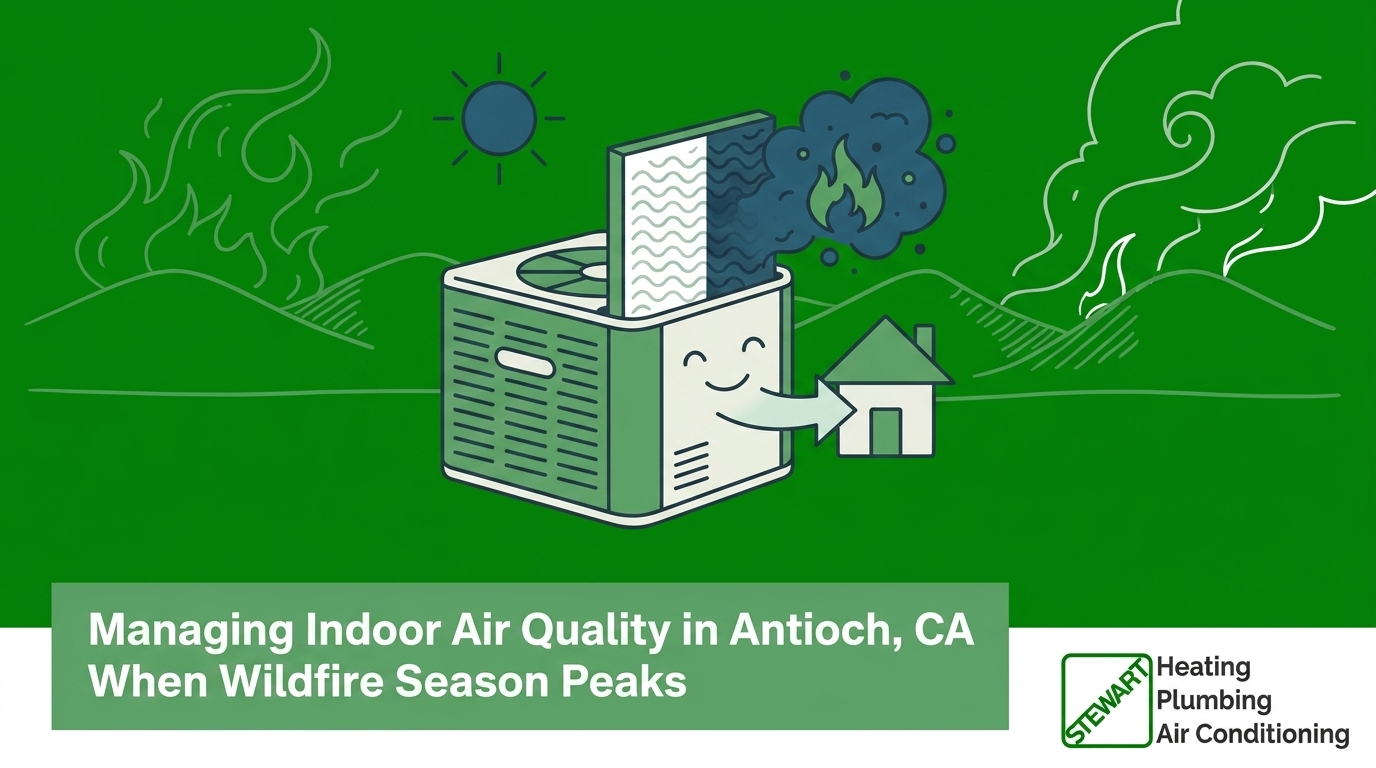
You wake up to an orange sky, and even with the windows tightly shut, the distinct, acrid smell of burning wood is already drifting through your living room. Managing indoor air quality in Antioch when wildfire season peaks is a constant battle for homeowners trying to keep their families comfortable and safe. The sudden drop in air quality catches many off guard, transforming the safe haven of your home into an uncomfortable and unhealthy environment. When heavy particulate matter pushes into Antioch and the surrounding valley, it creates an immediate crisis for your home's climate control system.
If you need immediate help optimizing your HVAC system for heavy smoke, our team is ready to assist.
This sudden influx of smoke introduces a frustrating dilemma for homeowners. On one hand, you desperately need to adjust your system settings and upgrade your filtration to trap the smoke and clean the air. On the other hand, aggressive filtration can easily suffocate your air conditioning equipment, leading to expensive breakdowns right when you need cooling the most. Most homeowners mistakenly believe that simply running their AC normally with a fresh filter will clear the air. Unfortunately, standard one-inch fiberglass filters are designed to catch large debris like pet hair and heavy dust, not microscopic ash. When exposed to dense wildfire smoke, these basic filters are quickly overwhelmed, sometimes clogging completely in a matter of days.
Protecting your home requires more than just swapping out a cheap filter. It demands proactive, strategic adjustments to your system's settings and a clear understanding of what your equipment can handle. Setting the right expectations is the first step: clearing heavy smoke from your indoor air is entirely possible, but it requires a careful balance between high-efficiency filtration and proper airflow mechanics.
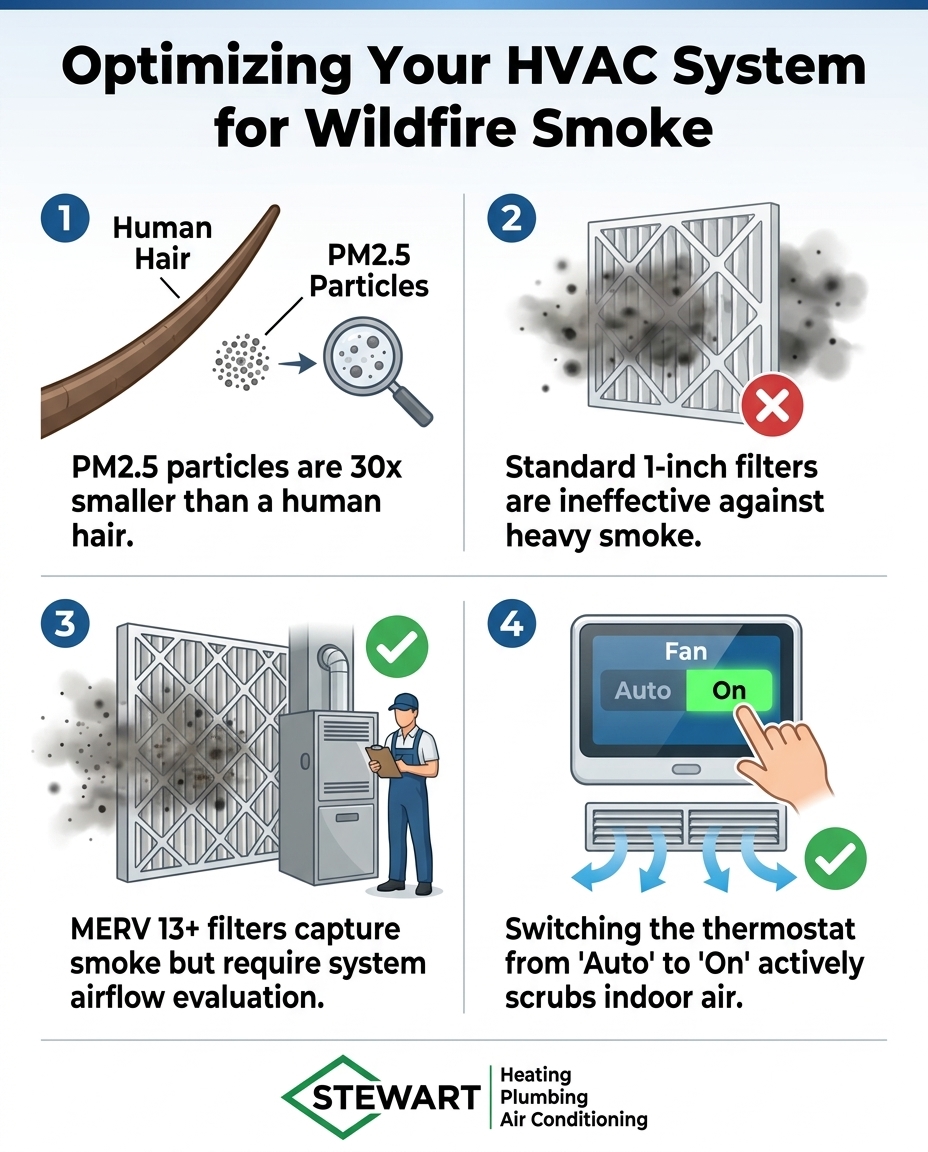
To understand why wildfire smoke is so difficult to manage indoors, you have to look at the science of the smoke itself. Wildfire smoke is primarily composed of PM2.5 particles. These are microscopic pollutants that measure 2.5 microns or less in diameter. To put that into perspective, a single PM2.5 particle is about 30 times smaller than the width of a human hair. Because they are so incredibly small, these particulates easily bypass standard HVAC filtration, slipping through the fiberglass mesh and circulating freely throughout your ductwork and living spaces.
The geography of our region makes this problem significantly worse. During the August late-summer wildfire season, the hot, dry microclimate in the Contra Costa County valley frequently creates severe temperature inversion layers. In a normal weather pattern, warm air rises and carries pollutants up and away. But during an inversion, a layer of warm air acts like a heavy lid over the valley, trapping cooler air and dense wildfire smoke near the ground. This topographical reality means that smoke doesn't just blow through Antioch; it settles, thickens, and lingers heavily for days or even weeks.
The impact of prolonged exposure: Allowing PM2.5 to circulate indoors has immediate health and comfort impacts. These microscopic particles bypass the body's natural respiratory defenses, leading to irritated eyes, scratchy throats, and aggravated asthma or allergy symptoms. Beyond the physical discomfort, the constant circulation of ash leaves a fine layer of dust on your furniture and a persistent campfire odor embedded in your upholstery.
Understanding this local environmental challenge dictates exactly why generic air quality advice often fails here. You cannot rely on basic strategies when the valley topography forces your home to sit inside a dense cloud of trapped particulates. If you want to dive deeper into the mechanics of this seasonal threat, understanding how wildfire smoke season impacts your air quality is a crucial step in preparing your home. Overcoming this requires specific, specialized filtration strategies designed for our unique microclimate.
Capturing microscopic PM2.5 particles requires specialized, denser filters—specifically, MERV 13+ filtration. The Minimum Efficiency Reporting Value (MERV) scale measures how effectively a filter traps small particles. While a standard MERV 4 filter catches basic dust, a MERV 13 filter is tightly woven enough to trap bacteria, virus carriers, and fine wildfire smoke. However, upgrading to these high-efficiency filters introduces a serious mechanical conflict with standard residential air conditioning systems.
The Problem: Airflow Restriction
Your air conditioner's blower motor is calibrated to push and pull a specific volume of air. Standard one-inch filter slots are designed for low-resistance fiberglass or pleated filters. When you slide a dense, one-inch MERV 13 filter into that standard slot, it acts almost like a piece of cardboard. The tight weave that makes it so great at catching smoke also makes it incredibly difficult for air to pass through.
The Cause: System Suffocation
As the blower motor struggles to pull air through the restrictive filter, the airflow across your indoor evaporator coil drops dramatically. Without enough warm indoor air blowing over it, the refrigerant inside the coil drops below freezing. The condensation on the coil turns to ice, eventually freezing the entire component into a solid block. Meanwhile, the blower motor is working overtime, drawing excess electrical current until it overheats and potentially burns out completely.
The Solution: Professional Evaluation
Because of this severe mechanical risk, proper system evaluation is absolutely necessary before you upgrade to thicker, high-efficiency filters. You must ensure your ductwork and blower motor can handle the increased static pressure. Seeking expert advice is the safest way to guarantee both clean air and system longevity. One local homeowner recently reached out because they needed a new filter system and were concerned about fire alarms and carbon monoxide detectors. A technician evaluated the home and made several tailored recommendations for safety and air quality improvements, ensuring the equipment could handle the necessary filtration upgrades without compromising their overall air conditioning performance.
Upgrading your filter is only half the battle; how you operate your HVAC system determines how effectively that filter cleans your home. During heavy smoke days, your thermostat settings become your most powerful tool for actively scrubbing the indoor environment. Most homeowners leave their thermostat fan setting on "Auto" year-round, but this default setting falls short during a wildfire event.
When your thermostat is set to "Auto," the blower fan only turns on when the system is actively cooling or heating your home. Once the target temperature is reached, the fan shuts off. If it is a mild morning and your air conditioner doesn't run for three hours, your indoor air sits completely stagnant for three hours. No air is moving through the ductwork, which means no smoke is being pulled through your filter.
By switching the fan setting from "Auto" to "On," you command the blower motor to run continuously, regardless of whether the compressor is actively cooling the air. This continuous circulation creates a constant cycle, actively pulling smoke-filled air from your rooms, forcing it through your high-efficiency filter, and pushing clean air back into the house.
1. Monitor local Antioch AQI spikes: Keep an eye on local air quality apps. When the Air Quality Index pushes into the unhealthy range and you notice smoke settling in the valley, it is time to take action.
2. Keep windows and doors tightly sealed: Before adjusting your thermostat, ensure all entry points are closed. Turn off any whole-house fans or fresh-air intake vents that might pull outdoor smoke directly inside.
3. Engage the fan to continuously push air: Switch your thermostat fan setting to "On." Let it run 24/7 while the smoke is heavy to continuously scrub the particulates out of your living spaces.
While continuous circulation is highly effective, it does use more electricity and puts extra hours on your blower motor. Once the inversion layer breaks and the outdoor air quality returns to safe levels, remember to switch your fan back to "Auto." Returning your settings to normal will conserve energy and give your HVAC equipment a well-deserved rest.
When the smoke rolls in, many homeowners rush to hardware stores to buy standalone HEPA air purifiers. While these portable units are certainly useful for temporary relief in single, closed-off spaces like a bedroom or a home office, they struggle immensely to protect an entire house. A standard plug-in purifier simply lacks the fan power to pull air from multiple rooms, leaving large open-concept living areas vulnerable to settling ash and smoke odors.
For permanent, comprehensive protection, whole-home media cabinets are the superior choice. A media cabinet is a specialized filter housing installed directly into your central HVAC ductwork, usually right next to the furnace or air handler. Instead of a flimsy one-inch filter, a media cabinet accommodates a massive four-inch or five-inch thick pleated filter. Because these filters are so thick, they contain a massive amount of surface area. This brilliant design allows them to trap microscopic PM2.5 smoke particles highly efficiently without restricting the airflow your blower motor desperately needs.
• Coverage Area — Standalone HEPA Purifiers: Limited to a single room (150-400 sq. ft.) — Whole-Home Media Cabinets: Cleans the entire house simultaneously
• Airflow Impact — Standalone HEPA Purifiers: Operates independently of HVAC — Whole-Home Media Cabinets: Thick pleats maintain optimal HVAC airflow
• Maintenance — Standalone HEPA Purifiers: Requires replacing multiple filters across units — Whole-Home Media Cabinets: One central filter replaced every 6-12 months
• Installation — Standalone HEPA Purifiers: Plug-and-play DIY — Whole-Home Media Cabinets: Requires professional ductwork modification
Unlike buying a portable unit, installing a media cabinet is a permanent mechanical upgrade to your home. It requires cutting into the existing sheet metal, sealing the new housing to prevent air leaks, and ensuring the system's static pressure remains balanced. Because this involves structural changes to your ductwork and interacting with high-voltage HVAC components, licensed professionals must handle the installation. Upgrading to professional indoor air quality solutions ensures your home is permanently prepared for whatever the valley weather brings.
Preparing your home for heavy smoke requires more than just buying a new filter; your underlying equipment must be in peak condition to handle the stress. Routine maintenance is a critical step in ensuring your system can survive the heavy workload of wildfire season. If your blower motor is already caked in years of dust, or if your ductwork has hidden blockages, adding a dense smoke filter will severely worsen the existing airflow issues, almost guaranteeing a mid-season breakdown.
A comprehensive pre-season tune-up addresses these hidden vulnerabilities before they become emergencies. During a thorough evaluation, a technician will check the static pressure of your ductwork to confirm it can handle upgraded filtration. They will clean the evaporator coils, verify the system's cooling capacity, and ensure the blower motor is pulling the correct electrical amperage. This preventative care is the only way to know for sure that your system won't freeze up the moment you install a thicker filter.
During a recent first-time furnace tune-up in the area, a technician performed an incredibly thorough inspection of the entire HVAC setup, explained necessary repairs for damaged items, and even identified the ideal spots for new carbon monoxide detectors. This level of comprehensive care ensures that your home is not just comfortable, but thoroughly protected against environmental hazards.
Stewart Heating and Air has decades of experience—serving the community since 1974—helping East Bay homeowners prepare their systems for the unique challenges of local microclimates. We understand exactly how the valley topography affects your equipment and what it takes to keep it running safely. We strongly encourage scheduling routine HVAC maintenance before the peak of late-summer fire season hits, so you aren't left scrambling when the sky turns orange.
Switch your thermostat fan setting to 'on' when indoor smoke is heavy. This forces the fan to circulate and filter air continuously, even when the cooling cycle is off. Continuous circulation actively scrubs the air in your home, provided you have a clean, properly rated filter installed. Once the outdoor air quality improves, switch it back to 'auto' to conserve energy.
Yes, it can cause severe damage if your system is not designed to handle it. A dense 1-inch MERV 13 filter can severely restrict airflow, acting like a wall that chokes your blower motor. This lack of airflow often leads to a frozen evaporator coil or an overheated motor. Always have a professional evaluate your system's static pressure before upgrading to high-efficiency 1-inch filters.
The most effective method is using a whole-home media cabinet equipped with a 4-inch or 5-inch thick filter rated MERV 13 or higher. These thick filters have enough surface area to trap microscopic PM2.5 particles without restricting the airflow your system needs to function. Pairing this upgraded filter with continuous fan circulation will actively clean the air in every room connected to your ductwork.
Start by keeping all windows and doors tightly sealed and turning off any whole-house fans that pull outdoor air inside. If your HVAC system has a fresh-air intake vent, ensure it is temporarily closed during severe smoke events. Weatherstripping your doors and caulking drafty windows will also significantly reduce the amount of smoke that naturally seeps into your home.
Standalone HEPA purifiers are excellent for cleaning the air in single, closed-off rooms, but they struggle to manage the air volume of an entire house. A properly upgraded HVAC system with a whole-home media cabinet is far more effective for whole-house protection. For the best results during severe wildfires, many homeowners use their upgraded HVAC system for primary filtration and place standalone units in bedrooms for targeted nighttime relief.
Managing indoor air quality in Antioch when wildfire season peaks doesn't have to be a guessing game of temporary fixes and uncomfortable days. By combining the right high-efficiency filter ratings with optimal continuous fan settings, you can actively scrub your indoor air and protect your family from harmful PM2.5 particulates. Moving away from standard 1-inch fiberglass filters and investing in professional whole-home air purifiers and media cabinets provides long-term safety without putting your mechanical equipment at risk.
You don't have to navigate these complex mechanical decisions alone. Consult with our local experts to develop a tailored filtration strategy that fits your specific system and home layout. By taking proactive steps now, you can secure clear, actionable guidance on filter ratings and system settings, ensuring your home remains a clean, breathable sanctuary no matter what the valley weather brings.

Very professional and complete. I would recommend Stewart to anyone. Highest quality of workmanship and clean installation.
Stewart Heating Plumbing Air Conditioning just did some work for us for the first time. They did an installation at my home and it turned out well. I thought the price was fair and I definitely would use them again. The technicians were very friendly and knowledgeable about their work. I highly recommend Stewart Heating Plumbing Air Conditioning and already told friends to use them.
We have been using Stewart Heating Plumbing Air Conditioning since 1995. They put the original heating and air unit in the house, and we have just stayed with them. They are dependable and honest people, and they have done a good job for us every time that we have used them!
They came and did an inspection and are coming tomorrow to do the repair.
They replaced a regulator the first time, and then the water heater vent had to be replaced. They did great work.
The gentleman that serviced us was helpful, insightful, and knew what he was talking about. Overall, it was a great experience.