

Recent Blogs
Stay updated with our latest blog posts.

The vents are blowing, the system is running constantly, but instead of the end-of-season cooling relief you expect, you feel a blast of furnace-like heat filling the room. At Stewart Heating, Plumbing and Air Conditioning, we know firsthand that when you are dealing with the mechanics of a heat pump reversing valve sticking in heating mode, an already uncomfortable situation quickly becomes an indoor climate emergency. Your air conditioning seems to have betrayed you at the worst possible moment. This is a common and incredibly frustrating scenario that our team sees frequently, especially when it strikes during the late-summer peak when your home is already struggling to maintain a comfortable temperature.
If you need immediate assistance with your home's temperature control, our team provides expert repairs for all types of HVAC systems.
During our severe August late-summer heatwaves here in the Pittsburgh CA area—often right during the busy back-to-school transition—a heat pump that refuses to cool isn't just an inconvenience; it makes your living space entirely unbearable. The culprit behind this sudden shift from cooling to heating is almost always a single, critical component: the reversing valve. This brass, multi-tubed device acts as the heavy-duty traffic cop for your system's refrigerant. It physically dictates whether the heat pump absorbs heat from inside your home and dumps it outside (cooling mode) or absorbs heat from outside and brings it inside (heating mode).
When this vital valve fails, it doesn't just stop working and shut the system down. Because of how it is engineered, a failed reversing valve will typically default to or get physically stuck in its previous mode. If it jams or loses power, your system will dutifully continue to pump out heat, completely ignoring your thermostat's desperate calls for air conditioning. Understanding why this specific component fails requires a look under the hood at the mechanical and electrical forces that keep your home comfortable.
To understand why a reversing valve gets stuck, you first have to understand how it operates when it is working perfectly. A heat pump is essentially an air conditioner that can run backward. The reversing valve is the exact mechanism that allows this backward operation. When you switch your thermostat from heat to cool, you are sending a signal to this valve to completely change the physical path of the pressurized refrigerant flowing through your system.
The problem: In our years of servicing the Bay Area Delta, our technicians have seen how our local climate experiences significant temperature swings, often requiring heat pumps to cycle between heating in the chilly early mornings and cooling in the hot late-summer afternoons. This constant shifting places immense mechanical demand on the reversing valve.
The cause: Inside the brass body of the reversing valve is a complex arrangement of parts that rely on exact pressure differentials to function. It isn't just a simple flapper door. It utilizes the high-pressure discharge gas coming directly from the compressor to force internal components to slide from one side of the chamber to the other.
The solution: By understanding the heavy lifting this valve does every day, homeowners can better appreciate why routine heat pump services are necessary to keep the system's pressures balanced and the mechanical components shifting smoothly.
• Cooling Mode — Reversing Valve Position: Energized (typically) — Indoor Coil Function: Acts as Evaporator (absorbs heat) — Outdoor Coil Function: Acts as Condenser (rejects heat)
• Heating Mode — Reversing Valve Position: De-energized (default) — Indoor Coil Function: Acts as Condenser (releases heat) — Outdoor Coil Function: Acts as Evaporator (absorbs outdoor heat)
• Defrost Mode — Reversing Valve Position: Energized temporarily — Indoor Coil Function: Acts as Evaporator (heats outdoor coil) — Outdoor Coil Function: Acts as Condenser (melts frost)
The actual shifting of the refrigerant is handled by a block—often made of a durable synthetic material like Teflon or nylon—called the internal slide. This slide sits inside the main horizontal brass tube of the reversing valve. It covers and uncovers different ports to redirect the flow of the hot gas.
However, the electrical signal from your thermostat doesn't move this heavy slide directly. Instead, the electrical signal opens a tiny pilot valve. This pilot valve bleeds high-pressure refrigerant to one side of the main slide and low-pressure suction to the other side. The resulting massive pressure difference physically slams the slide across the brass casing. If the system's overall refrigerant pressure is low, or if the slide itself is damaged, the block won't move, leaving you stranded in the wrong temperature mode.
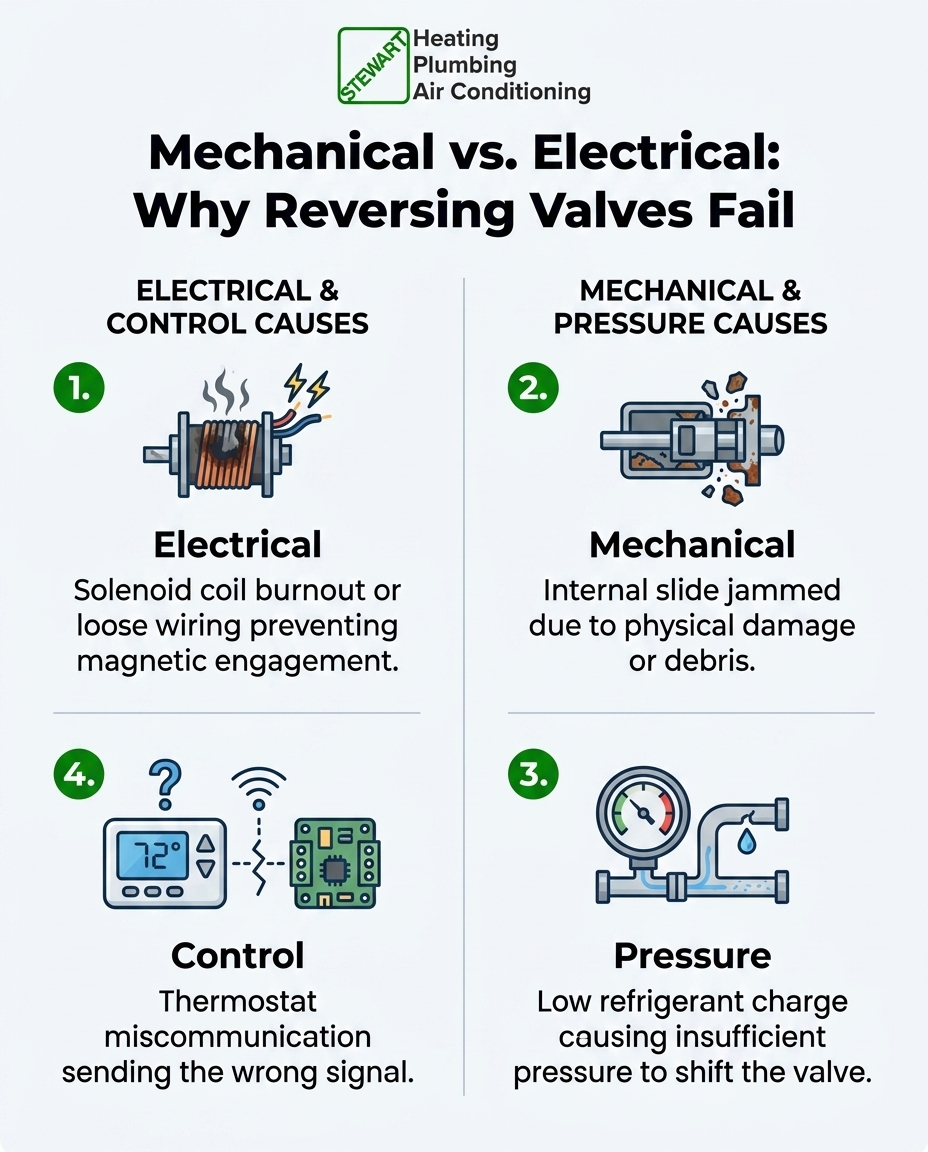
Before assuming the heavy brass valve has suffered a catastrophic mechanical failure, our professionals will always check the electrical side of the equation. The mechanical shifting of the internal slide is triggered by an electrical component called the solenoid coil. This coil sits like a small black cap on the outside of the pilot valve.
When your thermostat calls for cooling, it sends a 24-volt electrical signal to the solenoid. The solenoid coil instantly generates a strong magnetic field, which pulls a tiny metal plunger inside the pilot valve, initiating the pressure change that moves the main slide. If that magnetic field never forms, the valve stays exactly where it is—usually in its default heating position.
Electrical failures are incredibly common during the extreme demand of August late-summer heatwaves. A solenoid coil can simply burn out from years of use, short-circuit, or suffer from a loss of voltage due to damaged wiring elsewhere in the outdoor unit.
Our team at Stewart Heating, Plumbing and Air Conditioning recently helped a local homeowner who experienced this firsthand during a blistering August weekend. On a Friday evening, with the hot weather peaking and kids getting ready for the new school year, their system suddenly started blowing hot air. After two hours of methodical troubleshooting, our technician discovered that the reversing valve itself was perfectly fine. The culprit was a single loose wire that had vibrated free, cutting off the 24-volt signal to the solenoid. Once the wire was secured, the magnetic field engaged, the valve shifted with a satisfying "whoosh," and the air conditioning was restored.
Electrical diagnostics require specialized tools:
• Multimeters: Used to verify that exactly 24 volts are reaching the coil from the control board.
• Magnetic testers: Specialized tools that can detect if the coil is actually generating the required magnetic field when energized.
• Ohm meters: Used to check the internal resistance of the coil to see if the internal copper windings have shorted out or broken.
Because these checks involve working near high-voltage contactors and capacitors in the outdoor unit, tracing a voltage drop is strictly a job for a trained professional.
If the electrical solenoid is receiving the correct voltage and generating a strong magnetic field, but the system is still blowing hot air, the problem lies within the sealed mechanical system. This is where repairs become significantly more complex.
The problem: The internal slide inside the brass casing is physically jammed, or the system lacks the pressure required to move it. When this happens during the late-summer heat in the Bay Area Delta, the system is fundamentally incapable of providing cooling.
The cause: Mechanical binding can happen for several reasons. Over years of operation, the internal Teflon slide can wear down, causing it to catch on the edges of the brass ports. Alternatively, if a compressor is beginning to fail, it can send microscopic metal shavings or debris through the refrigerant lines, which then get lodged in the reversing valve's tight clearances.
Another frequent cause our technicians spot is a refrigerant leak. Because the reversing valve relies entirely on the pressure difference between the high side and the low side of the system to push the slide, a system that is low on refrigerant simply won't have the brute force necessary to make the switch.
The solution: If the valve is mechanically ruined, it cannot be opened and repaired; the entire brass assembly must be cut out and replaced. This is a major, highly technical repair that involves recovering the existing refrigerant, unbrazing (melting the silver solder) the four copper pipes connected to the old valve, precisely brazing in a new valve without melting its internal plastic parts, and pulling a deep vacuum on the system.
Replacing a stuck reversing valve is never a do-it-yourself project, primarily because it requires opening the sealed refrigerant circuit. Under Section 608 of the EPA Clean Air Act, it is illegal for anyone without proper certification to handle, recover, or purchase regulated refrigerants.
Venting refrigerant into the atmosphere causes severe environmental harm. Furthermore, if a homeowner attempts to open the system, moisture and non-condensable gases from the atmosphere will immediately contaminate the lines. When mixed with compressor oil, moisture creates a highly corrosive acid that will destroy the compressor from the inside out. Professionals use expensive recovery machines, micron gauges, and vacuum pumps to ensure the system remains completely sterile and environmentally compliant during a valve replacement.
Sometimes, the reversing valve is perfectly healthy, the solenoid is ready to work, and the refrigerant pressures are ideal—but the system still blows hot air. In these cases, our technicians must look at the brain of the operation: the thermostat and the control boards.
Your thermostat dictates the operation of the reversing valve through a specific wire connection, usually designated as the "O" or "B" terminal. Depending on the brand of your heat pump, the thermostat must either energize this wire to switch to cooling, or energize it to switch to heating. If the thermostat is configured incorrectly, if the internal relays in the thermostat are failing, or if a rodent has chewed through the low-voltage wire in your attic, the signal will never reach the outdoor unit.
Additionally, heat pumps have a specialized circuit board outside called a defrost control board. During the winter, this board intentionally forces the reversing valve into cooling mode for a few minutes to melt ice off the outdoor coils. If this board malfunctions during an August heatwave, it can hijack the signal and force the valve to stay in heating mode.
How technicians isolate the issue: A skilled technician will bypass the thermostat entirely. By applying 24 volts directly to the control board or the solenoid at the outdoor unit, they can instantly determine if the valve works. If the valve shifts when forced manually, the technician knows the mechanical system is fine, and the issue lies in the communication wiring or the thermostat itself. If your system is repeatedly suffering from these cascading electrical and control failures, we often advise homeowners that the equipment is aging out, which is a good time to consider how a new HVAC system increases home value, restores reliable comfort, and may even qualify you for federal tax credits or local utility incentive programs.
When you are facing an indoor climate emergency, the temptation to search for a quick DIY fix is strong. However, diagnosing a reversing valve requires methodical, experienced investigation. Since 1974, our team at Stewart Heating, Plumbing and Air Conditioning has leveraged decades of local experience to provide safe, precise diagnostics rather than relying on risky trial-and-error.
A professional diagnostic process ensures that you don't replace an expensive mechanical valve when the real issue was a simple loose wire. Here is how our seasoned technicians approach the problem:
1. Thermostat and Control Verification: The technician first checks the indoor thermostat configuration and measures the voltage output at the O/B terminal to ensure the "call for cooling" is actually being sent.
2. Solenoid and Magnetic Field Testing: Moving to the outdoor unit, the technician uses a multimeter to verify 24 volts at the coil. They will then test the magnetic pull of the solenoid to ensure the pilot valve is being actuated.
3. Refrigerant Pressure Analysis: Using specialized manifold gauges, the technician measures the high and low-side pressures of the system. If the system is low on refrigerant, the valve won't shift, and a leak search must be performed.
4. Temperature Differential Checks: If the valve is suspected to be leaking internally (partially stuck), the technician will use precise digital thermometers to measure the temperature of the four copper pipes connected to the valve. A specific temperature bleed-over pattern confirms an internal mechanical failure.
5. Safe Brazing Protocols: If replacement is required, the technician uses heat-blocking paste and wet rags wrapped around the new brass valve body while brazing. The internal Teflon slide will melt if the valve body gets too hot during the installation process.
Because this component is so critical to your system's operation, the best way to prevent unexpected failures is through proactive care. Having a professional check your system's pressures, electrical connections, and overall health through a routine HVAC maintenance plan can catch excessive wear and tear long before you are left sweating in a sweltering house.
Understanding the intricate mechanics of your heat pump's reversing valve helps you make informed, confident decisions about your home's comfort system. While it is fascinating to know how high-pressure gas and magnetic fields work together to cool your home, it is equally important to recognize when a problem requires expert intervention.
Whether the issue stems from a burnt-out electrical solenoid, a loss of refrigerant pressure, or a physically jammed internal slide, a professional diagnosis from our team is the only safe and reliable path forward. Trying to force a stuck valve or tamper with high-voltage wiring can lead to severe equipment damage or personal injury. If your system is blowing hot air when you need end-of-season cooling the most, rely on licensed professionals to accurately pinpoint the failure, safely handle the refrigerants, and restore your home's comfort effectively.
The most obvious sign of a bad reversing valve is a heat pump that blows hot air when set to cool, or cool air when set to heat. You might also hear a constant hissing noise from the outdoor unit, indicating that the internal slide is only partially shifted and refrigerant is bleeding between the high and low-pressure sides. A professional will confirm a bad valve by measuring the temperature differences on the four pipes connected to the valve body.
Reversing valves can fail electrically or mechanically. Electrical failures usually involve a burnt-out solenoid coil or damaged wiring that prevents the valve from receiving the signal to shift. Mechanical failures occur when the internal slide gets jammed by debris, wears out over time, or when the system has a refrigerant leak and lacks the internal pressure required to push the slide into position.
You should never attempt to forcefully unstick a reversing valve yourself, as hitting the brass body with a tool can permanently dent the casing and guarantee a costly replacement. A licensed technician, like those on our team, may sometimes try cycling the thermostat between heat and cool rapidly while gently tapping the valve body with a rubber mallet to dislodge debris, but if the valve is severely bound, it must be completely replaced.
The mechanical body of a reversing valve cannot be repaired. It is a sealed brass unit, and if the internal slide is damaged or jammed, the entire valve must be cut out of the refrigerant lines and replaced. However, if the failure is purely electrical—such as a bad solenoid coil—the technician can simply replace the external coil without opening the sealed refrigerant system.
Your heat pump defaults to heating mode when it loses power or mechanical function at the reversing valve. If the thermostat fails to send a signal, if the solenoid coil burns out, or if the internal valve slide jams, the system will remain in its default heating position, pulling heat from outside and blowing it into your already warm home.
Replacing a reversing valve requires a technician to safely recover the existing refrigerant into a specialized tank before unbrazing the old valve. Once the new valve is installed and the system is vacuumed, the recovered refrigerant can often be reused. However, if the system was low on refrigerant due to a leak, or if the old refrigerant was contaminated by a failing compressor, new refrigerant will need to be added to reach the correct factory charge.

Very professional and complete. I would recommend Stewart to anyone. Highest quality of workmanship and clean installation.
Stewart Heating Plumbing Air Conditioning just did some work for us for the first time. They did an installation at my home and it turned out well. I thought the price was fair and I definitely would use them again. The technicians were very friendly and knowledgeable about their work. I highly recommend Stewart Heating Plumbing Air Conditioning and already told friends to use them.
We have been using Stewart Heating Plumbing Air Conditioning since 1995. They put the original heating and air unit in the house, and we have just stayed with them. They are dependable and honest people, and they have done a good job for us every time that we have used them!
They came and did an inspection and are coming tomorrow to do the repair.
They replaced a regulator the first time, and then the water heater vent had to be replaced. They did great work.
The gentleman that serviced us was helpful, insightful, and knew what he was talking about. Overall, it was a great experience.