

Recent Blogs
Stay updated with our latest blog posts.

Evaporator vs condenser coil cleaning explained simply: your HVAC system has two coils that do opposite jobs, and each one collects different types of dirt that requires a different cleaning approach.
Here is a quick breakdown:
| Evaporator Coil | Condenser Coil | |
|---|---|---|
| Location | Indoors (air handler or furnace) | Outdoors (condenser unit) |
| Job | Absorbs heat and moisture from indoor air | Releases heat to the outside air |
| Common Debris | Dust, pet hair, mold, lint | Dirt, leaves, pollen, grass clippings |
| Cleaning Method | No-rinse foaming cleaner, soft brush | Garden hose rinse, coil-safe cleaner |
| Cleaning Frequency | Once a year (more with pets or dust) | Once a year (more in high-debris areas) |
Both coils sit at the heart of the refrigeration cycle. When either one is coated in grime, your system has to work harder to move heat — and that means higher energy bills, shorter equipment life, and weaker cooling throughout your home.
Most homeowners in Pittsburg, CA treat their air conditioner like a sealed box. The system blows air, so it must be fine — until the utility bill spikes or the system stops keeping up on a hot summer day. The reality is that dirty coils are one of the most common and most preventable causes of HVAC inefficiency. Research shows dirty coils can increase energy consumption by as much as 37% compared to clean ones, and can cut overall system efficiency by 15% to 30%.
Understanding the difference between these two coils — where they are, why they get dirty, and how to clean each one safely — puts you in control of your system's health and your home's comfort.
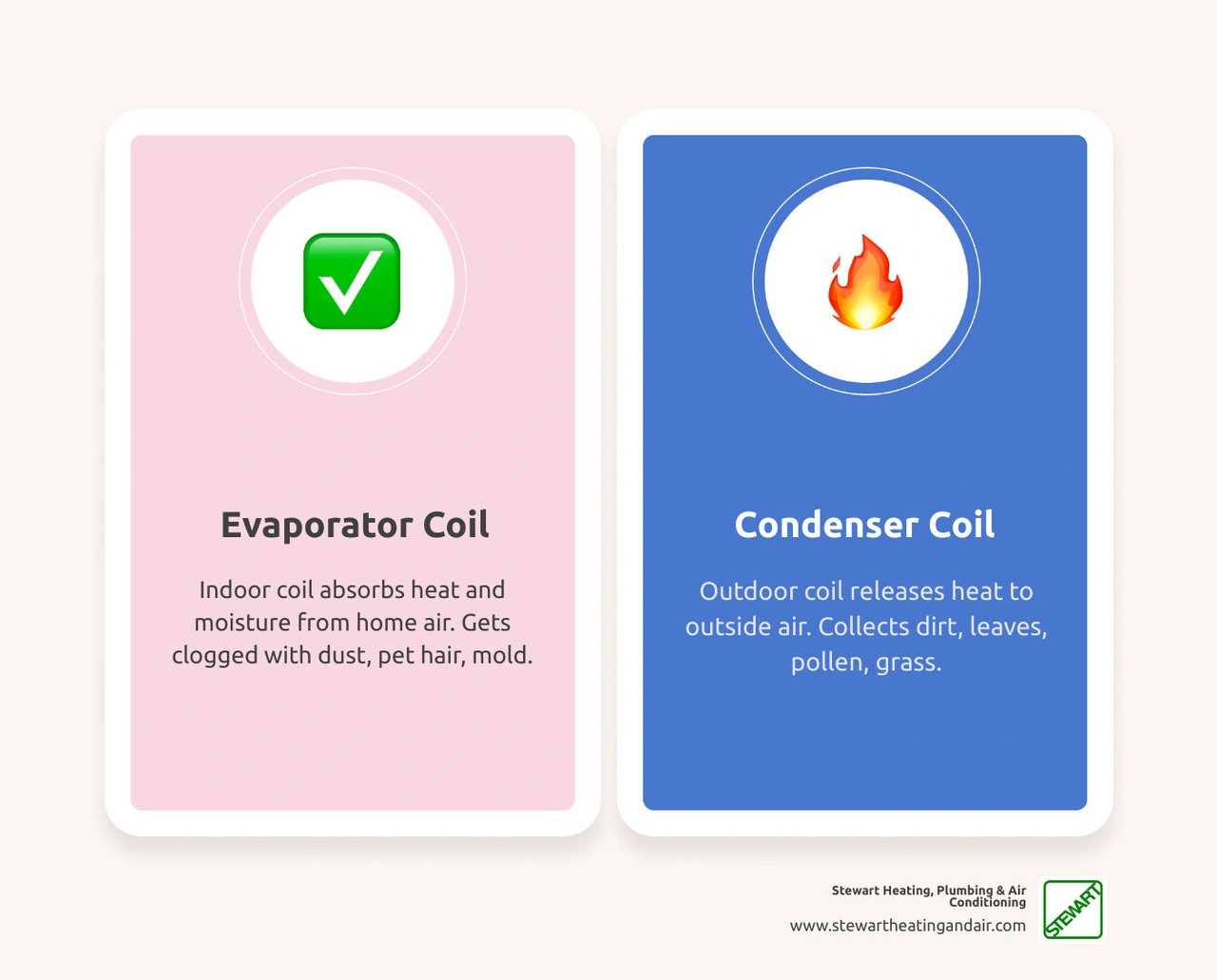
To understand why cleaning is so vital, we first need to look at how these coils work as a team. Your air conditioner doesn't actually "create" cold air; it moves heat from inside your home to the outside. This is called the refrigeration cycle, and the coils are the "lungs" of the operation.
The process relies on a phase change. Refrigerant flows through these coils, switching from a liquid to a gas and back again. As it changes state, it either absorbs or releases massive amounts of heat. If the surfaces of these coils are covered in a "blanket" of dust or grime, that heat transfer is blocked. It's like trying to cool off while wearing a heavy winter parka in July.
| Feature | Evaporator Coil | Condenser Coil |
|---|---|---|
| Primary Function | Heat Absorption & Dehumidification | Heat Rejection |
| Refrigerant State | Liquid to Gas (Evaporation) | Gas to Liquid (Condensation) |
| Environment | Indoor (Controlled) | Outdoor (Exposed) |
| Fins | Very closely spaced (12-18 per inch) | Durable but exposed to debris |
The evaporator coil is usually hidden away inside your home, tucked into the air handler or sitting right on top of your furnace. Because it is cold, moisture from your indoor air condenses on its aluminum fins—much like water beads on a cold soda can. This is how your AC dehumidifies your home.
However, because the coil is wet, it acts like a magnet for every bit of dust, pet hair, and lint that makes it past your air filter. Over time, this creates a sticky, gray "mat" of grime. If the buildup gets too thick, the coil can't absorb heat, and the moisture on the fins can actually freeze into a block of ice. If you are dealing with a severely neglected unit, you might even be looking at an Evaporator Coil Replacement to restore your home's comfort.
The condenser coil is the "heavy lifter" located in that large metal box outside your house. Its job is to take the heat that was collected indoors and dump it into the outside air. To do this, a large fan pulls outdoor air across the copper tubing and aluminum fins.
Because it lives outside, it deals with a completely different set of "enemies." It gets pelted with lawn clippings, pollen, spider webs, and dirt. In our Contra Costa County service area—from the windy hills of Martinez to the dusty plains of Oakley—outdoor coils can become clogged surprisingly fast. When the condenser is dirty, the refrigerant can't shed its heat, which causes the compressor to run hotter and under much higher pressure.
We often tell our neighbors in Concord and Antioch that a clean coil is the cheapest insurance policy you can buy for your home. Neglecting these components doesn't just make you a little warmer; it physically damages the machine.
When we talk about evaporator vs condenser coil cleaning explained, we have to talk about the "efficiency gap." A dirty coil can jack up your energy costs by as much as 40%. Why? Because the system has to run for 20 minutes to do a job that a clean system could do in 10. This leads to massive airflow restriction and puts an incredible strain on the compressor—the most expensive part of your AC.
For a deeper dive into why this matters locally, check out our AC Coil Cleaning Concord Complete Guide.
How do you know if your coils are crying out for help? Here are the red flags we look for:
Cleaning isn't just about today's comfort; it's about making sure your system lasts its full 15-year lifespan. Dirty coils cause "head pressure" to skyrocket, which can lead to the breakdown of compressor lubricants. Once that oil breaks down, acid can form within the sealed system, leading to a catastrophic "burnout."
Regular maintenance, especially in areas like Pittsburg, helps prevent this corrosion. If you want to keep your unit running until the 2030s, staying on top of AC Coil Cleaning Pittsburg CA is non-negotiable.
Ready to tackle some maintenance? Before you start, you need the right gear. Safety is paramount, so always wear gloves, safety glasses, and a dust mask.
Essential Tools:
For those in a hurry or dealing with a sudden heatwave, our 24-Hour AC Coil Cleaning Guide Concord offers quick tips for emergency maintenance.
Cleaning the indoor coil is a delicate job because it is usually located near electrical components and above your furnace.
If you’re in the Delta area, our experts in AC Coil Cleaning Antioch CA can help if your indoor unit is in a hard-to-reach attic or crawlspace.
The outdoor unit is a bit more rugged, but you still need to be careful.
Residents in the heart of the county can find more localized tips at AC Coil Cleaning Concord CA.
Even with the best intentions, DIY coil cleaning can go wrong. The most common mistake we see is the use of pressure washers. The aluminum fins on your coils are about as thick as a soda can; high-pressure water will flatten them instantly, permanently blocking airflow.
Another danger is using the wrong chemicals. Acidic cleaners meant for outdoor condensers can off-gas dangerous fumes if used on an indoor evaporator. Furthermore, if you suspect your evaporator coil has mold, stop immediately. Disturbing mold spores can spread them throughout your home's ductwork, impacting your family's health.
While a light annual dusting is a great DIY project, some situations require a pro. You should call us for AC Coil Cleaning Pleasant Hill CA if:
For comprehensive maintenance that covers more than just a surface spray, check out More info about AC coil cleaning services.
Generally, no. Evaporator cleaners are usually "no-rinse" and pH-balanced to be safe for indoor air quality. Condenser cleaners are often much stronger and more alkaline to cut through outdoor pollutants and oxidation. Always check the label—using a harsh outdoor chemical indoors can damage your drain pan or create toxic fumes.
As of April 2026, the standard recommendation remains at least once per year. However, if you have multiple shedding pets, live near a construction site in Brentwood, or have a smoker in the home, you should inspect your evaporator coil every six months.
Absolutely. Cleaning your coils is one of the most effective ways to lower your utility costs. By restoring proper heat transfer, you can see energy savings of up to 37%. It reduces the system's runtime and prevents the compressor from working overtime, which is a win for both your wallet and your home's comfort.
At Stewart Heating, Plumbing & Air Conditioning, we’ve spent years serving our neighbors across Contra Costa County—from Walnut Creek to Pittsburg and beyond. We know that evaporator vs condenser coil cleaning explained can seem technical, but it really comes down to one thing: keeping your system's "lungs" clear so it can breathe.
Whether you're looking for a quick DIY tip or you need a professional team to deep-clean a neglected system, we are here to help. We pride ourselves on quality craftsmanship and doing the job right the first time so you can enjoy a cool, efficient home all summer long.
Ready to boost your AC’s efficiency? Schedule your professional AC maintenance with Stewart Heating, Plumbing & Air Conditioning today!

Very professional and complete. I would recommend Stewart to anyone. Highest quality of workmanship and clean installation.
Stewart Heating Plumbing Air Conditioning just did some work for us for the first time. They did an installation at my home and it turned out well. I thought the price was fair and I definitely would use them again. The technicians were very friendly and knowledgeable about their work. I highly recommend Stewart Heating Plumbing Air Conditioning and already told friends to use them.
We have been using Stewart Heating Plumbing Air Conditioning since 1995. They put the original heating and air unit in the house, and we have just stayed with them. They are dependable and honest people, and they have done a good job for us every time that we have used them!
They came and did an inspection and are coming tomorrow to do the repair.
They replaced a regulator the first time, and then the water heater vent had to be replaced. They did great work.
The gentleman that serviced us was helpful, insightful, and knew what he was talking about. Overall, it was a great experience.