

Recent Blogs
Stay updated with our latest blog posts.

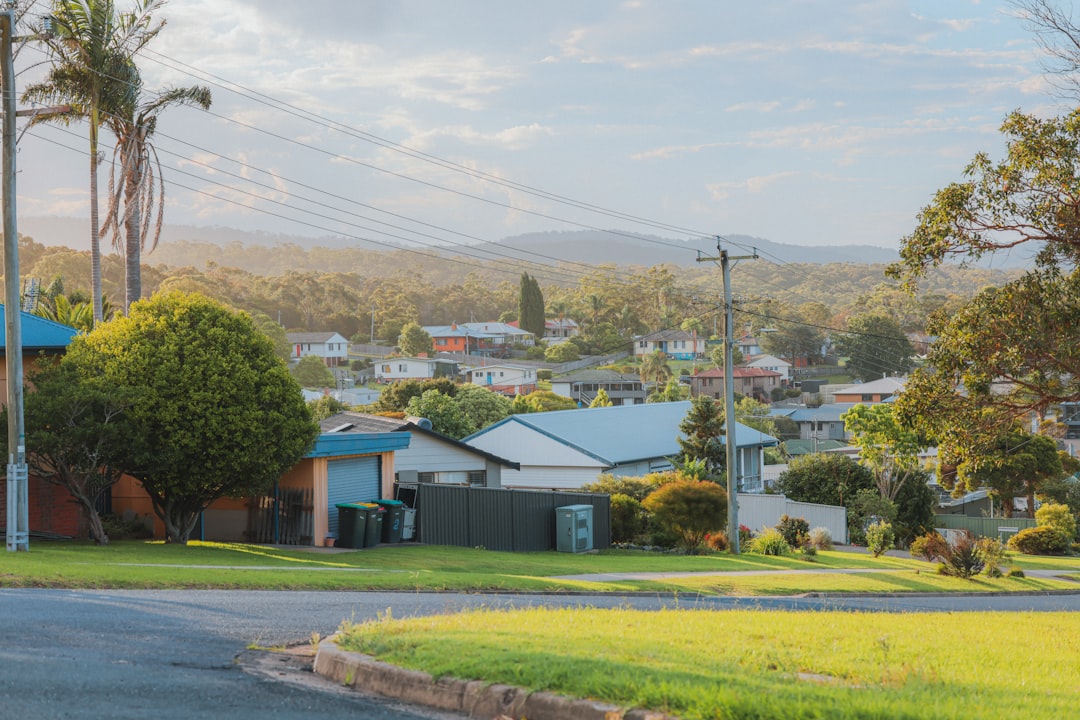
How delta breezes and microclimates affect your comfort comes down to a few key factors working together — and understanding them can explain why your neighbor's house feels noticeably cooler than yours on a hot July evening in Pittsburg or Brentwood, CA.
Here's a quick summary:
If you live anywhere in Contra Costa County — from Walnut Creek to Antioch — the outdoor microclimate around your home directly affects how hard your HVAC system works, how much energy you use, and how comfortable you feel both inside and out.
Cities are not just collections of buildings. They actively reshape local weather patterns, creating small climate zones that can differ dramatically from one street to the next. As one meteorological perspective puts it, urban areas function almost like living weather machines — bending sun, wind, and humidity to create conditions their residents never planned for.
In the Sacramento Valley and greater East Bay region, the Delta breeze has long served as a natural relief valve against punishing summer heat. But when that breeze gets blocked — by a high-pressure heat dome, dense urban development, or even the wrong landscaping choices — the difference in comfort can be dramatic, and your HVAC system pays the price.
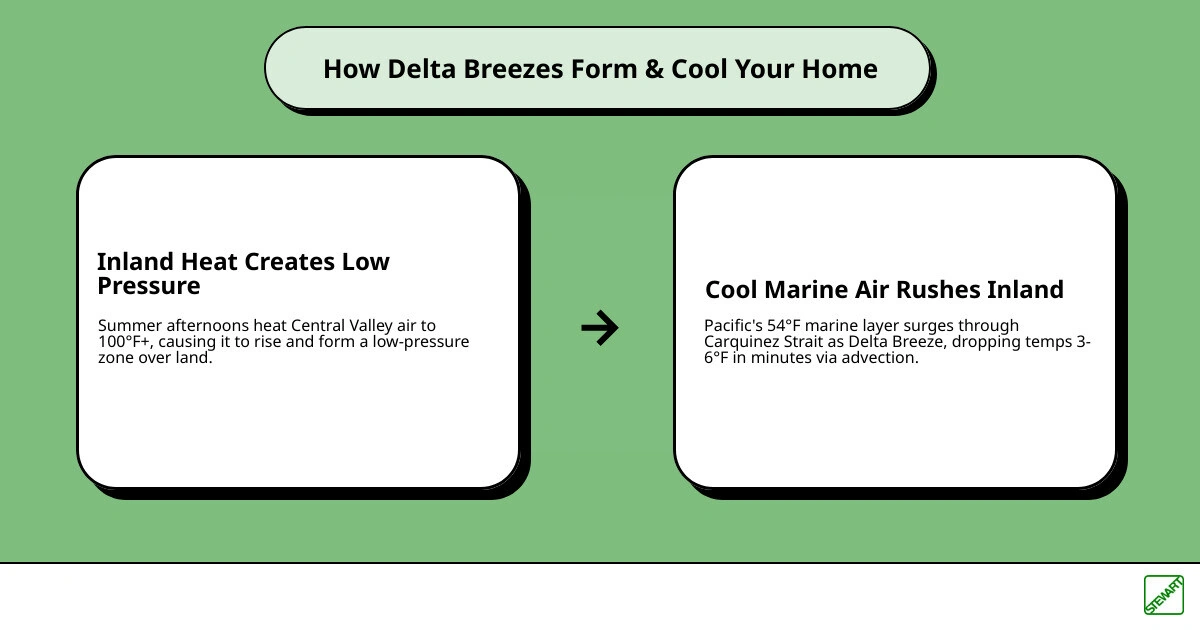

To understand why some homes in Pittsburg or Martinez feel that refreshing evening gust while others remain stifling, we have to look at the geography of the East Bay. The "Delta Breeze" is essentially a sea breeze on steroids. It forms because of a massive pressure gradient. During a typical May 2026 summer day, the inland valleys heat up rapidly. As that hot air rises, it creates a low-pressure zone. Meanwhile, the Pacific Ocean remains a cool, steady 54°F. This temperature difference forces the heavy, cool marine air to rush inland to fill the void.
The Carquinez Strait acts as a natural funnel. While the coastal mountains usually block this cool air, sea-level gaps like the Strait allow the marine layer to pour through. This process, known as advection, is the reason a 100-degree day in Concord can suddenly feel like 75 degrees by 7:00 PM. Understanding How Contra Costa County Climate Affects Your HVAC and Plumbing is vital because your home’s systems are designed to work in tandem with these natural shifts.
The strength of the breeze depends on the "marine layer depth." If the Pacific High pressure system is in the right position, it creates a subsidence inversion—a "cap" that keeps the cool air low to the ground. This allows the air to flow perfectly through the Golden Gate, the San Bruno Gap, and the Petaluma Gap. For those of us in Contra Costa County, the Carquinez Strait is our primary air conditioning duct from the Pacific. When this "duct" is open, our AC units get a much-needed break. When it’s closed by a heat dome, the air stagnates, and the microclimate around your home begins to bake.
Even when the Delta breeze is blowing, you might notice that a walk through a park in Walnut Creek feels significantly cooler than a walk through a downtown parking lot. This is the Urban Heat Island (UHI) effect in action. Materials like asphalt and concrete have a low "albedo," meaning they absorb solar radiation rather than reflecting it. These surfaces can reach temperatures 27°C to 50°C (80°F to 122°F) hotter than the actual air.
At night, while rural areas around Brentwood cool down quickly, urban centers retain this "anthropogenic heat." In cities like Rome or London, researchers have found nighttime temperatures can be up to 5°C (9°F) warmer than the surrounding countryside. This heat retention is a major factor in East Bay Climate HVAC Plumbing Complete comfort strategies. If your home is surrounded by impervious surfaces, you are living in a microclimate that refuses to cool down, even when the sun goes back.
This localized heat creates what we call a "heat bubble" around your outdoor AC condenser. Most air conditioning systems are designed to cool a home to about 20 degrees below the outdoor temperature. If it’s 105°F in Concord, your AC is aiming for 85°F. However, if your condenser is tucked into a narrow, paved side-yard where the air is stagnant, the temperature in that specific microclimate might actually be 115°F.
When the Delta breeze fails to clear out this stagnant air, your compressor runs for 10 or 12 hours straight without a break. This overwork can lead to dirty coils and mechanical failure. Maintaining your Indoor Air Quality Contra Costa County also becomes harder when the AC can't properly dehumidify the air because it’s struggling against an extreme local microclimate.
We often think that adding more plants is the universal solution to heat. While trees provide shade and cooling through evapotranspiration (essentially plant sweat), they can sometimes make things worse. In low-airflow environments, such as enclosed courtyards or narrow side-yards common in Danville or Orinda, dense vegetation can block what little breeze exists.
This creates a "Green Paradox." While the air temperature might be a degree or two lower, the "apparent temperature"—how it actually feels—can be higher. This happens because the plants increase humidity while simultaneously restricting ventilation. This is a critical consideration for Residential Indoor Comfort in Contra Costa County. If you’ve ever felt "sticky" on a shaded patio, you’ve experienced this moisture trapping firsthand.
Real-world simulations, such as those performed on the FCP courtyard, have shown that a "jungle" scenario can actually feel hotter to a human being than a "desert" scenario. In these tests, the lack of wind meant that the latent heat (humidity) from the plants couldn't be carried away. The result? A higher Predicted Percentage Dissatisfied (PPD) among people in the space. For homeowners in Pittsburg or Lafayette, this means that strategic planting—leaving corridors for the Delta breeze to move—is more important than just planting as much as possible.
How do we actually quantify how delta breezes and microclimates affect your comfort? It’s not just about the thermometer. Scientists use several metrics:
| Metric | What it Measures |
|---|---|
| Air Temperature | The actual kinetic energy of the air molecules. |
| Apparent Temperature (AT) | How hot it feels, factoring in humidity and wind. |
| PET | Physiological Equivalent Temperature; accounts for the human body's heat balance. |
| PMV/PPD | Predicted Mean Vote and Predicted Percentage Dissatisfied; tells us how many people will likely complain about the heat. |
These metrics show that air velocity (wind) and radiation (sunlight hitting your skin) are often more important than the air temperature itself. A strong Delta breeze provides "convection," which strips heat away from your body and your home’s exterior.
In studies of the Viale Carlo Felice Gardens in Rome, researchers found that smart design—combining shade with wind corridors—could reduce the PET by up to 4°C. This is the difference between feeling "hot" and feeling "comfortable." For residents looking for HVAC Concord CA, understanding these metrics helps in choosing the right system capacity. You aren't just cooling a square-footage; you are battling the specific thermal perception of your local microclimate.
The good news is that you can influence your home’s microclimate. Building geometry and surface choices play a huge role. For example, using "cool roofs" or high-albedo materials can prevent your attic from turning into an oven. In places like Pleasant Hill or Alamo, homeowners are increasingly looking at how their landscaping interacts with the prevailing winds. If you're interested in Heating and Cooling Concord CA, you should also be looking at your yard.
This is often due to urban geometry and wind shielding. If your backyard is enclosed by tall fences or the house itself blocks the Delta breeze, heat gets trapped. Additionally, the thermal mass of a large concrete patio can radiate heat long after the sun goes down, while a front yard with more airflow and grass stays cooler.
Absolutely. When the breeze kicks in, it clears the "heat bubble" from around your outdoor condenser unit. This allows the refrigerant to shed heat more efficiently, leading to shorter cycle-off periods and lower energy bills. It’s like giving your AC a cold compress.
Yes. Through a process called transpiration, plants release moisture into the air. In an enclosed space with low airflow, this moisture has nowhere to go. This increases the humidity, which prevents your sweat from evaporating, making you feel much hotter than the actual temperature suggests.
At Stewart Heating, Plumbing & Air Conditioning, we’ve spent years seeing how the unique geography of Contra Costa County affects home comfort. From the wind-swept hills of Pittsburg to the sun-drenched valleys of Brentwood, every home sits in its own unique microclimate.
Understanding how delta breezes and microclimates affect your comfort is the first step toward a more efficient, comfortable home. While we can’t control the Pacific High or the Carquinez Strait, we can help you optimize your HVAC system to handle whatever your specific microclimate throws at it. Whether it's through professional maintenance to keep those coils clean during a heat dome or installing high-efficiency systems that don't flinch when the breeze stops, we are here to help.
Don't let a "heat bubble" or a stagnant microclimate ruin your summer. Schedule your seasonal comfort consultation in Contra Costa County with us today, and let’s make sure your home is the coolest one on the block—neighbor or no neighbor!

Very professional and complete. I would recommend Stewart to anyone. Highest quality of workmanship and clean installation.
Stewart Heating Plumbing Air Conditioning just did some work for us for the first time. They did an installation at my home and it turned out well. I thought the price was fair and I definitely would use them again. The technicians were very friendly and knowledgeable about their work. I highly recommend Stewart Heating Plumbing Air Conditioning and already told friends to use them.
We have been using Stewart Heating Plumbing Air Conditioning since 1995. They put the original heating and air unit in the house, and we have just stayed with them. They are dependable and honest people, and they have done a good job for us every time that we have used them!
They came and did an inspection and are coming tomorrow to do the repair.
They replaced a regulator the first time, and then the water heater vent had to be replaced. They did great work.
The gentleman that serviced us was helpful, insightful, and knew what he was talking about. Overall, it was a great experience.