


Recent Blogs
Stay updated with our latest blog posts.

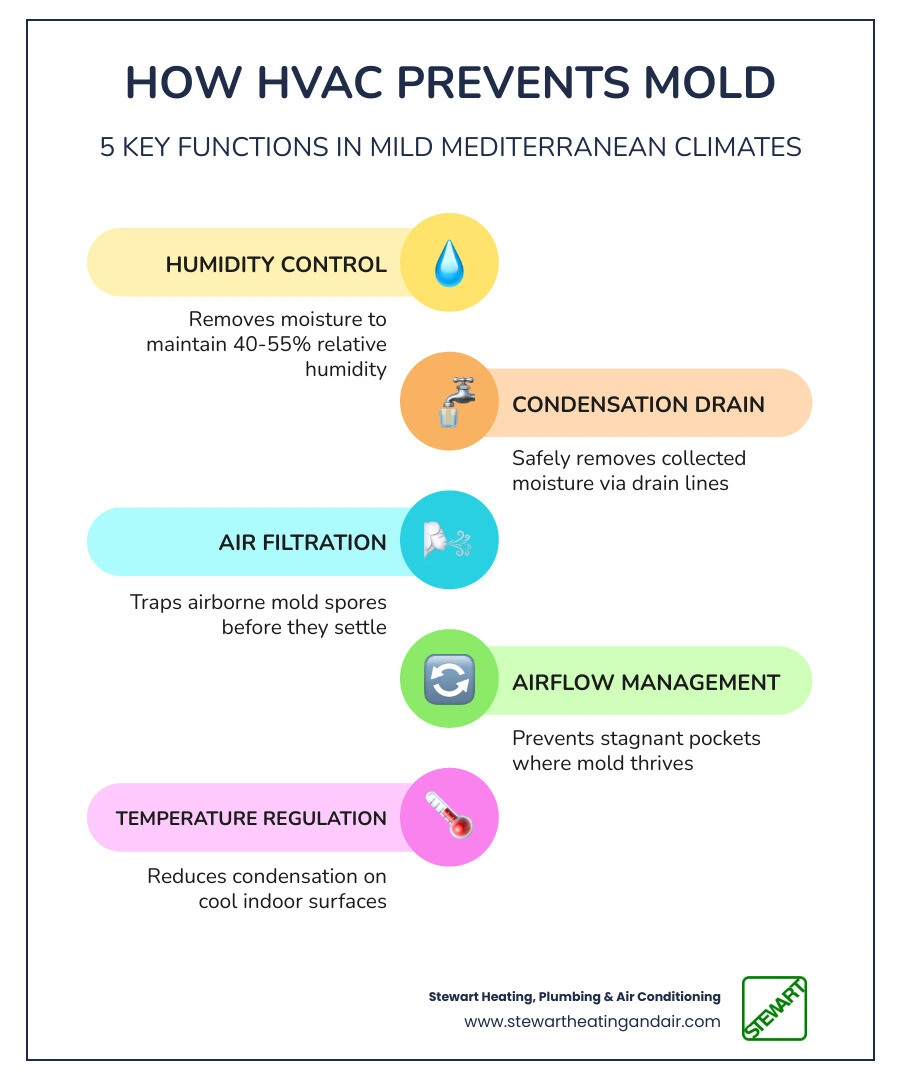
Understanding how your HVAC system prevents mold in Mediterranean mild climates like Contra Costa County is more important than most homeowners realize — especially as the wet season sets in each year. Your HVAC system is your first line of defense against indoor mold, and here is a quick summary of how it works:
How your HVAC system prevents mold in a Mediterranean mild climate:
Mediterranean climates like those found across Contra Costa County — in Pittsburg, Antioch, Concord, and Brentwood — have a deceptively mild reputation. Winters are not brutally cold. Summers are dry. But the rainy season, typically running from November through March, brings concentrated bursts of rain and sharp humidity spikes that can push indoor relative humidity well above the 60% threshold at which mold can begin colonizing common building materials within just 48 to 72 hours.
The challenge is that this climate feels too mild to worry about. Many homeowners assume mold is a problem for wetter, colder regions — not sun-soaked Southern and Central California. But indoor air is often two to five times more polluted than outdoor air, and when your HVAC system is not actively managing moisture, those mild wet winters create ideal conditions for mold to take hold inside your ductwork, on your evaporator coils, and throughout your home's air supply.
This guide walks you through exactly what your HVAC system does to stop mold, where it is most likely to fail, and what you can do to keep your home protected all year long.
In our corner of California, from Walnut Creek to Oakley, the HVAC system serves as a mechanical "lung" for the home. Its primary job isn't just to keep you cool in July or warm in January; it is to manage the hygrothermal dynamics of your living space. The most critical factor in this process is humidity control.
Industry standards recommend maintaining indoor relative humidity between 40% and 55%. When your system operates, the evaporator coil acts as a dehumidifier. As warm, moist air passes over the chilled coil, moisture condenses into liquid water, which is then funneled out of the house. This process is essential because indoor relative humidity above 60% sustained over 48 to 72 hours is sufficient to initiate mold colonization on common building materials like drywall and wood.
Proper airflow management ensures that this dehumidified air reaches every corner of the home. Without consistent circulation, "dead zones" can form—typically behind furniture or in closets—where moisture settles and mold thrives. By keeping the air moving, we ensure that proper HVAC maintenance prevents mold growth by eliminating these stagnant pockets of moisture.
Winters in places like Concord and Martinez are famously mild, but they are also our wettest months. This "mild-wet" combination creates a specific challenge: the latent heat load. Because it isn't freezing outside, your heater may not run long enough to thoroughly dry out the indoor air. Meanwhile, the rain outside increases the moisture content of the air that naturally infiltrates your home through small gaps and cracks.
When indoor air is moist and hits a cold surface—like a window pane or an uninsulated wall—condensation forms. This is where indoor air quality in Concord, CA becomes a priority. A well-tuned HVAC system helps mitigate this by circulating air and using the heating cycle to lower the relative humidity, preventing that "damp chill" that often leads to mildew on windowsills.
The rainy season in Contra Costa County often features "flash rain" events—concentrated bursts of precipitation followed by sunshine. This creates rapid humidity spikes. When the sun comes out after a heavy rain in Pittsburg or Antioch, the standing water evaporates quickly, creating a "sauna effect" outdoors.
Your HVAC system manages this through vapor pressure control. It works to keep the indoor environment at a lower vapor pressure than the outdoors, effectively pushing back against the moisture trying to seep into your home. If your system is oversized, it might "short-cycle," meaning it turns on and off too quickly. This is a problem because a system needs to run for a significant amount of time to actually remove moisture from the air. If it only cools the temperature but doesn't run long enough to dehumidify, your indoor air quality in Walnut Creek, CA will suffer as humidity levels climb.
Not all parts of your HVAC system are created equal when it comes to mold risk. Some components are naturally wetter and more prone to biological growth.
Preventing mold isn't a one-time event; it's a habit. We've seen that homes in Lafayette and Orinda that follow a strict maintenance schedule have significantly fewer air quality issues.
Monthly HVAC Inspection Checklist:
Sometimes, a standard HVAC system needs a little help, especially in older homes in Danville or Alamo where insulation might not be up to modern standards.
| Feature | Standalone Dehumidifier | Integrated Whole-Home System |
|---|---|---|
| Coverage | Single room or small area | Entire home via ductwork |
| Maintenance | Manual bucket emptying | Automatic drainage |
| Noise Level | Can be loud in living spaces | Quiet (located in attic/garage) |
| Efficiency | Lower (runs independently) | Higher (works with HVAC fan) |
| Mold Prevention | Localized | Comprehensive |
Generally, no. We don't recommend covering your outdoor condenser with plastic or heavy tarps. These covers trap moisture inside the unit, creating a humid micro-climate that promotes rust, corrosion, and—you guessed it—mold. Outdoor units are designed to withstand rain. If you are worried about falling leaves or debris in Brentwood or Antioch, use a breathable mesh cover that allows for airflow while keeping the "big stuff" out.
In Contra Costa County, we recommend a quick check once a month during the rainy season. Look for the white PVC pipe exiting your home. If the system is running and you don't see any moisture, or if you see water pooling in the emergency drain pan under your indoor unit, you likely have a clog. A quick vinegar flush can prevent most issues, but if it's already backed up, it's time for a professional to clear the line.
The most common sign is a musty or "dirty sock" smell when the air first kicks on. This usually indicates biological growth on the coils or in the ducts. Other signs include visible dark spots on your supply registers, a "clammy" feeling to the air even when the temperature is cool, or windows that are constantly fogged up on the inside. If your indoor hygrometer consistently reads above 60% humidity, your system needs immediate AC maintenance in Walnut Creek, CA.
At Stewart Heating, Plumbing & Air Conditioning, we’ve spent decades helping our neighbors in Pittsburg, Concord, and throughout Contra Costa County breathe easier. We know that a Mediterranean climate presents unique challenges, and we are committed to doing projects right the first time to ensure your home remains a healthy, mold-free sanctuary.
Whether you need a routine seasonal tune-up, a professional duct cleaning, or a high-tech air purification upgrade, our team is here to provide quality solutions with a focus on your total satisfaction. Don't wait for the musty smells to start—take a proactive step toward a healthier home today.
Breathe easier with professional Indoor Air Quality solutions in Contra Costa County

Very professional and complete. I would recommend Stewart to anyone. Highest quality of workmanship and clean installation.
Stewart Heating Plumbing Air Conditioning just did some work for us for the first time. They did an installation at my home and it turned out well. I thought the price was fair and I definitely would use them again. The technicians were very friendly and knowledgeable about their work. I highly recommend Stewart Heating Plumbing Air Conditioning and already told friends to use them.
We have been using Stewart Heating Plumbing Air Conditioning since 1995. They put the original heating and air unit in the house, and we have just stayed with them. They are dependable and honest people, and they have done a good job for us every time that we have used them!
They came and did an inspection and are coming tomorrow to do the repair.
They replaced a regulator the first time, and then the water heater vent had to be replaced. They did great work.
The gentleman that serviced us was helpful, insightful, and knew what he was talking about. Overall, it was a great experience.