

Recent Blogs
Stay updated with our latest blog posts.

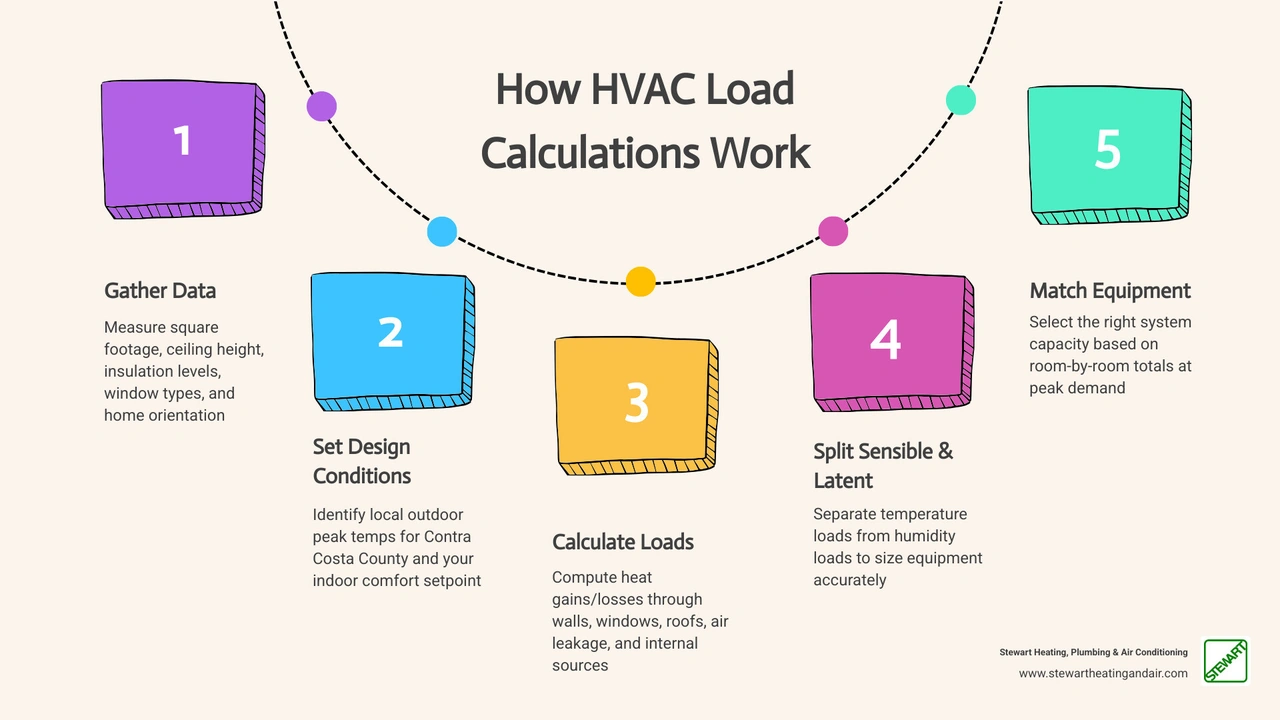
How HVAC load calculations work is one of the most important things to understand before replacing or installing any heating or cooling system in your home. In short, a load calculation determines exactly how much heating or cooling your home needs — measured in BTUs per hour — based on its specific characteristics, not just its size.
Here's a quick summary of how the process works:
Get this right, and your system runs efficiently, keeps you comfortable, and lasts longer. Get it wrong — even by going slightly too big — and you end up with short cycling, poor humidity control, higher energy bills, and unnecessary wear on expensive equipment.
For homeowners in Pittsburg, Walnut Creek, Antioch, and across Contra Costa County, where summer temperatures and microclimates vary significantly from neighborhood to neighborhood, a proper load calculation isn't optional — it's essential.
An HVAC load calculation is the process of figuring out how much heating or cooling a building needs at peak design conditions. That result is usually expressed in BTU/hr. For cooling equipment, 12,000 BTU/hr equals 1 ton of cooling capacity.
This matters because HVAC systems should be sized to the home, not guessed from the old unit nameplate or a rough square-foot rule. A properly sized system helps maintain comfort, humidity control, and efficiency. A poorly sized system does the opposite.
At the simplest level, load calculations answer two questions:
The calculation uses indoor design conditions, outdoor design temperatures, and home-specific details to estimate peak demand. Cooling load looks at heat gain. Heating load looks at heat loss.
That heat moves in several ways:
So when people ask how HVAC load calculations work, the short answer is: we total all the ways a house gains or loses heat, then size the equipment to handle that load under local peak conditions.
Square footage alone is a shortcut. It can be useful for a rough conversation, but not for final equipment selection. A 2,000-square-foot house with poor insulation and west-facing glass may need a very different system than a 2,000-square-foot house with upgraded windows, shade, and good air sealing.
Rules of thumb like "X tons per Y square feet" skip key factors such as:
A typical system moves about 400 CFM per ton of air conditioning, so even a one-ton sizing error affects both capacity and airflow. That is not a small miss.
| Method | What it uses | Accuracy |
|---|---|---|
| Square-foot estimate | Mostly floor area | Rough only |
| Manual J block load | Whole-house detailed inputs | Better |
| Manual J room-by-room | Detailed inputs by room | Best for sizing and comfort |
If equipment is too large, it often short cycles. It cools the house quickly, shuts off, and repeats. That sounds efficient until humidity stays behind and the house feels cool but clammy. Oversized cooling can also leave indoor relative humidity noticeably higher.
If equipment is too small, it may run constantly during extreme weather, struggle to hold setpoint, and wear faster.
Common problems include:
The goal is the Goldilocks version of HVAC sizing: not too big, not too small, and definitely not based on vibes.
For homes, the recognized sizing method is Manual J, published by ACCA. It is the standard used to calculate residential heating and cooling loads.
Manual J is not the same as equipment selection. It tells us how much load the home has. Then Manual S is used to match that load to actual equipment performance. Manual D addresses duct design, and Manual T covers air distribution.
A proper Manual J looks at much more than square footage. Inputs typically include:
It can be done as a whole-house block load, but the best residential practice is room by room.
A room-by-room approach is where the process gets much more useful. Not every room behaves the same.
A west-facing bedroom in Walnut Creek may see a much higher afternoon solar load than an interior hallway. A kitchen in Pittsburg may have extra gains from cooking and appliances. A bonus room over a garage may need different airflow than the rest of the house.
Room-by-room calculations help determine:
Software can speed up the process, but defaults can create bad results if they are not adjusted to the actual home. A calculation based on generic assumptions is just a more sophisticated guess.
Old equipment size is also a weak guide. The previous system may have been oversized from day one. Or the home may have changed since it was installed, with:
That is why measured, home-specific inputs matter.
If you are replacing a system, ask for the load calculation report. You do not need to love spreadsheets, but you should see evidence that the work was actually done.
Ask for:
If you are planning replacement, this guide to an HVAC replacement estimate can help you understand what should be included in the process.
Loads change because homes are different, and even similar-looking houses can perform very differently.
Bigger homes usually need more capacity, but shape matters too. A compact home may lose or gain less heat than a spread-out home with more exposed surface area.
Important envelope factors include:
The basic physics is simple: more area and less insulation usually mean more heat transfer.
Windows are major load drivers, especially for cooling. Solar gain through glass can add a lot of afternoon heat.
Key variables include:
Infiltration matters too. Uncontrolled outside air brings both sensible heat and moisture into the house. In many homes, tightening the envelope can meaningfully reduce total load.
People give off heat. So do lights, televisions, computers, ovens, and other appliances. A common rule used in residential work is roughly 250 BTU/hr sensible gain per person, though actual methods account for occupancy assumptions more specifically.
Internal gains commonly come from:
These loads are one reason two homes with the same square footage can need different equipment sizes.
Contra Costa County is not one single weather pattern. Conditions can shift between communities, and microclimates matter. A home in Pittsburg or Brentwood may experience different peak summer behavior than a home in Walnut Creek, Lafayette, or Orinda.
That is why load calculations use local design temperatures rather than generic statewide assumptions. Good sizing starts with the right weather data for the actual service area.
If you want a local sizing overview, see Getting the Right Size HVAC for Contra Costa County Homes.
A good load calculation does not just ask how hot a house gets. It also asks how much moisture must be removed.
Sensible heat changes air temperature. Latent heat changes moisture content.
Examples of sensible gains:
Examples of latent gains:
Summer comfort is not just temperature. A common comfort range is about 70 to 76 F with relative humidity around 45% to 65%. When humidity is too high, the house feels sticky even if the thermostat looks fine.
If a system is selected only for temperature and ignores moisture, comfort suffers. This is especially true in homes where oversized cooling equipment runs for short cycles and does not stay on long enough to remove enough moisture.
When latent load is not handled well, you may notice:
This is one of the more technical parts of how HVAC load calculations work, but it matters.
Instantaneous heat gain is not always the same as actual cooling load at that same moment. Why? Thermal storage.
Some heat, especially radiant heat from the sun, is absorbed by walls, floors, furniture, and other surfaces before it shows up as cooling load on the room air. That creates a time lag. The peak heat gain and peak cooling load may occur at different times.
That is why good methods account for building mass and time delay instead of simply adding every heat source at once and calling it a day.
Most homes use air-based systems, where the equipment removes heat from the air stream. In those systems, radiant heat absorbed by room surfaces later becomes convective load that the air system must remove.
Radiant-based cooling changes that relationship because cooled surfaces can absorb some of the radiant load directly. In other words, the path from heat gain to cooling load is different.
For homeowners, the takeaway is simple: the type of system affects how loads are handled, so the calculation method should match the application.
Not all load calculations are done the same way behind the scenes.
For residential sizing, Manual J8 is the usual standard. In broader HVAC engineering, two important methods are:
The Heat Balance Method is the most rigorous. It tracks how heat moves by conduction, convection, and radiation. The Radiant Time Series method is a practical simplification derived from heat balance principles and helps account for thermal storage and delayed cooling load.
You may also hear about older methods like CLTD/CLF. These still appear in legacy references, but modern software and current practice rely more on updated methods.
A proper on-site calculation may use a mix of basic tools and digital tools, such as:
A contractor should gather data such as:
Once the home is modeled, software can generate reports that show:
A clean report is helpful not only for sizing but also for explaining recommendations.
Load results should lead into equipment selection, not stop at the spreadsheet. This next step often follows Manual S principles, where actual equipment performance data is compared to the calculated load.
That helps with:
If you are comparing system types, these resources on Selecting the Right Heat Pump Size and Standard Efficiency vs High Efficiency HVAC Comparison are useful next reads.
You do not need to perform the math yourself, but you should know what good process looks like.
Look for these signs:
Be cautious if you hear things like:
Those are signs the recommendation may be based on shortcuts instead of actual load analysis.
A few smart questions can save a lot of frustration later:
If equipment placement is part of the project, this article on best locations for a new AC system is worth reviewing.
Any major home change can alter the load. Before replacing equipment, update the calculation if you have added or changed:
That is especially important in older homes that have been improved over time. The house your old system was sized for may no longer be the house you live in now.
Only for a rough early estimate. It is not enough for final sizing. Two homes with the same square footage can have very different loads based on insulation, windows, orientation, air leakage, and occupancy.
It depends on the size and complexity of the home, but a proper visit takes long enough to measure rooms, inspect the envelope, collect window and insulation details, and review ducts. If someone sizes a whole house in a few minutes without measuring, that is usually a red flag.
Yes. In fact, those upgrades can reduce heating and cooling loads significantly. That is why we recommend recalculating after major envelope improvements instead of automatically replacing your system with the same size.
A proper load calculation is the foundation of good HVAC design. It helps us choose equipment that fits the home, controls humidity, supports comfort room by room, and avoids the familiar problems of oversizing and undersizing.
For homeowners across Pittsburg, Antioch, Concord, Brentwood, Walnut Creek, Pleasant Hill, and greater Contra Costa County, understanding how HVAC load calculations work makes it easier to ask the right questions before installation day. And when the process is done correctly the first time, the results usually show up where it matters most: comfort, performance, and fewer headaches.
If you are planning a replacement or new installation, learn more about HVAC installation in Walnut Creek, CA.

Very professional and complete. I would recommend Stewart to anyone. Highest quality of workmanship and clean installation.
Stewart Heating Plumbing Air Conditioning just did some work for us for the first time. They did an installation at my home and it turned out well. I thought the price was fair and I definitely would use them again. The technicians were very friendly and knowledgeable about their work. I highly recommend Stewart Heating Plumbing Air Conditioning and already told friends to use them.
We have been using Stewart Heating Plumbing Air Conditioning since 1995. They put the original heating and air unit in the house, and we have just stayed with them. They are dependable and honest people, and they have done a good job for us every time that we have used them!
They came and did an inspection and are coming tomorrow to do the repair.
They replaced a regulator the first time, and then the water heater vent had to be replaced. They did great work.
The gentleman that serviced us was helpful, insightful, and knew what he was talking about. Overall, it was a great experience.