

Recent Blogs
Stay updated with our latest blog posts.

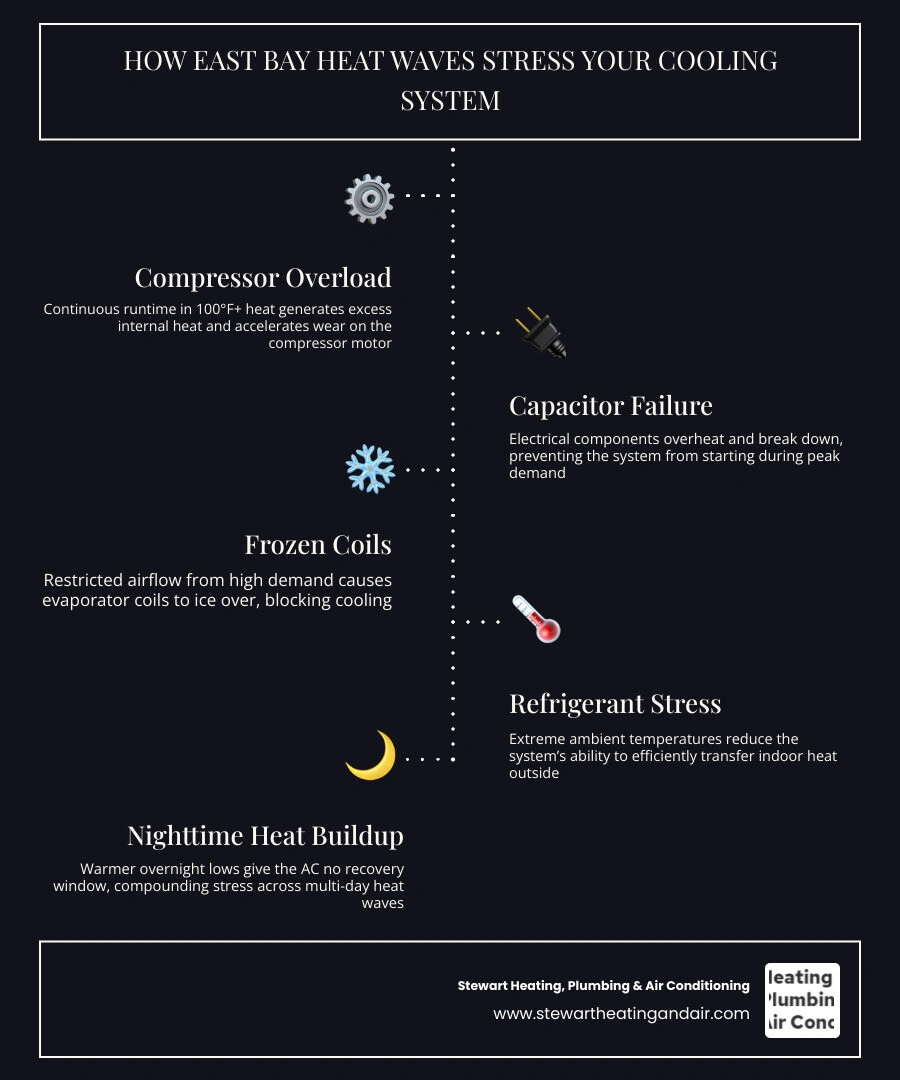
Understanding how East Bay heat waves stress your cooling system starts with knowing what happens inside your AC when outdoor temperatures push past 100°F for days at a time. Here is a quick breakdown:
East Bay valleys like Walnut Creek, Concord, and Livermore regularly see temperatures climb past 110°F during summer heat events. Research tracking the 2021 western U.S. heat waves found that daytime highs in major cities ran 10 to 20°C above the ten-year average — a staggering gap that pushes residential cooling equipment far beyond its design comfort zone. Unlike coastal areas that get some relief from marine air, inland East Bay communities face intense, sustained heat with little natural buffer.
What makes this especially dangerous for homeowners in Contra Costa County is the combination of extreme daytime highs, urban heat island effects, and warmer nights that give your AC no real break. The result is a system that runs harder, wears faster, and is far more likely to fail — right when you need it most.
Key how east bay heat waves stress your cooling system vocabulary:
When an extreme temperature spike hits communities like Antioch, Martinez, or Danville, your air conditioner transitions from standard operation into a high-stakes survival mode. To understand How Contra Costa County Climate Affects Your HVAC and Plumbing, we have to look closely at the mechanical and electrical limits of your cooling system.
The heart of your air conditioner is the compressor, which pumps refrigerant through the system to absorb indoor heat and dump it outside. Under normal conditions, this cycle runs periodically, allowing the unit to rest. However, during a major heat wave, the compressor is forced to run almost continuously. This relentless operation generates massive internal heat. When the outdoor air is already scorching, the system struggles to shed this heat, causing the compressor's internal temperature to skyrocket.
At the same time, the electrical components are pushed to their breaking points. The run capacitor—a small, cylindrical device that provides the electrical torque needed to keep the compressor and fan motors spinning—is highly sensitive to heat. Standard capacitors are oil-filled and designed to operate within strict temperature limits. When subjected to prolonged triple-digit temperatures, the internal chemistry of the capacitor degrades, leading to swelling, electrical leakage, and eventual failure. Once the capacitor dies, the compressor cannot start, and you are left wondering, "Why Is My AC Blowing Warm Air?"
During these extreme weather patterns, atmospheric phenomena like heat domes and atmospheric blocking trap massive ridges of high pressure over California. In past major heat events, daytime maximum temperatures soared 10 to 20 °C higher than the 10-year average maximum temperature. This extreme thermal load means your outdoor condenser coil is surrounded by superheated air, making it incredibly difficult for the refrigerant to condense back into a liquid. The entire system operates under elevated pressure, drawing more electrical current (amps) and rapidly accelerating the wear and tear on every single moving part.
Most residential air conditioning systems are designed and rated to perform optimally at an outdoor temperature of 95°F. Once the ambient temperature crosses this threshold, the cooling capacity of a standard single-stage system begins to drop, even as the demand inside your home increases.
In the East Bay, we regularly cross this 95°F threshold during the summer months. Cities like Walnut Creek often reach 110°F, Concord can hit 112°F, and inland valley areas have recorded temperatures as high as 115°F.
When temperatures remain above 100°F for multiple consecutive days, the structural thermal mass of your home absorbs heat. This heat penetrates deep into your walls, framing, and furniture, creating a continuous radiant heat load. A single-stage AC unit, which only operates at 100% capacity or 0% (completely off), will run continuously for 12 to 18 hours straight without a break. This constant runtime leaves no window for the electrical windings in the fan motors and compressor to cool down.
In contrast, modern variable-speed systems and heat pumps are designed to modulate their output, adjusting dynamically to handle these extreme loads more efficiently. The table below illustrates how different system configurations respond when pushed to a punishing 110°F outdoor temperature.
| Performance Metric | Traditional Single-Stage AC (at 110°F) | Modern Variable-Speed Heat Pump (at 110°F) |
|---|---|---|
| Cooling Capacity | Drops to ~75-80% of rated capacity | Maintains ~90-95% of rated capacity |
| Runtime Pattern | Continuous (100% output, high stress) | Modulated continuous (adjusts capacity dynamically) |
| Electrical Draw | Maximum amp draw, high risk of tripping breakers | Optimized power consumption via inverter technology |
| Compressor Stress | Extremely high (cycles on/off at max load) | Low to moderate (soft-starts and ramps down smoothly) |
| Component Lifespan Impact | Accelerates wear on capacitors and contactors | Minimal impact due to built-in thermal protection |
One of the most unique aspects of living in Contra Costa County is our dramatic microclimates. You can drive 15 miles from the cool, fog-kissed hills of Orinda or Lafayette to the sun-scorched valleys of Brentwood or Oakley and experience a temperature swing of 20 degrees or more.
For homeowners in more developed, inland areas like Concord and Pittsburg, this natural heat is further compounded by the Urban Heat Island (UHI) effect. In built-up areas, asphalt, concrete, and dark roofs absorb solar radiation throughout the day and re-radiate that heat back into the local environment. Research shows that during heat waves, the UHI index can increase baseline temperatures by up to 6 °C (nearly 11°F) compared to nearby rural or undeveloped spaces.
This localized heat retention creates a major barrier to nighttime recovery. Historically, the Bay Area has been famous for its cool nights, which allowed homes and air conditioners to cool down naturally. However, climate data reveals a dramatic increase in hot nighttime temperatures across the country, significantly reducing these critically important relief windows.
When the outdoor temperature stays above 75°F or 80°F overnight, your air conditioner must continue running through the night just to keep indoor temperatures manageable. Because the system never gets a chance to rest and cool down, the residual heat inside the compressor cabinet accumulates. This constant thermal stress accelerates oil degradation inside the compressor, leading to friction, mechanical locking, and premature system failure.
To combat this constant strain, ensuring optimal heat transfer is vital. This is where professional maintenance becomes a shield for your system; understanding the AC Coil Cleaning Benefits and Why It Matters is key to helping your system dump heat efficiently, even when the nighttime air fails to cool down.
During a major East Bay heat wave, your cooling system doesn't just contend with outdoor temperatures; it also has to survive the instability of the local electrical grid. When millions of households from Antioch to Danville crank up their air conditioners simultaneously, electrical demand surges to historic highs. This massive load stresses utility infrastructure, leading to rolling blackouts, brownouts, and voltage fluctuations.
Voltage drops (brownouts) are incredibly destructive to electric motors. When the voltage supplied to your home drops, your AC compressor and fan motors must draw more current (amperage) to maintain the same level of work. This sudden spike in amperage generates intense electrical heat within the motor windings, melting the protective varnish on the wiring and causing the motor to short out.
Furthermore, sudden power outages can cause severe electrical arcs across your system's contactors, welding them shut or pitting the metal surfaces. When the power suddenly cuts out and rapidly cycles back on, it can catch a compressor mid-cycle, forcing it to start against high head pressure. This can lock the rotor and cause immediate electrical failure.
These grid issues are no longer rare anomalies. With climate change projections showing that summer heat waves are now five times more likely to occur and heat domes are intensifying across the Northern Hemisphere, our regional infrastructure is facing unprecedented challenges. Humid heat extremes have doubled in frequency over the last few decades, meaning our air conditioners must work twice as hard to remove moisture from the air while fighting higher sensible temperatures.
When your system fails under these extreme grid and climate conditions, it ceases to be a simple inconvenience. To protect your home and family, it is crucial to recognize When an HVAC Failure is a True Emergency so you can take immediate action.
The failure of a cooling system during a severe heat wave carries profound consequences that extend far beyond physical discomfort. Extreme heat is the leading cause of weather-related fatalities in the United States, making functional air conditioning a critical piece of life-safety infrastructure.
When indoor temperatures climb past 90°F, vulnerable populations—including infants, young children, individuals over the age of 65, and those with pre-existing cardiovascular or respiratory conditions—are at an extremely high risk for heat exhaustion and heat stroke. Without a functional cooling system, indoor spaces can quickly turn into dangerous thermal traps.
While public cooling centers exist across Contra Costa County, accessing them can be incredibly difficult for those without reliable transportation, those living in underserved neighborhoods, or individuals who rely on specialized paratransit services. If a heat wave hits on a weekend, local libraries and community centers may have restricted hours, leaving residents with fewer options for relief.
On a financial level, a sudden, catastrophic AC failure during a peak summer heat wave is a costly emergency. Because HVAC companies are flooded with service requests during these periods, waiting times for parts and repairs can stretch for days. If your system is old and completely gives out, you may face the unexpected burden of an emergency system replacement during the hottest week of the year.
To help local homeowners navigate these stressful situations, we provide resources like our Emergency AC Repair Concord CA Guide and offer responsive, reliable 24-Hour AC Repair Concord CA to restore safety and comfort to your home as quickly as possible.
Fortunately, you do not have to sit by and wait for the next major temperature spike to push your system to the breaking point. By taking proactive, strategic measures, you can significantly reduce the load on your air conditioner, lower your energy bills, and prevent unexpected breakdowns.
To help you get your home ready, we have compiled five straightforward, highly effective steps based on our How to Prevent HVAC Emergencies with Maintenance principles and our comprehensive AC Maintenance Concord CA Guide.
A dirty, clogged air filter is the number one cause of avoidable AC failures. When a filter is loaded with dust, pet dander, and pollen, it restricts the volume of air flowing over your indoor evaporator coil. Without sufficient airflow, the cold refrigerant inside the coil cannot absorb enough heat from your home, causing the coil's temperature to drop below freezing. This moisture then freezes into a solid block of ice, choking off all airflow and forcing your compressor to work under extreme stress. Check your filter monthly during the cooling season and replace it at least every 1 to 3 months.
Your outdoor condenser unit needs plenty of space to breathe. If it is crowded by overgrown bushes, weeds, dry leaves, or stored items, the hot air blown out of the top of the unit will recirculate back through the sides. Keep a minimum of two feet of clear space around the entire perimeter of the outdoor unit and clear away any debris from the metal fins. Additionally, gently rinsing the outdoor coils with a garden hose (with the power off) removes built-up dust and pollen, instantly improving heat rejection.
Do not wait until the afternoon heat has baked your home to turn on your air conditioner. Trying to cool a house down from 85°F to 72°F in the middle of a 105°F afternoon forces your system to run at maximum capacity during the hottest, most expensive hours of the day. Instead, pre-cool your home by lowering your thermostat a few degrees early in the morning when the outdoor air is still cool. This allows your AC to work efficiently, cooling down the thermal mass of your home before the sun reaches its peak.
During peak heat hours (typically between 2:00 PM and 6:00 PM), set your thermostat to a reasonable temperature, such as 78°F. Every degree you raise your thermostat reduces the workload on your compressor by up to 6%. Supplement this by closing blinds and curtains on south- and west-facing windows to block out solar heat. Avoid running heat-producing appliances like ovens, clothes dryers, and dishwashers until late in the evening to keep your indoor air as cool as possible.
The absolute best way to ensure your system survives a heat wave is to have a professional technician inspect and tune it up before the hot weather arrives. A certified technician will check refrigerant levels, test the capacitors, tighten electrical connections, and clean the internal components. If you are planning a system upgrade, we can perform a precise Manual J load calculation to ensure your new system is perfectly sized for your home's unique layout, insulation, and local microclimate. For those looking to upgrade, our team specializes in high-efficiency Air Conditioning Installation in Concord CA to keep your home comfortable for years to come.
Catching a minor issue early can mean the difference between a quick, inexpensive repair and a catastrophic system failure in the middle of a heat wave. By learning the key Signs Your AC Needs Repair, you can call in our professional team before your system breaks down completely. Watch out for these common warning signs:
Modern air conditioning systems and heat pumps are designed and certified to operate effectively at outdoor temperatures up to 115°F to 120°F. While they will maintain their structural integrity at these extreme temperatures, their overall cooling capacity will naturally drop by about 10% to 15% once temperatures exceed 105°F. This is why proper system sizing, clean coils, and clean filters are absolutely critical to maintaining indoor comfort during our hottest summer days.
The Urban Heat Island (UHI) effect raises the ambient air temperature directly surrounding your home, especially if you have concrete patios, asphalt driveways, or dark roofing nearby. Because your outdoor condenser unit must reject heat into this superheated microclimate, it has to work significantly harder to cool your home. This increased thermal resistance lowers your system's operating efficiency, increases your monthly energy bills, and subjects your electrical components to higher operating temperatures.
During an extreme heat wave where outdoor temperatures exceed 100°F, it is completely normal for a properly sized air conditioner to run continuously for several hours during the hottest part of the afternoon. This is actually more efficient and less stressful on the compressor than cycling on and off repeatedly. However, to prevent excessive wear and tear, you should raise your thermostat setting slightly (to 76°F or 78°F) and use ceiling fans to keep the air moving, allowing your system to maintain a stable, manageable load.
When summer heat waves sweep through Contra Costa County, they put an immense amount of pressure on your home's cooling system. From compressor strain and capacitor failures to the added challenges of the urban heat island effect and power grid instability, your air conditioner has to work incredibly hard to keep your family safe and comfortable.
Fortunately, by taking proactive steps—like replacing your filters, clearing your outdoor unit, and scheduling regular professional maintenance—you can prevent unexpected breakdowns and extend the lifespan of your system.
At Stewart Heating, Plumbing & Air Conditioning, we have spent years helping homeowners in Pittsburg, Concord, Walnut Creek, and throughout Contra Costa County keep their homes comfortable in every season. Whether you need a routine spring tune-up, an emergency repair, or a complete system replacement, our family-owned team is committed to doing the job right the first time.
Don't wait for the next major heat wave to test your system's limits. Schedule expert HVAC and heating services in Contra Costa County with our friendly, certified team today!

Very professional and complete. I would recommend Stewart to anyone. Highest quality of workmanship and clean installation.
Stewart Heating Plumbing Air Conditioning just did some work for us for the first time. They did an installation at my home and it turned out well. I thought the price was fair and I definitely would use them again. The technicians were very friendly and knowledgeable about their work. I highly recommend Stewart Heating Plumbing Air Conditioning and already told friends to use them.
We have been using Stewart Heating Plumbing Air Conditioning since 1995. They put the original heating and air unit in the house, and we have just stayed with them. They are dependable and honest people, and they have done a good job for us every time that we have used them!
They came and did an inspection and are coming tomorrow to do the repair.
They replaced a regulator the first time, and then the water heater vent had to be replaced. They did great work.
The gentleman that serviced us was helpful, insightful, and knew what he was talking about. Overall, it was a great experience.