

Recent Blogs
Stay updated with our latest blog posts.

If you've noticed your AC making strange noises, understanding what they mean can save you from a costly breakdown. Here's a quick reference to the most common sounds and what they typically signal:
| Sound | Likely Cause | Action Needed |
|---|---|---|
| Banging / Clanking | Loose or broken parts inside the unit | Turn off AC, call a pro |
| Hissing | Refrigerant or duct leak | Call a pro soon |
| Buzzing | Electrical issue or frozen coils | Call a pro |
| Clicking (persistent) | Failing capacitor or relay | Schedule service |
| Screeching / Squealing | Worn motor bearings or belt | Turn off AC, call a pro |
| Rattling | Debris or loose panels | Check for debris first |
| Whistling | Dirty filter or blocked vents | Replace filter |
| Grinding | Worn bearings or motor failure | Turn off AC, call a pro |
| Bubbling / Gurgling | Refrigerant leak or clogged drain | Call a pro |
| Single click at start/stop | Normal thermostat relay | No action needed |
| Gentle hum + airflow | Normal operation | No action needed |
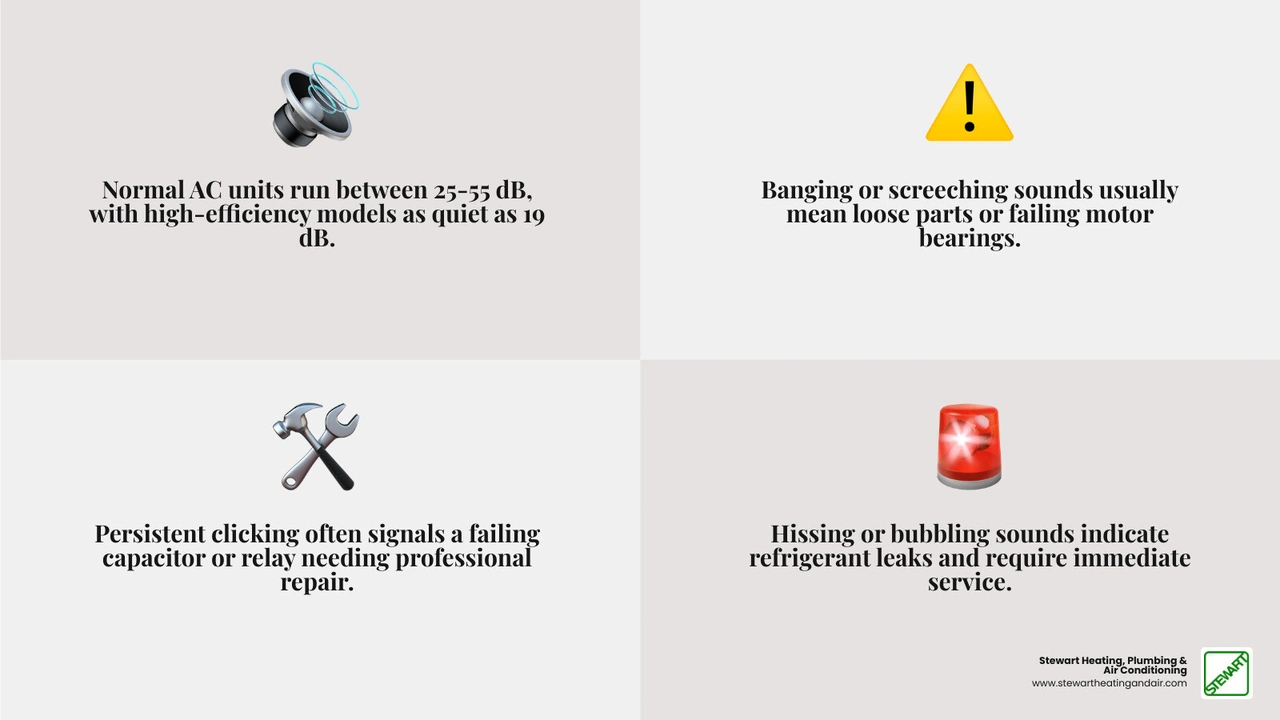
The gentle hum of your air conditioner running in the background is exactly how it should sound. Most modern AC systems operate somewhere between 25 and 55 decibels — quiet enough that you barely notice them. High-efficiency units can run as low as 19 dB, making any unusual sound stand out immediately.
When that familiar hum turns into banging, screeching, or hissing, your system is sending you a signal. Some sounds are harmless. Others mean you have a short window to act before a minor repair becomes a major expense — or before a $200 fix turns into a $2,000 compressor replacement.
The good news is that most AC noises point to a specific cause, and knowing what you're hearing puts you ahead of the problem. This guide walks Pittsburg, CA homeowners and property owners throughout Contra Costa County through exactly what each sound means, where it's coming from, and what to do next.
The first step in figuring out ac making strange noises what they mean is simple: identify both the sound and where it is coming from.
An indoor noise usually points to the air handler, blower, evaporator area, vents, or ductwork. An outdoor noise is more likely tied to the condenser fan, compressor, contactor, or debris around the unit. That location matters because a whistle from a vent means something very different than a metallic bang from the condenser.
A few sounds are normal:
What is not normal is anything loud, harsh, repetitive, or suddenly new. Age also plays a role. Most air conditioners last around 10 to 15 years before wear-related noise issues become more common. In Contra Costa County, summer heat, dust, and long run times can make those issues show up faster.
Start by standing near the thermostat when the system kicks on. Then walk through the house and outside.
Indoor sources often sound like:
Outdoor sources often sound like:
If you're not sure, turn the thermostat off and back on once. Listen for the exact moment the sound starts. That helps narrow down whether the blower, compressor, or another part is involved.
Here is the short version: soft and occasional is usually normal; loud and repeated is not.
| Sound | Usually Normal? | What It May Mean |
|---|---|---|
| Single click at startup or shutdown | Yes | Thermostat relay or contactor |
| Gentle hum | Yes | Motor and compressor operating normally |
| Air whooshing through vents | Yes | Normal airflow |
| Soft duct popping | Sometimes | Expansion and contraction |
| Dripping water at drain | Sometimes | Normal condensate movement |
| Repeated clicking | No | Relay, capacitor, thermostat, or electrical issue |
| Loud banging or clanking | No | Loose or broken internal parts |
| Hissing that continues | No | Refrigerant leak or duct leak |
| Screeching or grinding | No | Failing motor bearings or major friction |
| Electrical buzzing with odor | No | Possible electrical fault, stop system |
If a noise is paired with burning smells, weak cooling, water leaks, or tripped breakers, do not wait. Shut the system off and arrange service.
Different sounds are like your AC's version of charades, except much less fun and usually more expensive if ignored.
Banging is one of the most serious sounds. It often means a loose or broken part is moving around inside the system. In an outdoor unit, that can point to compressor trouble, loose mounting hardware, or a damaged fan assembly. Indoors, it may involve the blower wheel or fan blade.
Clanking is similar but often more metallic. It can mean:
Rattling is sometimes the least severe of the three, but not always. Common causes include:
What we recommend:
If your system is also showing other warning signs, this guide on signs your AC needs repair is a helpful next read.
Hissing deserves attention because it can point to a refrigerant leak or air escaping from damaged ductwork. Refrigerant leaks reduce efficiency, hurt cooling performance, and may create health concerns if ignored. Research on HVAC noise issues consistently flags hissing as one of the sounds that should not be brushed off.
Bubbling or gurgling can mean:
If the sound is near the indoor unit and you also see water, a drain issue is possible. If you suspect that, our article on AC drain clogged can help you understand the symptoms.
Whistling usually points to airflow restriction, such as:
A clogged filter is one of the most common causes of vent whistling. It can also make your system work harder, run longer, and sound louder than usual.
Buzzing often points to either an electrical issue or a mechanical problem. Common causes include:
If the system is buzzing and not cooling well, frozen coils may be part of the problem. You may also want to read why AC stops cooling on hot summer days.
Clicking can be normal if it happens once at startup and once at shutdown. Persistent clicking is different. That may indicate:
Screeching or squealing usually comes from moving parts under strain. On some older systems, a belt may be slipping. More often, it points to worn motor bearings or a fan motor in trouble. If the sound is sharp and sudden, turn the system off.
Grinding is urgent. It usually means metal-on-metal contact from worn bearings or motor failure. Running the unit in this condition can quickly damage major components.
Chirping is less common but still useful as a clue. It may mean:
Indoor and outdoor noises are not interchangeable. The same sound can mean different things depending on where you hear it.
Indoor units are more tied to airflow, the blower motor, drain system, and ductwork. Outdoor units deal with the compressor, condenser fan, electrical components, and weather exposure.
That exposure matters in our area. In Pittsburg, Concord, Brentwood, Walnut Creek, Antioch, Pleasant Hill, and across Contra Costa County, long hot summers, dust, and heavy cooling demand can speed up wear. Older systems also tend to run louder as bearings wear down, panels loosen, and motors strain harder.
Inside the home, the most common sounds are:
Low airflow often makes indoor noise worse. If you have a ductless system, troubleshooting low airflow from ductless AC may help you connect airflow problems to the sounds you're hearing.
Outside, louder sounds usually involve larger components.
Common outdoor noises include:
Check the basics first:
Outdoor units naturally make more noise than indoor ones because the compressor lives there. But "more noise" does not mean "any noise is fine."
There are a few homeowner-safe things we can do before scheduling service. The keyword is safe. If the issue appears electrical, refrigerant-related, or mechanically severe, stop there and call for help.
Try these in order:
For more on why clean coils matter for quiet, efficient operation, see AC coil cleaning benefits and why it matters.
Shut the system off right away if you hear:
These sounds can signal compressor damage, electrical risk, refrigerant problems, or motor failure. If you are in Concord or nearby and need more guidance, our AC repair Concord CA guide covers common repair situations and next steps.
Regular maintenance is one of the best ways to keep an AC quiet. It catches small issues before they become dramatic sound effects.
A tune-up can help prevent noise by addressing:
This matters because once a system gets noisy, it is often already under strain. And when strain continues, efficiency drops. A noisy AC is very often an inefficient AC too.
Contra Costa County summers put AC systems to work. During long hot stretches, units run longer cycles, pressures rise, and weak components show themselves faster. Dust buildup can clog filters and coat coils. Humidity can affect drainage. Older equipment can start sounding louder simply because every moving part has more wear on it than it used to.
In other words, your AC is not being dramatic. It is just tired.
For most homes and light commercial properties, the best prevention plan includes:
If you want a deeper look at preventive service, read our AC maintenance Concord CA guide. And if you're comparing system performance, our standard efficiency vs high efficiency HVAC comparison explains why newer systems often run more quietly.
Yes, it can be. A persistent hiss may mean refrigerant is leaking. That can reduce cooling, stress the system, and in some cases contribute to symptoms like headaches or nausea if exposure occurs in a confined area. It can also signal a duct leak that wastes energy and pulls in unfiltered air.
If you hear ongoing hissing:
Very hot days push your system to work harder and longer. That higher load can expose issues that stay hidden in mild weather, such as:
If your AC gets noisy only during heat waves in Pittsburg, Antioch, Brentwood, Concord, or nearby areas, it is still worth checking. "Only on the hottest days" usually means a part is nearing its limit, not that the sound is normal.
Usually, yes. As systems age, bearings wear, mounts loosen, fan blades drift out of balance, and compressors become louder. Since most systems begin showing more major wear around the 10- to 15-year mark, noise complaints become more common at that stage.
Newer high-efficiency systems are often quieter by design, so odd sounds are easier to notice. If your older system is making frequent new noises, needs repeated repairs, or struggles on hot days, it may be time to consider whether repair still makes sense.
When you're trying to figure out ac making strange noises what they mean, the two biggest clues are the type of sound and where it comes from. A soft click or gentle hum is usually fine. Banging, grinding, hissing, screeching, or persistent buzzing is your sign to pay attention now, not later.
At Stewart Heating, Plumbing & Air Conditioning, we help homeowners and property owners in Pittsburg, CA and across Contra Costa County get to the source of AC noise problems before they lead to bigger damage. We focus on doing the job right the first time and making the process as clear and stress-free as possible.
If your system is getting louder, cooling less, or simply no longer sounds like itself, now is a good time to act. For more information about our air conditioning services, visit our air conditioning page.

Very professional and complete. I would recommend Stewart to anyone. Highest quality of workmanship and clean installation.
Stewart Heating Plumbing Air Conditioning just did some work for us for the first time. They did an installation at my home and it turned out well. I thought the price was fair and I definitely would use them again. The technicians were very friendly and knowledgeable about their work. I highly recommend Stewart Heating Plumbing Air Conditioning and already told friends to use them.
We have been using Stewart Heating Plumbing Air Conditioning since 1995. They put the original heating and air unit in the house, and we have just stayed with them. They are dependable and honest people, and they have done a good job for us every time that we have used them!
They came and did an inspection and are coming tomorrow to do the repair.
They replaced a regulator the first time, and then the water heater vent had to be replaced. They did great work.
The gentleman that serviced us was helpful, insightful, and knew what he was talking about. Overall, it was a great experience.