

Recent Blogs
Stay updated with our latest blog posts.

If you are sitting in your living room asking yourself, is it normal for my air conditioner to run constantly on 100-degree days, you are definitely not alone. When a late August extreme heatwave settles over the area, the sound of your outdoor compressor humming for hours on end can easily trigger a wave of panic. You check the thermostat, see that the house is holding steady, but notice the system simply refuses to cycle off. The immediate instinct for many homeowners is to worry that the equipment is overworked, overheating, or on the verge of a catastrophic breakdown.
Before you panic, let's look at how your system handles extreme heat and when it is time to call for professional air conditioning services.
This common dilemma leaves many people wondering if they should turn the system off just to give it a brief rest. However, what feels like a mechanical struggle is often a sign that your cooling equipment is working exactly as it was engineered to perform. Air conditioners are not designed with infinite cooling capacity. Instead, they operate within specific mathematical limits based on local climate data. When the outdoor temperature spikes to triple digits, continuous operation is frequently the only way the system can extract enough heat from your home to maintain a safe, comfortable indoor environment. If the air blowing from your vents is cold and the indoor humidity feels low, that non-stop running is actually a testament to a well-calibrated machine doing its job during peak summer stress.
To understand why your system runs continuously, you have to look at how it was selected for your home in the first place. Heating and cooling systems are not one-size-fits-all appliances. They are chosen based on complex load calculations, often referred to as ACCA Manual J standards. A core component of these calculations is something called the "design temperature."
The design temperature is the specific outdoor temperature that a given region stays below for 99% of the year. When an installer selects an HVAC system for your house, they size it to handle this exact temperature perfectly. They do not size the equipment to handle the absolute hottest, rarest day of the decade. If a system is oversized to easily manage a freak 110-degree afternoon, it will be far too large for the other 99% of the summer. Oversized systems cool the air too quickly and shut off before they have a chance to remove humidity, leaving your home feeling like a cold, damp cave.
When the weather pushes against the 100-degree outdoor design temperature limit for our region, your system is operating at 100% of its intended capacity. Because the heat is pressing into your home just as fast as the air conditioner can pump it out, the system has to run continuously just to break even. As local experts serving the community since 1974, we understand the precise load calculations required for these specific microclimates. We know that a properly sized unit will run non-stop during these extreme spikes to maximize moisture removal and keep your living spaces comfortable without overloading the electrical components.
One of the most persistent misunderstandings in home cooling is the idea that an air conditioner needs a "rest" during a heatwave. It is incredibly tempting to switch the thermostat to off, thinking you are saving the compressor from burning out. In reality, turning the system off during peak afternoon heat is one of the worst things you can do for your equipment and your comfort.
Because Pittsburgh, CA and surrounding East Bay microclimates can experience rapid temperature spikes, it is absolutely essential to maintain a steady indoor temperature rather than trying to play catch-up later in the day. Here is exactly what happens when you turn your system off to give it a break:
1. Sensible heat rises immediately: The air temperature inside your home begins to climb within minutes as the sun beats down on the roof and windows.
2. Latent heat absorbs into materials: This is the hidden danger. Humidity and heat don't just sit in the air; they seep into your drywall, your hardwood floors, your sofa cushions, and your cabinetry. Your entire house acts like a giant thermal sponge.
3. The recovery phase strains the system: When you finally turn the system back on a few hours later, it doesn't just have to cool the air. It has to run at maximum capacity to pull all that deep-seated heat and moisture back out of your building materials.
Leaving your thermostat at a steady, reasonable temperature is significantly less stressful on the compressor. An air conditioner is built for long, steady run cycles. Forcing it to suddenly recover a house that has baked in the afternoon sun puts immense strain on the motors and electrical capacitors, vastly increasing the risk of a breakdown when you need cooling the most.
While continuous operation is expected during a late August extreme heatwave, you still need to know how to spot the difference between a system that is working hard and a system that is actively failing. Not all long run cycles are harmless. Paying attention to the quality of the air and the behavior of the equipment will tell you everything you need to know.
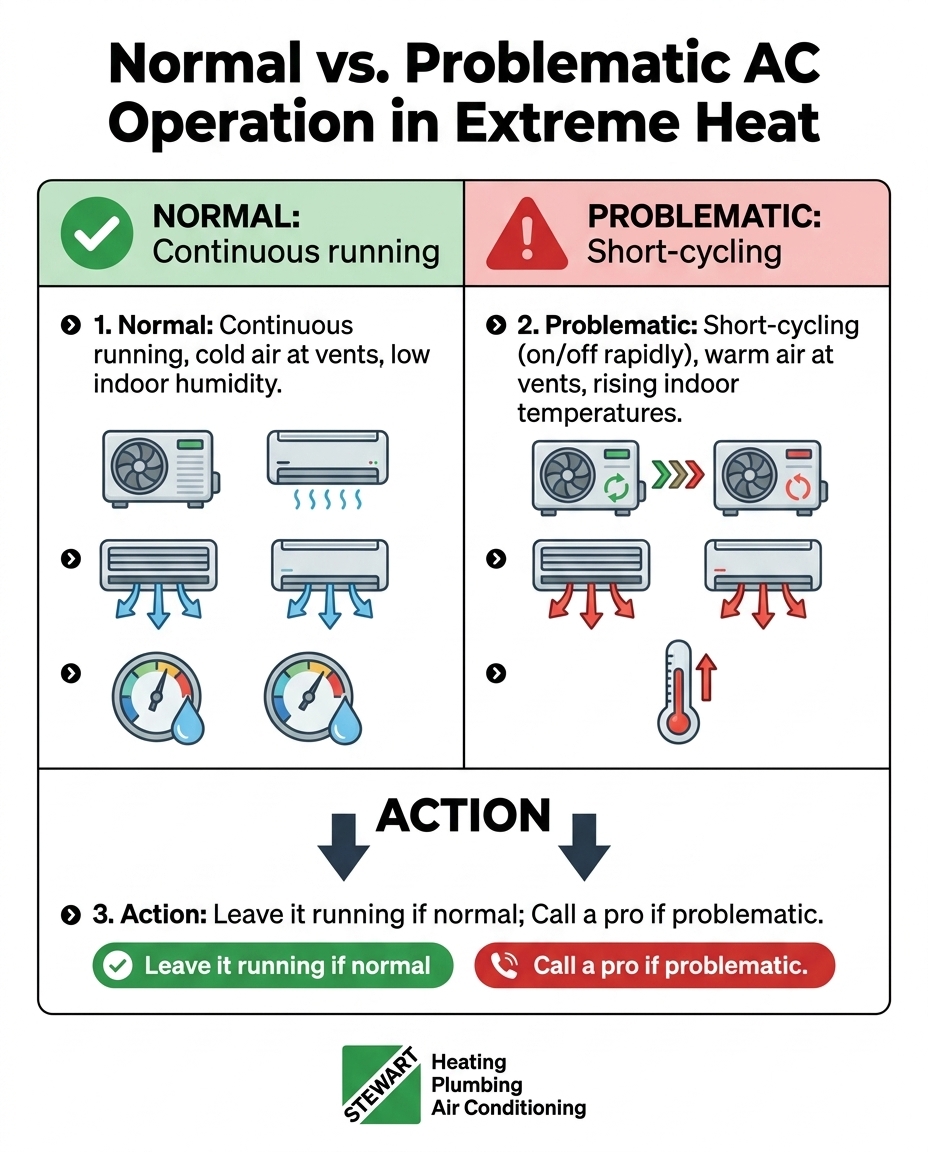
Ironically, a system that turns off too often is in much more danger than one that runs continuously. If your unit turns on, runs for five minutes, shuts off, and turns right back on again, this is called short-cycling. It is a massive red flag. Short-cycling destroys compressors, spikes your energy usage, and fails to dehumidify the home. If you hear this rapid on-and-off behavior, you need professional intervention immediately.
To help you diagnose what you are experiencing in your own home, look for these specific indicators of normal versus problematic operation:
• Running constantly for hours — Air Quality at Vents: Very cold to the touch — Indoor Humidity: Low and comfortable — What It Means: Normal. The system is matching the extreme outdoor heat load perfectly.
• Running constantly for hours — Air Quality at Vents: Warm or room temperature — Indoor Humidity: Sticky or rising — What It Means: Problematic. The system is running but failing to remove heat.
• Turning on and off every 5 minutes — Air Quality at Vents: Cold, but brief — Indoor Humidity: Clammy and damp — What It Means: Problematic. The system is short-cycling and risking severe motor damage.
If your system is running non-stop but the house is slowly getting warmer, the culprit is often found outside. By the time late summer arrives in Pittsburgh, CA and surrounding East Bay neighborhoods, your outdoor condenser unit has spent months pulling air through its metal fins. Along with that air comes dust, pollen, lawn clippings, and airborne debris.
The outdoor coil is responsible for releasing the heat that was absorbed from inside your house. When a thick layer of dirt blankets those metal fins, it acts just like a heavy winter coat. The system becomes insulated and cannot properly vent the heat into the outdoor air. As a result, the refrigerant returns to your house still carrying warmth, and the system has to run twice as long to achieve half the cooling effect.
This loss of efficiency mimics the effects of extreme weather. You might assume the unit is just struggling against the 100-degree heat, but in reality, it is suffocating under a layer of grime. If you notice a drop in cooling power, cleaning your AC coils is often the most effective way to restore capacity and shorten those exhausting run cycles.
There is a distinct line between a system working hard against a 100-degree outdoor design temperature limit and a system experiencing a mechanical failure. When the symptoms point to a breakdown, you need to act quickly to prevent minor component issues from cascading into a total compressor replacement.
If your unit is running continuously but blowing warm air, check your refrigerant lines outside. If you see thick white ice building up on the copper pipes, your system is frozen solid. This is usually caused by severely restricted airflow or a refrigerant leak. Turn the system off immediately to let it thaw, and call for support. Additionally, any unusual grinding, screeching, or buzzing noises from the outdoor unit suggest a failing motor or a bad capacitor, neither of which will resolve on their own.
Electrical issues are another common reason a system might run constantly without cooling, and these strictly require a licensed technician. One homeowner reached out during a late-summer holiday weekend when their system suddenly started pushing out heat instead of cold air. After two hours of careful troubleshooting, the technician discovered a loose wire causing the malfunction, and proper cooling was restored just in time for the rest of the hot weekend. Because high-voltage electrical components carry serious safety risks, you should always request AC service rather than attempting to open the access panels yourself.
It is completely normal for an AC to run almost continuously during the hottest parts of the day, often for several hours at a time, to maintain the thermostat setting. When the outdoor temperature pushes past the 100-degree outdoor design temperature limit, the unit must operate at full capacity just to match the heat entering your home. As long as the air at the vents is cold, this long cycle is safe and expected.
No, as long as it is blowing cold air and maintaining the indoor temperature. A properly sized unit is designed to run constantly when outdoor temperatures peak. Long run cycles are actually better for the equipment than turning on and off constantly, and they provide superior humidity control for your living spaces.
Most residential systems are designed for peak efficiency up to their regional design temperature (often around 90-95 degrees). Beyond that point, they may run continuously, and indoor temps might rise a degree or two during the late afternoon. This is not a malfunction; it is simply the physical limit of the system's cooling capacity based on its original load calculations.
Yes. If the house remains cool and comfortable, continuous operation simply means the system is matching the heat load of the home perfectly. The equipment is pulling heat out at the exact same rate the sun is pushing it in, resulting in a stable, comfortable indoor environment.
This indicates a problem that requires attention. If the unit runs constantly but blows warm air, it could be due to dirty coils, a clogged air filter, or a refrigerant leak. When the system loses its ability to transfer heat, it will run endlessly trying to satisfy the thermostat, requiring professional troubleshooting to resolve.
Surviving a late August extreme heatwave requires a bit of patience and an understanding of how your cooling equipment is meant to function. A continuously running air conditioner that is actively blowing cold air is doing exactly what it was built to do. By resisting the urge to turn it off and letting it maintain a steady temperature, you protect the compressor from the heavy strain of recovering a hot house.
Of course, keeping the system well-maintained is the best way to ensure these long run cycles do not cause unnecessary wear and tear. Recently, a customer who has relied on our team for 33 years experienced an unexpected cooling issue. After a thorough explanation of exactly what went wrong and the steps taken to prevent a recurrence, they felt completely confident moving forward and signed up for an ongoing HVAC maintenance plan. Proactive care keeps your coils clean, your airflow strong, and your home perfectly comfortable, no matter how high the temperatures climb outside.

Very professional and complete. I would recommend Stewart to anyone. Highest quality of workmanship and clean installation.
Stewart Heating Plumbing Air Conditioning just did some work for us for the first time. They did an installation at my home and it turned out well. I thought the price was fair and I definitely would use them again. The technicians were very friendly and knowledgeable about their work. I highly recommend Stewart Heating Plumbing Air Conditioning and already told friends to use them.
We have been using Stewart Heating Plumbing Air Conditioning since 1995. They put the original heating and air unit in the house, and we have just stayed with them. They are dependable and honest people, and they have done a good job for us every time that we have used them!
They came and did an inspection and are coming tomorrow to do the repair.
They replaced a regulator the first time, and then the water heater vent had to be replaced. They did great work.
The gentleman that serviced us was helpful, insightful, and knew what he was talking about. Overall, it was a great experience.