

Recent Blogs
Stay updated with our latest blog posts.

How a maintenance plan extends equipment life comes down to one core idea: catching small problems before they turn into expensive failures. Most homeowners in Contra Costa County don't think about their HVAC system until something goes wrong — and by then, the damage is already done.
Here is a quick summary of how a maintenance plan extends equipment life:
Think of it like regular checkups for your health. You don't wait until you're in the emergency room to start taking care of yourself — and your heating and cooling equipment deserves the same approach. Skipping routine service might feel like a money-saver today, but the numbers tell a different story: deferred maintenance follows a punishing 1:4 cost ratio, meaning every dollar you save by skipping a tune-up can eventually cost four dollars in emergency repairs.
Whether you're managing a home in Pittsburg, Antioch, or anywhere across Contra Costa County, a structured maintenance plan is one of the smartest investments you can make for your comfort and your budget.
Basic how a maintenance plan extends equipment life terms:
To truly understand how a maintenance plan extends equipment life, we have to look at the physics of how your heating and cooling systems operate. An HVAC system is a complex network of electrical, mechanical, and thermodynamic processes working in harmony. When one part of this system falls out of alignment, it creates a domino effect that impacts the entire unit.
The science of equipment wear and tear centers on three main physical threats:
When you invest in structured care, you are actively countering these physical forces. If you have ever wondered Is an HVAC Maintenance Plan Worth It, the answer lies in the physics of prevention. By keeping friction, thermal stress, and component imbalances at bay, you directly prevent the slow, cumulative degradation that forces systems into an early retirement.
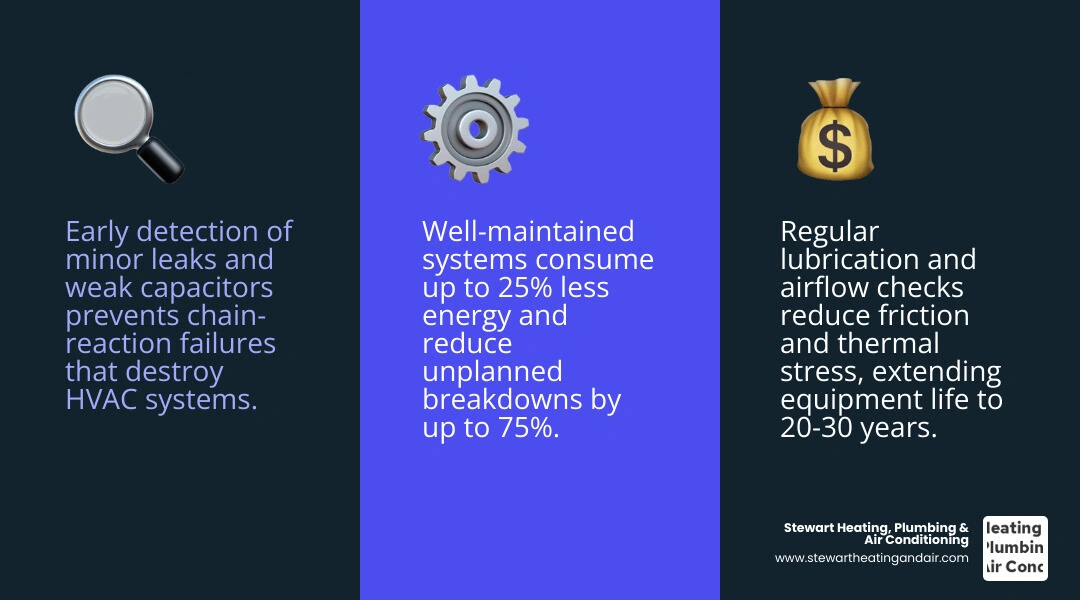
One of the most powerful aspects of a structured maintenance plan is its ability to reveal hidden system killers long before they cause a complete breakdown. Most major HVAC failures do not happen overnight. Instead, they are the result of minor, unaddressed issues that slowly worsen over months or years.
During a scheduled maintenance visit, our technicians use advanced diagnostic tools to analyze your system's vital signs. We measure electrical resistance, test voltage drops, check refrigerant pressures, and scan for minor leaks.
Consider these common examples of early detection in action:
Taking a proactive approach is the best way How to Prevent HVAC Emergencies with Maintenance. Instead of waiting for your system to fail on a scorching July afternoon in Concord, early detection allows you to handle minor repairs on your own terms, protecting the rest of your system from collateral damage.
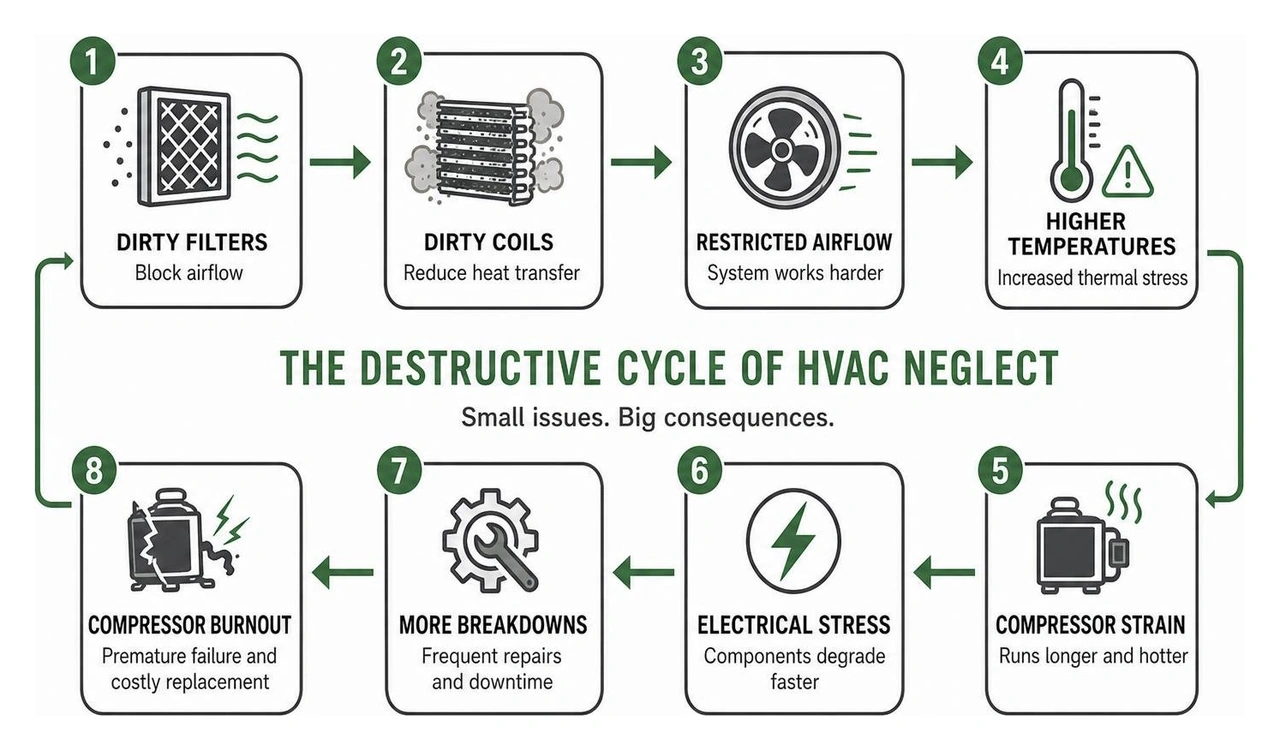
Imagine trying to run a marathon while breathing through a straw. That is exactly what your HVAC system goes through when it is forced to operate with restricted airflow, dirty coils, or clogged filters.
Restricted airflow creates high system resistance, which places immense operational stress on your blower motor. The motor has to spin faster and work harder to push air through the clogged passages. This extra workload increases the motor's operating temperature, degrades its internal lubrication, and leads to premature electrical failure.

Furthermore, when dust and dirt build up on your evaporator and condenser coils, they act as an insulating blanket. In the summer, your air conditioner cools your home by absorbing indoor heat and releasing it outside. If the outdoor condenser coil is coated in dirt, pollen, and lawn debris, the heat cannot escape. This forces the compressor to run at elevated pressures and temperatures, severely shortening its lifespan.
A comprehensive maintenance plan removes this operational stress by keeping the entire system clean and clear. By optimizing airflow and reducing resistance, we ensure your equipment can do its job with the absolute minimum amount of physical effort.
A truly effective maintenance plan is not just a quick visual inspection and a filter swap. To maximize the lifespan of your heating and cooling equipment, a maintenance program must include systematic inspections, safety audits, and precise technical adjustments.
When you look at What Does an HVAC Maintenance Visit Include, you will find a highly detailed checklist designed to restore your system to its peak operating condition. We focus on using original equipment manufacturer (OEM) parts and following exact calibration standards to ensure long-term asset reliability.
Poor lubrication is one of the leading causes of mechanical equipment failure. In fact, industry data shows that up to 40% of preventable bearing failures in mechanical systems are caused by lubrication issues, including both under-lubrication and over-lubrication.
Within your heating and air conditioning system, several critical moving parts require precise lubrication:
By applying the correct, manufacturer-specified lubricant at the right intervals, we keep friction to an absolute minimum, ensuring your system's moving parts glide smoothly year after year.
Your HVAC system relies on a complex electrical network to control heating, cooling, and safety operations. Over time, the normal vibrations of daily operation can loosen electrical connections. Loose wires create high electrical resistance, which generates heat and can lead to arcing, melted components, or even electrical fires.
During a maintenance visit, our team performs detailed electrical testing and calibration:
Maintaining clean, unobstructed airflow is vital to the health of your HVAC system. When dust, dirt, and biological growth are allowed to accumulate inside your unit, they restrict airflow and pose a threat to both your equipment and your indoor air quality.
Our cleaning and airflow optimization protocols include:
The difference between a well-maintained HVAC system and a neglected one is staggering. While physical equipment will eventually wear out, a structured maintenance plan can easily double the useful life of your system, delaying a major capital expense by a decade or more.
To illustrate the real-world impact of consistent care, let's look at how neglect accelerates equipment aging:
| System Characteristic | Well-Maintained HVAC System | Neglected HVAC System |
|---|---|---|
| Average Lifespan | 20 to 30 Years | 5 to 10 Years |
| Operating Efficiency | Retains 95% to 100% of factory rating | Loses 5% efficiency annually |
| Annual Breakdown Risk | Less than 5% | Up to 35% or higher |
| Compressor Health | Runs cool and at optimal pressures | Overheats due to dirty coils and low airflow |
| Warranty Status | Fully protected with service records | Voided due to lack of professional care |
| Overall Lifecycle Cost | Low (minimal repairs, optimized utility bills) | Extremely high (frequent emergency fees, early replacement) |
When you look at the numbers, it is clear that Do Maintenance Plans Save Money. A neglected system is forced to run 20% to 30% longer just to reach your desired indoor temperature. This constant, extended runtime means the system accumulates wear and tear at an accelerated rate, leading to premature failure.
By keeping your outdoor condenser clean and your indoor components calibrated, you ensure your system operates at peak efficiency. This minimizes runtime, reduces wear, and allows your equipment to easily reach its full design life.
When you purchase a new heating and cooling system, it typically comes with a valuable manufacturer's parts warranty that can last anywhere from 5 to 10 years. However, many homeowners are surprised to learn that these warranties are not unconditional.
Almost every major HVAC manufacturer — including Daikin, Carrier, Trane, and Lennox — requires proof of regular, professional maintenance to keep their parts warranties valid. If a critical component like your compressor or heat exchanger fails, the manufacturer will often ask for documented service records before approving a warranty claim. If you cannot provide proof of annual professional maintenance, your claim could be denied, leaving you to pay for the replacement part out of pocket.
Our maintenance plans provide the perfect solution by keeping a detailed, digital history of every service visit. We document all system vitals, parts replaced, and inspections performed. This consistent record-keeping is a key takeaway from our Annual HVAC Maintenance Guide 2026.
In addition to protecting your manufacturer's warranty, regular maintenance ensures compliance with local building codes and safety regulations in Contra Costa County. For commercial properties, routine inspections of safety controls, fire dampers, and ventilation rates are legally mandated. A structured maintenance plan ensures you remain fully compliant while protecting the safety of everyone inside your building.
We hear many of the same questions from homeowners across Pittsburg, Antioch, and Concord regarding how to keep their systems running as long as possible. Here are some of the most common questions and our expert answers.
For the vast majority of homes in Contra Costa County, we recommend a semi-annual maintenance schedule:
If you have a heat pump system, it runs year-round to provide both heating and cooling. Because of this continuous operation, heat pumps require professional service at least twice a year to maintain peak performance and prevent premature wear.
Yes, absolutely. HVAC systems account for approximately 43% of the average home's energy consumption. When your system is neglected, dirt buildup, restricted airflow, and worn-out electrical components force it to work harder and consume more electricity.
A neglected air conditioner can easily consume up to 25% more energy than a well-maintained unit. By optimizing airflow, cleaning the coils, and reducing internal friction, our maintenance plan restores your system's efficiency, helping you keep your monthly utility bills as low as possible.
Even with a maintenance plan, it is important to keep an eye out for warning signs that your system is struggling. Contact us immediately if you notice any of the following:
Your heating and cooling system is one of the most significant investments you will make in your home. Protecting that investment requires a proactive, strategic approach to maintenance rather than waiting for an expensive breakdown to occur.
At Stewart Heating, Plumbing & Air Conditioning, we are committed to helping our neighbors throughout Pittsburg, Antioch, Concord, and the surrounding Contra Costa County communities enjoy reliable, energy-efficient comfort. Our strong focus on quality and customer satisfaction means we take the time to do every maintenance visit right the first time, ensuring your equipment receives the detailed care it needs to stand the test of time.
Ready to protect your home's comfort and extend the life of your heating and cooling systems? Learn more about our customizable HVAC Maintenance Agreement or sign up for our comprehensive Maintenance Plan today!

Very professional and complete. I would recommend Stewart to anyone. Highest quality of workmanship and clean installation.
Stewart Heating Plumbing Air Conditioning just did some work for us for the first time. They did an installation at my home and it turned out well. I thought the price was fair and I definitely would use them again. The technicians were very friendly and knowledgeable about their work. I highly recommend Stewart Heating Plumbing Air Conditioning and already told friends to use them.
We have been using Stewart Heating Plumbing Air Conditioning since 1995. They put the original heating and air unit in the house, and we have just stayed with them. They are dependable and honest people, and they have done a good job for us every time that we have used them!
They came and did an inspection and are coming tomorrow to do the repair.
They replaced a regulator the first time, and then the water heater vent had to be replaced. They did great work.
The gentleman that serviced us was helpful, insightful, and knew what he was talking about. Overall, it was a great experience.