

Recent Blogs
Stay updated with our latest blog posts.

During late fall in the East Bay, evening temperatures can plummet by 20 degrees or more in just a few hours, making optimizing HVAC for rapid evening cool downs a top priority for local homeowners. Here at Stewart Heating, Plumbing and Air Conditioning, our team routinely sees how a 65-degree afternoon that feels perfectly mild can quickly turn into an immediate and heavy demand on residential heating equipment. As the sun dips below the horizon, the ambient air temperature drops sharply, pulling heat through your home's windows, walls, and roof. This rapid thermal shift forces homeowners to make a critical decision: should you aggressively lower the thermostat while you are away or asleep, or should you maintain a steady baseline temperature to keep the house comfortable?
Finding the right balance is essential for maintaining indoor comfort without driving up energy consumption. Whether you are relying on traditional heat pump systems to weather the chill or you are looking to install smart thermostat upgrades to automate the process, navigating these diurnal temperature swings requires a specific, strategic approach. When November evening temperature drops occur, treating a modern, highly efficient heating system like an old-fashioned furnace often leads to cold spots, constant cycling, and unnecessary strain on the equipment.
The core challenge: Most homeowners have been taught that lowering the thermostat significantly when they leave for the day saves energy. While we find this is generally true for certain types of heating systems in consistently cold climates, it can actually backfire during the unpredictable temperature swings of late fall. When a house loses a massive amount of heat in a short window of time, asking the system to recover a 10-degree deficit all at once can force it into its least efficient operating mode. Understanding how your equipment responds to these sudden changes is the first step toward a more comfortable and efficient home.
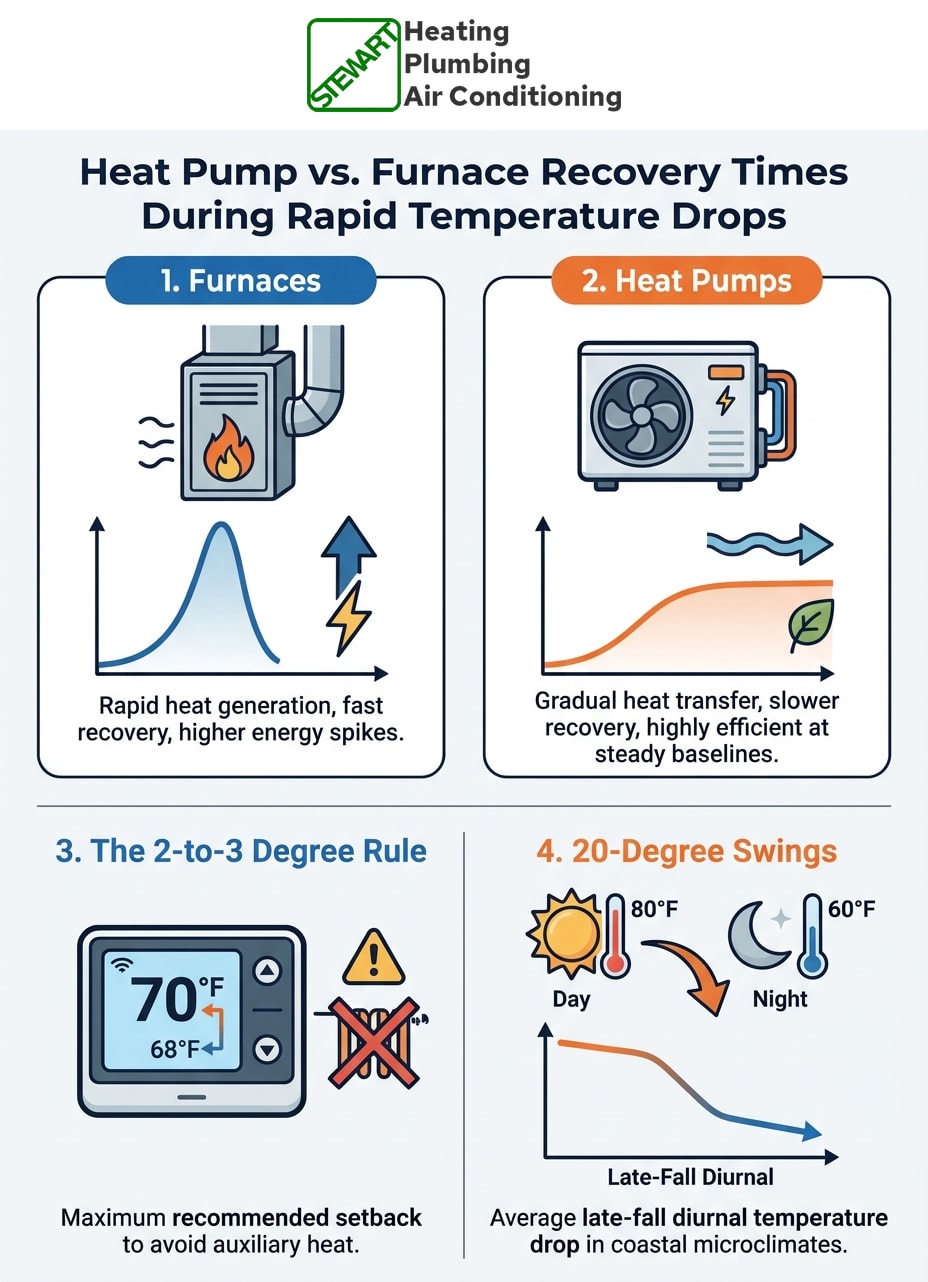
To master your home's climate control during rapid weather transitions, you first have to understand the fundamental mechanical differences in how various systems operate. Heat pumps are incredibly efficient, but they operate on an entirely different principle than traditional combustion furnaces. A gas furnace generates heat by burning fuel, creating a massive blast of high-temperature air that can raise the indoor temperature rapidly. Heat pumps, on the other hand, do not generate heat—they move it.
Because they rely on transferring thermal energy rather than creating it through combustion, heat pumps provide a much steadier, gentler warmth. However, this also means they have a slower recovery time when faced with a large temperature gap. If you allow your home to drop to 60 degrees during the day and then ask the system to reach 70 degrees the moment you walk in the door, a heat pump will struggle to close that 10-degree gap quickly, especially as the outdoor temperature is simultaneously plummeting.
Even when it feels chilly outside, the ambient air still contains a significant amount of heat energy. A heat pump's outdoor unit uses a specialized refrigerant cycle to absorb this latent heat, compress it to raise its temperature, and then transfer it inside your home. This process is highly efficient, often transferring three units of heat for every one unit of electricity consumed.
• Evaporation: Liquid refrigerant in the outdoor coil absorbs heat from the outside air, turning into a gas.
• Compression: The compressor squeezes this gas, significantly increasing its pressure and temperature.
• Condensation: The hot gas moves to the indoor coil, where it releases its heat into your home's air supply and turns back into a liquid.
• Expansion: The liquid passes through an expansion valve, cooling down rapidly before returning outside to repeat the cycle.
This gradual process of extracting and compressing heat works best when it operates continuously at a low, steady pace. When forced to play catch-up during sharp November evening temperature drops, the system must work at maximum capacity, which reduces its overall efficiency.
Modern heat pumps, particularly those with variable-speed compressors, are designed to cruise. Think of them like a car driving on the highway: maintaining a steady 65 miles per hour yields excellent fuel economy, whereas constantly slamming on the brakes and then accelerating aggressively burns through fuel quickly. By maintaining a steady baseline temperature—or using very modest setbacks—you allow the system to operate on its most efficient curve.
• Traditional Gas Furnace — Heat Source: Combustion (Natural Gas/Propane) — Recovery Speed: Very Fast — Best Thermostat Strategy: Deep setbacks (5-10 degrees) are acceptable.
• Standard Heat Pump — Heat Source: Ambient Air Heat Transfer — Recovery Speed: Gradual / Slow — Best Thermostat Strategy: Steady baseline or minor setbacks (2-3 degrees).
• Variable-Speed Heat Pump — Heat Source: Ambient Air Heat Transfer — Recovery Speed: Gradual / Adaptive — Best Thermostat Strategy: Strict baseline; let the system modulate capacity.
Keeping the temperature relatively stable prevents the system from falling too far behind the ambient drop outside. When the East Bay microclimates shift rapidly from a mild afternoon to a biting evening, a home that has maintained a steady baseline will only need to replace the heat it is actively losing, rather than trying to overcome a massive, self-imposed temperature deficit.
The most significant risk of using deep thermostat setbacks with a heat pump is the accidental activation of auxiliary heat. When a heat pump detects that it cannot reach the target temperature within a reasonable timeframe—usually because the gap between the current room temperature and the target setting is too large—it calls for backup. This backup comes in the form of auxiliary heat, which typically consists of electric resistance heating strips located inside the air handler.
Electric resistance heat is functionally identical to the glowing red coils inside a toaster or a hairdryer. While it generates heat very quickly and effectively, it consumes a massive amount of electricity to do so. Relying on auxiliary heat to recover from an aggressive setback completely negates the energy-saving benefits of having a heat pump in the first place. If you drop your thermostat by eight degrees while at work and then raise it back up when you return, the system will almost certainly use these expensive heat strips to bridge the gap.
The 2-to-3 degree rule: To avoid this hidden cost, our HVAC professionals strongly recommend keeping thermostat setbacks to no more than two or three degrees. If your ideal evening comfort level is 70 degrees, your daytime setback should not drop below 67 or 68 degrees. This tight temperature band ensures that when the sun goes down and the outdoor temperature drops, the heat pump can recover the space using its efficient compressor rather than relying on emergency heat strips. For homeowners looking to maximize their system's performance, exploring comprehensive home energy efficiency upgrades can further help the house retain this baseline heat.
Many homeowners are unaware that their system is relying on backup heat until they receive an unusually high utility bill. However, our technicians often point out several clear indicators that your system has engaged its electric resistance strips during a rapid evening cool down:
• Thermostat notifications: Most modern digital thermostats will display "Aux Heat," "Auxiliary," or "Emergency Heat" on the screen when the backup strips are active.
• Sudden, very hot air: Heat pumps normally blow air that is warm (around 90 to 100 degrees). If the air coming from your vents suddenly feels exceptionally hot, the resistance strips are likely running.
• A faint burning smell: Because auxiliary heat strips often sit unused for months, they collect dust. When they finally activate during a sharp November evening temperature drop, that dust burns off, creating a distinct, temporary odor.
• Long run times without satisfaction: If the outdoor unit is off but the indoor blower is running constantly while delivering heat, the system may be locked into auxiliary mode.
Managing a tight 2-to-3 degree temperature band manually can be tedious, especially when fall weather is unpredictable. Fortunately, technological advancements have provided solutions that preempt the evening chill without requiring constant user intervention. Smart thermostats equipped with adaptive recovery features are specifically designed to solve the problem of heat pump recovery times.
Adaptive recovery (sometimes called smart recovery or early start) is a feature that allows the thermostat to learn your home's unique thermal envelope. The device monitors how long it takes your specific HVAC system to raise the indoor temperature by one degree under various outdoor weather conditions. Instead of waiting until 5:00 PM to begin heating the house to 70 degrees, a smart thermostat will look at the dropping outdoor temperature and initiate a gradual heating cycle at 3:30 PM.
The transition from outdated manual controls to intelligent systems is often a critical step in achieving reliable comfort. In one recent project, our team helped a local Pittsburg homeowner who required a complete air conditioning replacement. When our technicians arrived and completed the replacement efficiently, a vital part of ensuring the new system's success was upgrading the outdated manual thermostat. By installing modern controls, we protected the new equipment from the aggressive, inefficient cycling that had contributed to the previous unit's failure. The result was a successfully completed installation that delivered vastly improved, consistent results.
Smart thermostats use machine learning algorithms to calculate the exact time needed to reach the target temperature efficiently. By initiating the heating cycle early, the thermostat ensures that the heat pump relies solely on its efficient compressor, entirely avoiding the sudden, inefficient ramp-up of auxiliary heat.
The technical advantage: These devices utilize Proportional-Integral-Derivative (PID) control loops. Instead of a simple "on/off" command based on a static temperature threshold, the algorithm calculates the rate of temperature change. If the East Bay evening breeze kicks in and the house begins losing heat faster than usual, the thermostat adjusts its recovery time dynamically. This means you walk into a perfectly comfortable home exactly when you want to, without paying the penalty of electric resistance heating.
General winter heating advice often falls flat when applied to specific regional environments. The East Bay is renowned for its diverse microclimates, where weather patterns can vary wildly from one neighborhood to the next. The most significant factor impacting home heat retention in this area is the rapid influx of coastal marine layers and evening breezes.
As the inland valleys heat up during the day, the rising warm air creates a vacuum that pulls cool, moist air in from the coast. By late afternoon, this marine influence crests the hills and sweeps through the region. This phenomenon causes ambient temperatures to plummet much faster than they would in a purely inland, static environment. When optimizing HVAC for rapid evening cool downs, you must account for this sudden environmental shift.
Since 1974, our experts at Stewart Heating, Plumbing and Air Conditioning have observed how local homes react to these specific weather patterns, revealing that localized approaches to HVAC programming are essential. A generic schedule downloaded from the internet will not account for the wind chill factor stripping heat from the exterior walls of an East Bay home at 4:30 PM.
Moisture and wind work together to accelerate heat loss. Dry, still cold air is relatively easy for a well-insulated home to resist. However, when the evening breeze carries moisture from the marine layer, it increases the rate of thermal transfer through building materials.
• Wind-washing: Evening gusts can push cold air into the small gaps in your home's exterior, displacing the warm air inside your wall cavities.
• Moisture density: Damp air feels colder and absorbs heat more readily from your home's windows and uninsulated surfaces.
• Solar cutoff: The marine layer often blocks the late-afternoon sun prematurely, cutting off natural solar heat gain just when the ambient temperature is dropping.
Because of these factors, standard thermostat schedules that wait until 6:00 PM to begin heating often fail in these specific microclimates. The home has already lost too much thermal mass, and the heat pump is forced to work against a rapidly steepening temperature curve.
Even the most sophisticated smart thermostat programming cannot overcome the limitations of a poorly maintained heat pump. When you rely on gradual heat transfer to maintain a steady baseline, your equipment must be operating at peak efficiency. Pre-winter stress testing is critical before the most severe temperature drops occur.
A heat pump's ability to extract heat from the outside air depends heavily on clean coils and proper airflow. If the outdoor condenser is choked with fall leaves, dirt, or debris, it cannot absorb enough ambient heat energy. Similarly, if the indoor air filter is clogged, the blower motor will struggle to distribute the warm air throughout the house. Professional assessments from our team can identify these issues, along with checking critical refrigerant levels, before they cause a breakdown during a cold snap.
Ensuring reliable operation is about proactive care. For example, when a local homeowner recently called us to have a new heater installed right as the fall weather began to turn, our technician arrived on time, completed the installation, and made sure the work area was left spotless. Crucially, our technician also took the time to instruct the homeowner on the proper operation of the new system, ensuring they understood how to manage the thermostat for the upcoming season. This level of attention to detail is what guarantees long-term performance.
To prepare your system for the demands of November evening temperature drops, consider the following proactive steps:
1. Verify airflow: Replace your indoor air filters regularly. Restricted airflow forces the system to run longer, increasing wear and tear.
2. Clear the perimeter: Ensure there is at least two feet of clearance around your outdoor heat pump unit. Remove fallen leaves, overgrown shrubs, and debris.
3. Schedule professional maintenance: Enrolling in a comprehensive HVAC maintenance agreement ensures that a licensed technician cleans the coils, calibrates the thermostat, and verifies the refrigerant charge annually.
4. Review your schedule: Take time to read up on transitioning thermostat settings for fall so your system's programming matches the current weather patterns.
By combining smart thermostat strategies, a steady baseline approach, and proactive maintenance, you can ensure your heat pump navigates the rapid evening cool downs efficiently, keeping your home perfectly comfortable without unnecessary strain on your equipment.
Should I turn down my heat pump at night during the fall?
The short answer is that you should only use very modest setbacks. Dropping the temperature by more than 2 to 3 degrees can force the heat pump to use inefficient auxiliary heat when trying to recover the temperature the next morning.
Why is my auxiliary heat coming on when the sun goes down?
If you notice your auxiliary heat activating in the evening, that usually means the gap between your home's current temperature and the thermostat's target setting is too large. A rapid drop in outdoor temperature combined with an aggressive thermostat setback forces the system to rely on electric backup strips to catch up.
What is the best thermostat schedule for fall temperature swings?
Most homeowners don't realize that maintaining a steady baseline temperature is highly effective for heat pumps. If you prefer a cooler house at night, limit the setback to 2 degrees and program the system to begin recovering the temperature very gradually before you wake up.
How does adaptive recovery work on a smart thermostat?
Adaptive recovery uses machine learning to understand exactly how long your specific HVAC system takes to heat your home. Instead of waiting for a scheduled time to turn on, it starts the heating cycle early so that your home reaches the target temperature right on time, using only the efficient compressor.
Why does my heat pump blow cool air when it first turns on in the evening?
Here's the thing: heat pumps produce air that is naturally cooler than a gas furnace (usually around 90 to 100 degrees compared to a furnace's 120 degrees). Because this air is close to your body temperature, it can feel cool to the touch when it first begins circulating, even though it is actively warming the room.
Can a smart thermostat really prevent my heat pump from overworking?
Yes, a smart thermostat prevents overworking by stopping the system from falling too far behind the ambient temperature. By managing the recovery process gradually, it avoids the high-stress, high-energy demand of auxiliary heating cycles.

Very professional and complete. I would recommend Stewart to anyone. Highest quality of workmanship and clean installation.
Stewart Heating Plumbing Air Conditioning just did some work for us for the first time. They did an installation at my home and it turned out well. I thought the price was fair and I definitely would use them again. The technicians were very friendly and knowledgeable about their work. I highly recommend Stewart Heating Plumbing Air Conditioning and already told friends to use them.
We have been using Stewart Heating Plumbing Air Conditioning since 1995. They put the original heating and air unit in the house, and we have just stayed with them. They are dependable and honest people, and they have done a good job for us every time that we have used them!
They came and did an inspection and are coming tomorrow to do the repair.
They replaced a regulator the first time, and then the water heater vent had to be replaced. They did great work.
The gentleman that serviced us was helpful, insightful, and knew what he was talking about. Overall, it was a great experience.