

Recent Blogs
Stay updated with our latest blog posts.

The days are getting shorter, the mornings are decidedly crisper, and suddenly you are wondering why hot water runs out faster in november than it did just a few months ago. If you find yourself shivering at the end of what used to be a comfortably long shower, you are not alone. In fact, our dispatchers at Stewart Heating, Plumbing and Air Conditioning take dozens of calls every fall from homeowners noticing a sudden and distinct drop in their hot water capacity right before the winter holidays arrive.
This seasonal shift introduces a frustrating dilemma: you are left trying to figure out whether your water heater is actually malfunctioning, or if it is simply reacting to the environmental changes happening outside your home. The good news is that this is a very common, physics-based phenomenon rather than an immediate appliance failure.
To understand what is happening in your pipes, our technicians often explain that we have to look at the temperature of the water before it ever reaches your heater. As the weather cools down, the starting temperature of your incoming water drops significantly. This means your system has to work much harder to bridge the gap between cold winter water and your preferred shower temperature. Whether you rely on traditional tanks or you are exploring modern tankless water heater solutions, the laws of thermodynamics apply equally.
While a slight reduction in capacity is normal during November pre-winter temperature drops, excessive flow loss can point to underlying maintenance needs. By understanding the science behind your plumbing, you can make informed decisions about when to ride out the seasonal shift and when it is time to call in professional plumbing services to restore your home's comfort.
To demystify exactly why your showers are running short, our plumbing team looks at a core plumbing concept known as "Delta T" (often written as ΔT). In the context of water heating, Delta T simply refers to the difference between the incoming cold water temperature and your desired output temperature.
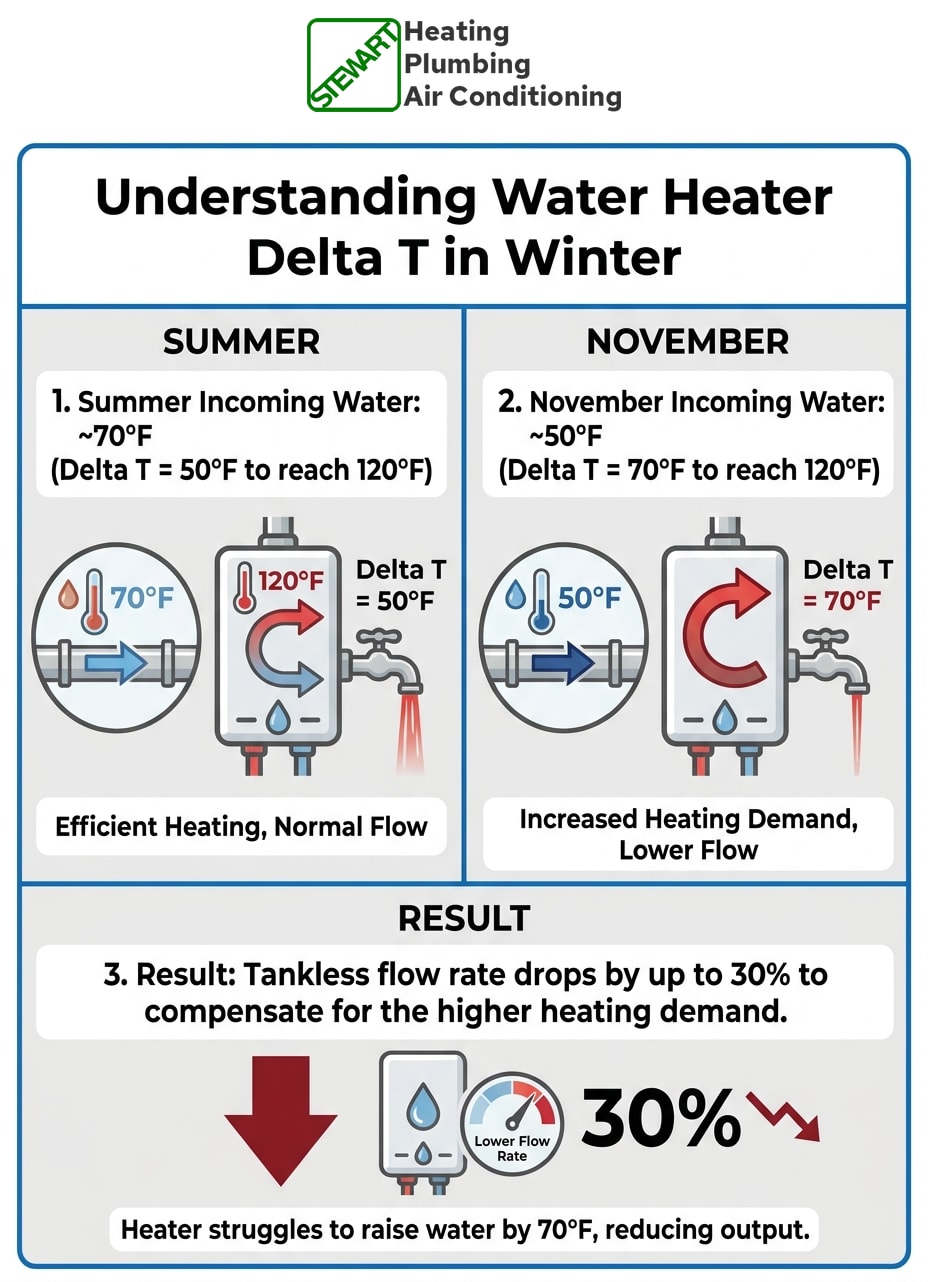
The math behind the chill: Most residential water heaters are set to deliver water at 120 degrees Fahrenheit, which aligns with Department of Energy (DOE) guidelines for safety and efficiency. During the peak of summer, the groundwater entering your home might already be 70 degrees. In that scenario, your water heater only needs to raise the temperature by 50 degrees (a Delta T of 50). However, when November arrives, that incoming water temperature can easily plummet to 50 degrees. Suddenly, your water heater is forced to achieve a Delta T of 70 degrees just to provide the exact same shower experience.
This mathematical reality affects all water heating systems across the board. When the required Delta T increases, the heater must consume more energy and work significantly harder to reach the target temperature. To illustrate how drastic this seasonal shift can be, consider the following comparison of incoming vs. outgoing water temperature demands:
• Summer (July) — Incoming Water Temp: ~70°F — Target Output Temp: 120°F — Required Delta T: 50°F — System Workload: Standard / Baseline
• Fall (November) — Incoming Water Temp: ~50°F — Target Output Temp: 120°F — Required Delta T: 70°F — System Workload: High / Strained
• Winter (January) — Incoming Water Temp: ~40°F — Target Output Temp: 120°F — Required Delta T: 80°F — System Workload: Maximum Capacity
Because the burner or heating element has a maximum physical limit to how much heat it can generate at any given moment, a higher Delta T (incoming vs. outgoing water temperature) means the system will struggle to keep up if water is flowing through it too quickly. For traditional tanks, this means the stored hot water is depleted rapidly and replaced by freezing cold water that takes much longer to heat up.
If you own an on-demand system, you might be particularly confused by seasonal changes. Our installers frequently hear from clients who bought a unit for "endless" hot water, asking why the water pressure suddenly feels weaker in the fall. The answer lies in how these modern systems are engineered to handle a high Delta T.
A tankless water heater does not store pre-heated water. Instead, it heats water instantly as it passes through a highly efficient heat exchanger. When the incoming water is exceptionally cold, the system realizes that if it allows the water to rush through at maximum speed, the burner won't have enough time to heat it to 120 degrees. To prevent you from getting a lukewarm shower, the system intentionally restricts the flow rate (measured in Gallons Per Minute, or GPM).
Here is the exact sequence of events that occurs inside your tankless unit when you turn on a faucet in November:
1. Temperature detection: Internal thermistors measure the temperature of the cold groundwater entering the unit.
2. Delta T calculation: The computerized control board calculates the exact temperature rise needed to reach your thermostat setting.
3. Burner ignition: The gas burner or electric elements fire up to their maximum safe operating capacity.
4. Flow restriction: A servo valve deliberately narrows the water passage, slowing down the flow so the water spends more time absorbing heat inside the exchanger.
5. Target achieved: The water exits the unit at exactly 120 degrees, but at a noticeably lower volume or pressure than you experience in the summer.
This reduction in flow is a deliberate safety and comfort feature, not a sign of appliance failure. The system is prioritizing temperature over volume. If you are experiencing fluctuations that go beyond just reduced pressure, it helps to understand why your tankless water heater randomly runs cold, as that can point to sensor issues or gas supply limits rather than just standard flow restriction.
The physics of water heating do not happen in a vacuum; they are directly tied to the infrastructure and climate of your specific location. Municipal groundwater supplies are heavily affected by late fall weather patterns, and the way water travels to your home dictates how your heater will perform.
As overnight temperatures drop in the East Bay and Pittsburg areas during November, the municipal water stored in local reservoirs and traveling through underground pipes begins to cool down. In some regions, water pipes are buried deep below the frost line, insulating them from ambient temperature swings. However, in California, pipes are often buried relatively shallowly. This means that as soon as the crisp fall air cools the ground, the water inside those pipes loses its ambient summer warmth very quickly.
Local expertise matters: Since 1974, Stewart Heating, Plumbing and Air Conditioning has proudly served this region. In our 50-plus years of working on local plumbing systems, our team has gained a deep understanding of how Contra Costa County's specific municipal water temperature changes impact residential plumbing. We consistently see a spike in homeowner concern right around November, precisely because the starting temperature of the water entering Pittsburg CA homes plummets over the course of just a few weeks.
This immediate drop directly impacts the Delta T calculation for local homes. If you notice your fixtures taking longer to get hot, or the flow rate dropping on your tankless unit just as the local weather turns chilly, rest assured that this is a predictable, regional seasonal shift. Your system is simply adapting to the colder municipal supply.
Understanding that colder groundwater causes flow restriction is only half the battle. To ensure your system survives the winter, you must also account for the compounding issues that make a high Delta T even harder for your unit to handle. The most significant of these factors is mineral scale buildup.
The Problem: As water is heated, naturally occurring minerals like calcium and magnesium separate from the water and bake onto the internal components of your water heater. When our plumbers perform winter maintenance, a pattern we see often is a crusty, chalky layer of scale heavily coating the heat exchanger or heating elements.
The Cause: This mineral buildup acts as a powerful layer of insulation between the heat source and the water. When November pre-winter temperature drops occur, your system already has to work overtime to heat the colder water. If the heat exchanger is coated in scale, the burner has to generate even more heat just to push through that insulating barrier. This inefficiency compounds the effects of a high Delta T, causing your tankless unit to restrict water flow much more severely than it would if it were clean.
The Solution: The only way to restore maximum efficiency and regain your lost water volume is through professional descaling. Flushing the system with specialized solutions breaks down the mineral barrier, allowing heat to transfer freely again. Proactive maintenance prevents the premature wear and tear that inevitably happens when a system is forced to overwork for months on end. Enrolling in a comprehensive water heater maintenance plan is the most effective way to ensure your unit is flushed and inspected before the coldest months arrive.
Because the line between a normal seasonal response and an actual mechanical failure can seem blurry, our technicians recommend knowing exactly what to look for. Use this practical diagnostic checklist to evaluate your system's performance in Pittsburg CA as the weather cools down.
If your system is simply reacting to the November chill, you will typically notice consistent, predictable behavior:
• Consistent temperature, lower volume: The water reaches the correct temperature (it feels just as hot as usual), but the flow rate from the showerhead or faucet is noticeably reduced.
• Gradual changes: The reduction in capacity correlates directly with recent cold snaps or a steady drop in local overnight temperatures.
• Simultaneous appliance behavior: The change is noticeable across all hot water fixtures in the house, not just an isolated bathroom.
If your system is actually malfunctioning or heavily scaled, you will see clear warning signs that go beyond basic flow restriction:
• Wild temperature fluctuations: The water goes from hot to freezing cold and back to hot again during a single shower (often called the "cold water sandwich").
• Diagnostic error codes: Your tankless unit's digital display is flashing an error code (frequently indicating scale buildup, blocked exhaust, or ignition failure).
• Completely cold water: The system fails to produce any hot water at all, regardless of the flow rate.
• Strange noises: Popping, rumbling, or knocking sounds coming from a traditional tank, which indicates heavy sediment boiling at the bottom of the unit.
A vital safety reminder: While checking your unit's external intake filters and ensuring exhaust vents are clear of debris are great winter prep steps, you should never attempt internal appliance repairs or descaling procedures without a licensed professional. Working with gas lines, high-voltage electricity, and highly acidic descaling chemicals poses severe safety risks. If your system is showing signs of failure, take advantage of local plumbing specials to have a certified technician diagnose the issue safely.
Your hot water runs out faster in winter because the incoming municipal groundwater is significantly colder than it is during the summer. This forces your water heater to use more energy and time to raise the water to your desired temperature. In traditional tanks, the stored hot water is depleted quickly and replaced by this freezing water, leading to a faster drop in shower temperature.
Cold weather affects a tankless water heater by triggering its internal flow restriction valve. Because the unit must heat very cold water instantly, it deliberately slows down the water passing through the heat exchanger to ensure it reaches the target temperature of 120 degrees. You still get hot water, but at a noticeably lower pressure or volume.
Water heater Delta T (temperature rise) is the mathematical difference between the temperature of the cold water entering your home and the final heated temperature you set on your thermostat. A higher Delta T (incoming vs. outgoing water temperature) requires the system to work much harder, which is why performance changes as the seasons shift.
If your hot water runs out suddenly, it is often due to a rapid drop in local weather temperatures cooling your underground water supply. However, if the weather has been mild, our plumbers frequently find that a sudden loss of hot water indicates a broken dip tube in a traditional tank, a failed heating element, or severe mineral scale buildup blocking heat transfer.
Yes, mineral buildup acts as a thermal insulator inside your water heater, making it incredibly difficult for the burner to transfer heat into the water. When this inefficiency is combined with the already high demands of cold winter water, your system's capacity will plummet, leading to extremely short showers and potential system overheating.
While a slight reduction in water flow is a perfectly normal response to colder groundwater, excessive drops in pressure or fluctuating temperatures are clear signs that your system is struggling. The physics of Delta T will always force your heater to work harder during November pre-winter temperature drops, but a clean, well-maintained system will handle that extra workload smoothly.
Do not wait until a house full of holiday guests pushes your plumbing to its breaking point. If you are still wondering why hot water runs out faster in november in your specific home, our expert team is here to give you a definitive answer. Schedule a professional inspection and descaling with Stewart Heating, Plumbing and Air Conditioning today to ensure your system is fully prepared for the freezing months ahead. If it's time for a replacement, we can also help you explore highly efficient upgrades that may qualify for generic utility incentive programs or federal tax credits (always verify current programs with your utility or tax professional). Let us give you the peace of mind that your hot showers won't be cut short when you need them most.

Very professional and complete. I would recommend Stewart to anyone. Highest quality of workmanship and clean installation.
Stewart Heating Plumbing Air Conditioning just did some work for us for the first time. They did an installation at my home and it turned out well. I thought the price was fair and I definitely would use them again. The technicians were very friendly and knowledgeable about their work. I highly recommend Stewart Heating Plumbing Air Conditioning and already told friends to use them.
We have been using Stewart Heating Plumbing Air Conditioning since 1995. They put the original heating and air unit in the house, and we have just stayed with them. They are dependable and honest people, and they have done a good job for us every time that we have used them!
They came and did an inspection and are coming tomorrow to do the repair.
They replaced a regulator the first time, and then the water heater vent had to be replaced. They did great work.
The gentleman that serviced us was helpful, insightful, and knew what he was talking about. Overall, it was a great experience.