

Recent Blogs
Stay updated with our latest blog posts.

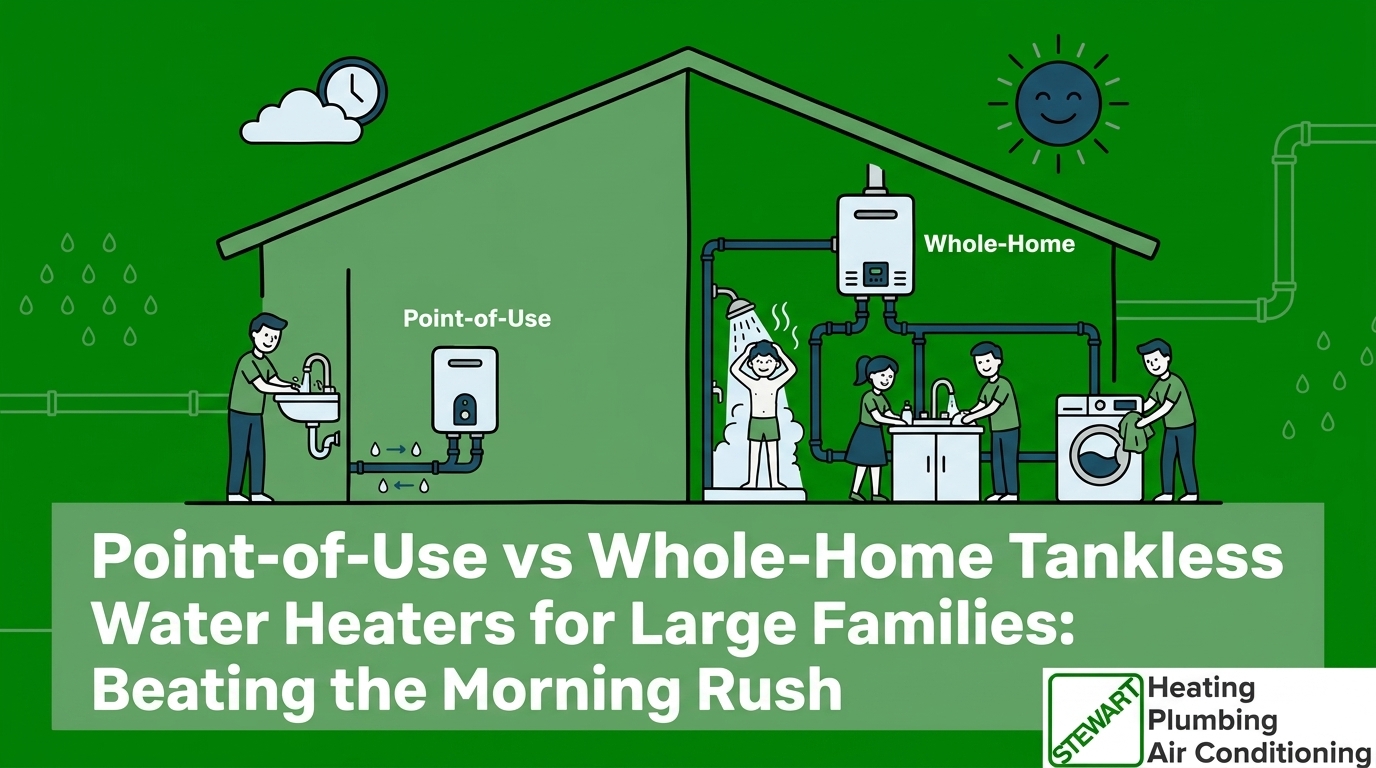
Are you constantly turning on the shower and waiting minutes for the water to heat up while everyone else in the house is scrambling to get ready? When our team helps customers evaluate point-of-use vs whole-home tankless water heaters for large families, we find this daily frustration is usually the driving factor behind the research. Having a large family means simultaneous hot water demand is a daily challenge, and the plumbing infrastructure of your home is put to the test every single morning.
During the intense August back-to-school morning rush, schedules compress. Everyone needs to shower, brush their teeth, and get out the door within a tight sixty-to-ninety-minute window. This concentrated demand forces homeowners to confront a core decision: should you rely on a single, massive central unit to supply the entire house, or should you install strategic, decentralized units directly where the water is needed? The right choice depends heavily on your home's unique plumbing architecture. If you are looking to upgrade your daily routine, exploring modern water heater solutions with an experienced local team is the first step toward reclaiming your mornings.
Many of the homeowners we work with assume that if they run out of hot water, their water heater is simply too small. However, as plumbing professionals, we know there is a fundamental difference between a water heater's ability to produce hot water (its capacity) and the plumbing system's ability to deliver that water to the fixture quickly (transit time). You might have a system with plenty of capacity, but if the water has to travel through long, uninsulated pipes, it loses heat rapidly along the journey.
In the sprawling Pittsburgh CA homes our plumbing team services every week, this physical distance creates a significant bottleneck. It is not uncommon for a distant master bathroom or guest suite to be located fifty or even eighty feet away from the central utility area. This distance translates directly into a delivery delay of one to two minutes, wasting both time and water. This transit time is a plumbing layout issue, not necessarily a water heater defect, and it forces homeowners to rethink their tankless strategy from the ground up. To properly address these layout challenges, having our team evaluate your residential plumbing services and pipe routing is just as critical as selecting the heater itself.
If you have ever experienced a brief blast of warm water, followed by an uncomfortable shock of cold water, and then finally a steady stream of newly heated water, you have encountered the "cold water sandwich." We hear about this phenomenon constantly on service calls. It occurs because hot water from a previous use sits in the pipes and cools down. When you turn the tap back on, the tankless unit fires up to heat fresh water, but it has to push that stagnant, cooled-down water out of the pipes first.
Long pipe runs severely exacerbate this frustrating experience. The greater the distance between the heater and the showerhead, the more cold water is trapped in the line, and the longer the "sandwich" lasts. In homes with extensive square footage, this can turn a quick morning shower into an endurance test.
The physical distance between the central utility area and the furthest fixtures dictates your delivery speed. Water pressure and pipe diameter play a role, but the sheer volume of water sitting in a long pipe run must be completely displaced before the hot water arrives. Larger floor plans inherently suffer from longer transit times simply because the plumbing trunk lines have more ground to cover. Recognizing this limitation is an essential step our technicians take before deciding whether to centralize or decentralize your hot water production.
A single, high-capacity tankless water heater is designed to replace a traditional tank by heating water on demand for the entire house. When sized correctly by our professionals, these robust units can handle the demands of multiple fixtures running simultaneously. They utilize powerful gas burners or heavy-duty electric heating elements to rapidly raise the temperature of incoming groundwater, providing a virtually endless supply of hot water as long as the total flow rate isn't exceeded.
When we install these systems, the primary appeal for our customers is simplicity. You have one piece of equipment to install, one gas line to route, one venting system to manage, and one unit to maintain over its lifespan. Understanding how long a tankless water heater actually lasts helps justify the investment in a high-quality central unit. However, the critical limitation remains: a central unit cannot bypass the physical distance to distant bathrooms. It leaves transit delays unresolved. We typically recommend this setup for homes where bathrooms, kitchens, and laundry rooms are clustered relatively close to the utility area, minimizing the pipe run lengths.
• Streamlined maintenance: You only have one heat exchanger to flush, one burner assembly to inspect, and one filter to clean during annual tune-ups.
• Centralized infrastructure: Upgrading a single gas line and installing one exhaust vent is often less invasive than modifying plumbing and electrical systems in multiple areas of the house.
• High peak output: Premium whole-home units can produce significant flow rates, easily supporting a busy household if the fixtures are reasonably close.
Even the most powerful central units have a ceiling. If too many showers, sinks, and appliances run at the exact same time, the central unit may restrict the water flow to ensure it can still heat the water to your set temperature. During the August back-to-school morning rush, when three showers might be running alongside a dishwasher or washing machine, this flow restriction becomes noticeable. This compressed schedule stress-tests the central capacity, sometimes resulting in a drop in water pressure at the showerhead.
Point-of-use tankless heaters take a completely different architectural approach. Instead of relying on one massive unit to serve the whole house, this strategy utilizes multiple smaller units placed directly at or very near the fixtures they serve. These are often compact electric models that can be installed under sinks, in adjacent closets, or within vanity cabinets. By decentralizing the hot water production, you bring the heat source directly to the demand.
Placing the heater mere inches or feet from the fixture virtually eliminates transit time and completely eradicates the cold water sandwich. When you turn on the tap, the water is heated immediately before it exits the spout. However, this strategy comes with distinct trade-offs. Point-of-use units require dedicated electrical circuits, which often necessitates an electrical panel upgrade. You also have to find the physical space to install them near the bathrooms, and you multiply your maintenance tasks by the number of units installed. Despite these hurdles, our plumbers find this strategy highly effective for isolated master suites or guest bathrooms situated far from the main plumbing trunk in sprawling Pittsburgh CA homes.
The most significant benefit of a decentralized approach is the immediate comfort it provides. Turning on a tap and getting hot water in seconds, rather than minutes, drastically improves the daily routine. This direct delivery solves the primary frustration of large floor plans, ensuring that no matter how far a bathroom is from the garage or utility room, the user experiences premium, instantaneous comfort.
While point-of-use units are small, they are not invisible. They require adequate ventilation and accessible placement for future servicing.
• Electrical demands: Electric point-of-use heaters draw a substantial amount of amperage to flash-heat water. Each unit typically requires its own dedicated 240V circuit, which means running new wiring from the main breaker panel to the bathroom.
• Space constraints: Finding a discreet but accessible location under a sink or in a linen closet requires careful planning to ensure the unit doesn't consume all available storage space.
• Multiplied maintenance: Descaling and inspecting multiple units takes more time than servicing a single central heater.
When selecting any tankless system, you must account for "temperature rise"—the difference between the incoming groundwater temperature and your desired output temperature (usually around 120 degrees Fahrenheit). The colder the groundwater, the harder the unit has to work. In freezing northern climates, tankless units struggle to produce high flow rates because the burners must expend maximum energy just to heat ice-cold water, often cutting the unit's effective Gallons Per Minute (GPM) in half.
Fortunately, regional climate plays a massive role in system efficiency. As local experts serving Pittsburg, CA, and the greater East Bay area, we know our mild winters mean groundwater temperatures rarely reach freezing extremes. This favorable climate allows both the whole-home and point-of-use systems we install to operate at or near their maximum rated GPM year-round. Because the local environment doesn't severely handicap the unit's heating capacity, the decision between whole-home and point-of-use for sprawling Pittsburgh CA homes leans even more heavily on pipe layout and transit time, rather than raw heating power.
To ensure whichever system you choose can handle the load, our team calculates your household's simultaneous demand in Gallons Per Minute (GPM). This technical calculation is the bedrock of proper system sizing. Standard showerheads typically use about 2.5 GPM, while modern, high-efficiency WaterSense fixtures use 2.0 GPM or less. Bathroom faucets generally pull around 1.0 to 1.5 GPM, and a kitchen sink can demand up to 2.2 GPM.
To calculate your total simultaneous demand, we add up the GPM of all fixtures that are likely to run at the exact same time. For example, if your August back-to-school morning rush involves three showers running simultaneously using standard showerheads, you need a system capable of delivering 7.5 GPM of continuous hot water. If someone starts the washing machine during that window, the demand spikes even higher. Accurately calculating this peak demand is critical before we recommend either a single massive central unit or properly sized point-of-use additions.
The calculation process our technicians follow:
1. Inventory your fixtures: We check the flow rate stamped on your showerheads and aerators.
2. Identify the peak window: We help you determine the busiest 60-minute window in your home's daily routine.
3. Sum the flow rates: We add the GPM of every fixture used during that peak window.
4. Factor in appliances: We add 1.5 to 2.0 GPM if a dishwasher or washing machine runs concurrently.
Emphasizing this peak usage window ensures that your system is designed for your worst-case scenario, preventing cold showers when your family needs hot water the most.
Synthesizing these factors helps clarify which approach aligns with your specific architectural challenges. For many sprawling Pittsburgh CA homes, we often recommend a hybrid approach: utilizing a robust central unit for the bulk of the house (kitchen, laundry, and proximate bathrooms) while installing a single point-of-use unit for an isolated master suite located on the far side of the property.
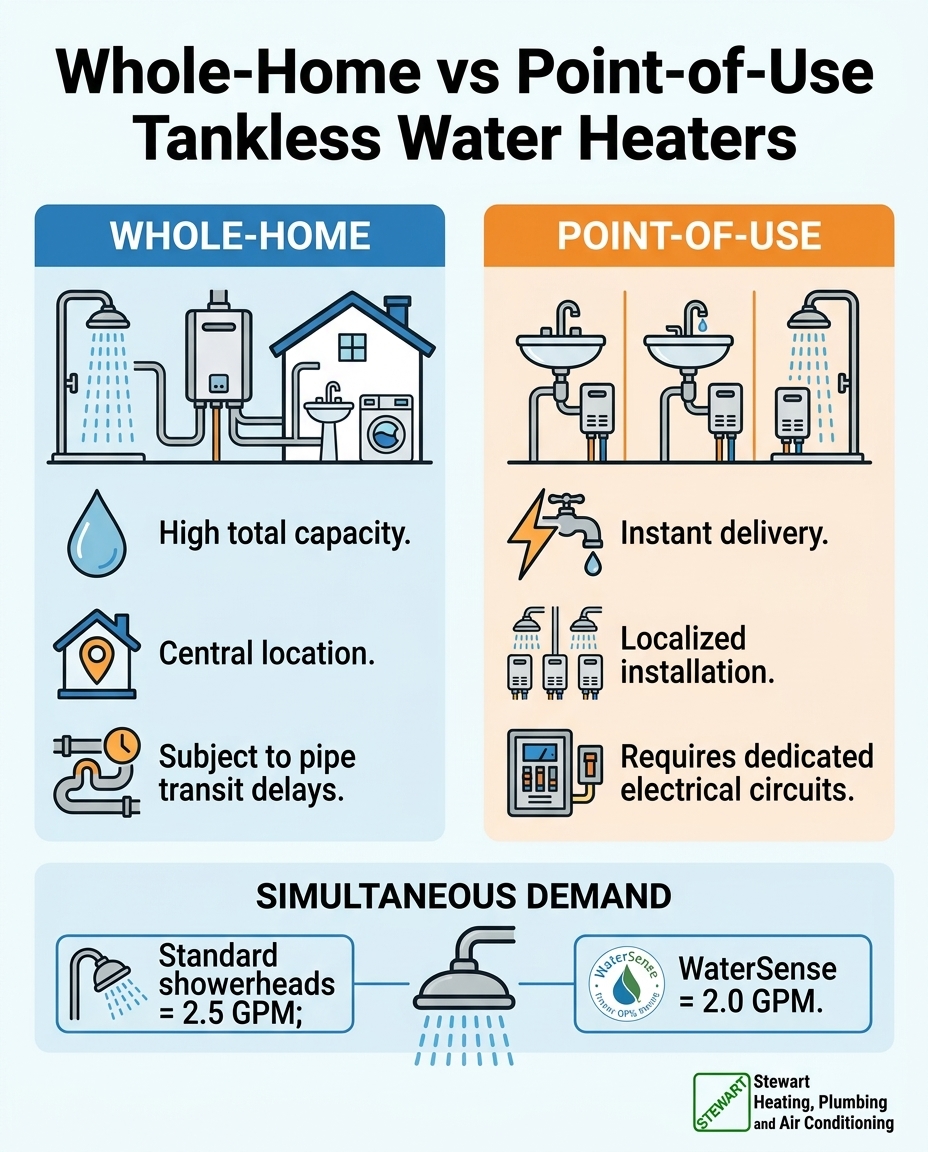
• Transit Time — Whole-Home Tankless: Subject to pipe length delays; can take 1-2 minutes for distant taps. — Point-of-Use Tankless: Virtually instant delivery; eliminates the cold water sandwich.
• Total Capacity — Whole-Home Tankless: High total GPM; designed to handle multiple simultaneous fixtures. — Point-of-Use Tankless: Lower individual GPM; designed for specific, localized fixtures.
• Maintenance — Whole-Home Tankless: Centralized; only one unit to flush and inspect annually. — Point-of-Use Tankless: Decentralized; requires servicing multiple units across the home.
• Infrastructure — Whole-Home Tankless: Requires upgraded gas lines and specialized central venting. — Point-of-Use Tankless: Requires dedicated 240V electrical circuits for each unit installed.
• Best Application — Whole-Home Tankless: Homes with clustered plumbing and high total volume needs. — Point-of-Use Tankless: Sprawling homes with distant, isolated bathrooms or additions.
Ultimately, the right choice depends entirely on your family's daily routine and the physical layout of your pipes. There is no one-size-fits-all answer when dealing with the unique architectural demands of large, sprawling properties. A system that works perfectly for a compact two-story home might fail to deliver comfort in a wide, single-story ranch.
Having served the community since 1974, our team at Stewart Heating, Plumbing and Air Conditioning provides trusted, family-oriented advice tailored to the practical needs of large local households. A professional assessment can pinpoint the exact cause of your transit delays and recommend the most efficient, reliable solution for your layout. Before the August back-to-school morning rush puts your plumbing to the ultimate test, reach out to request plumbing service and ensure your home is equipped to handle the demand smoothly.
Can one tankless water heater run a whole house?
Yes, a single properly sized tankless water heater can efficiently run an entire house. High-capacity units are designed to handle significant flow rates, easily supplying multiple bathrooms and appliances simultaneously. However, success depends on accurately calculating your peak GPM demand and ensuring your gas line and venting can support the unit's requirements.
Do I need two tankless water heaters for a large house?
You might need two units if your home's total simultaneous demand exceeds the maximum output of the largest available residential unit. Additionally, installing two units at opposite ends of a sprawling house can resolve severe transit time delays. A professional load calculation from our team is necessary to determine if dual units are a requirement or just a luxury.
Why does it take so long to get hot water with a tankless heater?
The delay is caused by the distance the water must travel through your home's pipes, not a flaw in the heater itself. When you turn on the tap, the tankless unit fires up instantly, but it must push all the cold, stagnant water out of the long pipe runs before the fresh hot water reaches you. Insulating your pipes or adding point-of-use units can mitigate this issue.
How many GPM do I need for a family of 5?
In our experience, a family of five typically requires a system capable of delivering between 7.0 and 9.0 GPM to handle peak morning routines comfortably. This capacity allows for three simultaneous showers, or two showers running alongside a washing machine or dishwasher. Checking the flow rates of your specific fixtures will provide the most accurate target.
Can I mix a whole-home unit with a point-of-use heater?
Absolutely. We find this hybrid approach is highly effective for large floor plans. You can use a robust central unit to supply the kitchen, laundry, and main bathrooms, while installing a dedicated point-of-use heater for an isolated master suite or distant guest bathroom to eliminate long wait times.
Does pipe insulation fix the cold water sandwich effect?
Pipe insulation helps retain heat in the lines between uses, which can reduce the severity of the cold water sandwich if the taps are turned on and off frequently. However, insulation cannot generate heat; if the water sits in the pipes overnight, it will still cool down. Insulation improves efficiency but does not entirely replace the instant delivery of a point-of-use system.

Very professional and complete. I would recommend Stewart to anyone. Highest quality of workmanship and clean installation.
Stewart Heating Plumbing Air Conditioning just did some work for us for the first time. They did an installation at my home and it turned out well. I thought the price was fair and I definitely would use them again. The technicians were very friendly and knowledgeable about their work. I highly recommend Stewart Heating Plumbing Air Conditioning and already told friends to use them.
We have been using Stewart Heating Plumbing Air Conditioning since 1995. They put the original heating and air unit in the house, and we have just stayed with them. They are dependable and honest people, and they have done a good job for us every time that we have used them!
They came and did an inspection and are coming tomorrow to do the repair.
They replaced a regulator the first time, and then the water heater vent had to be replaced. They did great work.
The gentleman that serviced us was helpful, insightful, and knew what he was talking about. Overall, it was a great experience.