

Recent Blogs
Stay updated with our latest blog posts.

August brings some of the most intense heat of the year, but just when you need reliable indoor comfort the most, you might find yourself dealing with late summer AC short-cycling: why your system struggles in August is a question that plagues many homeowners as the season peaks. At Stewart Heating, Plumbing and Air Conditioning, we frequently hear from frustrated customers who set their thermostat to a comfortable temperature, but instead of a steady stream of cold air, experience frequent on/off thermostat cycling without reaching the set temperature. The system powers up, runs for just a few minutes, and abruptly shuts down, only to repeat the frustrating process moments later.
In our experience, this rapid cycling is rarely a random glitch. Instead, it is the climax of cumulative wear and tear that has been building up since the first hot days of spring. Throughout the early summer months, your system has been quietly accumulating dust, losing microscopic amounts of efficiency, and enduring thousands of startup cycles. By the time the August late-summer peak heat arrives, the equipment is operating at its absolute limits. Addressing these symptoms immediately is critical to preventing catastrophic compressor failure.
If you are experiencing these warning signs and need an expert evaluation, exploring professional air conditioning services is the first step toward restoring your home's comfort and protecting your equipment.
To understand why an air conditioner begins to short-cycle late in the season, our technicians always look at what the equipment endured during the preceding months. Continuous operation through early and mid-summer gradually degrades system efficiency in ways that are often invisible to the homeowner.
HVAC professionals measure seasonal workload using "cooling degree days," a metric that tracks how much energy is required to cool a building based on outside temperatures. These cooling degree days peak in late summer. This means your system is working its absolute hardest right when its internal components are the most fatigued from sixty to ninety days of near-constant operation.
Here in Pittsburg and throughout Contra Costa County, our team sees firsthand how the specific regional climate forces residential systems to work severe overtime. The area is known for intense afternoon heat spikes followed by significant diurnal temperature swings. An air conditioner might sit idle in the cool morning air, only to be slammed with a massive thermal load by 3:00 p.m. This rapid shift forces the system to run at maximum capacity during the hottest part of the day, accelerating cumulative wear.
The unseen damage we typically uncover includes:
• Microscopic dust accumulation: Even with a good filter, tiny particles bypass the media and coat the internal blower wheel and evaporator coil.
• Vibration wear: Motors and fans vibrate slightly while running. Over hundreds of hours, this can loosen electrical connections and sensor mounts.
• Lubricant breakdown: The oil that keeps the compressor running smoothly degrades faster under high-heat stress, increasing mechanical friction.
When we get called out for an air conditioner that short-cycles, it is usually not the thermostat changing its mind. Instead, the system's internal safety switches are deliberately shutting down the compressor to prevent the unit from destroying itself.
Your thermostat may still be calling for cooling, sending a low-voltage signal to the outdoor unit to keep running. However, the internal safeties detect a critical operating parameter that has gone out of bounds—usually related to pressure or temperature—and they override the thermostat's command. This results in the rapid on/off symptom that defines short-cycling.
Modern HVAC systems are equipped with two primary safeguards that monitor the flow of refrigerant:
• The Low-Pressure Switch: This sensor monitors the suction line (the cold side of the system). If the pressure drops too low—usually due to a loss of refrigerant or a severe airflow blockage that causes the evaporator coil to freeze—the switch cuts power to the compressor to prevent it from running dry.
• The High-Pressure Switch: This sensor monitors the liquid line (the hot side of the system). If the system cannot expel enough heat at the outdoor condenser, internal pressures skyrocket. Before the copper lines can burst or the compressor motor burns out, the high-pressure switch trips and shuts the system down.
Bypassing or ignoring these safety shut-offs will inevitably lead to permanent compressor damage. When a system short-cycles, the only safe solution is to have a professional identify exactly which switch is tripping and resolve the underlying mechanical or airflow issue.
• Normal Operation — Cycle Duration: 15 to 20 minutes — Primary Indicator: Steady, even cooling reaching set temperature — Risk Level: Safe
• Mild Short-Cycling — Cycle Duration: 10 to 14 minutes — Primary Indicator: System struggles to maintain target temperature — Risk Level: Moderate (requires inspection)
• Severe Short-Cycling — Cycle Duration: Under 10 minutes — Primary Indicator: Rapid on/off switching, no noticeable cooling — Risk Level: Critical (immediate shutdown required)
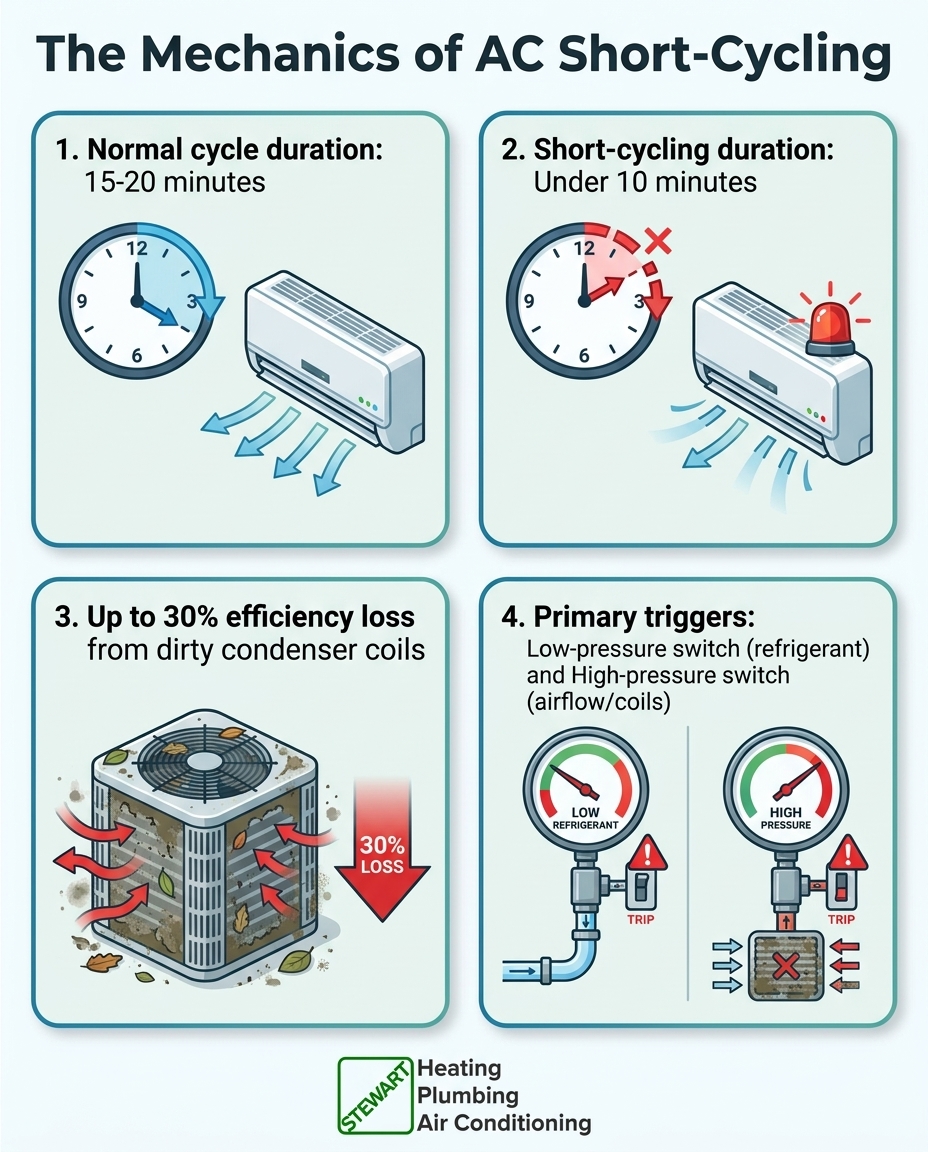
If our technicians had to point to one single factor responsible for the majority of late-summer high-pressure trips we encounter, it is a filthy outdoor condenser unit. Throughout the spring and summer months, the outdoor unit acts like a giant vacuum, pulling in airborne debris, pollen, grass clippings, and dust.
The outdoor coil is responsible for releasing the heat that was absorbed from inside your home. When a blanket of grime insulates the delicate aluminum fins, the heat cannot escape into the outside air. Because the heat is trapped, the temperature of the refrigerant remains too high, causing the internal system pressures to skyrocket until the high-pressure safety switch intervenes.
Signs your condenser is struggling:
• Excessive heat output: The air blowing out of the top of the outdoor unit feels exceptionally hot.
• Louder operation: The fan motor strains against the restricted airflow, creating a louder humming or buzzing noise.
• Visual blockage: You can visibly see a mat of lint, dirt, or pet hair clinging to the outside of the unit.
According to the U.S. Department of Energy, dirty coils can reduce a system's cooling efficiency by up to 30%. This forces the compressor to work harder, run hotter, and consume significantly more electricity just to provide a fraction of its normal cooling power. Deep coil cleaning requires specialized chemical treatments and professional handling to dissolve the baked-on grime without bending the fragile aluminum fins. Attempting to blast the coils with a high-pressure power washer will only fold the fins flat, permanently ruining the unit. For a deeper understanding of this critical maintenance step, read more about cleaning your AC coils.
While high-pressure trips are usually tied to dirty coils, our service calls for low-pressure trips are almost always tied to refrigerant issues. We frequently have to remind homeowners that it is a common misconception that air conditioners "consume" or "burn up" refrigerant over time. The refrigerant loop is a sealed system; low levels always indicate a leak somewhere in the copper lines, the evaporator coil, or the condenser coil.
A micro-leak that started as a pinhole in June might not immediately affect the system's performance. The air conditioner will continue to run, slowly losing an ounce of refrigerant at a time. However, by August, enough volume has been lost that the system can no longer maintain the correct internal pressure. When the pressure drops below the manufacturer's safe threshold, the low-pressure safety switch cuts the power.
Counterintuitively, low refrigerant often causes the indoor evaporator coil to freeze solid. Because there is less refrigerant in the system, it expands too rapidly and drops below the freezing point of water. Condensation from your indoor air then freezes onto the coils, creating a solid block of ice. This ice blocks all airflow through the ductwork, causing the system to rapidly cycle on and off as it struggles to push air through a solid wall of frost.
We highly advise against any DIY refrigerant checks or "top-off" kits sold online. Handling these chemicals requires EPA certification, specialized manifold gauges, and precise mathematical calculations to ensure the system is charged to the exact subcooling or superheat specifications required by the manufacturer.
Airflow is the lifeblood of any HVAC system. Without a steady volume of air moving over the indoor coil, the heat transfer process completely breaks down. While some airflow issues require one of our technicians to resolve, others start with simple homeowner maintenance that has been overlooked during the busy summer months.
A standard 1-inch fiberglass or pleated air filter can easily last a few months during the mild spring. However, under the heavy, continuous operation of a late-summer heat wave, that same filter can become completely clogged in just a few weeks. When the filter is choked with dust, pet dander, and pollen, the blower motor has to work twice as hard to pull air through the return duct.
This restricted airflow causes the blower motor to overheat and eventually trip its own thermal overload switches. Before assuming the worst about your rapidly cycling system, we always recommend checking the air filter first. A fresh filter is the easiest way to restore baseline airflow.
If the filter is clean but the system is still short-cycling, the airflow restriction is likely internal. This could be a failing blower motor that is not spinning at the correct RPM, a collapsed section of flexible ductwork in the attic, or heavily soiled indoor blower wheel blades. These complex issues require a technician's diagnostic tools.
For instance, one homeowner who has relied on our team at Stewart Heating, Plumbing and Air Conditioning for 33 years recently faced a recurring airflow and cooling issue. After a thorough inspection, our technician explained exactly what was failing within the internal blower assembly and how to prevent it from happening again, leading the customer to secure a permanent HVAC maintenance plan for ongoing peace of mind. Thorough, semi-annual inspections are the most reliable way to catch these compounding airflow issues before they result in a late-summer breakdown.
Ignoring a short-cycling air conditioner is one of the most expensive mistakes we see homeowners make. The rapid on/off switching is not just an annoyance; it is actively destroying the most critical and costly component in the entire system: the compressor.
Air conditioners draw the most electricity and endure the most mechanical wear during the start-up phase. When the compressor kicks on, it requires a massive surge of power—known as Locked Rotor Amps (LRA)—to overcome the resting inertia of the internal pistons and scrolls. Once running, it settles into a much lower, steady electrical draw.
When a system short-cycles, it multiplies this startup wear exponentially. Instead of starting up three or four times an hour, a short-cycling unit might start up fifteen or twenty times an hour. This constant surging overheats the electrical windings, degrades the starting capacitor, and physically grinds down the internal mechanical parts.
Allowing this to continue will inevitably lead to a complete system breakdown during the hottest days of the year, leaving your home unprotected against the late-summer heat. Immediate professional troubleshooting is required to identify whether the root cause is electrical, refrigerant-based, or mechanical.
Consider a situation our team handled during a recent late-summer season: at 7 p.m. on a Friday evening right around the busy back-to-school transition, a homeowner realized their air conditioning was sending out heat instead of cooling, while rapidly cycling on and off. Our technician spent two hours troubleshooting the complex electrical system, eventually discovering a loose wire that was interrupting the cycle and triggering the safeties. Because the issue was diagnosed and resolved quickly, the customer had their air conditioning restored safely during a notoriously hot weekend. If you are noticing strange cycling behavior, do not wait for the system to fail entirely; request AC repair service immediately to protect your equipment.
This rapid on/off switching is usually caused by cumulative wear triggering the system's internal safety switches. After running heavily through June and July, common culprits like dirty condenser coils, low refrigerant levels, or overheating blower motors finally reach a breaking point in August, causing the system to shut down prematurely to protect itself.
Yes, severe airflow restriction from a clogged filter causes the system to overheat and shut down prematurely. When air cannot flow freely over the indoor coil, the coil can freeze solid, or the blower motor can trip its thermal overload switch. Filters should be checked and replaced monthly during the peak cooling season.
Yes, low refrigerant triggers the system's low-pressure safety switch, forcing it to shut down to protect the compressor. It can also cause the evaporator coil to freeze, which blocks airflow and creates a rapid cycling effect. Because the system is sealed, low refrigerant always indicates a leak that must be professionally repaired.
Extremely bad; short-cycling drastically increases your energy bills and causes severe wear on the compressor. The start-up phase is the most strenuous part of the cooling cycle, and multiplying that stress by rapidly turning the unit on and off will eventually lead to premature, complete system failure.
A healthy, properly sized system typically runs for 15 to 20 minutes per cycle during hot weather. This duration is necessary to adequately cool the air and remove excess humidity from the home. Cycles that consistently last under 10 minutes indicate a serious sizing, airflow, or mechanical short-cycling issue.
Late-summer short-cycling is a clear cry for help from a fatigued system. While checking your air filter is a great first step, resolving high-pressure trips, cleaning delicate condenser coils, and diagnosing refrigerant leaks requires an expert hand. Our team at Stewart Heating, Plumbing and Air Conditioning has been serving the area since 1974, providing deeply experienced local experts who understand exactly how East Bay microclimates stress residential cooling systems. By scheduling a professional evaluation now, you can address the cumulative wear of summer, secure your indoor comfort, and ensure your system operates safely through the final heat waves of the season.

Very professional and complete. I would recommend Stewart to anyone. Highest quality of workmanship and clean installation.
Stewart Heating Plumbing Air Conditioning just did some work for us for the first time. They did an installation at my home and it turned out well. I thought the price was fair and I definitely would use them again. The technicians were very friendly and knowledgeable about their work. I highly recommend Stewart Heating Plumbing Air Conditioning and already told friends to use them.
We have been using Stewart Heating Plumbing Air Conditioning since 1995. They put the original heating and air unit in the house, and we have just stayed with them. They are dependable and honest people, and they have done a good job for us every time that we have used them!
They came and did an inspection and are coming tomorrow to do the repair.
They replaced a regulator the first time, and then the water heater vent had to be replaced. They did great work.
The gentleman that serviced us was helpful, insightful, and knew what he was talking about. Overall, it was a great experience.