

Recent Blogs
Stay updated with our latest blog posts.

Your vents are blasting warm air into an already sweltering room, which is exactly why we look beyond the zone board when your AC blows heat to find the real mechanical root cause. The immediate discomfort of a cooling system failing during the peak summer cooling season is frustrating enough, but the situation becomes even more stressful when the diagnosis feels uncertain. When a system actively pumps heat into a home that is already hot, the issue often mimics a complex electronic control failure. This overlapping set of symptoms can easily lead to hasty assumptions and incorrect repairs if the technician does not dig deep enough.
A common pitfall in the industry is the "parts cannon" approach. This happens when a technician sees an electronic symptom, assumes the central control system has failed, and begins swapping out expensive components hoping to hit the target. Because the zone board is the brain directing traffic between your thermostat and your cooling equipment, it frequently takes the blame. However, replacing a costly circuit board without verifying the mechanical components downstream is a disservice to your wallet and your home's comfort.
Protecting your investment requires a meticulous diagnostic process. Thorough troubleshooting means evaluating how the electronic signals interact with the physical hardware of your HVAC systems. By testing the entire chain of command—from the thermostat on your wall to the valves inside your outdoor unit—a professional can pinpoint the exact point of failure. This methodical approach ensures that you only pay for the repairs you actually need, restoring your comfort quickly and reliably without unnecessary component replacements.
To understand why the zone board is a frequent scapegoat, you have to understand its role in your home's climate control system. In a zoned setup, the zone board acts as the central dispatcher. It receives temperature requests from multiple thermostats throughout the house and translates those requests into actionable commands. It tells the dampers in your ductwork to open or close, and it sends the critical signal to the outdoor unit to begin the cooling cycle.
When a zone board actually fails, the symptoms can be chaotic. You might notice dampers remaining shut when a room is hot, the system failing to turn on entirely, or the equipment receiving conflicting signals. Because a malfunctioning board can disrupt the entire cooling process, inexperienced technicians might see a system blowing warm air and immediately conclude that the "brain" is broken. They assume the board is sending a heating command instead of a cooling command.
Real electronic failures certainly happen. For example, one homeowner reached out about a malfunctioning circuit board located in an unusual spot inside their home. A technician was able to quickly fix the problem and plan for a follow-up thermostat replacement to ensure long-term stability. However, while circuit board issues do occur, they must be proven rather than guessed.
The confusion arises because mechanical failures share many of the exact same symptoms. If the zone board is doing its job perfectly, but a mechanical valve outside refuses to move, the end result inside your house is identical: hot air blowing out of the vents. This is why verifying the 24-volt solenoid signal at the equipment level is absolutely critical before condemning the expensive electronic board.
• Air blowing warm in cooling mode — Potential Zone Board Cause: Board sending incorrect mode signal — Potential Mechanical Cause: Reversing valve physically stuck
• Only one room is cooling properly — Potential Zone Board Cause: Board failing to actuate duct dampers — Potential Mechanical Cause: Blocked ductwork or crushed flex pipe
• System runs constantly without cooling — Potential Zone Board Cause: Relay stuck closed on the circuit board — Potential Mechanical Cause: Low refrigerant charge or compressor issue
Many modern cooling systems are actually heat pumps. A heat pump is essentially an air conditioner that can run backward. Instead of just absorbing heat from inside your house and rejecting it outside, a heat pump can reverse the flow of its refrigerant to absorb heat from the outside air and pump it indoors. The component responsible for this magic trick is a mechanical device called the reversing valve.
The reversing valve is a heavy brass component containing a sliding internal mechanism. When you switch your thermostat from heating to cooling, the system sends an electrical signal to shift that slide. This physical movement redirects the flow of high-pressure refrigerant gas coming from the compressor. If the internal slide becomes jammed due to wear, tear, or internal system debris, the valve will not shift. Even if the zone board is screaming for the system to cool, a stuck reversing valve will trap the system in heating mode.
Contrasting a mechanical valve failure with an electronic zone board failure highlights the need for a different repair approach. A zone board is a solid-state electronic device; it either sends the correct voltage or it doesn't. The reversing valve is a physical, moving part subjected to extreme pressures and temperatures. If the valve is stuck, replacing the zone board will do absolutely nothing to solve the problem. The system will continue to blow heat because the mechanical pathway of the refrigerant remains unchanged. Fixing this requires recovering the refrigerant, cutting out the heavy brass valve with an oxyacetylene torch, brazing in a new valve, and recharging the system—a completely different job than swapping a circuit board.
Bridging the gap between the electronic zone board and the mechanical reversing valve is a small electromagnetic coil called the solenoid. The solenoid sits on top of the reversing valve. When the zone board sends its command, it energizes this coil, creating a magnetic field that physically pulls the internal pilot valve, which then uses system pressure to shift the main reversing valve slide. Verifying this connection is the key to accurate diagnostics.
The professional signal tracing process involves several critical steps:
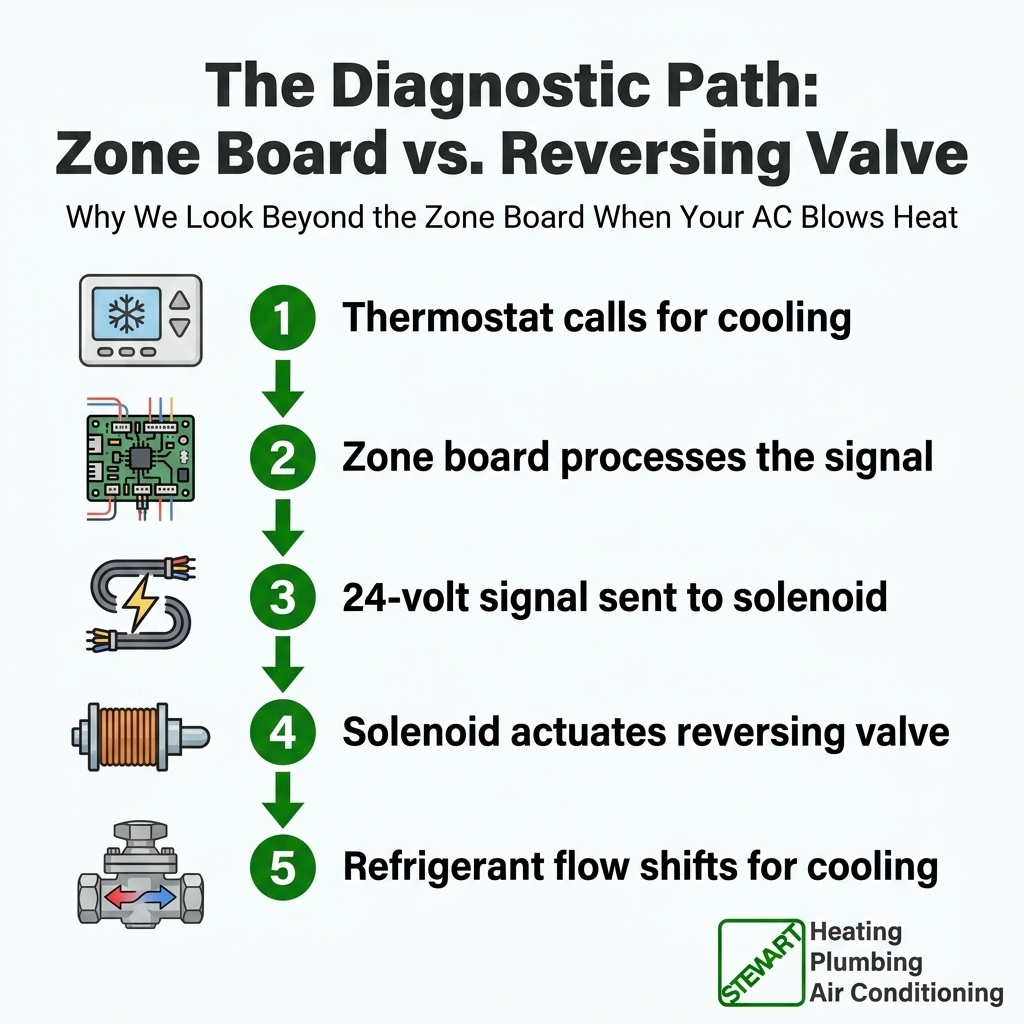
1. Initiating the cooling call: The technician sets the thermostat to call for cooling, ensuring the zone board registers the demand.
2. Testing the board output: Using a multimeter, the technician checks the terminals on the zone board to confirm it is successfully sending the 24-volt solenoid signal outward.
3. Testing at the outdoor unit: The technician moves outside and tests the low-voltage wires arriving at the condenser to ensure the signal wasn't lost in the wiring between the house and the unit.
4. Verifying solenoid voltage: The multimeter is applied directly to the solenoid coil leads. If the 24-volt solenoid signal is present here, the electronic communication is flawless.
5. Checking magnetic pull: The technician can often test if the solenoid coil is generating a magnetic field. If the field is present but the valve hasn't shifted, the mechanical valve is officially diagnosed as stuck.
If the correct voltage reaches the coil but the system still blows heat, the issue is definitively mechanical. The zone board is completely vindicated. This step-by-step electrical tracing is strictly a professional diagnostic procedure. Working with live voltage around high-amperage outdoor equipment is dangerous, and interpreting the multimeter readings requires specific training. Trusting professional AC repair services ensures this vital test is performed safely and accurately.
Diagnostics become even more complex when regional climate stressors enter the equation. With the intense summer heat waves in Contra Costa County, systems are forced to run continuously for hours on end. This rapid cycling and prolonged operation increase the thermal and electrical loads on every component, particularly solenoids and wiring connections.
The impact of extreme heat on your system includes:
• Degraded electrical connections: Continuous vibration from the compressor running non-stop can cause wire nuts and terminal screws to vibrate loose over time.
• Thermal breakdown: Solenoid coils can overheat and fail internally when subjected to constant voltage during weeks of triple-digit temperatures.
• Pest interference: Seeking shelter from the heat, rodents often nest in outdoor units and chew through low-voltage wiring, severing the communication line.
Sometimes, a system blowing heat isn't a failed zone board or a stuck mechanical valve at all. It might simply be a compromised wire interrupting the signal. For example, one homeowner reached out at 7 p.m. on a Friday evening during a hot Labor Day weekend when their air conditioning started blowing hot air. A technician troubleshot the system for two hours and found that the culprit wasn't a major component failure, but a loose wire. The air conditioning was restored quickly on a holiday weekend, proving that thorough electrical tracing is essential.
When you need AC repair in Concord or the surrounding areas, comprehensive troubleshooting during emergency service calls is non-negotiable. A loose wire is a fast, inexpensive fix compared to replacing a zone board, but it takes patience and expertise to find it during the summer cooling season.
A true professional doesn't stop diagnosing once they find one potential issue. Broadening the diagnostic scope to include other factors is what separates a quick fix from a lasting repair. When a technician evaluates your system, they are looking at the holistic health of the equipment. Serving since 1974, this deep diagnostic expertise and long-standing reputation show exactly why experienced technicians look beyond superficial symptoms to evaluate the entire system.
Secondary issues can heavily impact cooling performance and mimic major failures. A severe refrigerant imbalance, for instance, can cause the indoor coil to freeze solid, blocking airflow and making the air coming out of the vents feel warm. Similarly, a failing blower motor might barely push air through the ducts, making the house feel hot and stuffy even if the outdoor unit is functioning perfectly. Proactive, seasonal inspections can identify degrading solenoids or loose wiring before they cause a total loss of cooling.
One of the most commonly overlooked issues during a cooling failure is the condensate management system. Air conditioners pull massive amounts of humidity out of the air. That water has to drain away safely. If you have a clogged AC drain line, water will back up into the drain pan. Modern systems are equipped with safety float switches that detect this rising water. To prevent a catastrophic indoor flood, the switch will intentionally shut down the outdoor compressor.
However, the indoor fan will often continue blowing unconditioned air over the warm indoor coil. To a homeowner, this feels exactly like the AC is blowing hot air. If a technician assumes the zone board is bad without checking the drain pan, they will completely miss the actual problem. The cascading effects of poor airflow and poor drainage reinforce the immense value of a routine HVAC maintenance plan to keep all these interconnected systems running smoothly.
Your zoned AC may be blowing hot air due to a stuck reversing valve, a failed zone damper, or a miscommunicating thermostat. Because these components all work together to control temperature and airflow, a failure in any one of them can cause warm air to enter the room. Isolating the exact component requires professional signal tracing to determine if the issue is electronic or mechanical.
Technicians test a reversing valve solenoid by using a multimeter to check for the correct voltage at the coil while the system actively calls for cooling. They verify that the 24-volt solenoid signal is successfully traveling from the control board all the way to the outdoor unit. If the proper voltage is present at the coil but the physical valve does not shift to cooling mode, the mechanical valve is likely stuck.
The most obvious symptom of a bad reversing valve is a system that blows heat in cooling mode, or vice versa. You might also hear unusual hissing noises originating from the outdoor unit as high-pressure refrigerant bypasses the internal seals of a stuck valve. Additionally, the system may struggle with reduced heating or cooling capacity as the valve fails to fully seat in either direction.
Yes, a bad control board can cause an AC to blow hot air if it fails to send the correct operational signal to the reversing valve or the outdoor compressor. If the board's internal relays are fused or failing, it cannot translate the thermostat's cooling request into action. However, board failures are frequently misdiagnosed, which is why verifying the voltage output is a critical diagnostic step.
Yes, a stuck reversing valve can quickly become an emergency, especially during extreme summer temperatures. A system actively pumping heat into a home that is already fighting triple-digit outdoor heat poses a severe comfort and safety risk to the occupants. The system should be turned off immediately at the thermostat until a professional can evaluate and repair the unit.
Accurate diagnostics require looking far beyond obvious electronic symptoms. As we've explored, tracing mechanical and electrical faults—like verifying the 24-volt solenoid signal—is the only way to determine the true root cause of a system blowing heat during the summer cooling season. Jumping to conclusions often leads to the "parts cannon" approach, where homeowners pay for expensive electronic boards when the real culprit is a physical valve or a simple loose wire.
Proper testing prevents unnecessary and expensive parts replacements, safeguarding your investment in your home's infrastructure. If your system is struggling to keep up or actively working against you, don't settle for guesswork. We encourage homeowners to seek out experienced professionals who understand the intricate relationship between zone boards, wiring, and reversing valves. Getting a clear, technical explanation and insisting on specific diagnostic steps ensures your comfort is restored the right way, the first time. Why we look beyond the zone board when your AC blows heat is simple: we believe in fixing the actual problem.

Very professional and complete. I would recommend Stewart to anyone. Highest quality of workmanship and clean installation.
Stewart Heating Plumbing Air Conditioning just did some work for us for the first time. They did an installation at my home and it turned out well. I thought the price was fair and I definitely would use them again. The technicians were very friendly and knowledgeable about their work. I highly recommend Stewart Heating Plumbing Air Conditioning and already told friends to use them.
We have been using Stewart Heating Plumbing Air Conditioning since 1995. They put the original heating and air unit in the house, and we have just stayed with them. They are dependable and honest people, and they have done a good job for us every time that we have used them!
They came and did an inspection and are coming tomorrow to do the repair.
They replaced a regulator the first time, and then the water heater vent had to be replaced. They did great work.
The gentleman that serviced us was helpful, insightful, and knew what he was talking about. Overall, it was a great experience.