

Recent Blogs
Stay updated with our latest blog posts.

At Stewart Heating, Plumbing and Air Conditioning, we know that October marks a distinct shift in the East Bay, with evening temperatures finally dipping into the low 50s. As you prepare your home for the colder months ahead, knowing exactly what to expect from your heating and plumbing systems is half the battle. If you are searching for reliable home maintenance tips and troubleshooting advice, you are likely dealing with one of two common seasonal scenarios: a strange burning smell when your furnace kicks on for the first time, or a sudden drop in hot water performance from your tankless water heater. Navigating this October heating startup period requires a clear understanding of what is normal and what requires professional attention.
When you walk over to the thermostat on that first chilly night and switch the system to "heat," you expect warm air and peace of mind. Instead, you might be greeted by an unsettling odor spreading through the vents. Over our 50 years of serving the area, we've found that dropping groundwater temperatures at this exact time of year begin to expose underlying issues within your plumbing system, specifically impacting high-efficiency water heating equipment. Figuring out whether these quirks are harmless seasonal adjustments or legitimate safety hazards is the primary decision point for any homeowner right now.
Fortunately, you do not have to guess. By understanding the mechanical changes happening inside your equipment as the seasons change, you can protect your home and your family. If you need immediate assistance with your plumbing or heating, we offer comprehensive water heater services and make it easy to request plumbing service. Let's break down exactly what our technicians see happening inside your utility closet this fall.
Your furnace has spent the last six to eight months sitting completely idle. While your air conditioner was working hard all summer, the heating components inside your HVAC cabinet were quietly collecting dust, pet dander, and microscopic airborne particles. When you finally initiate that October heating startup, the system has to clear out the cobwebs—literally and figuratively. In our experience, understanding the difference between a harmless nuisance and a dangerous mechanical failure will save you unnecessary stress.
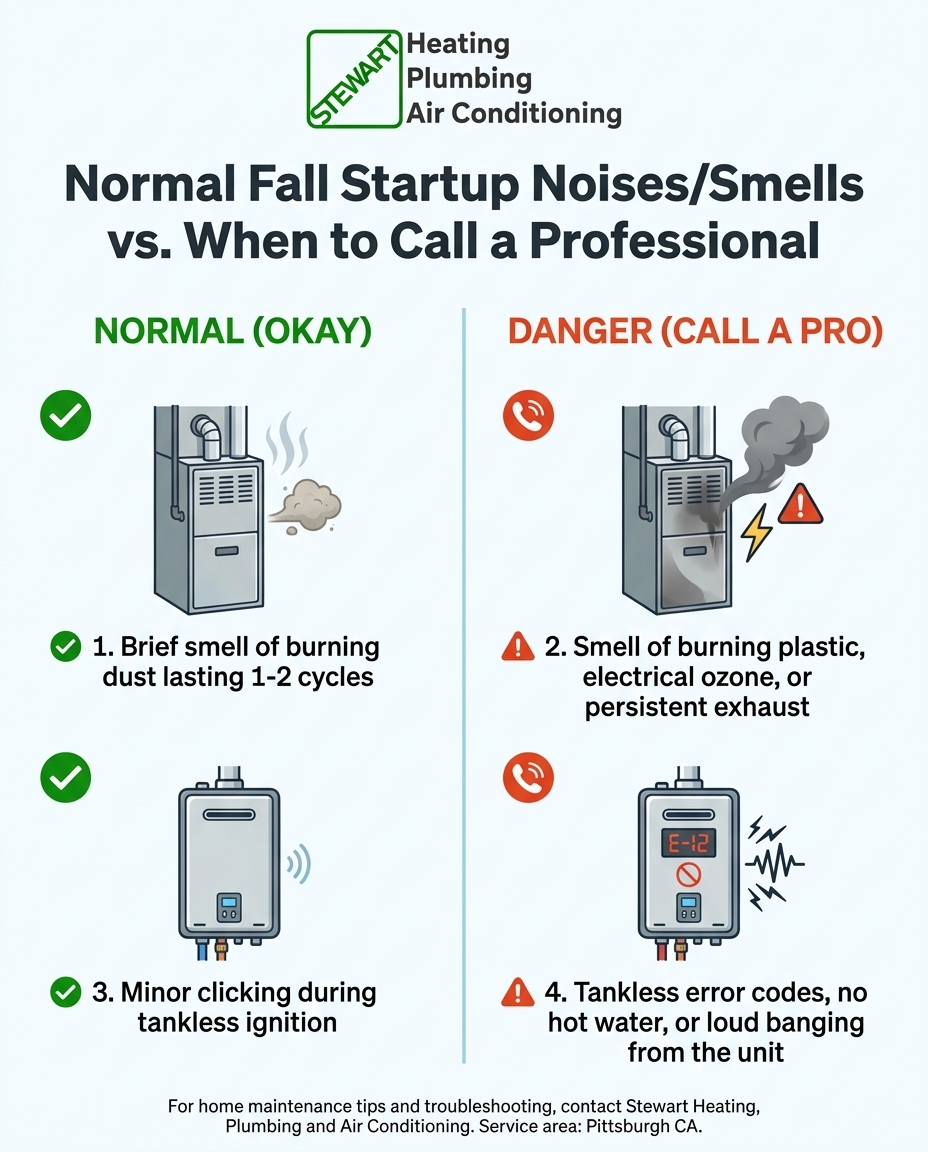
One of the most frequent calls our dispatchers receive in the early fall is about a burning smell, which is usually simply dust burning off the heat exchanger. The heat exchanger is a series of metal tubes or coils that get extremely hot to warm the air circulating through your house. Because it has been dormant, a layer of dust has settled directly on this metal surface. When the burners ignite, that dust is instantly singed, creating a distinct, slightly smoky odor that travels through your ductwork.
The timeline our team typically sees for normal burn-off:
• The smell should be most noticeable during the very first heating cycle of the season.
• It typically dissipates within 30 to 45 minutes of continuous operation.
• By the second or third time the furnace cycles on, the odor should be completely gone.
However, not all smells are harmless. We advise our customers to be vigilant for odors that indicate a failing component or an electrical hazard. If you smell burning plastic, this often points to melting wire insulation inside the cabinet. An odor resembling electrical ozone (similar to the smell of an overheated appliance) usually means a blower motor is seizing up or a capacitor is failing. A persistent smell of sulfur, rotten eggs, or exhaust gases is the most dangerous sign of all, pointing to a potential gas leak or a cracked heat exchanger leaking carbon monoxide.
• Singed dust or mild smoke — Likely Cause: Summer dust accumulation on the heat exchanger — Required Action: Monitor for 30-45 minutes; should resolve on its own.
• Burning plastic or rubber — Likely Cause: Melted electrical wiring or failing capacitor — Required Action: Shut down immediately and call a professional.
• Electrical ozone / metallic — Likely Cause: Overheating blower motor bearing — Required Action: Turn off system at thermostat; requires diagnostic.
• Rotten eggs or sulfur — Likely Cause: Natural gas leak — Required Action: Evacuate the home and call the gas company immediately.
Establishing a clear threshold for when to turn off your equipment is a vital part of seasonal safety. If a burning smell lasts longer than an hour, grows stronger instead of fading, or is accompanied by visible smoke coming from your vents, turn off the system immediately at the thermostat. We strongly caution homeowners to never attempt DIY repairs on gas valves, electrical relays, or combustion chambers. These components require specialized diagnostic tools like combustion analyzers and manometers to service safely.
While you are monitoring your furnace, you might also notice your morning shower isn't quite as hot as it used to be. In Pittsburgh, CA, and throughout Contra Costa County, our plumbers frequently see how local hard water conditions play a massive role in the performance of your plumbing fixtures. Hard water contains high levels of dissolved minerals, specifically calcium and magnesium. While these minerals are safe to drink, they wreak havoc on high-efficiency water heating equipment.
Tankless water heaters operate by passing cold water through a highly conductive copper or stainless steel heat exchanger. The water is superheated on demand, meaning the internal temperatures of that heat exchanger get incredibly high very quickly. When hard water is subjected to rapid, intense heat, the calcium and magnesium precipitate out of the water and cling to the metal walls. Over months of use, a pattern we see often is the formation of a thick, chalky layer of scale buildup.
Scale acts as a powerful thermal insulator. Instead of the heat transferring directly from the burners through the metal and into your water, the heat has to fight through a layer of rock-hard calcium. This forces the unit to run longer and burn more fuel just to achieve the same water temperature.
Why our technicians see this become obvious in the fall:
• Colder incoming water: During the summer, municipal groundwater might enter your home at 65 degrees. In the fall and winter, that incoming temperature drops significantly.
• Increased Delta-T: The "temperature rise" (Delta-T) your unit has to achieve is much larger in October than in July. If you want 120-degree water, the unit has to work much harder to bridge the gap from cold fall groundwater.
• System overload: If the heat exchanger is coated in scale, it simply cannot transfer heat fast enough to overcome the colder incoming water, resulting in lukewarm showers and frustrated mornings.
This is why securing professional plumbing solutions for seasonal descaling is so important. A licensed technician uses a submersible pump to circulate a specialized descaling solution (often food-grade white vinegar or a safe chemical equivalent) through the unit for 45 to 60 minutes, dissolving the minerals and restoring the heat exchanger to peak efficiency.
Beyond scale buildup, tankless units can experience sudden ignition failures right when you need them most. Waking up on a cold morning, turning the handle, and feeling freezing water is incredibly frustrating. Before you panic, it helps to understand the sequence of operations happening inside the unit and what you can safely check yourself before calling our team.
Modern tankless water heaters are equipped with digital displays that flash specific error codes when something goes wrong. If your unit refuses to ignite, it has likely gone into a "lockout" mode for safety reasons. The system requires adequate water flow, proper gas pressure, a clear exhaust vent, and a functional flame sensor to operate safely. If any of these parameters are off, the computer shuts the whole process down to prevent gas buildup or overheating.
Safe troubleshooting steps our dispatchers recommend taking:
1. Check the power supply: Ensure the unit is plugged in and the circuit breaker has not tripped. Tankless units require electricity to power the computer and the igniter, even if they use gas for heating.
2. Verify water and gas valves: Make sure the main gas valve leading to the unit is fully open (parallel to the pipe). Check the cold water isolation valve to ensure water is actually flowing into the system.
3. Inspect the exhaust vent: Walk outside and look at the PVC exhaust pipe on the side of your house or roof. Ensure no autumn leaves, bird nests, or debris are blocking the airflow.
4. Perform a system reset: Sometimes a temporary drop in gas pressure can cause a nuisance lockout. Turn the power off, wait one minute, and turn it back on to clear the code.
If you perform a reset and the unit still refuses to fire, you have reached the limit of safe DIY troubleshooting. Continuing to force the unit to start can be dangerous. You will need a professional to handle the internal components. For more specific guidance on this process, you can read our detailed guide on troubleshooting a tankless water heater that won't ignite.
Why professional intervention is required for persistent failures:
• Dirty flame sensors: The flame sensor sits directly in the burner assembly. Over time, it develops a layer of carbon soot. If it cannot detect the flame, it immediately shuts off the gas valve to prevent an explosion. Cleaning this requires opening the sealed combustion chamber.
• Flow sensor issues: A tiny turbine measures how much water is moving through the unit. If a piece of debris jams the turbine, the unit won't know you turned on the tap.
• Gas pressure calibration: Only a licensed technician with a manometer can safely test and adjust the manifold gas pressure to ensure clean, safe combustion.
Reacting to cold showers and burning smells is stressful. The best way to avoid these October heating startup surprises is through proactive, scheduled care. Since 1974, our family-owned team at Stewart Heating, Plumbing and Air Conditioning has provided trustworthy diagnostics to homeowners in Pittsburgh, CA, and the surrounding East Bay area. We believe in finding the actual root cause of a problem rather than pushing immediate replacement pitches for simple issues like normal dust burn-off or a dirty flame sensor.
A comprehensive fall tune-up addresses both your comfort and your safety. When one of our professional technicians arrives at your home, they perform a rigorous series of checks that go far beyond simply changing a filter. Keeping your system well-maintained may also ensure your high-efficiency equipment remains eligible for any applicable generic energy rebates or utility incentive programs you plan to utilize.
What our professional fall inspection entails:
1. Heat Exchanger Inspection: We use specialized cameras to inspect the furnace heat exchanger for hairline cracks. Even a microscopic crack can allow deadly carbon monoxide to leak into your living space.
2. Burner and Sensor Cleaning: We carefully remove and clean the flame sensor and burner assembly, ensuring your furnace ignites smoothly and stays running safely throughout the winter.
3. Electrical Component Testing: We test the amp draw on your blower motor and check the microfarad reading on your capacitors to catch failing parts before they leave you freezing on a Sunday night.
4. Tankless Flushing and Descaling: We isolate your water heater from the main plumbing lines and circulate a descaling solution through the heat exchanger, removing the mineral buildup caused by local hard water.
5. Water Heater Filter Cleaning: We clean the cold water inlet filter, removing trapped sediment that restricts water flow and causes pressure drops.
Proper diagnostics often reveal that a system simply needs a thorough cleaning and recalibration. By enrolling in a routine maintenance plan, you ensure that these vital steps are completed every single year, extending the lifespan of your equipment and keeping your utility bills in check.
It is the smell of dust that settled on the heat exchanger over the summer burning off. Our team considers this a completely normal part of the seasonal transition, and it should disappear entirely after one or two heating cycles. If the smell persists for more than an hour, you should shut the system down.
Verify the gas and water valves are fully open, check the exterior exhaust vent for blockages, and try a simple system reset by cycling the power. If it still won't ignite, we recommend calling a professional to clean the internal flame sensor or check the gas assembly safely.
No, a burning plastic or electrical smell is never normal and indicates a serious mechanical issue. Shut off the system immediately at the thermostat and call a professional to inspect the cabinet for melted wires, failing capacitors, or an overheating blower motor.
Due to local hard water conditions, our plumbers highly recommend annual flushing to protect the heat exchanger from scale. Homes without a whole-house water softener may even require flushing every six months to prevent severe mineral buildup and efficiency loss.
Mineral scale buildup restricting flow and dropping incoming municipal water temperatures are the two most common issues we see that cause the unit to underperform. Both of these factors force the system to work harder, often resulting in the water not getting hot enough during peak morning usage.
As the East Bay settles into the colder months, your heating and plumbing systems become the most important appliances in your home. Remember that a brief burning dust smell during your October heating startup is perfectly normal, but persistent odors, electrical smells, or sudden hot water failures require immediate attention. By understanding how local hard water affects your tankless unit and what noises to listen for when the furnace kicks on, you can stay one step ahead of major breakdowns.
You deserve a clear baseline of what to expect from your equipment and a reliable path to resolving any red flags that pop up. Our experts at Stewart Heating, Plumbing and Air Conditioning are always available to ensure your home remains safe, efficient, and comfortable all season long. Do not wait for a complete system failure on the coldest night of the year—take proactive steps today. If you need reliable home maintenance tips and troubleshooting support, or if you are ready to request plumbing service, reach out to schedule your comprehensive fall diagnostic.

Very professional and complete. I would recommend Stewart to anyone. Highest quality of workmanship and clean installation.
Stewart Heating Plumbing Air Conditioning just did some work for us for the first time. They did an installation at my home and it turned out well. I thought the price was fair and I definitely would use them again. The technicians were very friendly and knowledgeable about their work. I highly recommend Stewart Heating Plumbing Air Conditioning and already told friends to use them.
We have been using Stewart Heating Plumbing Air Conditioning since 1995. They put the original heating and air unit in the house, and we have just stayed with them. They are dependable and honest people, and they have done a good job for us every time that we have used them!
They came and did an inspection and are coming tomorrow to do the repair.
They replaced a regulator the first time, and then the water heater vent had to be replaced. They did great work.
The gentleman that serviced us was helpful, insightful, and knew what he was talking about. Overall, it was a great experience.