

Recent Blogs
Stay updated with our latest blog posts.

Did your first attempt to warm up the house this fall end with a strange rattling noise or lukewarm air blowing through the vents? When your heating system struggles right out of the gate, making the right options comparisons for homeowners becomes the most important task on your fall to-do list. The October heating-startup period is a critical time for your home. After sitting dormant through the long summer, firing up a central heating system can reveal underlying mechanical wear and tear that accumulated over the previous seasons. Suddenly, you are faced with a significant dilemma: do you pour money into repairing an aging gas unit, or do you take this opportunity to explore modern, high-efficiency upgrades?
Addressing this crossroad requires a holistic approach to your home's winterization. True comfort and efficiency mean ensuring all critical infrastructure is prepared for the temperature drop. Just as you might evaluate water heater repair and replacement before winter to ensure consistent hot showers, you must weigh your central air heating options carefully. A home operates as an interconnected ecosystem. If one system is failing, it often puts a strain on others. This is why comprehensive home care involves coordinating everything from your ductwork and thermostats to professional plumbing services, ensuring every part of your property is ready for the colder months ahead.
The typical pattern we see: Homeowners often assume a quick fix will get them through another year. However, patching a failing system right before peak demand can lead to unexpected mid-winter breakdowns. Taking a step back to objectively compare your options now, before the chill sets in deeply, gives you the leverage to make a calculated, stress-free decision rather than a panicked emergency purchase.
When you research heating systems online, you are often bombarded with national advice that assumes you will be battling blizzards, freezing snow, and sub-zero wind chills. That generic advice heavily favors traditional gas combustion systems and often discourages all-electric options. However, the mild Mediterranean winter lows in the Pittsburgh CA / East Bay area completely rewrite the rules for what makes a heating system efficient and viable.
To understand why our specific climate matters, consider these critical regional factors:
1. Mild winter lows: In our area, average winter night temperatures rarely dip below 40 degrees Fahrenheit. While it certainly feels chilly enough to require reliable indoor heating, we do not experience the deep, sustained freezes common in the Midwest or Northeast.
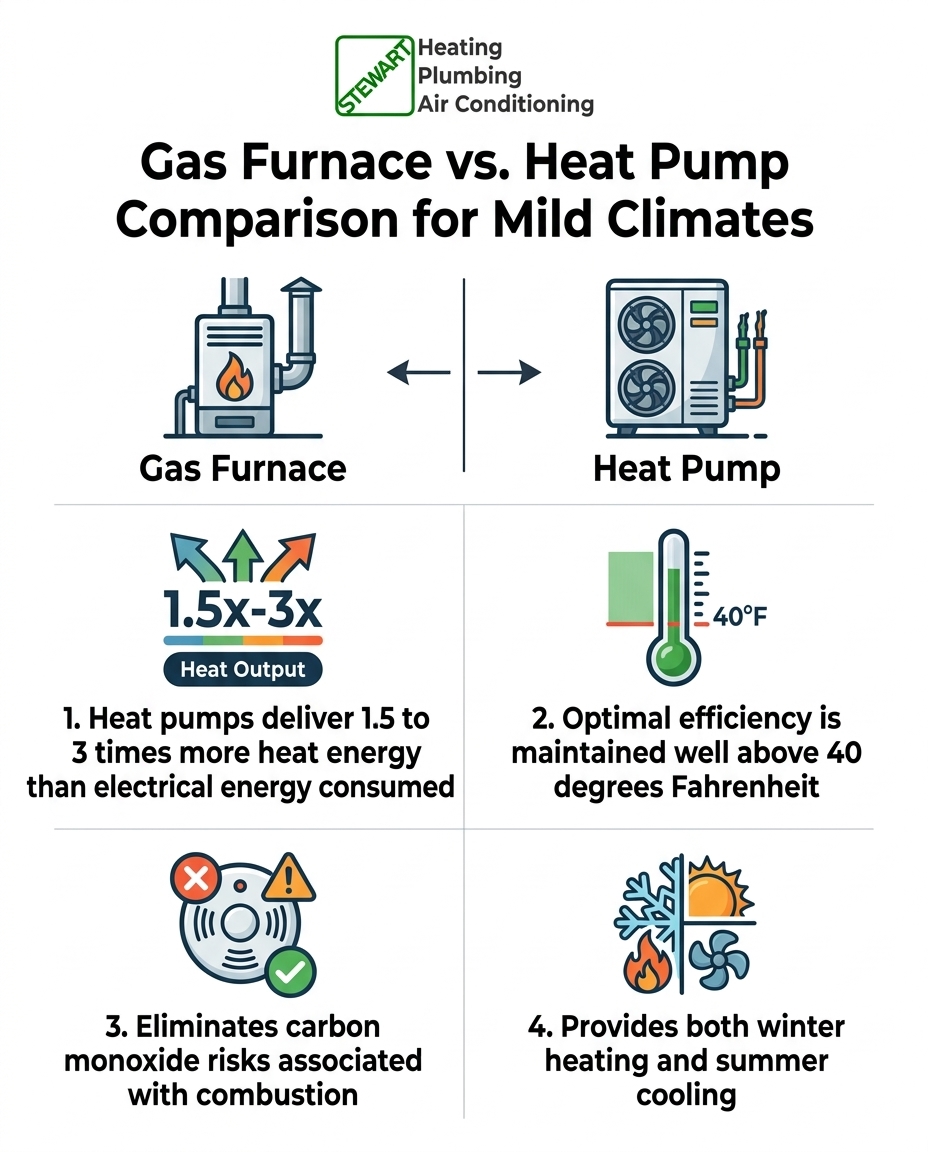
2. Optimal operating zones: The 40-to-50-degree temperature range is the absolute sweet spot for standard air-source heat pumps. In this zone, they operate at peak efficiency, extracting abundant ambient heat from the outside air with minimal electrical effort.
3. Elimination of dual-fuel needs: In colder climates, homeowners often install a dual-fuel system—a heat pump paired with a gas furnace backup for when temperatures drop below freezing. Because the East Bay climate is so temperate, that expensive secondary backup system is entirely unnecessary.
4. Year-round utility: An all-electric heat pump does not just heat your home; it reverses its cycle to provide high-efficiency air conditioning during our hot summer afternoons, giving you a comprehensive, single-system solution for year-round comfort.
The secret to a heat pump's incredible efficiency lies in its operational mechanics. Unlike a gas furnace that burns fossil fuels to generate heat, a heat pump simply transfers heat from one place to another. Even when it is 45 degrees outside, there is a massive amount of thermal energy in the air. The heat pump uses a specialized refrigerant cycle to absorb that ambient outdoor heat, compress it to raise its temperature, and release it inside your home.
Because moving heat requires significantly less energy than creating it through combustion, the efficiency metrics are staggering. According to Department of Energy data, modern heat pumps can deliver 1.5 to 3 times more heat energy to your living space than the electrical energy they consume to operate. In the mild Pittsburgh CA / East Bay area environment, this means a heat pump can run at its highest possible efficiency rating nearly all winter long, providing consistent, gentle warmth without the energy waste associated with traditional gas burners.
The problem: You turn on your thermostat for the October heating-startup, and the furnace struggles to ignite, runs for a few minutes before shutting off, or produces a distinct burning dust smell that refuses to dissipate. The cause: Aging gas furnaces face cumulative mechanical stress. Over years of thermal expansion and contraction, critical components like the heat exchanger, gas valve, and draft inducer motor begin to warp, corrode, or fail entirely. The solution: A thorough pre-winter inspection by a licensed professional to determine if the system is safe to operate or if the risk of failure outweighs the cost of repair.
Identifying these issues early in the fall is the most critical window for homeowners. Once peak winter demand hits, scheduling emergency repairs becomes more difficult, and living without heat while waiting for specialized parts is highly uncomfortable. More importantly, continuing to patch up an old gas furnace presents severe safety risks. The heat exchanger, which separates the toxic combustion gases from the breathable air circulating through your vents, is particularly vulnerable. A crack in this component can allow carbon monoxide to enter your living space—a silent, invisible threat that makes running an old, compromised furnace incredibly dangerous.
Because gas systems involve combustible fuels, high-voltage electricity, and toxic exhaust gases, diagnosing and repairing them should never be treated as a DIY project. The mechanical complexity of a modern gas valve or a variable-speed inducer motor requires specialized diagnostic tools and professional training. Just as diagnosing a tripped pressure switch on your tankless water heater requires a deep understanding of venting and pressure differentials, evaluating a failing furnace requires an expert eye to ensure your family's safety.
When weighing a repair against a replacement, it is vital to look beyond the immediate invoice. The hidden costs of keeping an aging system alive can quickly outpace the value of the unit itself. First, there is the issue of diminished efficiency. A furnace that was rated at 80% AFUE (Annual Fuel Utilization Efficiency) a decade ago may only be operating at 65% efficiency today due to wear, soot buildup, and failing sensors. That means a significant portion of the energy you pay for is literally going up the exhaust flue.
Second, cumulative repair costs follow a predictable, escalating pattern. Today it might be a flame sensor; next month, the blower motor capacitor; next season, the entire circuit board. Investing heavily in a system that is past its expected lifespan is a losing battle. Transitioning to a new, warranty-backed system—whether a modern high-efficiency furnace or an advanced heat pump—provides unparalleled peace of mind, knowing that your winter comfort is secured against sudden, cascading mechanical failures.
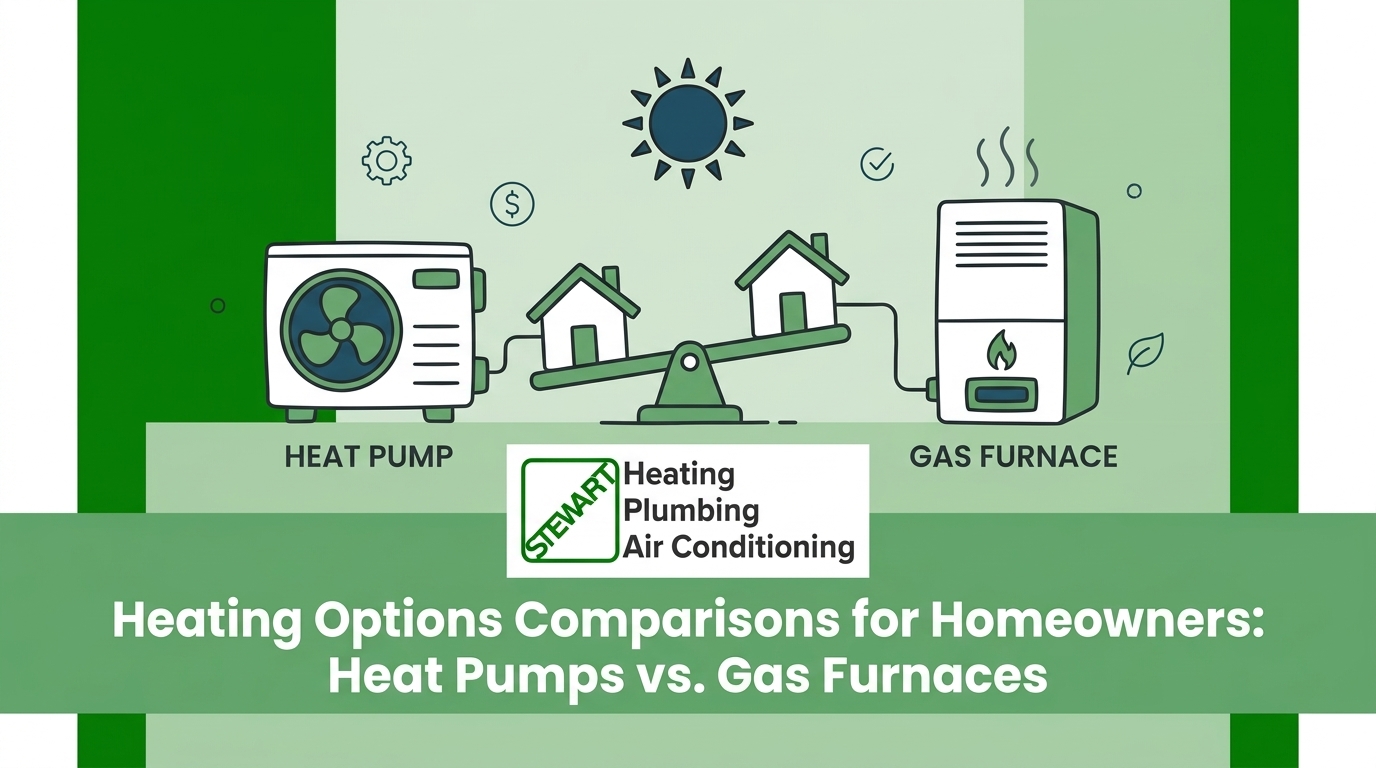
To make the best decision for your home, you need a clear, objective comparison of how these two distinct technologies perform in the real world. While both systems ultimately achieve the goal of warming your home, their methods, efficiency metrics, and long-term maintenance profiles differ significantly. In the Pittsburgh CA / East Bay area, these differences become even more pronounced due to our specific weather patterns.
• Energy Efficiency Metric — Modern Gas Furnace: Measured by AFUE (Annual Fuel Utilization Efficiency). High-efficiency models can reach up to 98%, meaning minimal fuel waste. — Air-Source Heat Pump: Measured by HSPF (Heating Seasonal Performance Factor). Can achieve over 300% efficiency by transferring ambient heat rather than generating it.
• Safety Profile — Modern Gas Furnace: Involves combustion. Requires strict maintenance to prevent carbon monoxide leaks, gas leaks, and fire hazards. — Air-Source Heat Pump: All-electric operation. Completely eliminates the risk of carbon monoxide exposure, gas leaks, and combustion-related fires.
• Expected Lifespan — Modern Gas Furnace: Typically lasts 15 to 20 years with proper, consistent professional maintenance. — Air-Source Heat Pump: Typically lasts 12 to 15 years, as the system works year-round to provide both heating and cooling.
• Installation & Utility — Modern Gas Furnace: Provides heating only. Requires dedicated gas lines, proper exhaust venting, and a separate AC unit for summer cooling. — Air-Source Heat Pump: Provides both heating and cooling. Requires adequate electrical panel capacity but simplifies the home by combining two systems into one.
• Climate Suitability — Modern Gas Furnace: Excellent for extreme, sub-zero climates where rapid, high-heat generation is necessary to combat freezing temperatures. — Air-Source Heat Pump: Exceptionally efficient in mild climates like the East Bay, where winter lows remain well within optimal operating ranges.
As the table illustrates, the choice often comes down to your home's existing infrastructure and your long-term efficiency goals. If your home already has robust gas lines and a relatively new air conditioning unit, a high-efficiency furnace might be a straightforward swap. However, if your AC is also aging and you want to eliminate fossil fuels from your property, upgrading to a heat pump offers a highly compelling, two-in-one solution.
Whether your options comparisons for homeowners lead you to select a state-of-the-art gas furnace or a high-efficiency heat pump, the hardware alone does not guarantee decades of flawless performance. The true secret to maximizing your investment is uncompromising, ongoing maintenance. Since 1974, our team has served this community, giving us decades of historical data on which systems last the longest locally. The one undeniable constant across all that data is that systems receiving regular professional care outlast neglected systems by years, operating with fewer breakdowns and lower energy consumption.
A comprehensive fall tune-up during the October heating-startup is non-negotiable. For a gas furnace, this involves cleaning the burners, calibrating the gas valve, inspecting the heat exchanger for micro-fractures, testing all safety limit switches, and ensuring the flue is drafting correctly. For a heat pump, the process includes verifying the refrigerant charge, cleaning the outdoor condenser coils, testing the defrost cycle controls, and ensuring the electrical contactors are not pitted or failing. Skipping these steps forces your system to work harder, accelerating wear and driving up your monthly utility bills.
To take the guesswork out of this process, we highly recommend enrolling in a preventative maintenance plan. These plans ensure your equipment is serviced on schedule every single year, catching minor issues—like a worn belt or a weakening capacitor—long before they cause a catastrophic system failure on a cold January night. Furthermore, maintaining optimal home comfort often requires coordinating multiple services. It is incredibly convenient to rely on a trusted, comprehensive team where you can schedule your HVAC tune-up and request plumbing service simultaneously, ensuring your entire home infrastructure is protected.
One of the most exciting aspects of upgrading your heating system today is the availability of various incentive programs designed to encourage energy efficiency. When you choose to install a high-efficiency heat pump, you may qualify for general federal tax credits or state-level energy rebates aimed at reducing residential carbon footprints.
Because these programs frequently update their requirements and funding pools, we advise all homeowners to consult directly with their local utility provider or a qualified tax professional to verify the current programs available for their specific installation. While no specific dollar amounts can be guaranteed upfront, the combination of potential tax incentives and the proven, long-term energy savings in our mild climate makes the transition to advanced heating technology a financially sound strategy for the future.
Is a heat pump better than a furnace in California?
In many parts of California, particularly the mild Pittsburgh CA / East Bay area, a heat pump is often considered the superior choice. Because our winter temperatures rarely drop below freezing, heat pumps can operate at their maximum efficiency year-round, transferring ambient heat rather than burning fossil fuels. This results in excellent energy savings, a safer all-electric home environment, and the added benefit of summer cooling from the exact same unit.
When should you not repair a gas furnace?
You should decline a repair and opt for replacement if your furnace is over 15 years old and requires a major, expensive component replacement, such as a cracked heat exchanger or a failed blower motor. Additionally, if the system poses any safety risks—like carbon monoxide leaks or frequent pilot light failures—it is no longer worth the investment. A good rule of thumb is that if the repair cost exceeds half the value of a new system, replacement is the wiser financial decision.
At what temperature does a heat pump become inefficient?
Standard air-source heat pumps begin to lose their peak efficiency when outdoor temperatures drop below 25 to 30 degrees Fahrenheit, as there is less ambient thermal energy available to extract. However, because the East Bay area rarely experiences these deep freezing temperatures, this limitation is virtually a non-issue for our region. Modern cold-climate heat pumps can even operate efficiently down to sub-zero temperatures, though such advanced models are generally not necessary for our local weather patterns.
Should I replace my 15-year-old furnace with a heat pump?
Yes, replacing a 15-year-old furnace with a heat pump is an excellent upgrade for most homeowners. At 15 years old, a gas furnace has likely lost a significant portion of its original efficiency and is entering the window where major mechanical failures become common. Switching to a heat pump upgrades your home to safer, more efficient technology and simultaneously replaces your aging air conditioning system, providing a complete HVAC overhaul in one installation.
Does switching to an all-electric heat pump require upgrading my home's electrical panel?
It depends on your home's current electrical capacity and the size of the heat pump being installed. Because heat pumps run entirely on electricity and handle both heating and cooling loads, homes with older 100-amp service panels may require an upgrade to a 200-amp panel to safely support the new equipment. A professional HVAC technician will perform a thorough load calculation during your consultation to determine if your existing electrical infrastructure can handle the transition or if an upgrade is necessary.
Navigating the October heating-startup does not have to be a source of anxiety. By understanding how the mild local climate makes heat pumps an exceptional, high-efficiency upgrade, you can make an informed choice that benefits your home for decades. While repairing a newer gas furnace can still make perfect sense if the components are largely intact, continuing to pour resources into a failing, decade-old system is a risk you do not need to take. The key is to make this decision early in the fall season, long before an emergency breakdown forces your hand.
Every house is unique, and the best heating solution depends heavily on your specific floor plan, existing ductwork, and personal comfort preferences. We encourage you to have your home thoroughly evaluated by an experienced local professional who understands the exact demands of the East Bay environment. If you are ready to explore the best options comparisons for homeowners, do not wait for the winter chill to settle in. Reach out to schedule a comprehensive inspection today, and let our trusted experts help you secure reliable, efficient warmth for the season ahead.

Very professional and complete. I would recommend Stewart to anyone. Highest quality of workmanship and clean installation.
Stewart Heating Plumbing Air Conditioning just did some work for us for the first time. They did an installation at my home and it turned out well. I thought the price was fair and I definitely would use them again. The technicians were very friendly and knowledgeable about their work. I highly recommend Stewart Heating Plumbing Air Conditioning and already told friends to use them.
We have been using Stewart Heating Plumbing Air Conditioning since 1995. They put the original heating and air unit in the house, and we have just stayed with them. They are dependable and honest people, and they have done a good job for us every time that we have used them!
They came and did an inspection and are coming tomorrow to do the repair.
They replaced a regulator the first time, and then the water heater vent had to be replaced. They did great work.
The gentleman that serviced us was helpful, insightful, and knew what he was talking about. Overall, it was a great experience.