

Recent Blogs
Stay updated with our latest blog posts.

Late August in the East Bay brings relentless afternoon heat, making right now the worst possible time to discover the true cost of ignoring minor AC refrigerant leaks until fall. When your cooling system starts blowing lukewarm air just as the back-to-school season begins, the temptation to request a quick "freon recharge" is incredibly strong. You simply want to limp through the final hot weeks of summer without dealing with a major repair. However, in our decades of serving Pittsburgh and the surrounding areas, we've seen firsthand that treating a closed-loop mechanical failure with a temporary band-aid is a dangerous gamble that frequently leads to catastrophic equipment damage.
Homeowners facing this late-summer dilemma stand at a critical decision point: spend a little now on a temporary fix, or address the underlying leak properly. Choosing the quick top-off masks severe mechanical strain. Adding more chemical coolant without sealing the breach means the system will continue to operate under immense stress during Late August East Bay heatwaves. If you are noticing a drop in cooling performance, our technicians highly recommend that you explore professional air conditioning services to diagnose the root cause. Choosing to request AC repair service before a total breakdown occurs is the only reliable way to protect your equipment from permanent damage.
The underlying reality: Air conditioning systems do not consume refrigerant like a car consumes gas. If the levels are low, there is a physical hole in the copper lines, the evaporator coil, or the condenser. Ignoring that hole and simply refilling the system is akin to putting air in a punctured tire every morning—eventually, a blowout is inevitable. By understanding the mechanical realities of how your system operates, you can make an informed decision that protects your home's comfort and your long-term investment.
Most homeowners understandably view refrigerant purely as the substance that makes the air cold. While it is true that this chemical compound absorbs heat from inside your home and releases it outside, it serves a secondary, equally vital function that is rarely discussed. In standard residential split-system AC compressors, the refrigerant acts as the essential carrier for the specialized oil that lubricates the compressor's internal moving parts.
The compressor is the heart of your cooling system, a powerful motor that pumps high-pressure gas through the lines. Like any high-speed motor, it requires constant lubrication to prevent metal-on-metal friction. However, standard residential split-system AC compressors do not have a separate oil pump. Instead, the compressor oil is miscible—meaning it mixes completely—with the liquid and gaseous refrigerant. As the refrigerant travels through the indoor and outdoor coils, it carries this lubricating oil along with it, ensuring every internal component remains coated and protected.
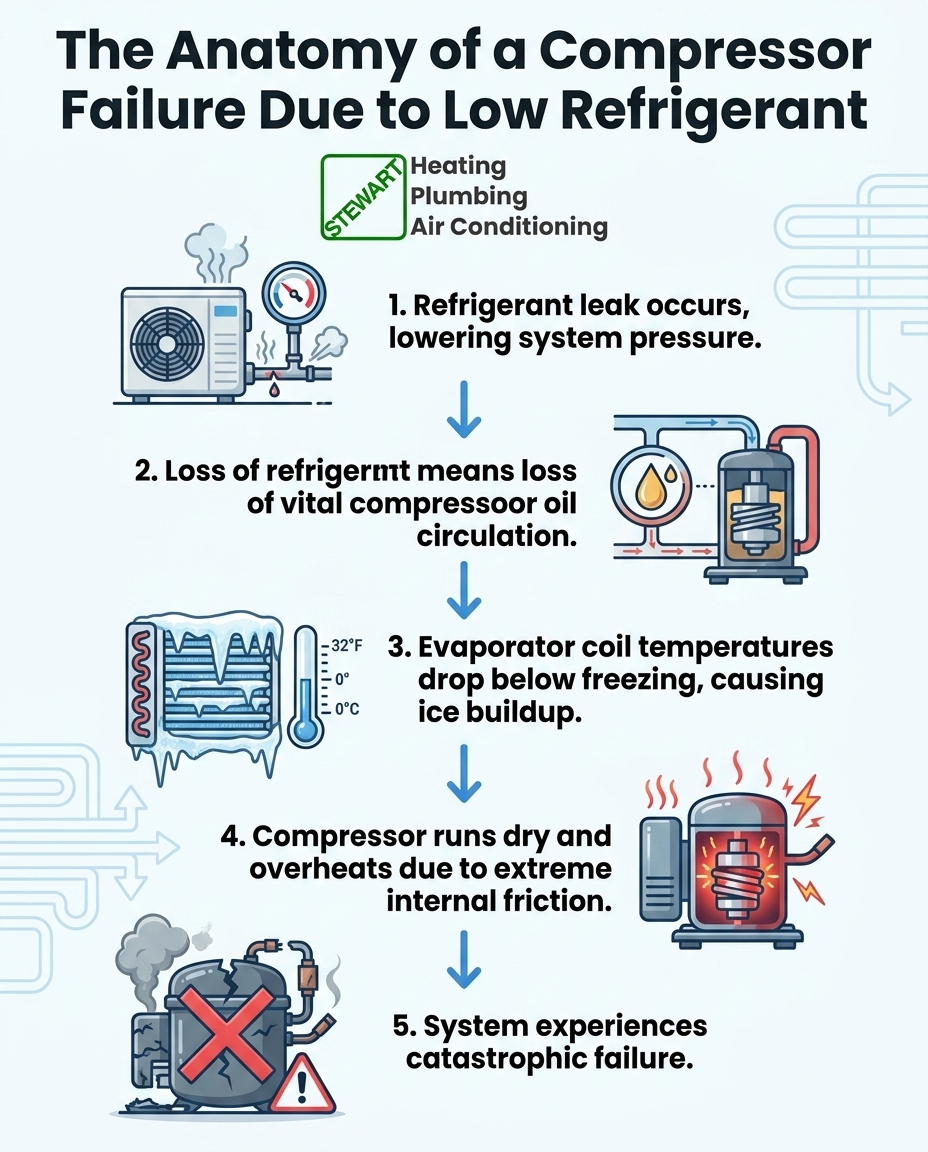
When a leak develops, the system does not just lose its ability to cool the air; it loses its ability to circulate this vital oil. As the chemical charge drops, the remaining oil pools in the evaporator coil or the suction line, failing to return to the outdoor unit. The compressor is then forced to run dry. Operating a high-speed motor without lubrication creates extreme internal friction and rapid heat buildup. This is why repairing an aging AC compressor often becomes necessary after a season of running on a low charge—a pattern our service team sees far too often.
What happens inside the unit:
• Increased Friction: Without oil, internal pistons or scrolls grind against each other, causing microscopic metal shavings to break off and contaminate the lines.
• Thermal Overload: The friction generates intense heat, causing the compressor to trip its internal thermal overload switches repeatedly.
• Electrical Burnout: Eventually, the extreme heat melts the protective insulation on the motor windings, resulting in a permanent electrical short known as a "burnout."
The timing of a refrigerant leak plays a massive role in how quickly the system will fail. Contra Costa County and Pittsburgh CA are known for intense afternoon heat spikes in late summer. When the outdoor temperature climbs into the triple digits, your cooling system is already working at its maximum capacity. Introducing a leak into this environment creates a perfect storm for mechanical failure.
Air conditioners operate in "duty cycles"—the amount of time they run compared to the amount of time they rest. On a mild day, a system might run for 15 minutes and rest for 20. But during Late August East Bay heatwaves, a properly functioning system might run for 40 minutes out of every hour just to maintain a comfortable indoor temperature.
During a recent Labor Day weekend, our emergency dispatch received a call at 7 p.m. on a Friday from a local customer whose system was suddenly blowing warm air. One of our lead technicians troubleshot the system for two hours, ultimately tracing the problem to a loose wire and restoring the cooling before the holiday was ruined. However, when our team encounters a system pushing out warm air during these intense heatwaves, the culprit is frequently much more severe than a loose connection—it is often a system starved of refrigerant, struggling to survive an impossible duty cycle.
When a system is undercharged by even 20 percent, its cooling capacity plummets. To compensate for the lack of heat absorption, the thermostat forces the system to run continuously. The compressor is now running non-stop, during the hottest part of the day, without its necessary lubricating oil. This chain reaction turns a minor, fixable leak into a rapid compressor killer precisely when you need the cooling the most.
• Cooling Capacity — Normal System (Proper Charge): 100% efficient heat transfer — Compromised System (Minor Leak): Significantly reduced heat absorption
• Duty Cycle (95°F Day) — Normal System (Proper Charge): Runs 30-40 minutes per hour — Compromised System (Minor Leak): Runs continuously without resting
• Compressor Lubrication — Normal System (Proper Charge): Oil circulates smoothly with refrigerant — Compromised System (Minor Leak): Oil pools in lines; compressor runs dry
• Energy Consumption — Normal System (Proper Charge): Standard utility usage — Compromised System (Minor Leak): Exponentially higher utility bills
The damage caused by a leak is not limited to the outdoor compressor. The loss of chemical charge fundamentally alters the pressure dynamics throughout the entire closed-loop system, wreaking havoc on your indoor components as well. Standard residential split-system AC compressors rely on a very specific balance of high pressure and low pressure to facilitate the phase change of the refrigerant from a liquid to a gas.
1. The Pressure Drops: As refrigerant escapes through the leak, the overall pressure inside the indoor evaporator coil drops significantly.
2. Temperatures Fall Below Freezing: In the world of thermodynamics, a drop in pressure equals a drop in temperature. The coil, which normally hovers around 40°F, suddenly drops below 32°F.
3. Condensation Freezes: The indoor coil constantly pulls humidity out of your home's air. When the coil drops below freezing, this normal condensation instantly turns to ice.
4. Airflow is Blocked: Within hours, a thick block of solid ice encases the evaporator coil. This ice acts as a physical barrier, preventing warm household air from passing through the fins.
5. The Blower Motor Strains: Your indoor blower motor continues to push air against this solid wall of ice. The motor overheats and draws excessive electricity as it struggles against the static pressure.
6. Liquid Slugging Occurs: Because the ice prevents the refrigerant from absorbing heat, the chemical never boils into a gas. It travels back to the outdoor compressor as a liquid. Compressors are designed to pump gas, not liquid. When liquid hits the compressor valves (a phenomenon known as "slugging"), it can shatter the internal components instantly.
In our experience, adding more refrigerant without sealing the leak simply restarts this destructive cycle. The system will function for a few days or weeks, only to freeze up again as the pressure drops, multiplying the wear and tear on both the indoor and outdoor units.
When you are sweating through Late August East Bay heatwaves, a technician offering a cheap "recharge special" can sound appealing. However, framing a top-off as a solution is fundamentally misleading. It is a gamble that actively puts your expensive equipment at risk. Since 1974, our team at Stewart Heating, Plumbing and Air Conditioning has operated on the principle that homeowners deserve honest, long-term solutions and transparent evaluations, rather than being sold cheap, temporary band-aids that lead to premature equipment death.
Proper leak detection is a meticulous process that requires specialized equipment and training. A professional evaluation involves utilizing electronic sniffers, ultraviolet dyes, or high-pressure nitrogen tests to pinpoint the exact location of the micro-fracture. Once the leak is identified, our technicians can present legitimate repair options, which may involve brazing the copper lines, replacing a faulty Schrader valve, or swapping out a corroded evaporator coil.
We recently had a customer schedule a fall inspection for the heating and air conditioning units at a potential investment property. Our technician provided a thorough, honest assessment, identifying specific areas of concern and delivering detailed information about the equipment's condition and longevity. That is the exact level of transparency we believe is required when dealing with a suspected leak. You need to know exactly where the system is failing and what it will take to secure it permanently.
Emphasizing long-term system health over short-term comfort patches is the most cost-effective strategy a homeowner can adopt. Enrolling in a comprehensive HVAC maintenance plan ensures that these micro-leaks are caught by our team during routine spring inspections, long before the peak heat hits and the compressor is put in jeopardy.
• The Quick Top-Off — The Process: Adding refrigerant without locating the leak. — The Long-Term Outcome: High risk of repeat failure, oil loss, and compressor burnout.
• Professional Leak Detection — The Process: Using nitrogen, UV dye, or electronic sensors to find the breach. — The Long-Term Outcome: Permanent repair, restored efficiency, and protected equipment lifespan.
The system loses its cooling capacity and struggles to absorb heat from your home, causing it to run continuously. More importantly, the compressor loses its vital lubricating oil, leading to severe overheating. Prolonged operation in this state almost always results in permanent mechanical failure.
Refrigerant acts as the carrier for the specialized oil that keeps the compressor lubricated. When the system leaks, it loses this chemical carrier, meaning the oil pools in the lines instead of returning to the outdoor unit. Without sufficient lubrication, the compressor runs dry, causing internal friction that burns out the motor.
Topping off a system without fixing the underlying leak is highly discouraged by our team and industry professionals alike. It is a temporary fix that allows the system to continue losing oil and operating under extreme strain. This approach masks the real problem and often results in permanent damage to the compressor.
Common signs include warm air blowing from your indoor vents, visible ice buildup on the indoor evaporator coils, and faint hissing or bubbling sounds near the outdoor condenser unit. Unusually high energy bills can also indicate the system is overworking due to a low pressure charge.
Yes, poor airflow from a severely clogged air filter, blocked return vents, or a failing blower motor can also cause evaporator coils to freeze over. Because the symptoms overlap, a professional evaluation by our technicians is necessary to determine if the root cause is an airflow restriction or a pressure drop from a chemical leak.
Understanding the mechanical dangers of oil loss and pressure drops empowers you to make better repair decisions when your system struggles during Late August East Bay heatwaves. Sacrificing a high-performance compressor for a few weeks of temporary comfort is never worth the risk. By rejecting the quick top-off and insisting on proper leak detection, you protect your home's comfort infrastructure. If your system is blowing warm air or showing signs of ice buildup, reach out to our team to explore professional diagnostic options today to ensure your equipment safely makes it through the remaining heat without suffering catastrophic failure.

Very professional and complete. I would recommend Stewart to anyone. Highest quality of workmanship and clean installation.
Stewart Heating Plumbing Air Conditioning just did some work for us for the first time. They did an installation at my home and it turned out well. I thought the price was fair and I definitely would use them again. The technicians were very friendly and knowledgeable about their work. I highly recommend Stewart Heating Plumbing Air Conditioning and already told friends to use them.
We have been using Stewart Heating Plumbing Air Conditioning since 1995. They put the original heating and air unit in the house, and we have just stayed with them. They are dependable and honest people, and they have done a good job for us every time that we have used them!
They came and did an inspection and are coming tomorrow to do the repair.
They replaced a regulator the first time, and then the water heater vent had to be replaced. They did great work.
The gentleman that serviced us was helpful, insightful, and knew what he was talking about. Overall, it was a great experience.