

Recent Blogs
Stay updated with our latest blog posts.

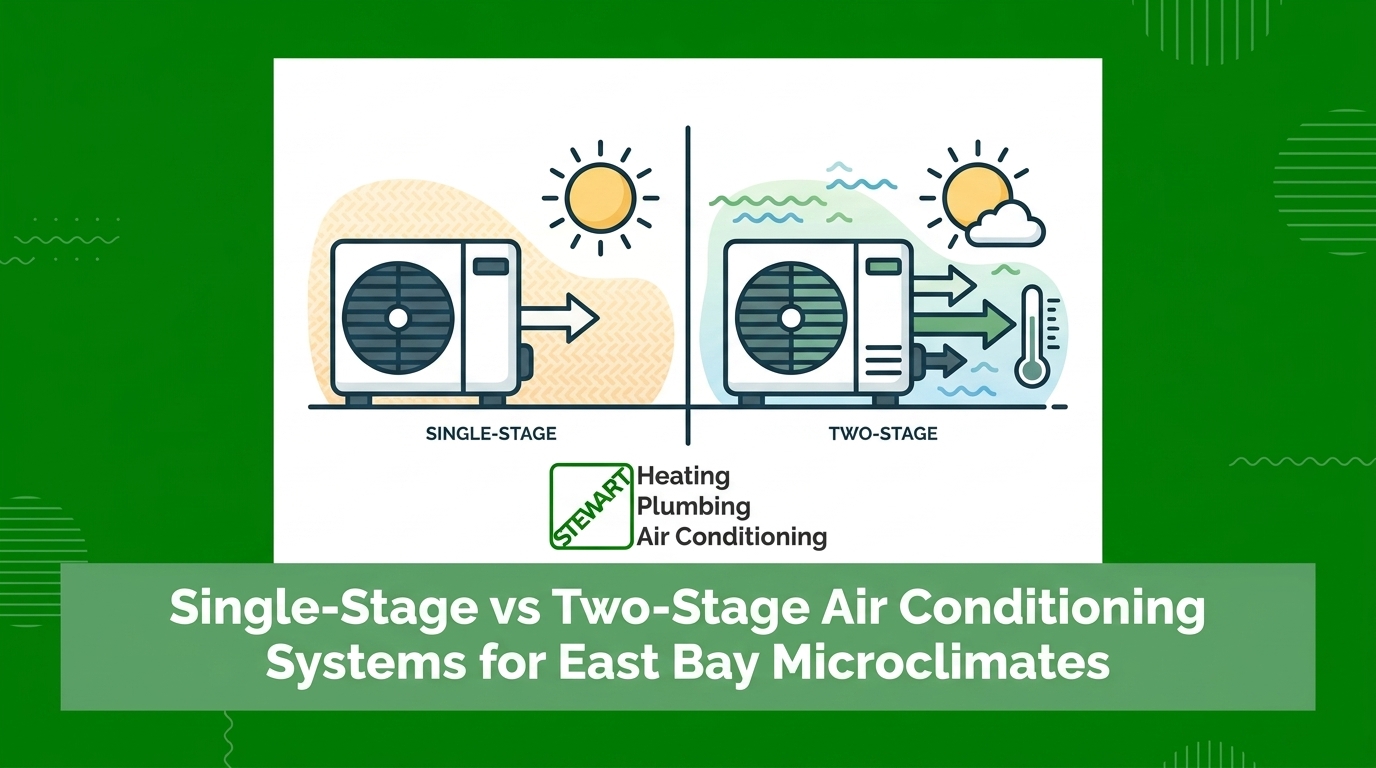
When evaluating Single-Stage vs Two-Stage Air Conditioning Systems for East Bay Microclimates, many homeowners ask us why their AC seems to blast freezing air only to shut off rapidly as the sun goes down. In our decades of experience at Stewart Heating, Plumbing and Air Conditioning serving Pittsburgh CA, our team typically sees standard units struggle against the unique environmental challenges of our regional weather. Homes here regularly endure scorching afternoon temperatures that spike well into the nineties, only to experience rapid evening cool-downs the moment the Delta breeze rolls in. Traditional air conditioning systems are forced to work overtime to manage these massive daily temperature swings. This constant starting and stopping leaves many homeowners struggling with inconsistent indoor cooling and lingering humidity, particularly during grueling August late-summer heatwaves. When an aging AC unit starts struggling to keep up with these shifts, you face an important decision: replacing it with another standard unit or upgrading to a system designed to handle variable weather. If you are ready for a professional evaluation, schedule an HVAC installation estimate before the back-to-school season ends.
To understand why traditional cooling systems struggle in our specific climate, you have to look at how they operate mechanically. A standard single-stage air conditioner has exactly one speed: 100% capacity. When your thermostat detects that the house is too warm, it signals the compressor to turn on full blast. The system pumps maximum cooling power into your home until the target temperature is reached, and then it shuts off completely. There is no middle ground, no low gear, and no way to adjust its output based on the actual cooling demand.
This all-or-nothing approach becomes a significant liability during August late-summer heatwaves, specifically when the evening weather shifts. At 3:00 PM, when the sun is beating down on your roof, that 100% capacity is exactly what you need. But by 7:00 PM, when the Delta breeze drops the outdoor temperature by twenty degrees, your home's cooling load suddenly plummets. Your single-stage AC still turns on at 100% capacity, rapidly blasts the house with cold air, satisfies the thermostat in just a few minutes, and abruptly shuts down. A few minutes later, as residual heat radiates from your walls, the system kicks right back on. This rapid on-and-off process is known as short-cycling.
Short-cycling is incredibly hard on mechanical equipment. The most stressful moment for any electrical motor is the startup phase, which draws a massive surge of power. When a system short-cycles all evening, it accelerates the wear and tear on aging components, pushing older units toward end-of-season failure. A pattern we see often on late-summer service calls is burnt-out contactors and failed capacitors directly caused by relentless short-cycling. Understanding this mechanical limitation is a critical part of proper HVAC sizing and selection, as putting a massive single-stage unit in a home with variable cooling needs often creates more problems than it solves.
• Increased energy consumption: Because the system draws peak amperage every time the compressor starts, turning on and off ten times an hour uses significantly more electricity than running continuously at a lower speed.
• Uneven temperature distribution: Short, powerful bursts of air do not give your ductwork enough time to push conditioned air to the furthest rooms in your house, leaving some bedrooms freezing and others stuffy.
• Premature component failure: The constant electrical surges and mechanical jolts degrade contactors, capacitors, and compressor motors long before their expected lifespan.
Two-stage air conditioning systems solve the short-cycling problem by offering two distinct levels of cooling output. Instead of being limited to a simple on/off switch, a two-stage compressor can operate at a lower capacity—typically around 65% to 70% of its maximum power—or ramp up to its full 100% capacity when the weather demands it. This variable operation makes it uniquely suited for the dramatic temperature swings of the East Bay.
Here is how a two-stage system adapts to a typical late-summer day in our region:
1. Morning maintenance: As the sun comes up and the house slowly begins to warm, the two-stage AC turns on in its lower, energy-saving first stage. It runs quietly and efficiently, using only about 65% of its power to maintain your preferred temperature without overcooling the space.
2. Afternoon peak demand: By mid-afternoon, when the outdoor temperature peaks and the heat load on your home is highest, the system recognizes that the first stage can no longer keep up. It seamlessly shifts into its second stage, delivering 100% cooling capacity to fight back against the harsh afternoon sun.
3. Evening adaptation: As the sun sets and the Delta breeze arrives, the outdoor temperature drops rapidly. Instead of short-cycling like a standard unit, the two-stage system drops back down to its lower capacity. It runs gently and continuously, providing just enough cooling to keep the house comfortable without blasting you with freezing air.
Because the system spends the majority of its time operating in that lower first stage, it experiences far fewer hard start-ups. This drastically reduces the mechanical stress on the compressor and electrical components, extending the lifespan of the equipment. Furthermore, the lower operating speed results in significantly quieter operation, meaning you will not have to turn up the television every time the AC kicks on in the evening.
When evaluating which system is right for your home, it helps to see exactly how they compare across the metrics that matter most. Both systems can physically cool your house, but the way they achieve that goal—and the comfort they provide along the way—differs greatly. Proper AC installation in Pittsburg is critical to ensure either system performs to its exact manufacturer specifications, but the underlying technology dictates the ceiling of your home comfort.
• Cooling Capacity — Single-Stage AC Systems: Operates strictly at 100% capacity or 0% (off). — Two-Stage AC Systems: Operates at ~65% for mild heat, 100% for peak heat.
• Energy Efficiency — Single-Stage AC Systems: Lower overall efficiency due to frequent, high-power start-ups. — Two-Stage AC Systems: Higher efficiency (better SEER utilization) by running on low power most of the time.
• Temperature Consistency — Single-Stage AC Systems: Prone to noticeable temperature swings; blasts cold air then shuts off. — Two-Stage AC Systems: Maintains steady, even temperatures with continuous, gentle airflow.
• Noise Levels — Single-Stage AC Systems: Noticeably louder, especially during the initial compressor kick-on. — Two-Stage AC Systems: Significantly quieter operation during the first stage (which is used most often).
• Upfront Investment — Single-Stage AC Systems: Requires a lower initial investment for equipment and installation. — Two-Stage AC Systems: Requires a higher initial investment, offset by long-term operational efficiency.
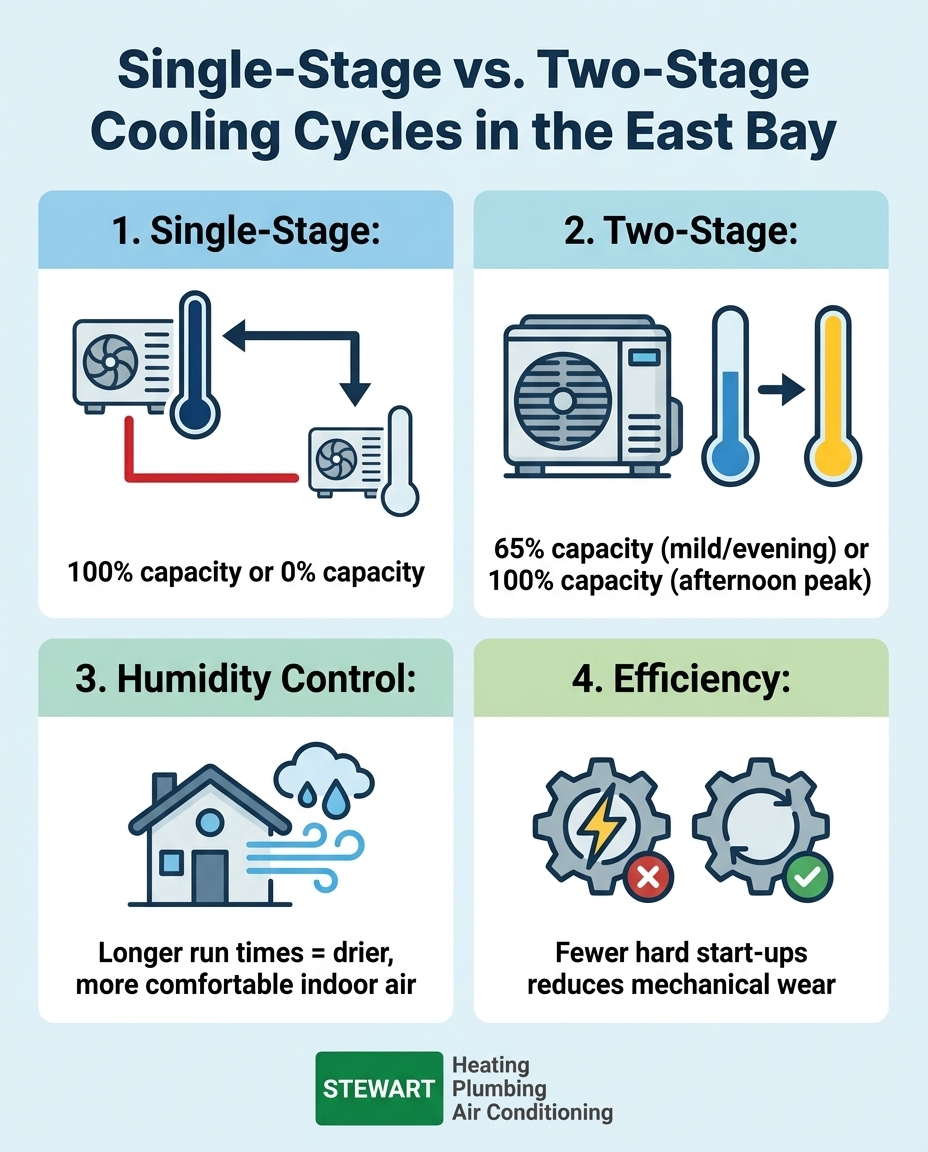
One of the most misunderstood aspects of air conditioning is how these systems actually remove moisture from the air. Your AC does not just lower the temperature; it acts as a whole-home dehumidifier. However, the science of dehumidification requires time. Warm, humid indoor air must pass over the freezing cold evaporator coil inside your HVAC system. As the air touches the cold metal, the moisture condenses into water droplets, drips into a drain pan, and is safely routed outside your home.
This condensation process takes time to establish. If your AC only runs for five or ten minutes before shutting off, the evaporator coil barely has enough time to get cold and start extracting moisture. The short, full-blast cycles of a single-stage unit fail to run long enough to effectively dehumidify the air. This is why a house can feel cold but still feel clammy or sticky on a warm August evening.
A two-stage system solves this problem effortlessly. By running on its lower 65% capacity for extended periods, it continuously circulates indoor air over the cold evaporator coil for thirty to forty-five minutes at a time. This extended run time extracts massive amounts of humidity from your home. The result is a profound increase in overall comfort: because the indoor air is significantly drier, you will actually feel cooler at a higher thermostat setting. You might find that 74 degrees with low humidity feels far more comfortable than 70 degrees with high humidity, saving you even more on your monthly energy usage.
Deciding between a single-stage and two-stage system ultimately comes down to balancing your upfront budget with your long-term comfort goals. It is true that two-stage systems require a higher initial investment. The technology is more advanced, the compressors are more complex, and the variable-speed blower motors required to support them cost more to manufacture. However, the significant gains in comfort, humidity control, and energy efficiency often make the upgrade worthwhile for homeowners planning to stay in their properties for years to come.
One local homeowner reached out over the summer when their aging system finally required a full AC replacement. They were tired of the constant temperature swings and the loud start-ups that woke them up at night. Our technicians completed the installation of a new variable-capacity system, and the customer was highly satisfied with how smoothly the new unit managed the shifting temperatures without the disruptive noise of their old single-stage unit.
As a company that has been serving the region since 1974, Stewart Heating and Air brings decades of localized knowledge to every installation. We know that the East Bay and Pittsburgh CA inland microclimates demand more from an HVAC system than milder coastal areas. We can provide honest, localized advice on whether the two-stage investment actually pays off for your specific floor plan and sun exposure. Additionally, high-efficiency variable-capacity systems frequently qualify for generic federal tax credits or utility rebates, which can help offset the initial installation costs. We always advise our customers to verify current programs with their utility providers or tax professionals to maximize their savings.
It is also worth noting that if your home has specific, isolated hot spots—such as a converted garage or a sunroom that never seems to cool down—upgrading your central AC is not the only option. You might also consider adding cooling without ductwork through a ductless mini-split system to supplement your main unit. An honest, localized assessment is the best way to determine the most effective path forward for your unique property.
This rapid cycling, known as short-cycling, happens because a single-stage AC only runs at 100% capacity. When the Delta breeze cools the outdoor air in the evening, your home requires very little cooling. The AC blasts maximum cold air, hits the target temperature in minutes, shuts off, and then turns right back on when the house warms up slightly. This constant starting and stopping puts immense strain on the system.
A two-stage AC handles humidity better by running for longer, continuous periods at a lower capacity. Dehumidification requires air to pass over the indoor evaporator coil long enough for moisture to condense into water. Because a two-stage system runs gently for 30 to 45 minutes rather than blasting air for 10 minutes, it extracts significantly more moisture, leaving your home feeling crisp and dry.
While a two-stage AC runs longer than a traditional unit, it does not run constantly, nor does it use more energy. It runs for extended periods at a much lower, more energy-efficient speed (typically around 65% capacity). This continuous, low-power operation uses less electricity than a single-stage unit that repeatedly draws massive surges of power to start its compressor at 100% capacity.
For homes in areas with dramatic temperature shifts, the upgrade is usually worth the investment. The higher upfront cost is offset by long-term operational efficiency, a longer equipment lifespan due to reduced mechanical stress, and vastly superior indoor comfort. Additionally, these high-efficiency systems often qualify for various energy rebates and tax credits that can help lower the initial installation cost.
Yes, variable capacity technology is perfectly suited for climates with hot afternoons and cool nights. Instead of being stuck with a system that is either too weak for a 100-degree afternoon or far too powerful for a 65-degree evening, a two-stage system adapts to the exact weather conditions outside, providing tailored cooling precisely when you need it.
Surviving late-summer heatwaves in the East Bay requires a cooling system built to handle our specific local climate. A clear, regionally-grounded comparison helps justify the right technological upgrade, ensuring you don't spend another summer dealing with loud start-ups, lingering humidity, and inconsistent temperatures. If your current unit is struggling to keep up with the evening temperature shifts, it is time to talk to a local expert who understands the nuances of local microclimates. Reach out to our team today to evaluate your home's specific cooling needs and find the perfect solution for your long-term comfort.

Very professional and complete. I would recommend Stewart to anyone. Highest quality of workmanship and clean installation.
Stewart Heating Plumbing Air Conditioning just did some work for us for the first time. They did an installation at my home and it turned out well. I thought the price was fair and I definitely would use them again. The technicians were very friendly and knowledgeable about their work. I highly recommend Stewart Heating Plumbing Air Conditioning and already told friends to use them.
We have been using Stewart Heating Plumbing Air Conditioning since 1995. They put the original heating and air unit in the house, and we have just stayed with them. They are dependable and honest people, and they have done a good job for us every time that we have used them!
They came and did an inspection and are coming tomorrow to do the repair.
They replaced a regulator the first time, and then the water heater vent had to be replaced. They did great work.
The gentleman that serviced us was helpful, insightful, and knew what he was talking about. Overall, it was a great experience.