

Recent Blogs
Stay updated with our latest blog posts.

Are you currently searching for home maintenance tips and troubleshooting advice because your heating system just filled the hallway with an alarming burning odor? You are not alone. As temperatures begin to drop and thermostats are switched from cooling to heating, that first late October heating startup often brings a wave of unexpected smells and strange mechanical noises. For many homeowners in Pittsburgh CA and the greater East Bay, this initial startup creates immediate anxiety. In our five decades of serving local families at Stewart Heating, Plumbing and Air Conditioning, we see this exact panic every fall. Is the house in danger, or is the system just shaking off the dust from a long summer?
The short answer is that while some initial odors are completely harmless, others serve as critical warning signs of component failure. Modern furnaces and water heaters are built with strict internal safety mechanisms designed to protect your home from hazardous conditions. Understanding what these symptoms mean is the first step in ensuring your family's safety and comfort throughout the colder months.
If you need immediate professional assistance inspecting your furnace or water heater systems, our trusted local technicians are ready to help properly diagnose the issue.
When you initiate your late October heating startup, our technicians consistently find that the most common culprit behind that unsettling smell is simply accumulated dust. Over the course of the spring and summer, airborne particles, pet dander, and household dust settle directly onto the cold heat exchangers and burners inside your heating equipment. When the burners ignite for the first time in months, this layer of debris is instantly incinerated.
This process is entirely normal, but it is important to know the boundaries of what constitutes a safe burn-off versus a hazardous situation. Normal dust burn-off produces a distinct, slightly charred, dusty odor that should begin to dissipate within 30 to 60 minutes of the system running. If the smell persists beyond this window, or if the odor takes on a chemical or electrical nature, you must take immediate action to protect your home's indoor air quality and prevent potential fire risks.
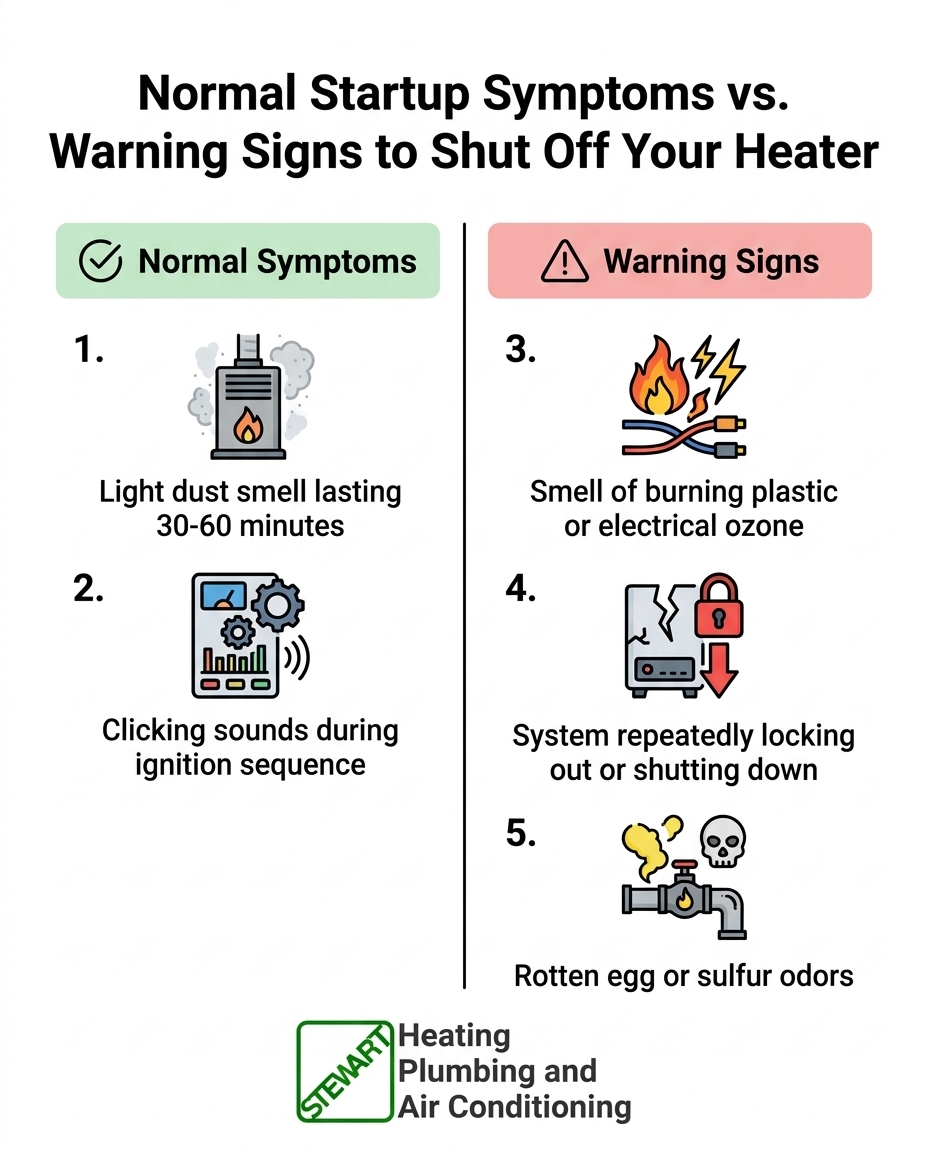
Use the following comparison to evaluate your system's startup symptoms:
• Normal Dust Burn-Off — Description of Odor or Sound: Dry, dusty, slightly charred smell (similar to a warm hair dryer). — Expected Duration: 30 to 60 minutes after initial seasonal startup. — Required Action: Monitor the system. Open a window if the smell is bothersome.
• Normal Expansion Noises — Description of Odor or Sound: Light popping, pinging, or clicking as metal components heat up. — Expected Duration: Intermittent during the first few heating cycles. — Required Action: No action needed; this is standard thermal expansion.
• Hazardous Electrical Issue — Description of Odor or Sound: Sharp, acrid smell of burning plastic, melting wire insulation, or ozone. — Expected Duration: Persistent; does not fade after the first hour. — Required Action: Shut off the system immediately at the thermostat and breaker. Call a professional.
• Dangerous Gas/Exhaust Leak — Description of Odor or Sound: Sulfur, rotten eggs, or heavy exhaust fumes inside the living space. — Expected Duration: Immediate and persistent upon startup. — Required Action: Evacuate the home, call the gas company, and schedule emergency service.
If you have a modern, high-efficiency furnace or a power-vent water heater, you may encounter an error code indicating a specific mechanical fault. One of the most common and misunderstood errors our team encounters is a homeowner learning that a pressure switch failed open on their water heater or furnace system. To understand why this happens, you first need to understand the sequence of operations for gas-fired appliances.
When your thermostat calls for heat, the system does not immediately ignite the gas. First, a small motor called the draft inducer turns on. This motor is responsible for pulling toxic exhaust gases out of the combustion chamber and pushing them safely out of your home through the flue pipe. The pressure switch is a vital safety sensor connected to this inducer motor via a small rubber hose. Its sole job is to verify that the inducer motor is actually moving enough air to safely vent the exhaust.
If the switch detects proper airflow, it closes its internal electrical circuit, giving the system permission to open the gas valve and ignite the burners. Therefore, when the system reports that the pressure switch "failed open," it means the switch intentionally remained in the open (disconnected) position because it detected a dangerous venting issue. The switch intervened to stop the ignition sequence, preventing the buildup of lethal carbon monoxide inside your home.
Addressing this issue requires more than just swapping out a part. In our years of running HVAC diagnostics across the East Bay, we've found that because the switch is doing its job by detecting a broader systemic failure, finding the root cause requires comprehensive plumbing services and expert attention from a licensed professional.
A pressure switch rarely fails on its own; it is usually reacting to a blockage or mechanical failure elsewhere in the system. Based on the service calls our team runs, the most frequent causes include:
• Blocked vent pipes or flue exhausts: Over the summer, our technicians frequently discover that birds, rodents, or insects have built nests inside exterior exhaust pipes. A buildup of leaves or debris can also restrict airflow, causing the pressure switch to stay open.
• Condensation buildup or blocked drainage tubes: High-efficiency systems produce water condensation as a byproduct of combustion. If the internal drainage tubes become clogged with dust or algae, water can back up into the pressure switch hose, blocking the air pressure reading.
• A failing draft inducer motor: If the inducer motor is aging, worn out, or suffering from electrical issues, it may not spin fast enough to create the necessary draft. The pressure switch senses this weak airflow and halts the ignition process.
• Cracked or disconnected vacuum hoses: The small rubber hose connecting the switch to the inducer housing can become brittle, crack, or fall off due to age and vibration, leading to a loss of pressure.
When faced with a cold house and a system that refuses to run, some homeowners are tempted to look up DIY workarounds online. One of the most dangerous pieces of misinformation found on the internet is the suggestion to temporarily bypass a pressure switch by crossing the electrical wires. We cannot stress this enough: you should never, under any circumstances, bypass a safety switch on your heating equipment.
Bypassing a pressure switch or any other internal safety control explicitly violates manufacturer guidelines and immediately voids your equipment warranty. More importantly, it removes the only line of defense your system has against catastrophic failure. The National Fire Protection Association (NFPA) consistently highlights heating equipment as a leading cause of home fires and carbon monoxide incidents during the colder months. These safety mechanisms exist for a reason.
If you force a system to run with an open switch, you are forcing it to burn gas without proper ventilation. This guarantees that dangerous exhaust gases, including carbon monoxide—an invisible, odorless, and potentially fatal gas—will spill backward into your living space rather than venting safely outdoors. Furthermore, improper combustion can lead to extreme heat buildup, cracking the heat exchanger and creating a severe fire hazard.
Because these risks are so high, internal diagnostics and repairs must always be performed by a licensed professional. A qualified technician will use specialized tools, like a digital manometer, to precisely measure the draft pressure and determine exactly why the switch failed open during your late October heating startup. We fix the underlying danger, rather than just masking the symptom.
To understand why fall startup issues are so prevalent, we have to look at the unique climate of our region. In the Pittsburgh CA / East Bay area, we experience a distinct, long dry season that typically stretches from May through September. During these months, regional particulate matter, dry soil dust, pollen, and even distant wildfire ash circulate heavily through the air.
Our crews see a clear pattern every fall: even if your heating system is turned off all summer, your HVAC blower is likely still running to circulate air for your air conditioning system. As air moves through your ductwork, a significant amount of this regional dust bypasses the filter and settles deep inside the dormant heating components. It coats the heat exchanger, the burner assemblies, the flame sensor, and the delicate venting components of your water heater.
Just as heavy summer usage can eventually lead to a clogged AC drain from algae and debris, months of absolute inactivity cause substantial buildup in your heating components. The longer the dry spell, the thicker the accumulation.
This environmental reality makes the first fall startup particularly prone to smells, minor operational hiccups, and sensor lockouts. When a flame sensor is coated in dry-season dust, it cannot properly detect the burner flame, causing the system to shut down prematurely. When a heat exchanger is blanketed in particulates, the resulting burn-off smell is much stronger and lasts longer than it would in a more humid, less dusty climate. Recognizing how our specific local weather patterns impact indoor equipment helps explain why we strongly recommend proactive fall maintenance.
While a brief dusty smell is normal, homeowners should never feel forced to guess whether their heating system is safe to operate. If you observe any critical warning signs during your late October heating startup, the safest course of action is to power down the equipment and bring in expert help.
Here are the absolute stopping points where you should cease operation:
• Persistent burning smells: If a smell resembling burning plastic, melting rubber, or electrical ozone lasts longer than a few minutes, shut off the power at the breaker.
• Repeated system lockouts: If the furnace or water heater turns on, runs for a few minutes, and abruptly shuts down multiple times in a row, the internal safety switches (like the pressure switch or flame roll-out switch) are intentionally halting operation.
• Physically damaged venting: If you visually inspect your exhaust pipes and see rust, disconnected joints, or signs of animal nesting, do not turn the system on.
• Loud, aggressive noises: While light clicking is normal, heavy banging, screeching, or grinding sounds point to failing blower motors or inducer assemblies.
Enrolling in a preventative maintenance plan is the most effective way to catch these safety switch issues and excessive dust buildup before the cold weather sets in. A thorough professional cleaning and inspection removes the guesswork.
When dealing with combustible gas and carbon monoxide safety, relying on a trusted local expert ensures long-term solutions rather than quick, dangerous fixes. Stewart Heating has deep local roots and a proud legacy of serving the East Bay since 1974. Our decades of experience mean we diagnose the root cause with accuracy, reassuring anxious homeowners and keeping families safe.
A normal dust burn-off smell should begin to fade within 30 to 60 minutes of the first seasonal startup. If the odor persists beyond an hour, or if it smells like electrical ozone or burning plastic rather than dry dust, shut the system down immediately. Persistent smells often indicate a failing motor or an electrical short that requires professional attention.
Light clicking, popping, or pinging noises are completely normal as metal components expand and contract during the initial heating cycles. You may also hear the hum of the inducer motor engaging before the gas ignites. However, loud grinding, screeching, or booming sounds are not normal and usually point to a failing motor bearing or delayed gas ignition.
When a pressure switch fails open, it means the safety sensor has detected a lack of proper airflow in the exhaust venting and has intentionally locked out the ignition sequence. This protective measure prevents dangerous carbon monoxide from backing up into your home. It typically points to a blocked flue pipe, a clogged condensate drain, or a failing draft inducer motor.
It is normal for a heater to smell like burning dust for a short period during the first fall startup. It is never normal for a heater to smell like burning plastic, melting wires, or sulfur (rotten eggs). If you detect any chemical, electrical, or gas-like odors, turn off the system immediately and contact a licensed professional in the Pittsburgh CA / East Bay area.
The safest way to prepare your water heater is to clear the area around it, ensuring there are no combustible materials or boxes blocking the air intake or exhaust vents. Visually inspect the exterior pipes for rust or damage. For internal maintenance, such as checking the pressure switch, flushing the tank, or testing the anode rod, always rely on a licensed plumbing and HVAC professional.
Navigating that first late October heating startup doesn't have to be a stressful experience. While some quirks, like a brief dusty odor or the sounds of expanding metal, are perfectly normal, it is vital to respect the safety switches designed to protect your home. Components like the pressure switch exist to prevent hazardous operation, and their warnings should never be ignored or bypassed.
True peace of mind comes from knowing your equipment has been thoroughly inspected, cleaned, and tested by a qualified technician. If you are experiencing persistent odors, system lockouts, or strange noises, do not wait for the winter chill to fully arrive. Take the proactive step to request professional service today. We are here to provide clear, safe guidelines on what is normal versus what requires repair, ensuring your heating and water heater systems are fully prepared for the season ahead.

Very professional and complete. I would recommend Stewart to anyone. Highest quality of workmanship and clean installation.
Stewart Heating Plumbing Air Conditioning just did some work for us for the first time. They did an installation at my home and it turned out well. I thought the price was fair and I definitely would use them again. The technicians were very friendly and knowledgeable about their work. I highly recommend Stewart Heating Plumbing Air Conditioning and already told friends to use them.
We have been using Stewart Heating Plumbing Air Conditioning since 1995. They put the original heating and air unit in the house, and we have just stayed with them. They are dependable and honest people, and they have done a good job for us every time that we have used them!
They came and did an inspection and are coming tomorrow to do the repair.
They replaced a regulator the first time, and then the water heater vent had to be replaced. They did great work.
The gentleman that serviced us was helpful, insightful, and knew what he was talking about. Overall, it was a great experience.