

Recent Blogs
Stay updated with our latest blog posts.

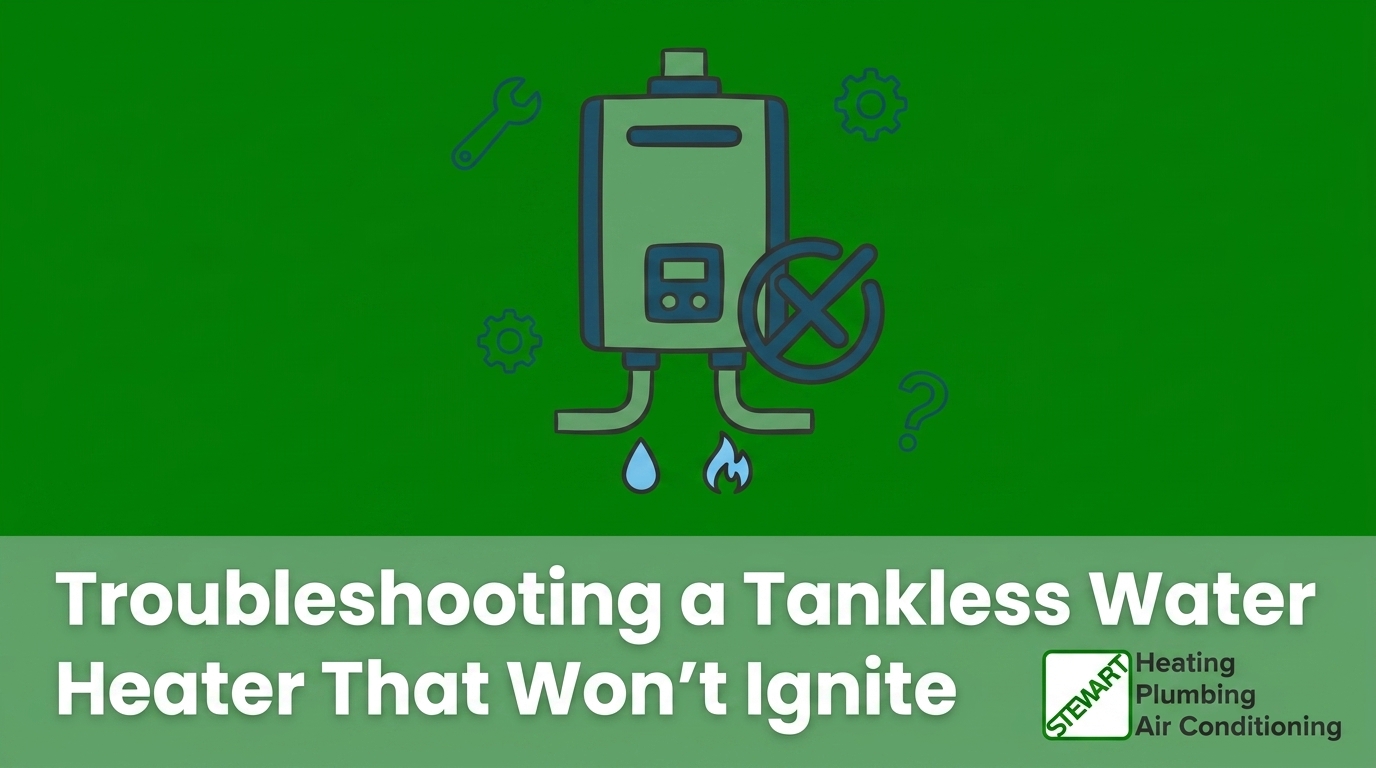
Are you turning the shower handle, waiting patiently for a warm stream, only to be met with freezing cold water? Troubleshooting a tankless water heater that won't ignite is one of the most frustrating challenges a homeowner can face, especially when your household depends on a continuous supply of hot water for daily routines. When a tankless system fails to ignite, the immediate disruption is undeniable, leaving you wondering if the unit is completely broken or simply locked out due to a minor fault.
The core diagnostic challenge with modern on-demand water heaters is determining whether the issue stems from a simple external blockage—like a closed valve or a tripped breaker—or a complex internal component failure. While the technology behind these systems is highly advanced, they are designed with strict safety protocols that will shut down the ignition sequence at the first sign of trouble. If you need immediate assistance navigating these issues, our professional plumbing services and water heater repair and replacement teams are ready to help restore your comfort safely.
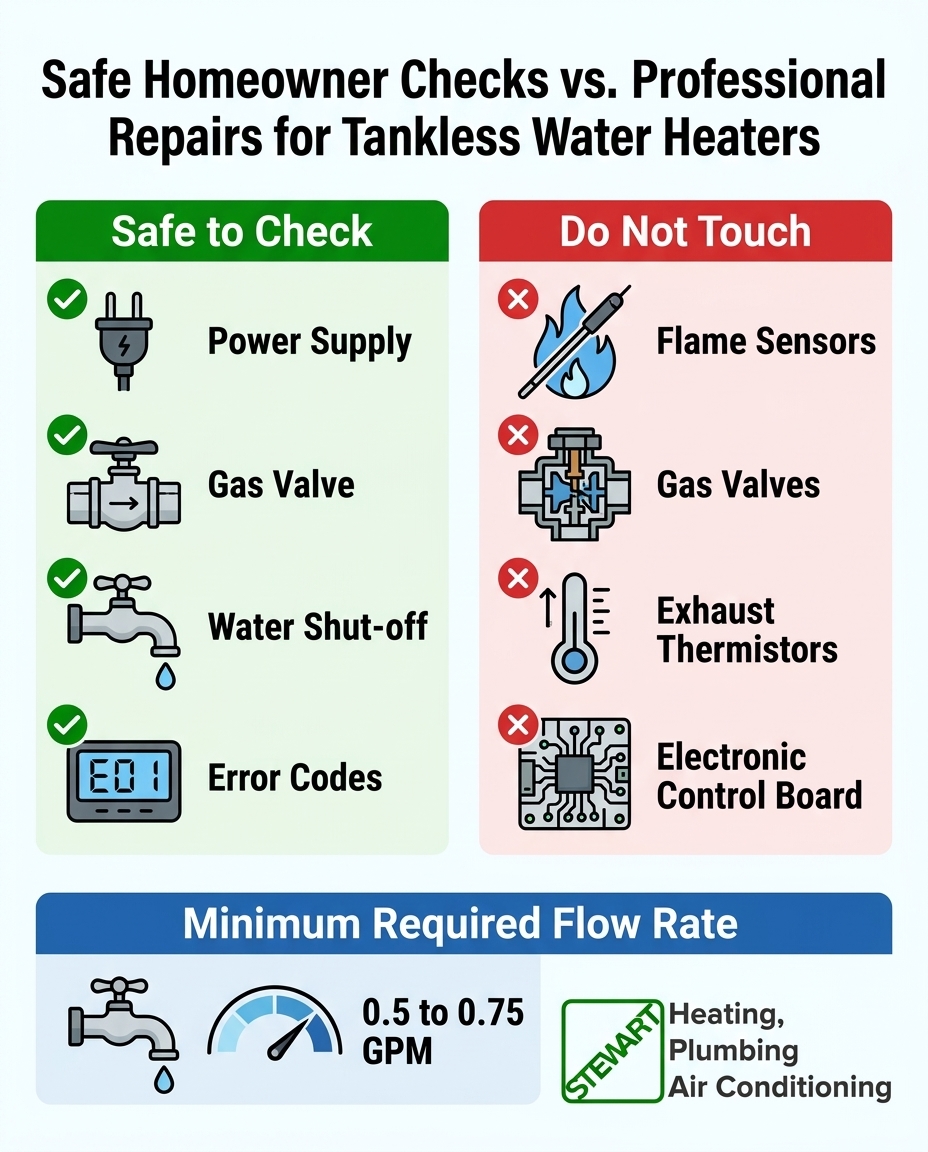
Before you begin inspecting the unit, it is critical to set a firm safety boundary. There are several safe, external checks that any homeowner can perform to rule out basic utility interruptions. However, the moment a diagnostic step requires opening the combustion chamber, testing electrical voltage, or handling gas delivery components, the line is crossed into dangerous territory. A tankless water heater won't ignite if its internal sensors detect unsafe conditions, and attempting to bypass or repair these internal mechanisms without proper licensing can lead to catastrophic hazards.
When you discover your tankless water heater not working, your first course of action should be to verify that the unit is receiving everything it needs to operate: power, gas, and water. These external requirements are often the culprits behind a failure to ignite, and checking them requires no special tools or technical training.
Follow these safe, immediate troubleshooting steps before calling a professional:
1. Verify the electrical power supply: Even gas-powered tankless water heaters require electricity to operate the digital control board, flow sensors, and electronic ignition pack. Check the electrical outlet where the unit is plugged in, and inspect your home's main electrical panel for any tripped circuit breakers. If the digital display on the unit is completely blank, a lack of power is likely the issue.
2. Ensure the gas supply valve is fully open: The system cannot ignite without a steady supply of fuel. Locate the gas shut-off valve on the pipe leading to the water heater. The handle should be parallel to the gas line; if it is perpendicular, the gas is shut off. Additionally, test other gas appliances in your home, such as a stove or furnace, to confirm that your property is receiving gas from the utility provider.
3. Confirm water flow is unrestricted: Tankless systems are activated by water movement. If the cold water inlet valve or the hot water outlet valve is partially or fully closed, the system will not register enough demand to trigger ignition. Ensure all water shut-off valves connected to the unit are fully open.
4. Check the digital display for error codes: Modern units are equipped with self-diagnostic control boards. If a safety lockout occurs, the display will flash a specific error code. Document this code exactly as it appears.
Understanding Common Error Code Categories
While specific codes vary by manufacturer, they generally fall into distinct categories that help professionals pinpoint the problem. Knowing the category can help you understand what the system is experiencing.
• Ignition Failure — Typical System Symptom: System tries to fire but shuts down — What It Means for the Unit: The unit is not receiving gas, or the flame sensor cannot detect a stable flame.
• Airflow / Venting — Typical System Symptom: Fan runs loudly, then system aborts — What It Means for the Unit: The exhaust vent is blocked, or the intake pipe is not drawing enough fresh air for combustion.
• Water Flow — Typical System Symptom: No response when faucet is turned on — What It Means for the Unit: The flow sensor is not detecting the minimum required gallons per minute (GPM) to start.
• Overheating — Typical System Symptom: System shuts down abruptly during use — What It Means for the Unit: Heat exchangers are running too hot, often due to severe mineral scale buildup.
One of the most common reasons a tankless water heater won't ignite has nothing to do with the gas supply or the burner—it has to do with how the system detects your demand for hot water. Unlike traditional tank heaters that keep a reservoir hot at all times, tankless systems remain dormant until you open a tap. They rely on highly sensitive internal flow sensors to tell the control board when to wake up and start the ignition sequence.
For a tankless water heater to ignite, water must pass through the internal flow sensor at a specific minimum rate. For most residential models, this minimum flow rate requirement is strictly calibrated between 0.5 to 0.75 gallons per minute (GPM). If you slightly open a faucet to get a trickle of warm water for washing your face, the flow rate might only hit 0.3 GPM. The flow sensor will not register this as a legitimate demand, and the burner will remain completely off.
This flow dependency becomes especially apparent during seasonal transitions. Consider the shift into late summer (August) when back-to-school routines suddenly create highly concentrated morning hot water demand. Family members may be running multiple low-flow fixtures simultaneously, or taking rapid, back-to-back showers. If the unit's internal flow sensor is struggling to read the water movement accurately, these high-demand mornings will expose the limitation, resulting in cold water when you need it most.
The accuracy of the flow sensor can be severely compromised by the quality of the water passing through it. In areas like Pittsburg, CA, regional water hardness introduces high levels of calcium and magnesium into your plumbing system. Over time, these minerals precipitate out of the water and form a hard, crusty scale on internal components.
When scale accumulates on the delicate spinning turbine of a flow sensor, it adds weight and friction. A scaled-up sensor might require 1.0 or 1.5 GPM of water flow just to start spinning fast enough to signal the control board. This tricks the system into ignoring legitimate water demand. Keeping these sensors clean and calibrated is a primary reason why enrolling in a preventative maintenance plan is essential for long-term tankless performance.
If you have verified that the power is on, the gas is flowing, and the water valves are open, but your tankless water heater won't ignite, the problem lies deep within the unit's internal mechanics. This is where homeowner troubleshooting must stop and professional diagnostic work must begin.
Modern tankless systems are governed by a sophisticated electronic control board. This board acts as the brain of the heater, constantly monitoring a network of safety sensors. If any sensor reports an anomaly—whether it's abnormal temperatures, improper combustion, or gas pressure irregularities—the control board will instantly lock out the ignition sequence to protect your home. Resolving these tankless water heater problems requires specialized testing equipment and a thorough understanding of gas combustion physics.
Common internal failures that demand professional attention include:
• Electronic Control Board Malfunctions: Power surges or prolonged exposure to internal moisture can short out the main board, preventing it from sending the signal to open the gas valve.
• Ignition Pack Failure: The component responsible for generating the high-voltage spark that lights the gas can wear out over time, resulting in a system that clicks repeatedly but never fires.
• Gas Valve Lockouts: If the internal proportional gas valve fails to open, or if the incoming gas pressure drops below safe operating levels, fuel will never reach the burner assembly.
When these internal faults occur, the safest and most effective solution is to request plumbing service from a licensed professional who can test the components with a multimeter and replace faulty parts safely.
One of the most frequent causes of ignition failure is a dirty or faulty flame sensor. The flame sensor is a thin metallic rod located directly inside the combustion chamber. Its job is to prove that a flame actually exists after the gas valve opens. If the sensor is coated in carbon buildup, it cannot detect the flame, and the control board will shut the gas off within seconds to prevent a dangerous raw gas leak.
While it may be tempting to open the unit and wipe down the sensor, this is incredibly dangerous. Opening the sealed combustion chamber exposes you to severe carbon monoxide risks and potential fire hazards if the seals are not re-seated perfectly. Furthermore, the flame rod requires professional calibration to ensure it accurately detects microamps of electrical current during combustion. Scrubbing it with abrasive materials can permanently damage the sensor coating, turning a simple cleaning into an expensive part replacement.
Modern high-efficiency tankless water heaters are engineered to extract as much heat as possible from the combustion process. Because they operate with such tight tolerances, they must continuously monitor the flow of exhaust gases leaving the unit. If the system cannot safely vent exhaust outdoors, it will abort the ignition sequence entirely to prevent carbon monoxide from backing up into your living space.
Venting blockages can occur for several reasons. During the summer months, birds, rodents, and insects frequently seek shelter inside exterior exhaust pipes, building nests that restrict airflow. Additionally, heavy winds can blow leaves and debris into the termination hood. In some cases, improper initial installation—such as using the wrong pipe material or running the vent too far with too many elbows—can create excessive backpressure.
The unit monitors this venting process using specific safety devices, primarily the exhaust thermistor and pressure switches. The exhaust thermistor measures the temperature of the outgoing gases. If a blockage causes the heat to back up into the unit, the thermistor detects the dangerous temperature spike and signals the control board to cut the gas. Similarly, air pressure switches measure the draft inside the vent pipe. If the draft is insufficient, the switch trips, halting the ignition process immediately. If you suspect your unit is experiencing airflow issues, understanding the mechanics of these safety limits is crucial, which is why we recommend reviewing our guide on diagnosing a tripped pressure switch on your tankless water heater.
The most common reasons a tankless water heater won't ignite include a lack of gas supply, a tripped electrical breaker, insufficient water flow, or a dirty internal flame sensor. Because these units rely on a precise sequence of events to operate, a failure at any stage—from the flow sensor failing to detect water movement to the gas valve failing to open—will halt the entire process. Identifying the exact cause usually requires checking the digital display for an error code to determine if the issue is external or internal.
To safely reset a tankless water heater, begin by turning off the power to the unit, either by unplugging it or switching off the dedicated circuit breaker. Next, close the hot water taps in your home to stop demand. Wait for about five to ten minutes to allow the internal computer to clear its temporary memory. Finally, restore the electrical power and open a hot water tap to see if the system successfully initiates the ignition sequence. This process can clear minor, temporary error codes.
If your unit was running fine but suddenly leaves you with a tankless water heater not getting hot, the primary culprits are usually scale buildup, flow sensor failure, or a mid-cycle gas valve lockout. Severe mineral scale can coat the heat exchanger, acting as an insulator that prevents the burner's heat from transferring into the water. Alternatively, if the exhaust venting becomes partially blocked while the unit is running, safety sensors will detect the heat buildup and shut down the burner to prevent damage.
No, you should never attempt to clean a tankless water heater flame sensor yourself. Accessing the flame sensor requires opening the sealed combustion chamber, which exposes you to serious risks of carbon monoxide leaks and fire hazards if the unit is not reassembled perfectly. Furthermore, the delicate metallic rod requires professional handling and precise calibration to ensure it accurately detects the microamps of current generated by the burner flame. Always leave combustion chamber maintenance to a licensed professional.
If you have performed a hard reset and the system still fails to ignite, you should immediately document any error codes flashing on the digital display. Stop attempting to force the unit to start, as repeated failed ignition attempts can flood the combustion chamber with unburned gas. Once you have noted the error code and verified that your gas, water, and power supplies are active, contact a licensed plumbing technician to perform a professional diagnostic on the internal components.
Dealing with a tankless water heater that won't ignite is disruptive, but understanding the boundary between basic troubleshooting and complex repair keeps your home safe. While checking your electrical panel, verifying the gas valve position, and ensuring your water flow is unrestricted are excellent first steps, internal ignition failures demand professional expertise. Diagnosing sensitive components like electronic control boards, proportional gas valves, and flame sensors requires specialized training and equipment.
You don't have to navigate these technical lockouts on your own. Since 1974, our team has built a legacy of trust, backed by a 75% customer referral rate, proving that our community relies on us for safe, accurate, and honest diagnostics. If your system is flashing an error code or refusing to provide the hot water you need, a licensed technician can safely identify the fault and restore your system's performance. Schedule an inspection today to get your hot water flowing reliably once again.

Very professional and complete. I would recommend Stewart to anyone. Highest quality of workmanship and clean installation.
Stewart Heating Plumbing Air Conditioning just did some work for us for the first time. They did an installation at my home and it turned out well. I thought the price was fair and I definitely would use them again. The technicians were very friendly and knowledgeable about their work. I highly recommend Stewart Heating Plumbing Air Conditioning and already told friends to use them.
We have been using Stewart Heating Plumbing Air Conditioning since 1995. They put the original heating and air unit in the house, and we have just stayed with them. They are dependable and honest people, and they have done a good job for us every time that we have used them!
They came and did an inspection and are coming tomorrow to do the repair.
They replaced a regulator the first time, and then the water heater vent had to be replaced. They did great work.
The gentleman that serviced us was helpful, insightful, and knew what he was talking about. Overall, it was a great experience.