


Recent Blogs
Stay updated with our latest blog posts.

Are you wondering how to handle ductless mini-splits vs extending existing ductwork for fall room additions without throwing your entire home's temperature out of balance? Expanding your living space is an exciting project, but it brings up a significant mechanical hurdle: how to effectively heat and cool the new square footage. As you wrap up construction, you face a critical decision. Do you attempt to stretch your current setup into the new room, or do you install an independent system? Making the wrong choice can lead to hot and cold spots, skyrocketing energy bills, and unnecessary wear on your equipment. Navigating the September pre-heating season transition means you need to finalize this plan quickly so the new space is comfortable before winter arrives.
Ready to explore your options? Learn more about ductless mini-split systems or schedule an HVAC installation estimate today.
Tapping into your current ductwork seems like the most straightforward solution for a new room. After all, the equipment is already sitting right there in your home. However, the mechanical reality of altering an existing central HVAC system is far more complex than simply cutting a hole and attaching a new pipe.
When your home was originally built, the heating and cooling equipment was specifically sized for the original square footage. Professionals use a strict formula called an ACCA Manual J load calculation to determine exactly how much heating and cooling capacity a house requires. This calculation factors in the size of the rooms, the number of windows, the quality of the insulation, and the local climate in the Pittsburgh CA / East Bay area. Because equipment is tailored to these exact specifications, existing systems are rarely oversized enough to comfortably handle an extra 200 to 500 square feet of new living space.
During a routine fall pre-heating season tune-up, our team at Stewart Heating, Plumbing and Air Conditioning recently helped a local homeowner who asked about improving their system's overall efficiency after noticing uneven temperatures. Our technician reviewed the layout, explained how previous duct modifications were straining the equipment, and suggested specific measures to restore efficiency. We see this pattern all the time: adding load without upgrading capacity almost always results in diminished performance across the entire house.
To understand why extending ducts is risky, we always explain the concept of static pressure to our customers. Think of your ductwork like a plumbing system. The blower motor pushes a specific volume of air through a specific size of pipe.
• Increased resistance: When you add more ducting, you force the blower motor to push air further than it was designed to.
• Pressure drops: This extra distance causes a drop in static pressure, meaning the air loses momentum before it reaches the furthest vents.
• Stolen airflow: Because the system only produces a fixed amount of air, routing air to the new addition physically steals airflow from other rooms in the house.
• Premature failure: The blower motor has to work overtime to compensate for the pressure drop, which significantly shortens its lifespan and increases the likelihood of an unexpected breakdown.
If you extend the ductwork without having our team recalculate the load capacity, you risk leaving the new addition under-conditioned while making the rest of your home less comfortable.
Ductless mini-splits offer a completely different approach to climate control. Instead of tying into the main house's ductwork, these systems operate independently. A compact outdoor compressor connects to a sleek indoor air handler via a small bundle of refrigerant lines. Because they function on their own, they do not steal airflow or heating capacity from your main house.
This independent operation creates a dedicated climate zone for your new addition. You can set the thermostat in the new room to whatever temperature you prefer, completely separate from the thermostat in the hallway. If you want the addition to be a cozy 72 degrees while the rest of the house stays at 68 degrees, a ductless system handles it effortlessly.
This level of control is particularly valuable given the climate in the Pittsburgh CA / East Bay area. Our region features a Mediterranean climate characterized by hot late summers and mild, wet winters. The shifting fall weather patterns demand incredible versatility. You might experience a lingering heat wave in late September that requires rapid cooling during the afternoon, followed by a sudden, sharp drop in temperature that demands immediate heating by nightfall.
A central system tied to a single thermostat struggles to manage these rapid swings, especially if the new addition faces the afternoon sun while the thermostat sits in a shaded hallway. An independent ductless system allows you to adapt to the East Bay's unpredictable fall weather instantly, keeping the new space perfectly comfortable without freezing or roasting the rest of your family.
The physical process of adding climate control to a new room varies wildly depending on the method you choose. When you extend existing ductwork, you are signing up for a highly invasive construction project.
Routing new sheet metal or flex duct from your main trunk line to the new addition requires opening up ceilings, cutting through drywall, and navigating around existing framing, plumbing, and electrical wires. This process generates significant dust and debris. Once the ductwork is in place, you then have to hire contractors to patch the drywall, re-texture the ceiling, and paint the affected areas. Extending ducts often adds several days—or even weeks—to a renovation timeline, pushing the completion date further out.
In contrast, installing a ductless mini-split is remarkably streamlined. The connection between the indoor air handler and the outdoor compressor only requires a small, three-inch hole drilled through an exterior wall. There is no tearing into the ceiling, no major drywall repair, and no need to reroute existing utilities. In most cases, our professional installation team can have a ductless system fully installed and operational in a single day.
As a family-owned business serving Contra Costa County since 1974, we have helped countless homeowners navigate complex home additions. We know that by the time you reach the final stages of construction during the September pre-heating season transition, you are ready for the dust to settle. Minimizing disruption to your home is a major priority for us.
Aesthetically, you also have choices. While traditional ductwork relies on standard floor or ceiling registers, ductless systems utilize modern wall-mounted air handlers, low-wall units, or discrete ceiling cassettes. These units integrate smoothly into new construction, providing powerful climate control without the mess of major structural alterations to your central air conditioning setup.
When evaluating the best option for your room addition, it is critical to look beyond the initial installation and consider the long-term energy costs. The way a system delivers air has a massive impact on its overall efficiency.
Central ducted systems are inherently vulnerable to energy loss. As heated or cooled air travels through the ductwork—especially if those ducts run through unconditioned spaces like an attic or crawlspace—energy escapes. In fact, standard duct losses can reduce a system's overall energy efficiency by up to 30%. If you extend your ductwork, you are increasing the surface area where thermal loss can occur, forcing your equipment to consume more electricity or gas to achieve the desired temperature.
Ductless mini-splits eliminate this problem entirely. Because the air handler sits directly inside the room it is conditioning, there is zero duct loss. The energy you pay for is delivered straight into your living space.
Furthermore, modern heat pump mini-splits are engineered with advanced inverter technology. Instead of blasting on at full power and shutting off completely like traditional systems, the inverter continuously adjusts the compressor speed to maintain a steady temperature. This results in exceptionally high SEER (cooling) and HSPF (heating) ratings, often qualifying for ENERGY STAR certification.
Because of this high efficiency, federal tax credits or local utility incentive programs may apply to qualifying heat pump installations. We always advise our readers to verify current programs with their utility provider or a tax professional. While specific programs vary, choosing high-efficiency equipment often yields significant long-term savings. Most importantly, independent zoning allows you to heat or cool only the occupied addition. If you only use the new room for a few hours a day, you do not have to pay to run the central system for the entire house just to keep one space comfortable.
To help you make an informed decision for your Pittsburgh CA / East Bay area home, here is a clear breakdown of the structural and comfort tradeoffs between the two approaches.
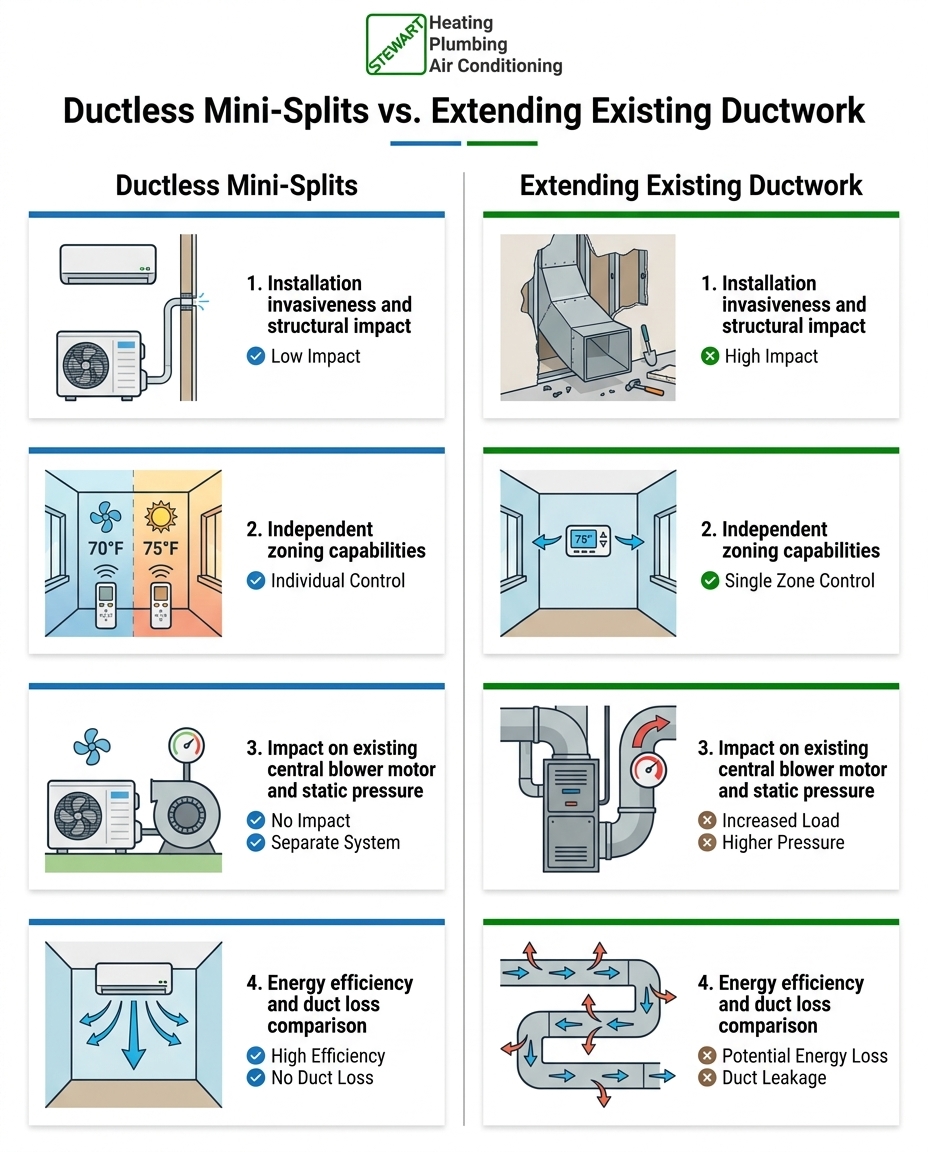
• Installation Scope — Extending Existing Ductwork: Highly invasive; requires cutting drywall, framing modifications, and subsequent patching/painting. — Ductless Mini-Split System: Minimal disruption; requires only a 3-inch wall penetration for refrigerant and electrical lines.
• Zoning & Control — Extending Existing Ductwork: Tied to the whole-house thermostat; cannot control the room's temperature independently. — Ductless Mini-Split System: Independent room control; customized temperature settings separate from the main house.
• Impact on Main System — Extending Existing Ductwork: High risk of pressure drops, unbalanced airflow, and premature wear on the central blower motor. — Ductless Mini-Split System: Zero impact; operates entirely independently without straining the existing central equipment.
• Energy Efficiency — Extending Existing Ductwork: Vulnerable to duct loss (up to 30%); requires running the whole-house system to condition one room. — Ductless Mini-Split System: Highly efficient inverter technology; zero duct loss; conditions only the occupied space.
• Ideal Use Case — Extending Existing Ductwork: Homes where the original HVAC system was significantly oversized and easily accessible. — Ductless Mini-Split System: Standalone fall room additions requiring reliable, independent comfort without major construction.
If you are exploring further alternatives for adding cooling without ductwork, a direct comparison confirms that mini-splits consistently offer superior efficiency and lower structural impact.
Timing is everything when it comes to home renovations. September marks a critical transition period for the HVAC industry. As the lingering late-summer heat begins to fade, our team shifts focus toward preparing homes for the upcoming cold weather. This makes the September pre-heating season transition the ideal window to finalize the climate control plan for your new addition.
Waiting too long to secure your installation can cause unnecessary stress. Once the first real cold snap hits, emergency calls spike, and contractor schedules fill up rapidly. If you delay your decision, you risk heading into the core winter heating season with an unconditioned room, rendering your beautiful new space unusable during the holidays.
We recently helped an East Bay homeowner who experienced this exact urgency when they needed a new system installed just before Thanksgiving. By planning ahead with our team, the installation day went smoothly. Our technicians arrived early, got the new system online, explained the operation of the new thermostat, and left the work area completely clean. The family was able to host their holiday gathering in total comfort.
To avoid the holiday scheduling rush, it is crucial to act early. Let us perform a professional Manual J load calculation to determine exactly what your existing system can handle, and get an estimate for a ductless option. Finalizing your choice now ensures that your new room will be warm, welcoming, and ready for use the moment the winter weather arrives.
Usually, the answer is no, unless the original system was installed with significant excess capacity. Heating and cooling systems are precisely sized for the specific square footage of the home at the time of construction. Attempting to add more space requires a professional Manual J load calculation by our team to verify if the current blower and compressor have the power to handle the extra demand without failing.
The primary disadvantages include increased static pressure, which can lead to premature blower motor failure, and unbalanced temperatures throughout the home. Because the system is forced to push air further, the new room often remains under-conditioned while airflow is stolen from existing rooms. Additionally, the installation process is highly invasive, requiring drywall removal, framing work, and extensive cleanup.
At Stewart Heating, Plumbing and Air Conditioning, we highly recommend mini-splits because they operate completely independently from the main house's ductwork. They preserve the existing system's airflow and prevent dangerous pressure drops. Furthermore, they require almost no structural modification to install and offer precise, independent room zoning, allowing you to control the temperature of the addition without affecting the rest of the home.
Yes, utilizing a dedicated system like a heat pump mini-split is usually the best approach. A heat pump provides both powerful cooling in the summer and efficient heating in the winter. By installing a separate unit, you ensure the new space remains comfortable year-round without placing an unsustainable burden on your main house's central equipment.
A standard ductless mini-split installation by our professional team is typically completed in a single day. Because the process only requires drilling a small hole for the conduit lines and mounting the equipment, it bypasses the multi-day disruption of routing new sheet metal, patching drywall, and painting ceilings that comes with extending traditional ductwork.
Choosing how to heat and cool your new room addition does not have to be a guessing game. By understanding the mechanical realities of airflow, static pressure, and energy efficiency, you can clearly see the distinct advantages of independent zoning. While extending existing ductwork might seem tempting, the risk of unbalancing your entire home's comfort and straining your central blower motor is significant. Ductless systems provide a clean, efficient, and highly customizable solution that perfectly handles the shifting temperatures of the September pre-heating season transition.
Do not leave the comfort of your new addition to chance or rely on guesswork. Have our experienced team evaluate your home's specific load requirements so you can make an informed, objective decision. If you are ready to finalize your plans and enjoy your new space, schedule an HVAC installation estimate with Stewart Heating, Plumbing and Air Conditioning to ensure your home is perfectly prepared for the seasons ahead.

Very professional and complete. I would recommend Stewart to anyone. Highest quality of workmanship and clean installation.
Stewart Heating Plumbing Air Conditioning just did some work for us for the first time. They did an installation at my home and it turned out well. I thought the price was fair and I definitely would use them again. The technicians were very friendly and knowledgeable about their work. I highly recommend Stewart Heating Plumbing Air Conditioning and already told friends to use them.
We have been using Stewart Heating Plumbing Air Conditioning since 1995. They put the original heating and air unit in the house, and we have just stayed with them. They are dependable and honest people, and they have done a good job for us every time that we have used them!
They came and did an inspection and are coming tomorrow to do the repair.
They replaced a regulator the first time, and then the water heater vent had to be replaced. They did great work.
The gentleman that serviced us was helpful, insightful, and knew what he was talking about. Overall, it was a great experience.