

Recent Blogs
Stay updated with our latest blog posts.

Figuring out exactly why your tankless water heater randomly runs cold during back-to-back showers is one of the most frustrating challenges a homeowner can face. Here at Stewart Heating, Plumbing and Air Conditioning, our technicians hear about this jarring experience all the time. You step into the shower right after a family member finishes, expecting a steady stream of comfortable heat, only to be hit with a sudden, icy blast of unheated water. This jarring experience immediately forces a critical decision point: homeowners need to know if this intermittent cold water is a sign of a catastrophic system failure requiring immediate professional intervention, or simply a temporary capacity limitation that requires a few behavioral adjustments.
Interestingly, a pattern we see often is that this phenomenon occurs even during peak summer July demand. High household flow rates can trigger intermittent cold spells if multiple fixtures are running simultaneously. When a household demands more hot water than the system can process in real-time, the equipment must prioritize either the temperature or the flow rate—and it usually sacrifices temperature to keep the water moving.
Proper diagnosis of this issue starts with understanding exactly how flow rates and ignition sequences work. This technical foundation is a core component of our expert plumbing services, as it separates genuine mechanical breakdowns from simple usage overloads. Not every temperature fluctuation indicates a broken unit, and not every cold shower requires immediate water heater repair and installation. By examining the mechanics of on-demand heating, you can quickly determine whether your system is truly malfunctioning or just temporarily overwhelmed by the household's morning routine.
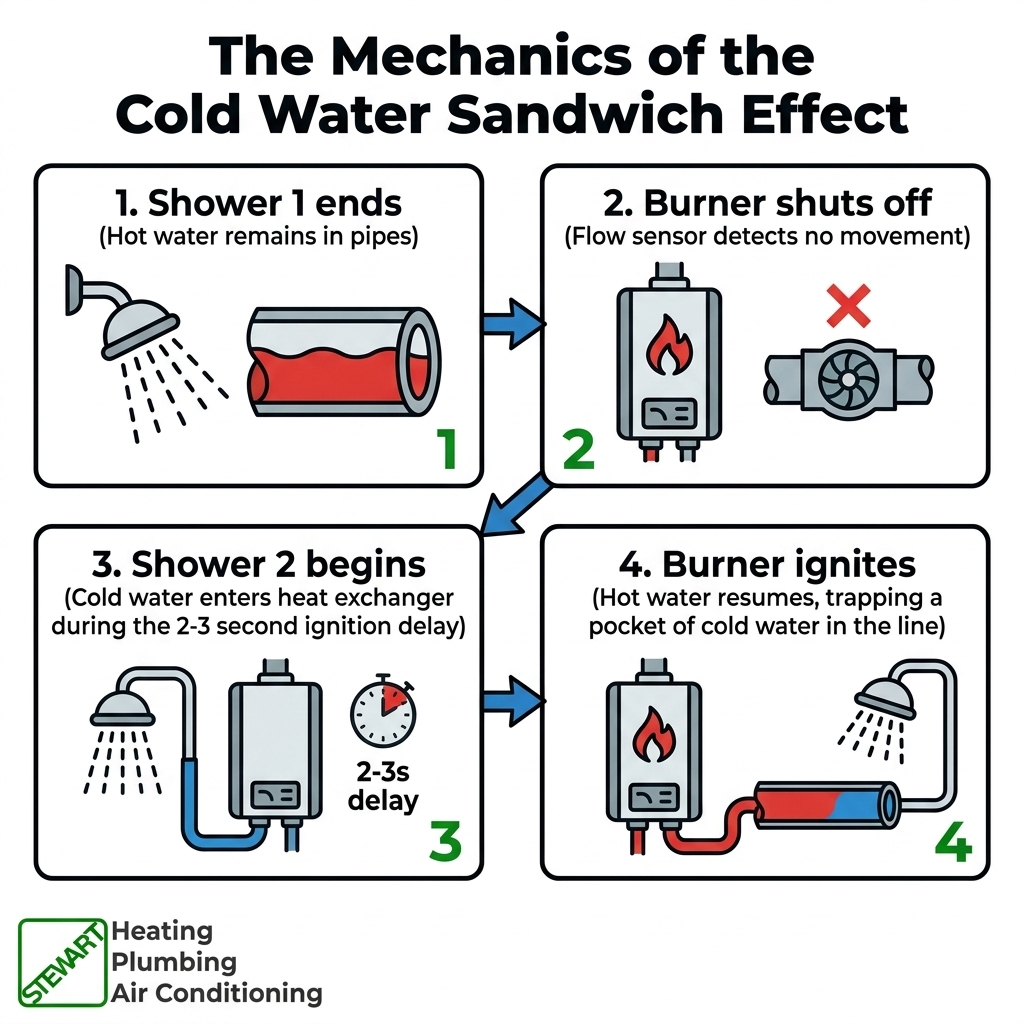
The sudden burst of cold water between two otherwise hot showers is so common in the plumbing industry that it has an official name: the "cold water sandwich." This effect is defined as a brief, distinct pocket of unheated water that travels through the plumbing lines when a tankless unit is turned off and then rapidly turned back on. Understanding the mechanics behind this brief chill is the first step in diagnosing intermittent temperature drops.
When the first person finishes their shower and turns off the tap, the water heater's flow sensor detects that water has stopped moving, and it immediately shuts off the gas burner. However, the plumbing pipes leading from the heater to the showerhead remain full of residual hot water. When the second person turns the shower on a minute later, they initially feel that leftover hot water. Behind that residual hot water is a gap of cold water that passed through the heat exchanger during the brief time the unit was off, followed by newly heated water once the burner reignites. That gap is the "sandwich."
When a tankless water heater not getting hot experiences this highly specific, momentary delay, it is functioning exactly as designed. It is not malfunctioning. Many modern units we install in Pittsburgh CA homes feature integrated recirculation pumps or small internal buffer tanks specifically designed to mitigate this effect by keeping a small reserve of hot water ready, but older or standard models do not have this luxury.
The cold water sandwich is entirely the result of a necessary safety sequence. A tankless system cannot keep its burner running constantly; it must follow a strict, multi-step ignition process every single time a hot water tap is opened.
1. Flow detection: The internal flow sensor must first detect that water is moving through the system at a sufficient volume.
2. Draft fan activation: The unit turns on its exhaust fan to ensure any residual gas fumes are cleared from the combustion chamber.
3. Gas valve opening: Once the chamber is cleared, the internal gas valve opens to allow fuel into the burner area.
4. Igniter sparking: The electronic igniter sparks to light the burner and begin heating the heat exchanger.
This multi-step safety process takes approximately two to five seconds to complete. During those few seconds, unheated groundwater is actively flowing past the inactive burner and into your home's hot water lines, creating the cold pocket that eventually reaches your showerhead.
Unlike traditional storage-tank water heaters, which are sized by the total volume of water they hold, tankless units are sized by their Gallons Per Minute (GPM) capacity. This is the maximum volume of water the unit can heat to your desired temperature in exactly one minute. If your household demands more GPM than the unit is rated to handle, the system will fail to keep up.
Standard showerheads typically use approximately 2.1 to 2.5 GPM. If your tankless system has a maximum capacity of 6.0 GPM, it can comfortably handle two showers running simultaneously. However, if two showers are running while a modern washing machine fills and the kitchen sink is turned on, the total household demand can easily spike to 8.0 GPM or higher. When simultaneous fixtures exceed the unit's maximum capacity, the water heater must restrict the flow or drop the temperature.
When this happens, a common homeowner complaint our dispatchers hear is, "my tankless water heater is not working." In reality, the unit is simply prioritizing flow over temperature, resulting in lukewarm or completely cold water reaching the fixtures. The system is operating at its maximum output, but the demand is mathematically too high for the burner to heat the water fast enough.
Conversely, there is also a minimum flow rate activation threshold. Most tankless units require at least 0.4 to 0.5 GPM of water movement to engage the burner. If you turn the hot water tap on just a tiny trickle to shave, the flow sensor may not register enough movement to ignite the gas, resulting in cold water.
Understanding your daily usage requires a basic breakdown of common fixture flow rates. By adding these up, you can see how overlapping usage during busy mornings pushes the system past its rated threshold.
• Standard Showerhead — Average Flow Rate (GPM): 2.1 to 2.5 GPM
• Low-Flow Showerhead — Average Flow Rate (GPM): 1.5 to 1.75 GPM
• Kitchen Faucet — Average Flow Rate (GPM): 1.5 to 2.0 GPM
• Bathroom Sink Faucet — Average Flow Rate (GPM): 1.0 to 1.5 GPM
• Washing Machine — Average Flow Rate (GPM): 2.0 to 2.5 GPM
The math of morning routines: If two family members are showering (4.5 GPM) while the dishwasher is running (1.5 GPM), the household is demanding 6.0 GPM. If your heater is only rated for 5.0 GPM, the water will run cold until one of those fixtures is turned off.
A tankless water heater's GPM capacity is not a fixed, static number; it fluctuates based on the temperature of the incoming municipal water. This fluctuation is governed by a concept known as "Delta T," which is the difference between the incoming groundwater temperature and your desired output temperature (usually set around 120 degrees Fahrenheit).
In regions like Contra Costa County, groundwater temperatures can warm up significantly by peak summer July, directly altering the maximum flow capacity of tankless systems in Pittsburgh CA. During this peak heat, the incoming municipal water is much warmer, sometimes reaching 70 degrees before it even enters the house. This means the tankless unit only needs to achieve a 50-degree temperature rise (Delta T). Because the heating demand is lower, the unit can process water much faster, producing a higher GPM flow rate and operating at peak energy efficiency.
The diagnostic takeaway from our plumbers: If a unit is randomly running cold in the middle of summer when the incoming water is already warm and the unit is operating at its most efficient, our team typically sees that it is highly likely a flow-sensor delay (the cold water sandwich) or a massive simultaneous usage overload, rather than a lack of heating capacity. Cold water during peak summer usually points to flow dynamics rather than a struggling burner.
It is important to distinguish between the brief, temporary cold water sandwich effect and a sustained drop in temperature that occurs halfway through a single, continuous shower. If the water goes completely cold after 10 minutes and stays cold, you are no longer dealing with an ignition delay. This points to an entirely different set of mechanical or flow-related interruptions.
A sustained temperature drop often occurs due to a subtle drop in flow rate. For example, if a homeowner feels the shower is slightly too hot and turns the hot water handle down, they might inadvertently drop the flow rate below the 0.4 GPM minimum threshold. The flow sensor assumes the hot water has been turned off and shuts down the burner, leaving the bather in unheated water.
Fluctuating municipal water pressure can also cause this issue. In older Pittsburgh CA neighborhoods, our team frequently encounters sudden drops in neighborhood water pressure that can temporarily trick the flow sensor into shutting off the burner, even if the tap is fully open. When troubleshooting a tankless water heater that won't ignite or stay ignited, flow stability is always the first variable we check.
Additionally, venting issues can cause a mid-shower shutdown. Tankless units require precise air intake and exhaust venting to operate safely. If a bird's nest, debris, or a collapsed pipe blocks the exhaust vent, the unit's internal safety sensors will detect a dangerous buildup of heat or carbon monoxide. To protect the home, the unit will automatically shut down the gas valve after running for several minutes, resulting in a sudden loss of hot water.
While flow rate limits and the cold water sandwich are normal operational realities, there are times when a tankless water heater not working requires professional intervention. If you have spaced out your showers, verified that you are not exceeding your GPM limit, and checked that your flow rate is high enough, persistent cold water indicates a true mechanical failure.
Signs of genuine mechanical failure include error codes flashing on the digital display, a complete failure of the unit to ignite even when a high-flow bathtub faucet is opened, or cold water persisting when only one fixture is running in the entire house. These symptoms point to internal component degradation that cannot be solved by changing your shower habits.
One of the most common mechanical culprits our technicians find is a dirty flow sensor. If the small turbine inside the flow sensor becomes coated with sediment or debris, it will fail to spin properly when water passes through. If the sensor doesn't spin, it cannot signal the control board to open the gas valve, and the burner will remain off. Similarly, a malfunctioning gas valve or a failing electronic ignition pack will prevent the system from generating heat.
When a tankless water heater not working stems from these internal component failures, it requires a licensed professional to clean, descale, or replace parts. At Stewart Heating, Plumbing and Air Conditioning, our team has been serving the community since 1974, acting as a trusted, neutral expert to help homeowners determine if they simply need to space out their showers or if a genuine repair is required. If your system is failing to ignite under normal loads, it is time to request plumbing service to restore reliable performance.
Mineral scale buildup is a leading cause of unexpected temperature drops. When hard water is rapidly heated, calcium and magnesium minerals bake directly onto the narrow passages of the heat exchanger.
• Flow restriction: As scale builds up, it physically restricts the amount of water that can pass through the unit, artificially lowering your GPM capacity.
• Overheating prevention: Thick scale acts as an insulator, preventing the heat exchanger from transferring heat to the water. The unit's internal sensors will detect that the heat exchanger is overheating and will shut down the burner to prevent a fire hazard, resulting in sudden cold water.
• Maintenance flushes: Regular, professional descaling flushes dissolve these minerals, preventing the flow restrictions and safety shutdowns that lead to unexpected cold showers.
Your tankless water heater suddenly goes cold either because of the "cold water sandwich" effect or because your household has exceeded the unit's maximum flow rate capacity. If the cold water lasts for just a few seconds between back-to-back showers, it is simply the unheated water that passed through the unit during the brief ignition delay. If the water stays cold, multiple fixtures running simultaneously have likely overwhelmed the system's Gallons Per Minute (GPM) rating, causing it to prioritize flow over temperature.
Technically, you do not need to wait for a tank to refill because a tankless system heats water on demand indefinitely. However, our team often recommends waiting 1 to 2 minutes between showers to allow the unit to properly reset its ignition sequence and fully purge the "cold water sandwich" from the plumbing lines. Letting the shower run for just a few seconds before stepping in ensures that the brief pocket of unheated water has passed down the drain.
Whether a tankless water heater can run two showers at once depends entirely on the unit's GPM rating and the flow rate of your specific showerheads. A standard showerhead uses about 2.5 GPM, meaning two showers require 5.0 GPM of continuous flow. If your tankless unit is rated for 6.0 GPM or higher, it can easily handle two showers simultaneously, but if it is a smaller unit rated for only 4.0 GPM, the water will quickly run cold.
The most effective behavioral fix for the cold water sandwich effect is to simply turn on the shower and wait 10 to 15 seconds before stepping in, allowing the unheated pocket of water to pass. For a permanent mechanical fix, our licensed professionals can install a recirculation pump or a small external buffer tank. These professional solutions keep a small reserve of hot water actively circulating near the fixtures, completely eliminating the temperature gap caused by the ignition delay.
Turning up the thermostat on your tankless water heater does not fix intermittent cold water, and it can actually make the problem worse during periods of high demand. When you increase the target temperature, you increase the "Delta T" (the amount of heat the unit must generate), which forces the system to slow down the water flow to achieve that higher temperature. If you are already struggling with GPM capacity limits during peak summer July usage, forcing the unit to heat water to a higher degree will further restrict your flow rate.
Knowing the difference between a normal flow rate limitation and a broken unit is the key to maintaining uninterrupted comfort in your home. The "cold water sandwich" and GPM capacity limits are mechanical realities of on-demand heating, not necessarily signs of a failing system. A clear, jargon-free understanding of how your system detects flow and ignites its burner empowers you to make smart usage adjustments, like spacing out high-demand appliances or allowing the shower to run for a few seconds before stepping in.
However, if spacing out your usage and adjusting your habits doesn't solve the problem, it is time to seek a professional diagnosis. Persistent cold water, error codes, or a complete failure to ignite point to internal issues like mineral scale buildup or failing sensors. If you are dealing with consistent temperature drops in Pittsburgh CA, talk to our professional team to ensure your system is properly scaled, descaled, and maintained for your household's true daily demand.

Very professional and complete. I would recommend Stewart to anyone. Highest quality of workmanship and clean installation.
Stewart Heating Plumbing Air Conditioning just did some work for us for the first time. They did an installation at my home and it turned out well. I thought the price was fair and I definitely would use them again. The technicians were very friendly and knowledgeable about their work. I highly recommend Stewart Heating Plumbing Air Conditioning and already told friends to use them.
We have been using Stewart Heating Plumbing Air Conditioning since 1995. They put the original heating and air unit in the house, and we have just stayed with them. They are dependable and honest people, and they have done a good job for us every time that we have used them!
They came and did an inspection and are coming tomorrow to do the repair.
They replaced a regulator the first time, and then the water heater vent had to be replaced. They did great work.
The gentleman that serviced us was helpful, insightful, and knew what he was talking about. Overall, it was a great experience.