

Recent Blogs
Stay updated with our latest blog posts.

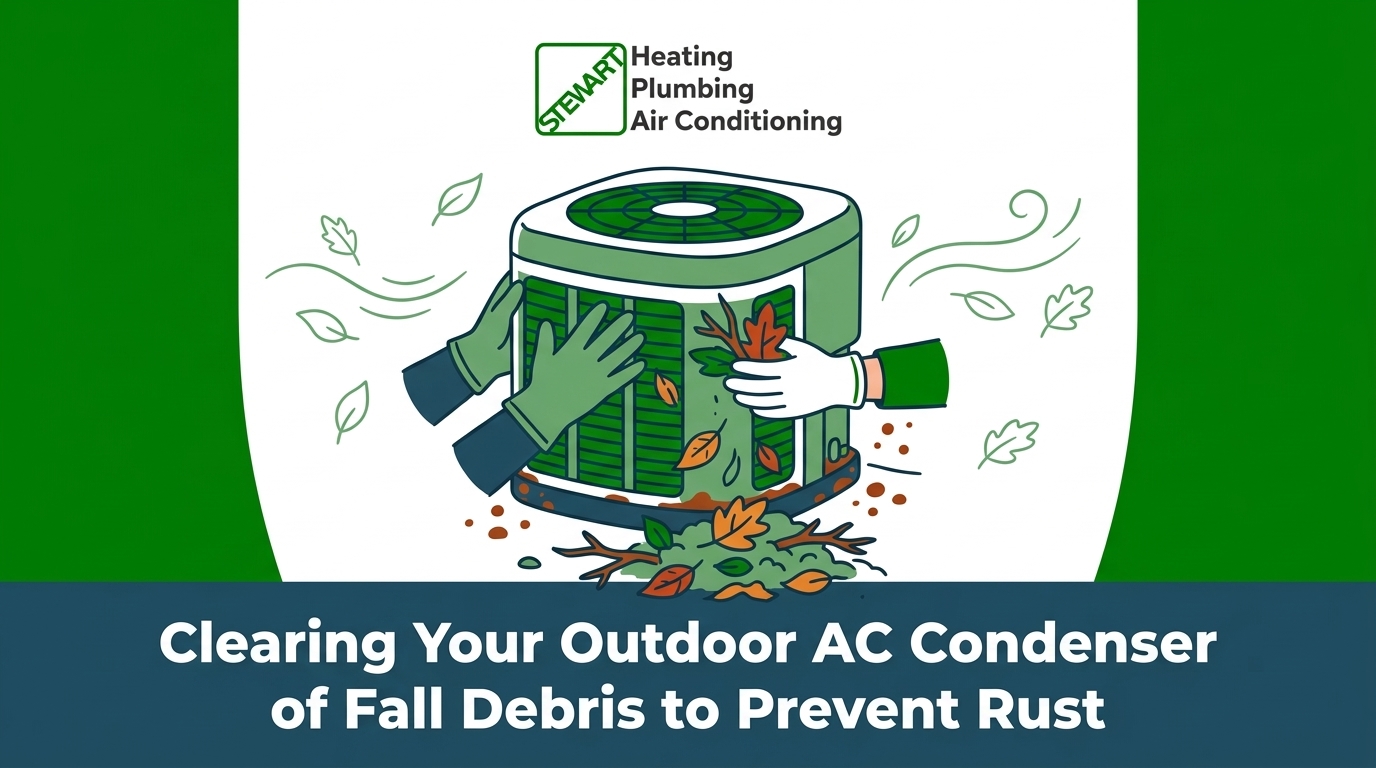
The September and early fall transition brings a massive drop of leaves, twigs, and yard waste right into your backyard—and directly onto your HVAC equipment. Clearing your outdoor AC condenser of fall debris to prevent rust is one of the most important, yet frequently overlooked, steps our team at Stewart Heating, Plumbing and Air Conditioning recommends to protect your system as the cooling season ends. When the weather shifts, it is incredibly common to see a layer of organic material blanketing the top and sides of the outdoor cabinet.
Ignoring this buildup is not just an aesthetic issue; it is a direct functional threat to the longevity of your cooling system. Taking the time now to clear the exterior cabinet prevents a cascade of expensive problems down the road. You face a critical decision point right now: spend a few minutes establishing a clean perimeter around your equipment, or allow organic matter to decay against the sensitive metal components all winter long. Proper exterior clearance is a foundational preventative maintenance step that safeguards your Air Conditioning Services investment for the years ahead.
What you need to look out for:
• Heavy leaf accumulation: Broad leaves that cover the top grate and block critical airflow.
• Pine needle intrusion: Small, acidic needles that slip through the exterior louvers and rest directly on the coils.
• Base buildup: Wet mulch, dirt, and grass clippings packed around the bottom of the unit, preventing proper drainage.
The problem: When yard waste settles on and around your outdoor unit, it doesn't just sit there harmlessly. As leaves, twigs, and grass clippings break down, they create a highly corrosive micro-environment right against the metal chassis and delicate internal fins.
The cause: Decomposing organic matter releases a steady stream of moisture and natural chemicals. This process accelerates the breakdown of the protective factory coatings on your condenser, exposing the bare metal underneath to the elements. Instead of normal, gradual wear and tear over a 15-year lifespan, the equipment experiences rapid degradation in a fraction of the time.
The solution: Completely removing the fuel source—the organic debris—before it has a chance to decay breaks the cycle. By keeping the exterior clear, you eliminate the trapped moisture and acidic compounds, allowing the unit to dry out naturally between winter storms.
Certain types of common yard debris are highly acidic. Oak leaves, pine needles, and decaying bark release tannic acids as they break down. When these acids come into contact with the copper and aluminum coils inside your condenser, a destructive chemical reaction occurs. The acid slowly eats away at the thin, protective coatings designed to shield the metal. Once that barrier is compromised, the exposed aluminum fins and copper tubing become highly susceptible to galvanic and organic corrosion. This is not a fast process that happens overnight, but rather a slow, silent deterioration that takes place over the entire off-season.
Beyond the chemical threat, trapped organic matter acts exactly like a dense sponge. A thick layer of wet leaves prevents normal airflow and stops natural evaporation from occurring. When rain falls, the debris absorbs the water and holds it directly against the metal cabinet and base pan for weeks at a time.
• Moisture Exposure — Normal Wear and Tear: Unit gets wet during rain but dries quickly due to open airflow. — Accelerated Organic Corrosion: Wet leaves hold moisture against metal constantly, preventing drying.
• Chemical Environment — Normal Wear and Tear: Neutral pH rainwater washes over the protective cabinet coating. — Accelerated Organic Corrosion: Tannic acids from decaying leaves actively strip away protective coatings.
• Expected Lifespan — Normal Wear and Tear: Coils remain intact for the standard 12-15 year equipment lifecycle. — Accelerated Organic Corrosion: Coils can develop micro-leaks and severe rust years ahead of schedule.
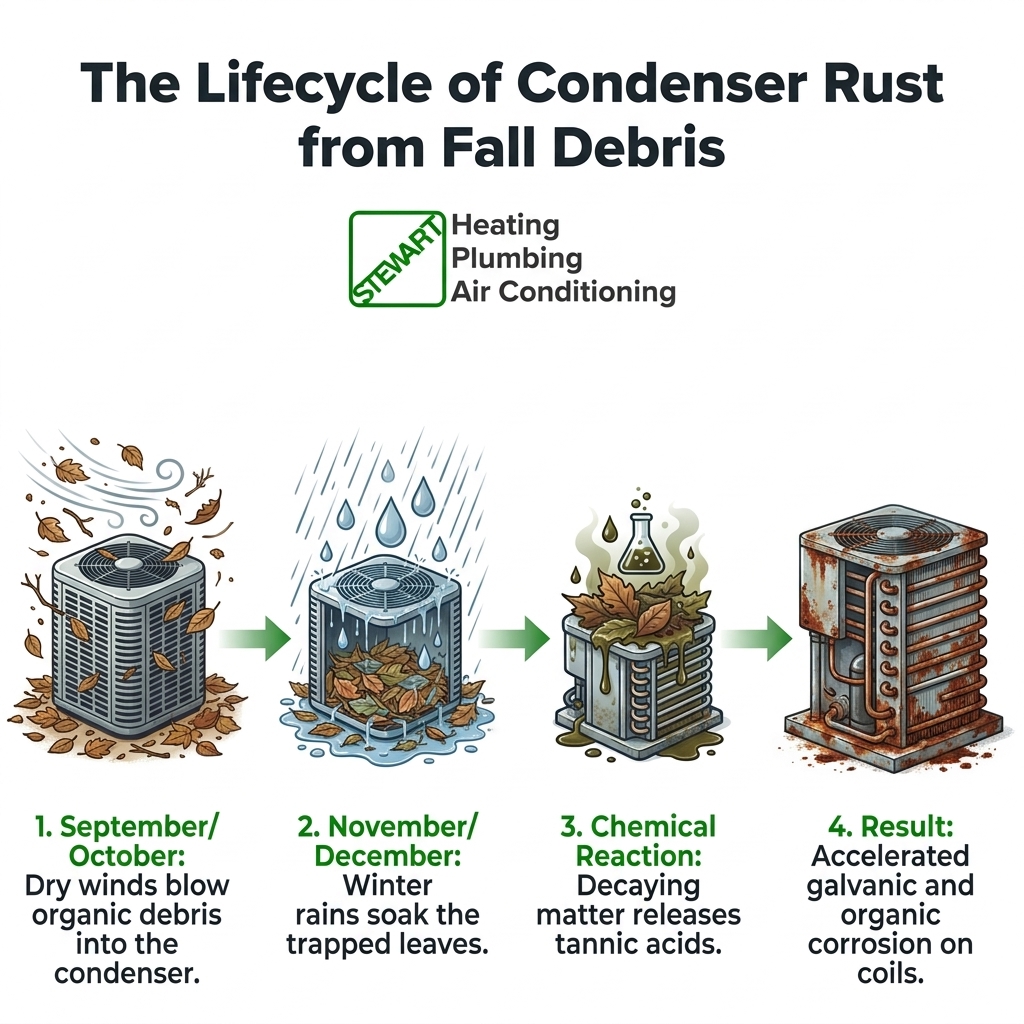
The specific weather patterns in our region create a unique set of challenges for outdoor HVAC equipment. During the September and early fall transition, the East Bay is notorious for dry, high-velocity "Diablo winds." These intense wind events act like a funnel, blowing extensive amounts of dry organic matter, dust, and particulate directly into residential yards and right through the exterior louvers of HVAC equipment.
This dry debris might seem harmless at first, but the danger compounds when the season shifts. Following the dry winds, the region transitions into heavy winter atmospheric river rains. These massive storms soak the previously deposited, bone-dry debris, instantly turning it into a wet, decaying mat of vegetation. This specific sequence of weather events creates the perfect storm for trapped moisture. While many national guides focus heavily on winterizing against snow and ice, homeowners in our area must recognize that heavy winter rain is the primary local catalyst for rust.
With decades of experience serving the area as a family-owned business since 1974, our technicians at Stewart Heating, Plumbing and Air Conditioning have seen the historical data firsthand. A pattern we see often is premature coil failures specifically in Contra Costa County microclimates, and the vast majority trace back to neglected fall clearance. The combination of early wind-packed debris and late heavy rains creates an environment that equipment simply cannot survive without intervention.
Protecting your equipment does not require a degree in HVAC mechanics, but it does require consistency. The Department of Energy (DOE) recommends a strict two-foot clearance rule for all vegetation and debris around the outdoor unit. This ensures the system has the breathing room it needs to operate efficiently and dry out properly after storms.
Actionable steps for safe exterior clearance:
1. Rake the perimeter: Carefully rake all fallen leaves, twigs, and heavy debris away from the base of the unit, ensuring a clean 24-inch radius on every side.
2. Sweep the concrete pad: Use a stiff broom to clear dirt and decaying mulch off the concrete pad so the unit's drainage weep holes remain unobstructed.
3. Brush the exterior cabinet: Use a soft-bristle brush or a dry cloth to gently wipe away loose debris clinging to the exterior metal louvers. Never use a pressure washer, as high-pressure water can instantly bend the delicate aluminum fins inside.
4. Assess winter covers carefully: Many homeowners ask about wrapping the unit. A highly breathable top-cover can keep heavy leaves out of the fan grate, but wrapping the entire unit in a non-breathable plastic tarp is a mistake. A tight plastic cover traps condensation and ground moisture inside the cabinet, creating the exact same corrosive environment that wet leaves do.
Take a tape measure and visually establish a strict 24-inch zone around all sides of the condenser. If you have shrubs, bushes, or ornamental grasses planted near the unit in your Pittsburgh CA yard, early fall is the perfect time to prune them back. Trim away any overhanging branches that are likely to drop late-season leaves directly into the top of the fan grate. Maintaining this perimeter is the most effective way to reduce the need for deep AC Coil Cleaning later on.
While clearing the perimeter is a necessary homeowner task, it is vital to establish strict safety boundaries regarding what you can do yourself versus what requires a licensed professional. Homeowner maintenance must be strictly limited to the exterior yard work and the outside of the metal cabinet.
Never cross these boundaries:
• Do not open the electrical cabinet: The access panel houses high-voltage capacitors and contactors that hold a lethal charge even when the power is turned off at the thermostat.
• Do not remove the fan motor: Taking the top off the unit to reach leaves inside risks dropping the heavy fan motor onto the delicate coils, causing catastrophic damage.
• Do not spray household chemicals: Internal coil cleaning requires specialized, non-corrosive foaming agents that neutralize acids without eating the aluminum. Standard household degreasers will destroy the fins.
A professional inspection ensures that no internal debris was missed during the seasonal transition. When a professional evaluates your equipment, they look at the whole picture. For example, during a recent fall service visit in Pittsburgh CA, one of our technicians at Stewart Heating, Plumbing and Air Conditioning thoroughly reviewed a customer's heating and cooling system, clearly explaining how internal debris was impacting the system's performance, and suggested specific efficiency measures to improve airflow. That level of diagnostic insight and safe handling is exactly why internal maintenance should always be left to the experts. If you suspect debris has bypassed the exterior cabinet and packed into the internal coils, it is time to Schedule HVAC Service.
The same dry autumn winds that blow debris into your AC condenser also signal that it is time to check your heating system. The transition between cooling and heating seasons in Pittsburgh CA is the perfect window to address the entire HVAC ecosystem at once.
Comprehensive seasonal maintenance addresses both sides of the coin: protecting the idle AC from off-season rust while simultaneously prepping the active furnace for the cold months ahead. When a Stewart Heating, Plumbing and Air Conditioning technician visits your home in the fall, they can safely open the outdoor condenser, extract the debris that slipped past the louvers, apply professional-grade protective coil cleaners, and then move indoors to verify the furnace's heat exchanger, burners, and safety limits are operating correctly.
Handling both tasks simultaneously ensures nothing is overlooked. By enrolling in an HVAC Maintenance Plan, you guarantee that a trained eye assesses the entire system during this crucial seasonal shift, preventing surprise breakdowns in the dead of winter and ensuring your AC is pristine when summer returns.
You should only use a breathable top-cover designed specifically for HVAC units, never a fully sealed plastic tarp. A breathable cover keeps heavy leaves and twigs out of the top fan grate without trapping moisture inside. If you wrap the entire unit tightly in plastic, ground moisture will evaporate, get trapped under the cover, and rapidly rust the internal components.
Plants and shrubs should be kept a minimum of 24 inches (two feet) away from all sides of the AC condenser. This clearance is recommended by the Department of Energy to ensure proper airflow and heat dissipation. Trimming vegetation back also prevents leaves, sap, and branches from easily falling into the equipment during heavy winds.
AC condenser coils rust when trapped organic matter, like wet leaves and pine needles, decays against the metal and releases tannic acids. These acids strip away the factory protective coatings on the aluminum and copper. Once the metal is exposed, the constant moisture held by the decaying debris accelerates galvanic and organic corrosion.
You can safely clean leaves from your AC unit by raking a two-foot perimeter around the base and using a soft-bristle brush to gently wipe loose debris off the exterior metal louvers. Never use a high-pressure washer, as it will bend the delicate fins. If leaves are trapped deeply inside the cabinet, you must call a licensed professional to safely open the unit and remove them.
No, normal winter rain does not damage a clean, uncovered AC condenser. These units are engineered to withstand rain, and the water easily drains out of the bottom weep holes. Rain only becomes a problem when the unit is packed with dirt and leaves, which clog the drainage holes and act like a sponge, holding the water against the metal for extended periods.
Safe exterior clearance involves sweeping, raking, and gently brushing the outside of the metal cabinet, which any homeowner can do. Internal coil cleaning requires shutting down high-voltage power, safely removing the fan assembly, and applying specialized chemical foaming agents to the delicate fins. Because of the electrical dangers and the risk of damaging the coils, internal cleaning must be performed by a licensed technician.
There is a critical, undeniable link between removing organic debris in the fall and preventing off-season rust in the winter. By establishing a clean two-foot perimeter around your outdoor equipment in Pittsburgh CA, you eliminate the trapped moisture and tannic acids that silently destroy copper and aluminum coils.
Taking a few actionable steps right now preserves your unit's efficiency and structural integrity for next summer. We encourage you to explore professional maintenance options to ensure your entire system is prepared for the changing seasons. With clear boundaries on what you can safely handle and what requires an expert touch, you can rest easy knowing your equipment is protected against the elements by the trusted team at Stewart Heating, Plumbing and Air Conditioning.

Very professional and complete. I would recommend Stewart to anyone. Highest quality of workmanship and clean installation.
Stewart Heating Plumbing Air Conditioning just did some work for us for the first time. They did an installation at my home and it turned out well. I thought the price was fair and I definitely would use them again. The technicians were very friendly and knowledgeable about their work. I highly recommend Stewart Heating Plumbing Air Conditioning and already told friends to use them.
We have been using Stewart Heating Plumbing Air Conditioning since 1995. They put the original heating and air unit in the house, and we have just stayed with them. They are dependable and honest people, and they have done a good job for us every time that we have used them!
They came and did an inspection and are coming tomorrow to do the repair.
They replaced a regulator the first time, and then the water heater vent had to be replaced. They did great work.
The gentleman that serviced us was helpful, insightful, and knew what he was talking about. Overall, it was a great experience.